
The Defiant Anthem of Resilience
Some poems whisper. Others declare. Maya Angelou’s “Still I Rise” does something rarer: it laughs in the face of history while holding its pain. Written in 1978, when Angelou was fifty years old and already a force in American letters, this poem refuses the posture of the victim. It does not ask for permission to exist fully. It announces that existence as fact.
The poem emerged at a curious moment after the Civil Rights Movement’s legislative victories but before its cultural work was complete. It speaks not to the courtroom or the voting booth, but to the human spirit. Within its forty-three lines, Angelou constructs something that feels less like literature and more like architecture: a building that gets taller as you move through it, floor by floor, until you reach the roof and find yourself looking down at what tried to bury you.
What makes this poem endure is its dangerous joy. In a world that expects the oppressed to speak in minor keys, Angelou chose major. She gave generations a vocabulary for survival that did not require diminishing their own light.
Summary of Still I Rise
At its core, “Still I Rise” is a nine-stanza declaration of unbreakable spirit addressed to an unnamed “you” history’s oppressors, personal doubters, or systemic forces of diminishment. The speaker moves from dust to air to ocean, each image expanding in power and scope. She answers hatred with sassiness, violence with sensuality, and historical erasure with cosmic inevitability.
The poem first appeared in Angelou’s third poetry collection, And Still I Rise, published by Random House in 1978. This was Angelou at her mid-career peak already famous for I Know Why the Caged Bird Sings (1969), established as a lecturer, and increasingly visible in television and film. The collection arrived during the Black Arts Movement’s second wave, when artists were claiming space to define Black identity beyond the white gaze.
Four decades later, the poem circulates in ways Angelou likely never imagined. It appears in protest signs, graduation speeches, therapy sessions, and Instagram captions. It has been analyzed in academic journals and shouted in the streets. This longevity suggests the poem succeeded in its aim: it created a portable architecture of resilience that travels across context and time.
Historical Context: The Voice of 1978
To read “Still I Rise” without understanding 1978 is to hear music without knowing the instrument. The year sat at a complicated intersection post-civil rights but pre-multiculturalism, after the assassinations of King and Malcolm X but before the Reagan era’s retrenchment.
The Civil Rights Movement had won its legal battles. The Civil Rights Act of 1964 and Voting Rights Act of 1965 were thirteen years past. But legal equality and lived equality remained in different countries. Angelou wrote from this gap the space between what the law promised and what the streets delivered.
The Black Arts Movement, which peaked between 1965 and 1975, had by 1978 dispersed its energy into broader cultural production. Its insistence on art by, for, and about Black people had opened publishing doors previously locked. Angelou benefited from this breach while transcending the movement’s occasional nationalism. Her “you” is specific enough to recognize, universal enough to include anyone who has faced diminishment.
Angelou’s personal history seeps into the poem’s certainty. Born Marguerite Johnson in St. Louis in 1928, she survived childhood sexual abuse, teenage pregnancy, and the Jim Crow South. She worked as a cook, a sex worker, a dancer, and a journalist before becoming the writer the world knows. This biography matters because the poem’s confidence reads differently knowing it was earned rather than inherited. When she writes of rising “like dust,” she writes as someone who has been ground down and witnessed her own scattering.
Structure & Form: The Architecture of Defiance
The poem builds itself as you read it. This is not metaphor, it is mechanics. Angelou constructed “Still I Rise” with deliberate architectural intelligence, creating a form that physically enacts its message.
The first seven stanzas are quatrains four lines each, neat and contained. The eighth stanza expands to six lines. The ninth and final stanza balloons to nine lines, the longest in the poem. Visually, on the page, the poem grows. It rises. The reader’s eye must travel further down as the poem progresses, mimicking the vertical movement the words describe.
The meter shifts strategically. Early stanzas employ a trochaic meter stressed syllable followed by unstressed, a falling rhythm. “You may write me down in history.” The voice drops at the end of each line. But as the poem progresses, iambic meter unstressed followed by stress, a rising rhythm takes over. “I am a black ocean, leaping and wide.” The voice lifts upward. The poem literally changes its breathing pattern from sighing to singing.
The rhyme scheme follows an ABCB pattern through most of the poem, with the second and fourth lines rhyming. This creates expectations. The reader begins to anticipate the closing sound. But in the final stanza, Angelou breaks her own pattern, allowing the triple repetition of “I rise” to stand without rhyme, creating a mantra-like effect that feels less like poetry and more like incantation.
Still I Rise
by Maya Angelou
Stanza 1
You may write me down in history
With your bitter, twisted lies,
You may trod me in the very dirt
But still, like dust, I’ll rise.
Stanza 2
Does my sassiness upset you?
Why are you beset with gloom?
‘Cause I walk like I’ve got oil wells
Pumping in my living room.
Stanza 3
Just like moons and like suns,
With the certainty of tides,
Just like hopes springing high,
Still I’ll rise.
Stanza 4
Did you want to see me broken?
Bowed head and lowered eyes?
Shoulders falling down like teardrops,
Weakened by my soulful cries?
Stanza 5
Does my haughtiness offend you?
Don’t you take it awful hard
‘Cause I laugh like I’ve got gold mines
Diggin’ in my own backyard.
Stanza 6
You may shoot me with your words,
You may cut me with your eyes,
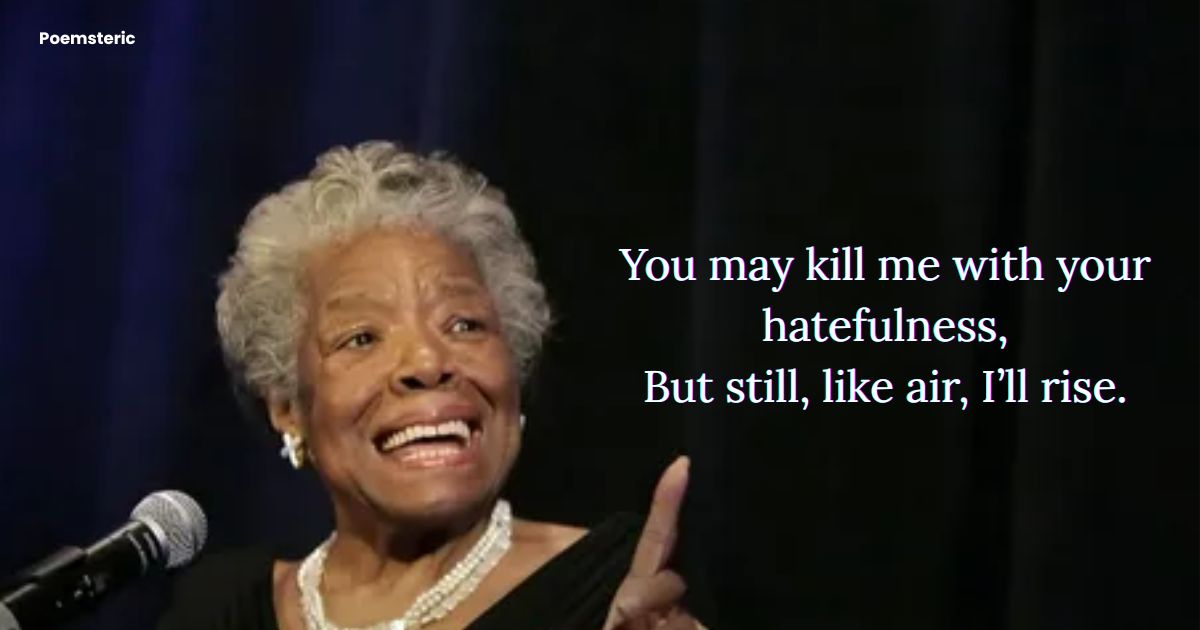
You may kill me with your hatefulness,
But still, like air, I’ll rise.
Stanza 7
Does my sexiness upset you?
Does it come as a surprise
That I dance like I’ve got diamonds
At the meeting of my thighs?
Stanza 8
Out of the huts of history’s shame
I rise
Up from a past that’s rooted in pain
I rise
I’m a black ocean, leaping and wide,
Welling and swelling I bear in the tide.
Stanza 9
Leaving behind nights of terror and fear
I rise
Into a daybreak that’s wondrously clear
I rise
Bringing forth the gifts my ancestors gave,
I am the dream and the hope of the slave.
I rise
I rise
I rise
Stanza-by-Stanza Analysis
Stanzas 1-2: The Sassiness of Survival
The poem opens with an act of erasure being described in order to be refused. “You may write me down in history with your bitter, twisted lies.” The “you” arrives immediately unidentified, yet specific. This is the white educational system, the colonial archive, the personal enemy who spreads rumors. Angelou names the power of narrative control, the way history has functioned as a weapon.
Her response is not argument but transformation. “But still, like dust, I’ll rise.” The smile is unexpected. Dust is not noble. It is the opposite of the “bitter, twisted lies” that claim grandeur. Dust is what remains after destruction, what gets swept away, what settles on forgotten things. Yet dust also persists. It cannot be eliminated, only moved. It outlasts what created it.
The second stanza introduces economic imagery that will build throughout the poem. “Does my sassiness upset you? Why are you beset with gloom? ‘Cause I walk like I’ve got oil wells pumping in my living room.” Here Angelou performs what scholar Henry Louis Gates Jr. might recognize as “signifyin'” reversing the expected order. The oppressed are supposed to appear poor, diminished, grateful for small mercies. Instead, she walks with the wealth of Texas beneath her floorboards. The oil wells suggest not just money but resources, energy, power drawn from deep within the earth deep within the self.
Stanzas 3-4: Cosmic Inevitability
The poem shifts scale. No longer domestic (dust, living rooms), it becomes astronomical. “Just like moons and like suns, With the certainty of tides, Just like hopes springing high, Still I’ll rise.” Angelou borrows the authority of natural law. Moons rise. The sun rises. Tides rise. These are not choices but inevitabilities. By placing herself in this company, she suggests her rise is equally non-negotiable.
The fourth stanza introduces violence disguised as concern. “Did you want to see me broken? Bowed head and lowered eyes? Shoulders falling down like teardrops, weakened by my soulful cries?” The questions are rhetorical but specific. They name the pleasure oppression takes in witnessing pain. The image of shoulders falling like teardrops is physically precise; you can see the posture of defeat. But the speaker refuses it. She names the desire of the oppressor (“Did you want to see me broken?”) in order to demonstrate its frustration.
Stanzas 5-6: Violence and Ascension
The tone sharpens. “Does my haughtiness offend you? Don’t you take it awful hard ‘Cause I laugh like I’ve got gold mines Diggin’ in my own backyard.” The progression from oil to gold increases the wealth of imagery. More importantly, the emotional register shifts from “sassiness” to “haughtiness” arrogance, pride, and the refusal to be humble. The speaker is not asking for tolerance; she is announcing her magnificence and daring the listener to object.
The sixth stanza brings the threat of violence into explicit language. “You may shoot me with your words, You may cut me with your eyes, You may kill me with your hatefulness, But still, like air, I’ll rise.” The weapons escalate: words become bullets, glances become blades, hatred becomes murder. Yet the response is not defense but transcendence. Air cannot be shot, cut, or killed. It is everywhere and nowhere, essential and invisible. The speaker transforms from solid (dust) to gaseous (air), becoming impossible to grasp or destroy.
Stanza 7: Black Female Sexuality
The seventh stanza marks the poem’s centre and its most controversial lines. “Does my sexiness upset you? Does it come as a surprise That I dance like I’ve got diamonds At the meeting of my thighs?” Here Angelou does something politically complex. She claims the Black female body historically hypersexualized by white supremacy and respectability-policed by Black middle-class anxiety as a site of value and pleasure.
The “diamonds at the meeting of my thighs” is deliberately provocative. It insists on the speaker’s sexual self-possession, her economic self-sufficiency (diamonds as wealth), and her physical joy. This is not the body as victim of historical sexual violence, though Angelou knew that history intimately. This is the body as a resource, as home, as a source of power. The intersection of race and gender here is not theoretical but embodied. The speaker is not just Black, not just female, but both, and refuses to choose between dignified race consciousness and sexual self-expression.
Stanzas 8-9: The Oceanic Climax
The eighth stanza breaks the quatrain form, expanding to six lines. It also breaks the pattern of simile. No longer “like dust,” “like air” now the speaker declares identity directly. “Out of the huts of history’s shame I rise Up from a past that’s rooted in pain I rise.” The abstraction “history’s shame” names slavery without euphemism. The “huts” suggest the material conditions of enslaved people. The “past that’s rooted in pain” acknowledges that this history is not past, that the roots continue to draw nutrients from suffering.
But the final stanza completes the transformation. “I’m a black ocean, leaping and wide, Welling and swelling I bear in the tide. Leaving behind nights of terror and fear I rise Into a daybreak that’s wondrously clear I rise Bringing forth the gifts my ancestors gave, I am the dream and the hope of the slave. I rise / I rise / I rise.”
The ocean metaphor absorbs all previous images. Dust settles; air disperses; but oceans contain, surround, and overwhelm. The ocean is Black not just the colour of depth but the identity of the speaker. The triple repetition of “I rise” at the poem’s end functions as a secular prayer, a meditation, and a drumbeat. It refuses to stop. The poem ends not with a period but with an ongoing action, suggesting the rising will continue beyond the page.
Major Themes Explored
Defiance in the Face of Oppression
The poem’s central engine is refusal. It refuses to grant the oppressor the satisfaction of witnessing pain. It refuses to accept the narrative of inferiority. It refuses to be modest about its own power.
This defiance takes the form of joy. As Audre Lorde wrote in Sister Outsider, “The master’s tools will never dismantle the master’s house.” Angelou seems to understand this intuitively. She does not answer lies with counter-lies, or hatred with hatred. She answers with what James Baldwin called “the difficult joy” the insistence on pleasure and self-regard in spaces designed to deny both.
The “you” addressed throughout the poem is never specified, which allows the defiance to remain multiple. It can be a specific person, a historical force, a systemic structure, or the speaker’s own internalized doubt. This ambiguity is strategic. It lets the reader insert their own oppressor and claim the poem’s resistance for their own circumstance.
The Power and Beauty of Blackness
“Still I Rise” performs what philosopher Cornel West calls “Black genius” the creative transformation of pain into beauty. The poem reclaims the word “Black” from its history of diminishment and loads it with power. The “black ocean” is not polluted or darkened; it is vast, containing, and ultimately unknowable in its depths.
The wealth imagery of oil, gold, diamonds rejects the economic logic of slavery and segregation. These resources were historically extracted from colonized lands and enslaved labor. Angelou imagines them as internal, as inherent to the Black body and spirit. This is not capitalism; it is self-valuation. It insists that worth is not earned or granted but exists as a natural resource.
Gender and Sexual Empowerment
The poem’s treatment of female sexuality was radical in 1978 and remains so. In a tradition where Black women’s bodies were either exploited or erased, Angelou insists on pleasure. The “sexiness” and “diamonds at the meeting of my thighs” claim the right to be desirable and desiring, to be subject rather than object.
This is intersectionality before Kimberlé Crenshaw named the concept in 1989. The speaker is never just one thing. She is Black and female and poor and powerful and sexual and spiritual. These identities do not compete; they amplify each other. The poem suggests that the liberation of Black women requires all of these aspects to be visible and valued.
Ancestral Legacy and Historical Trauma
The final stanza’s reference to “the dream and the hope of the slave” places the individual speaker within a continuum. She is not rising alone; she is rising on the shoulders of those who could not, or who rose in smaller ways, or whose rising was cut short.
This creates a complex relationship to history. The “nights of terror and fear” are real and inherited. The “past that’s rooted in pain” is not denied or transcended; it is acknowledged as foundation. But the poem refuses to be defined by this foundation. It is the dream of the slave not because the slave was defeated, but because the slave dreamed of exactly this freedom, voice, power, joy.
Literary Devices & Poetic Techniques
Angelou employs anaphora the repetition of phrases at the beginning of lines with strategic variation. “You may” appears three times, establishing the pattern of threat and response. “Just like” appears twice, building the cosmic comparison. But “I rise” appears ten times, accelerating in frequency until it dominates the final stanza. This is not mere repetition; it is accumulation, each “I rise” adding weight to the last.
The rhetorical questions function as a trial in which the oppressor is put on the stand. “Does my sassiness upset you?” “Did you want to see me broken?” These questions do not seek information; they expose motive. They force the “you” to acknowledge the pleasure taken in others’ pain.
The progression from simile to metaphor is crucial. Early stanzas use “like” “like dust,” “like moons,” “like suns.” The speaker compares herself to other things, suggesting she must borrow their authority. But in the final stanzas, the “like” disappears. “I am a black ocean.” This grammatical shift mirrors the psychological shift from seeking validation to claiming identity.
Apostrophe the direct address to an absent or abstract listener creates intimacy and confrontation simultaneously. The “you” is always present in the poem, always being spoken to, always failing to stop the rising.
The assonance of the long i sound in “rise,” “eyes,” “surprise,” “thighs,” and “tide” creates a sonic thread that pulls the reader through the poem. The mouth opens wide to make this sound, physically enacting the expansiveness the poem describes.
Symbolism Deep Dive
Dust to Air to Ocean (Ascension Arc)
The poem’s symbolic architecture traces an elemental progression. Dust is earth reduced, the smallest solid particle. Air is invisible, ubiquitous, necessary for life. The ocean is water at scale, containing all life, surrounding continents, connecting distant shores.
This arc suggests not just rising but transformation. The speaker does not remain dust that happens to float upward. She becomes something entirely different something that cannot be contained or destroyed by the same means. Dust can be swept; air can be temporarily displaced; but the ocean can only be temporarily troubled before returning to its level.
Oil, Gold, Diamonds (Wealth as Self-Worth)
The mineral imagery builds in value from oil to gold to diamonds but also in intimacy. Oil wells are distant, industrial. Gold mines are closer underground. Diamonds are at the “meeting of my thighs” inside the body, at the center of sexual pleasure. The wealth moves from external resources to internal essence.
This reverses the economic history of Black labor, where Black bodies were valued only for their productive capacity. Here, the Black body is valuable because it is Black, because it is female, because it is itself.
Natural Elements (Moons, Suns, Tides)
The astronomical imagery in stanzas three and four borrows the authority of inevitability. These are not human choices but cosmic patterns. By placing her rising in this company, Angelou suggests that her liberation is as natural and necessary as planetary motion. The tides do not ask permission to rise. They simply respond to the moon’s gravitational pull a force invisible but undeniable.
Critical Reception & Cultural Impact
Academic analysis of “Still I Rise” has evolved significantly. Early criticism often dismissed Angelou’s work as “popular” rather than literary, too accessible to be serious. This judgment reflected the bias of a critical establishment that equated difficulty with value.
More recent scholarship, particularly through the lens of Critical Discourse Analysis, has recognized the poem’s sophisticated manipulation of power dynamics. Studies examine how the poem constructs the “you” as simultaneously powerful (controlling history) and impotent (unable to stop the rising). This analysis reveals Angelou as a craftswoman of pronouns, using grammar to enact political reversal.
The poem’s cultural circulation exceeds any academic framework. It was read at presidential inaugurations, chanted at Black Lives Matter protests, and quoted in mental health recovery programs. This range suggests the poem succeeded in its aim: it created a portable language for resilience that travels across context.
Debate continues about whether the poem is specifically about Black female experience or universally applicable. The answer is probably both the particularity of the “black ocean” and the “huts of history’s shame” grounds the poem in specific history, while the structural movement from oppression to liberation speaks broadly.
Why “Still I Rise” Still Matters Today
The poem arrives in new hands with each generation. For contemporary movements like Black Lives Matter and #MeToo, it offers a vocabulary for survival that does not require perfection or politeness. The speaker is “sassy,” “haughty,” “sexy,” and she is not asking nicely for her rights.
In mental health discourse, the poem has been adopted as a tool for resilience. Therapists use it with clients recovering from trauma, not because it denies pain but because it insists on survival as victory. The “nights of terror and fear” are acknowledged but not final.
Educationally, the poem serves as an entry point and depth charge. It is accessible enough for middle school students to grasp its surface meaning, and complex enough to sustain doctoral dissertations on its rhetorical strategies. It teaches that poetry can be both popular and profound, both personal and political.
Frequently Asked Questions
What inspired Maya Angelou to write this poem?
Angelou rarely identified a single inspiration, but the poem emerged from her lifelong engagement with African-American oral traditions, spirituals, and the blues. The call-and-response structure echoes church services she attended in her grandmother’s Arkansas church. The defiance reflects her own survival of childhood trauma and her observation of how Black women specifically were expected to carry pain silently.
Is the speaker Maya Angelou herself?
The speaker is and is not Angelou. Like all lyric poetry, it draws on personal experience but transforms it through art. Angelou certainly shared the speaker’s history and attitudes, but the “I” of the poem is also a constructed voice designed to carry collective experience. The speaker is Angelou amplified, mythologized, and made representative.
What does “still I rise” mean?
The word “still” does double work. It means “nevertheless” despite everything done to stop me. And it means “continuously” I keep rising, I have been rising, I will continue rising. The phrase suggests both persistence through time and defiance in the moment. It is not “I rose” (past, completed) or “I will rise” (future, aspirational) but “I rise” ongoing, present, active.
Why is this poem considered feminist?
The poem insists on female power without apology. It claims the right to be “sassy” and “sexy” without asking male permission. It centers the female body as a source of wealth and pleasure. It refuses the expectation that women, especially Black women, should be modest about their achievements or careful with their anger. In doing so, it enacts what bell hooks called “feminism as movement toward freedom.”
Final Thought
“Still I Rise” ends, but it does not conclude. The triple repetition of “I rise” hangs in the air like a chord that refuses resolution. This is the poem’s final gift it does not offer closure but continuation. The rising goes on beyond the page, into the reader’s life, into whatever morning comes next.
Maya Angelou gave us something rarer than comfort. She gave us a method: transform the language of diminishment into the language of expansion. Read your enemy’s narrative and write your own over it. Start with dust and end with the ocean. And when they ask how you survived, tell them you rose still rise will rise.
Related to the article : Soccer Poems That Changed the Game From Victorian Fields to World Cup Glory

- 50+ Best Poems About God | Inspirational, Short & Famous Verses - April 1, 2026
- 30 Types of Poems | Complete Guide with Examples for Every Poet - March 28, 2026
- Long Distance Love Poems | 33 Heartfelt Poems for Every Emotion - March 27, 2026