
Introduction
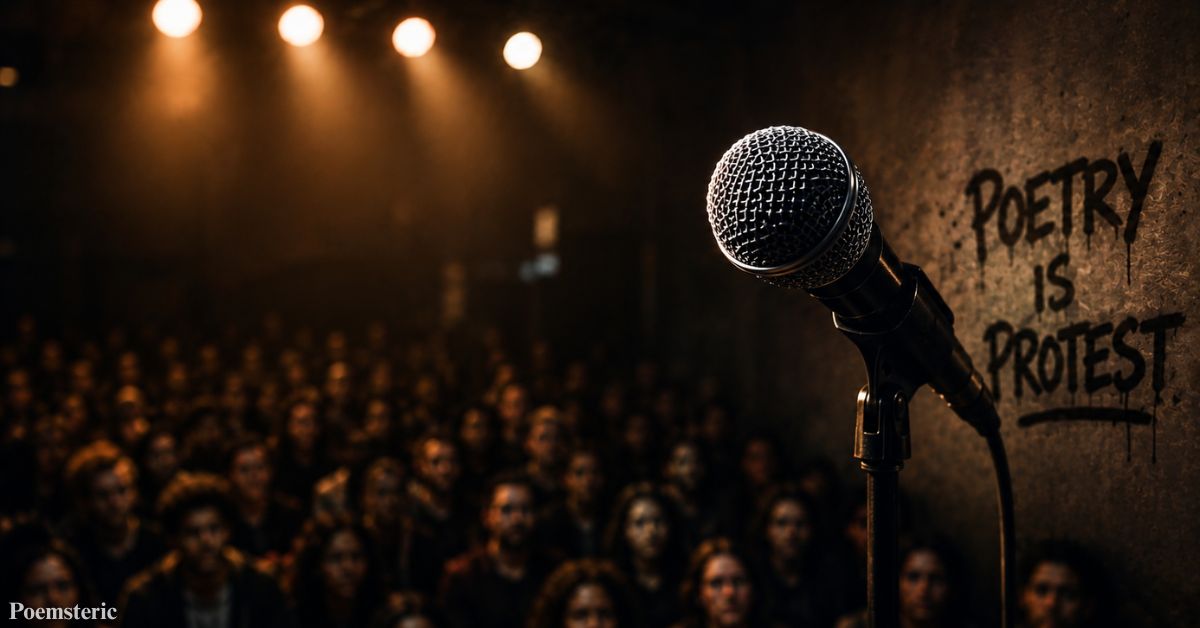
If you have ever sat in a dimly lit café and watched a performer grip a microphone, pour their soul into three minutes of raw verse, and leave the room breathless, you have already felt the power of this art form. This guide is built for the curious beginner, the aspiring writer, and the performer who wants to understand what happens when poetry leaves the page and meets the stage.
We will walk through the real history, the unwritten rules, the scoring systems, and the voices that built the movement from a single bar in Chicago to national championships. By the end, you will know exactly how to write your first piece, where to perform it, and what separates a forgettable open mic set from a performance that wins the room.
Key Takeaways
This art form was born in 1984 at the Green Mill Cocktail Lounge in Chicago, created by Marc Kelly Smith to make poetry accessible and competitive.

A standard poetry competition uses five random audience members as judges, scoring performances from 0.0 to 10.0.

The three-minute rule is strict: go over time and you lose points, no exceptions.

The best spoken word artists combine personal truth, rhythmic language, and intentional stage presence.

You do not need a degree, a book deal, or years of experience to start. You need a notebook, a voice, and a local open mic night.
What Is Slam Poetry and How Did It Start?
At its core, this is a competitive art form where poets perform original work in front of live judges. Unlike traditional poetry readings where the audience sits in polite silence, a poetry slam invites reaction. The crowd snaps, cheers, gasps, and sometimes boos the judges. The energy is electric because the stakes are real.
The concept was invented by Marc Kelly Smith, a Chicago construction worker and poet who was tired of elitist academic readings where the audience seemed asleep. In 1984, he launched the first weekly event at the Green Mill, a historic jazz club once frequented by Al Capone. Smith wanted poetry to feel like a boxing match: two opponents, a crowd, and a winner. He called it a “slam” because of the competitive energy. Within a decade, the format spread to coffee shops, universities, and theaters across the United States. Today, the National Poetry Slam draws teams from dozens of cities, and the Individual World Poetry Slam crowns a solo champion every year.
What makes this format different is the democracy of it. Anyone can sign up. A college professor and a high school dropout share the same stage. The judges are pulled from the audience, not selected for literary credentials. This creates a rare space where emotional honesty often beats technical perfection.
The Origins and Evolution of Performance Verse
Before there were microphones and scoring paddles, oral poetry was the primary way stories traveled. Homer recited The Iliad from memory. African griots preserved genealogies through spoken verse. The Beat poets of the 1950s, including Allen Ginsberg, performed with jazz musicians in San Francisco basements. The Black Arts Movement of the 1960s, led by Amiri Baraka, used spoken performance as political resistance.
What Marc Kelly Smith did in 1984 was not invent performance poetry. He created a scoring system around it. That scoring system changed everything. It turned a gentle art into a sport. By the 1990s, HBO’s Def Poetry Jam brought the scene to television, introducing millions to artists like Saul Williams and Beau Sia. The early 2000s saw the rise of YouTube, where a single performance could go viral and reach audiences who had never stepped into a live venue.
Today, the scene is hybrid. Poets perform in person while audiences film and share clips on TikTok and Instagram. The form has evolved to include musical backing, multi-voice group pieces, and even ASL interpretation. Yet the heart remains the same: one person, one microphone, one truth told without filters.
How a Poetry Slam Competition Actually Works
If you have never attended a live event, the format can feel mysterious. Here is exactly what happens, step by step.
Registration. Poets sign up at the door or online. Some events are “open slam,” meaning anyone can compete. Others are “invitational,” featuring pre-selected artists.
The Sacrificial Poet. Before scoring begins, one poet performs a piece that is not judged. This calibrates the judges and gives the audience a taste of the night’s energy.
Random Judges. The host pulls five people from the audience. They cannot be poets, partners of poets, or venue staff. They hold up scorecards from 0.0 to 10.0, Olympic-style.
The Rounds. Most slams have two or three rounds. After each round, the lowest-scoring poets are eliminated. A final round determines the winner.
The Finals. The top three or four poets perform one last piece. The highest combined score wins. The prize might be cash, a feature slot at a future show, or simply bragging rights.
The entire event usually lasts two to three hours. Between rounds, there are often open mic slots for non-competitors. The atmosphere is supportive but intense. You will hear incredible art, and you will hear poems that fall flat. Both are part of the learning curve.
Scoring Rules and Judging Criteria Explained
Understanding the scoring system is essential if you plan to compete. Judges are not given a rubric, which means subjectivity is baked into the format. However, there are universal expectations that most experienced judges follow.
The Three-Minute Time Limit and Penalty System
Every solo piece must be three minutes or less. The clock starts the moment the poet begins speaking or making intentional sound. At three minutes and ten seconds, a timekeeper signals the poet. At three minutes and thirty seconds, the poet is cut off, and 0.5 points are deducted from their score. At three minutes and forty seconds, another 0.5 points are lost. The penalties stack. Go to four minutes, and you have lost a full point. This rule exists because brevity forces precision. You cannot ramble. Every word must earn its place.
How Audience Judges Are Selected and Trained
The host looks for people who seem engaged but not obviously connected to any performer. Once selected, judges are told to score based on whatever moves them: content, delivery, originality, or emotional impact. The highest and lowest scores are dropped. The middle three are averaged. This prevents one overly generous or harsh judge from skewing results.
Writing Powerful Spoken Word Pieces: A Step-by-Step Guide
Great writing is the foundation of every memorable performance. You cannot act your way out of a weak poem. Here is how to build one from scratch.
Finding Your Authentic Voice and Core Message
Start with obsession, not ambition. What keeps you awake at night? What story do you tell at parties? What anger or joy do you return to again and again? Your first draft should be messy. Write for fifteen minutes without stopping. Do not rhyme. Do not worry about structure. Just dump the truth onto the page.
Once you have raw material, ask: what is the one sentence I want the audience to remember? That is your anchor. Every line should either move toward that sentence or echo it. If a line does not serve the core message, cut it. Spoken word is ruthless editing disguised as spontaneity.
Structuring Your Piece for Maximum Stage Impact
After you have your anchor, build an arc. Most winning pieces follow a simple structure: the hook, the body, and the landing.
- The Hook (first 15 seconds): Grab attention immediately. Start in the middle of action. “The doctor said I would never speak again” is stronger than “I want to tell you about my surgery.”
- The Body (middle 90 seconds): Layer detail. Use sensory language. Show, do not tell. If you are writing about grief, describe the unwashed coffee cup your father left on the counter, not just “I miss my dad.”
- The Landing (final 30 seconds): This is your closing image or call. It should land like a bell. The audience should exhale. Practice ending on a note that does not need explanation.
Read your draft aloud. If you stumble over a phrase, rewrite it. The ear is a better editor than the eye for this medium.
15 Famous Slam Poetry Examples Every Beginner Should Know
Studying the masters teaches you more than any workshop. These fifteen pieces shaped the culture and remain essential listening.
- “Coded Language” by Saul Williams : A manifesto on linguistic revolution and hip-hop’s roots.
- “Shaheed” by Suheir Hammad : A devastating exploration of war, family, and Palestinian identity.
- “OCD” by Neil Hilborn : The most-viewed spoken word poem online; a love story filtered through mental illness.
- “Dear Straight People” by Denice Frohman : A sharp, funny, and unapologetic letter on queer identity.
- “What Teachers Make” by Taylor Mali : A defense of educators delivered with comedic timing and moral force.
- “If I Should Have a Daughter” by Sarah Kay : A tender list poem that went viral after her TED Talk.
- “Knock Knock” by Daniel Beaty : A piece about incarceration and fatherhood that builds to a heart-breaking crescendo.
- “Shrinking Women” by Lily Myers : An examination of body image and inherited silence in women.
- “The Nutritionist” by Andrea Gibson : A survival guide for anyone living with depression or anxiety.
- “To This Day” by Shane Koyczan : A powerful anti-bullying piece animated by dozens of artists.
- “Lost Voices” by Darius Simpson and Scout Bostley : A duo piece on race and gender that flips perspective mid-poem.
- “Rigged Game” by Dylan Garity : A critique of standardized testing and educational inequality.
- “Paper Dolls” by Sierra DeMulder : A haunting piece on domestic violence and resilience.
- “Repetition” by Phil Kaye : A poem about stuttering, family, and the stories we inherit.
- “When Love Arrives” by Sarah Kay and Phil Kaye : A duo piece performed at the National Poetry Slam about the complexity of love.
Watch each of these at least twice. Once for the content. Once for the performance choices: where they pause, where they speed up, where they let silence do the work.
Stage Presence Tips for First-Time Slam Poets
You can write a brilliant poem and still lose the room if your body language contradicts your words. Stage presence is not theatrical overacting. It is alignment between what you say and how you stand.
Stand with your feet shoulder-width apart. This grounds you. Nervous energy makes people pace, sway, or shift weight. Plant yourself. Let the microphone do the work of projection so you can focus on intention.
Use your hands deliberately. Open palms suggest vulnerability. A pointed finger drives a command home. But do not choreograph every gesture. The best physicality emerges from the text itself. If your poem says “I reached for her hand,” reach. If it says “the room went still,” freeze.
Make eye contact with different sections of the room. Do not stare at the back wall. Find three friendly faces left, center, right and rotate between them. This creates the illusion that you are speaking to every person individually.
Finally, control your breathing. Most beginners rush because adrenaline tells them to. Mark your script with breath symbols. Pause before your most important line. The audience cannot rush you. They are waiting for you to give them permission to feel.
Common Mistakes New Performers Make at Open Mic Nights
Every veteran has stories of their early disasters. Learn from these common errors so you do not repeat them.
Mistake 1: Apologizing Before You Begin. Do not say “This is my first time” or “I just wrote this.” It lowers the audience’s expectation and your own authority. Start strong.
Mistake 2: Over-Rhyming. Forced rhyme schemes make poems sound like greeting cards. Use slant rhyme, internal rhyme, or abandon rhyme entirely if it does not serve the message.
Mistake 3: Speed-Reading. If the audience cannot process your words, they cannot feel them. Slow down. Embrace silence.
Mistake 4: Ignoring the Time Limit. Nothing kills momentum like a host waving a flashlight because you went long. Practice with a timer. Respect the format.
Mistake 5: Performing a Piece You Have Not Memorized. Reading from a phone or crumpled paper disconnects you from the audience. Memorize at least 80 percent of your piece so you can make eye contact.
The Difference Between Spoken Word and Slam Poetry
These terms are often used interchangeably, but they are not identical. Understanding the distinction helps you choose where to focus your energy.
The spoken word is the umbrella. It includes any poetry written specifically for oral performance: hip-hop verse, storytelling, political rants set to rhythm, and theatrical monologues. A poet can do spoken word at a library, a school, a protest, or a podcast. There is no scoring. The goal is communication, not competition.
Slam poetry is a specific subcategory. It is competitive. It follows the rules of a poetry slam: original work, time limits, judges, and elimination rounds. Every slam piece is a spoken word, but not every spoken word piece is a slam piece. Some topics work beautifully in a gentle storytelling setting but fall flat in a high-energy competition.
If you love community and feedback, compete. If you prefer quiet artistic exploration, attend open mics without scores. Many artists do both.
Building Confidence Through Vocal Delivery and Body Language
Your voice is an instrument, and most people play only one note. Learn to use the full range.
Volume: Do not shout the entire poem. Start at conversational volume. Build to a crescendo. Drop to a whisper for intimacy. Contrast creates drama.
Pace: Slow down for emotional weight. Speed up for anxiety, chaos, or humor. Mark your script with symbols: a line through a word means stretch it. An arrow means accelerate.
Tone: A flat monotone puts audiences to sleep. Inflect meaningfully. Raise your pitch at questions. Drop it at declarations of fact.
Body Language: Lean forward when confessing. Step back when reflecting. Use the stage depth. If your poem has two characters, physically shift position when switching voices. This is called “blocking,” and it makes complex narratives easy to follow.
Record yourself on video. Watch it without sound. If your body looks engaged, you are on the right track. If you look stiff, rehearse until the movements feel organic.
How to Find Local Poetry Slam Events Near You
The community is more accessible than you think. Most cities have at least one monthly event, and many have weekly open mics.
Start with Poetry Slam, Inc. and Button Poetry event listings. Search Facebook Events for “open mic” plus your city name. Check local coffee shops, bookstores, and university creative writing departments. Many venues host events but do not advertise widely.
When you find a venue, attend as an audience member first. Watch how the host runs the show. Notice how poets treat the stage. Introduce yourself to the organizer. Volunteer to help set up chairs or run the sign-up sheet. Building relationships matters more than showing up to compete immediately.
If you live in a rural area with no local scene, start one. Find a library meeting room or a church basement. Post on community boards. The first event might have five people. That is how every great scene began.
The Cultural Impact of Competitive Performance Poetry
This movement has done something rare in art: it created a pipeline from underground bars to mainstream culture without losing its soul.
In education, teachers use spoken words to engage students who hate traditional literature. Programs like Urban Word and Youth Speaks have turned thousands of teenagers into published authors. In activism, poets have testified before Congress, performed at presidential inaugurations, and organized fundraisers for social justice causes.
The form has also influenced music. Artists like Kendrick Lamar, Lin-Manuel Miranda, and Hozier openly credit spoken word artists as influences. The emphasis on narrative, vulnerability, and rhythmic precision has reshaped how we think about lyricism across genres.
Most importantly, the scene has democratized authorship. You do not need a publisher, an MFA, or a famous last name. You need a story and the courage to tell it. That accessibility is the movement’s greatest legacy.
Famous Slam Poets Who Changed the Movement Forever
Every era of this art form has pioneers who redefined what was possible.
Marc Kelly Smith is the founder. Without him, there is no movement. He still performs and teaches in Chicago.
Patricia Smith (no relation) is a four-time National Poetry Slam individual champion. Her work on race, motherhood, and history set a standard for narrative precision.
Saul Williams bridged the gap between the scene and popular culture. His album Amethyst Rock Star and his role in the film Slam introduced the art form to global audiences.
Sarah Kay and Phil Kaye co-founded Project VOICE, bringing spoken word into schools worldwide. Their TED Talks have millions of views.
Neil Hilborn proved that a single poem could reach the entire internet. “OCD” has been viewed over 75 million times, making him the most recognizable face in the genre.
Andrea Gibson has spent two decades writing about gender, mental health, and love with a tenderness that has redefined vulnerability on stage.
Study their careers not just for the poems, but for the paths they carved. Each found a way to stay authentic while reaching wider audiences.
Creating Your First Three-Minute Slam Piece
You have read the theory. Now build the practice. Here is a repeatable process.
Day 1: The Spark. Free-write for twenty minutes on a memory that still holds emotional charge. Do not edit.
Day 2: The Shape. Read your free-write aloud. Circle the lines that make your chest tighten. Those are your anchors. Arrange them into a beginning, middle, and end.
Day 3: The Language. Replace abstract words with concrete images. Instead of “I was sad,” write “I sat on the kitchen floor eating cereal with a fork.” Specificity creates universality.
Day 4: The Sound. Read the draft again. Mark where natural rhythm appears. Add alliteration, assonance, or repetition where it feels organic. Do not force it.
Day 5: The Cut. Time yourself. If you are over three minutes, cut the weakest stanza. Then cut another line. Brevity is strength.
Day 6: The Memory. Practice without the page. Record yourself. Listen back. Note where you stumble. Rewrite those transitions.
Day 7: The Stage. Perform it for one trusted friend. Ask: what did you feel? Where did you disconnect? Revise based on that feedback.
Repeat this cycle until the piece feels like a conversation, not a recitation.
Why Slam Poetry Still Matters in the Digital Age
In an era of TikTok attention spans and AI-generated text, you might wonder if live oral performance still has a place. It matters more than ever.
Algorithms curate our content into echo chambers. A live poetry event breaks that bubble. You sit next to strangers. You hear stories from lives you will never live. You cry at a poem about immigration even if you have never left your hometown. That kind of forced empathy is rare and necessary.
Additionally, the rise of short-form video has actually helped the scene. Poets now build audiences online and convert them into live ticket buyers. Button Poetry’s YouTube channel has over a billion views. Individual artists sell out theaters based on Instagram followings. The digital age did not kill live performance. It created a funnel for it.
Finally, in a world where much communication is mediated by screens, the unfiltered human voice remains the most powerful technology we have. A poet on stage cannot hide behind a filter or a delete button. That rawness is the point.
FAQs
Q: What is slam poetry and how is it different from regular poetry readings?
A: It is a competitive performance art where poets recite original work in front of live judges, unlike traditional readings where the audience listens passively. The format includes time limits, scoring, and elimination rounds, which creates an energetic, sports-like atmosphere. While a standard reading might feature published authors in a quiet library, a slam can happen in a bar or theater with crowd reactions, snapping, and dramatic scoring. The key difference is the built-in competition and the emphasis on oral delivery over written text.
Q: How does a poetry slam competition actually work for beginners?
A: Beginners sign up at the door, perform an original piece under three minutes, and receive scores from five randomly selected audience judges. The highest and lowest scores are dropped, and the middle three are averaged. Most events have multiple rounds, with lower-scoring poets eliminated after each round. There is usually a sacrificial poet who performs first to calibrate the judges. The winner might receive cash, a future feature spot, or simply recognition. The environment is supportive, and many first-timers attend several events as audience members before competing.
Q: What are the most important rules every slam poet needs to know?
A: The three most critical rules are the time limit, originality, and no props. Your piece must be three minutes or less, with point deductions starting at three minutes and ten seconds. You must perform original work you wrote; covering another poet’s piece results in disqualification. You cannot use costumes, musical instruments, or props beyond the microphone and your own body. Some venues have additional rules about content warnings or clean language, so always check with the host before performing.
Q: How can I improve my stage presence and vocal delivery for spoken word?
A: Start by planting your feet shoulder-width apart to reduce nervous swaying. Practice making eye contact with different sections of the audience rather than staring at the back wall. Record yourself on video and watch without sound to evaluate your body language. Vary your volume, pace, and tone to create contrast and emotional impact. Mark your script with breath symbols and pause deliberately before your most important lines. Rehearse until your movements feel organic rather than choreographed, and always read your piece aloud during the editing process.
Q: Where can I find local poetry slam events and open mic nights near me?
A: Search Facebook Events for “open mic” or “poetry slam” combined with your city name. Check the event listings on Poetry Slam, Inc. and Button Poetry. Visit local coffee shops, independent bookstores, university creative writing departments, and library community boards. Many cities have dedicated poetry venues that host weekly or monthly events. If no scene exists in your area, consider starting one by reserving a community space and promoting through social media and local bulletin boards.
Final Thoughts
You now have the history, the rules, the examples, and the step-by-step blueprint. The only thing left is doing. Go to an open mic. Sign up. Shake for the first thirty seconds. Then find your breath and say what you came to say.
This art form does not belong to the experts. It belongs to anyone brave enough to stand under a light and tell the truth. The stage is waiting. The microphone is on. Your story is enough.
Recent Article : What Are Acrostic Poems? A Complete Guide With 60+ Examples

Jennifer Aston is a passionate poetry curator and writer with a deep love for the written word. She believes poetry has the power to heal, inspire, and connect people across all walks of life. Through PoemSteric, she brings together timeless and modern verses for every emotion and every moment.