
Introduction
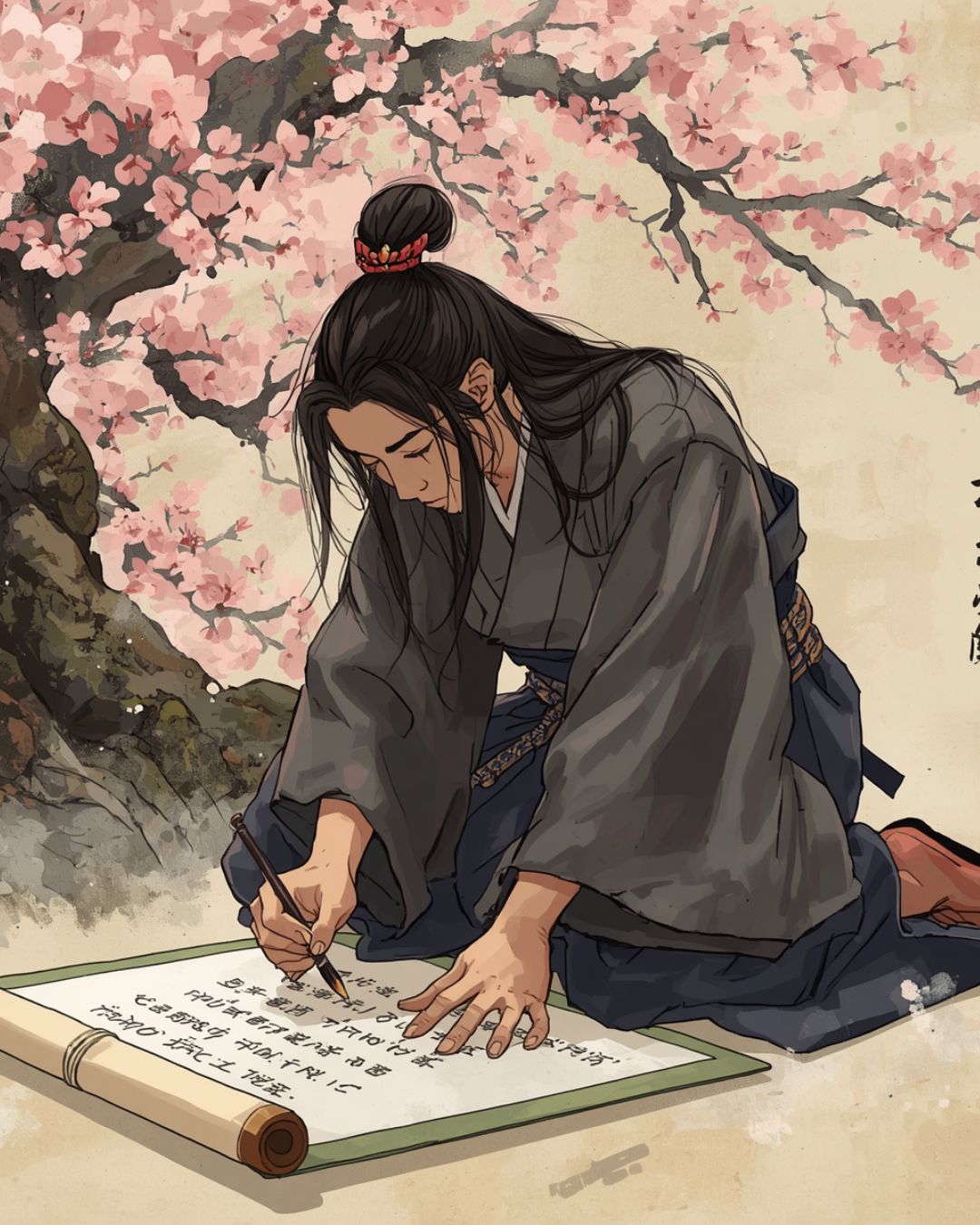
When most people imagine a samurai, they picture a warrior. Armour. A sword. A battlefield. What the popular image rarely includes is a brush, an ink stone, and a piece of rice paper.
Yet some of the most skilled fighters in Japan’s history were also poets. In the hours before their deaths whether by seppuku, execution, or combat many of them sat in stillness and wrote. These short, carefully crafted verses are called jisei no ku (辞世の句): the farewell poem to the world.
They are unlike any other kind of writing. A person standing at the true edge of their own death has nothing to prove and no one to impress. What comes out in those few lines is exactly what they believed, what they had made peace with, what still weighed on them or, in some cases, what they found quietly funny about the whole business of being alive.
Samurai death poems are among the most honest literary artefacts in human history. This guide gives you twelve of the most powerful, with the context you need to feel them fully, not just read them.
Key Takeaways
Before moving to the poems, here is the essential framework for reading them:
- Jisei is Japan’s tradition of writing a farewell poem at the moment of death practised by monks, warriors, nobles, and even WWII pilots.
- The most common form is the tanka (5-7-5-7-7), not the haiku, though both appear.
- Nature imagery cherry blossoms, autumn leaves, the moon, drifting clouds replaces direct mentions of death, which were considered inappropriate.
- The tradition spans from 686 CE to the present, with some contemporary Japanese still writing jisei.
- Not all death poems are solemn. Several are openly ironic or humorous, challenging the idea that warriors faced death with grim silence.
What Are Samurai Death Poems? The Meaning of Jisei
The word jisei (辞世) translates directly as “farewell to the world.” A jisei is a poem composed by someone who knows they are about to die ideally written on the final day itself, though sometimes prepared weeks in advance.
The practice did not originate with warriors. Zen Buddhist monks in Japan were writing farewell poems as a spiritual exercise centuries before the samurai adopted the custom. For monks, the poem was a final act of consciousness, a way of releasing attachment before releasing life itself. Over time, the tradition passed to the Japanese aristocracy, then to the warrior class, and eventually became expected of any literate person facing a known death.
What distinguishes jisei from a deathbed confession or a final letter is form: compressed, image-driven, deliberately indirect. A well-crafted death poem does not say “I am afraid” or “I am at peace.” It shows a leaf falling. A cloud without direction. A duck crying in still water. The image carries what direct language cannot hold.
The Three Poetic Forms: Tanka, Haiku, and Kanshi
Most people assume all jisei are haiku. They are not. The most common form is the tanka (also called waka) a five-line poem following a 5-7-5-7-7 syllable structure, totalling 31 syllables. Over half of all surviving death poems are in this form.
Haiku three lines, 17 syllables (5-7-5) grew more common during the Edo period as literacy spread and haiku became Japan’s dominant poetic form. The shorter structure demands even greater compression. Every syllable has to earn its place.
A third form, kanshi, was written in classical Chinese verse. Samurai or officials who wanted to express political loyalty or social duty rather than personal feeling often chose kanshi for its gravity and formality.
The form is not decoration. The tanka’s structure is three lines of image, two lines of emotional turn means the real meaning of a jisei often lands in the final couplet. If you stop reading at line three, you miss everything.
Who Wrote Them and Who Were They Written For?
This question is almost never addressed in mainstream coverage of jisei, yet it changes everything about how you read them.
Death poems were written for an audience most often disciples, family members, or close friends who would preserve and study the poem after the author’s death. For a Zen monk, it was a final teaching. For a samurai bound by bushido, it was a demonstration that he had met death with composure and clarity, the ultimate proof of everything his life had practised.
Some jisei were prepared weeks in advance, carried into battle folded inside a sleeve. Others were composed in genuine last moments. There is even a Japanese term zekku for a poem that was not intended as a death poem but became one, because the author died before writing another.
A Brief History: How the Jisei Tradition Began
The earliest surviving Japanese death poem was composed in 686 CE by Prince Ōtsu, son of Emperor Temmu, moments before his forced execution on charges that were almost certainly false. He wrote:
“Today, taking my last sight of the mallards crying on the pond of Iware, must I vanish into the clouds?” Prince Ōtsu (663–686)
That poem set the template for thirteen centuries of jisei: a natural image, a question that is not quite a plea, and an emotional weight that settles in the reader after the poem is finished.
From the aristocracy, the custom moved to Zen monks during the Heian and Kamakura periods. As Zen Buddhism became woven into the culture of the warrior class, samurai adopted the practice. By the Edo period, composing a death poem before seppuku had become near-obligatory for literate warriors. To die without one was seen as incomplete and unfinished life.
How to Read a Jisei Decoding the Hidden Imagery
Reading a death poem for the first time can feel like looking at a painting in a dark room. The shapes are there, but the light is dim. Once you understand the symbolic language, everything sharpens.
Here is a quick reference for the most common jisei imagery:
Cherry blossoms (sakura): Beautiful, brief, and inevitable in their falling. Any poem involving blossoms is meditating on the beauty of a life that cannot last. The blossom does not fight the wind. It simply falls.
Autumn leaves: Similar to blossoms, but heavier. Autumn suggests something that has already peaked and ripened a life fully lived before its close.
The moon: Clarity, emptiness, enlightenment. A poem with a clear, unobstructed moon describes a mind free of fear and attachment.
Drifting clouds: Directionlessness, freedom from ego, release. The cloud does not choose where the wind takes it and is not troubled by this.
Fire and coolness: Often paired as opposites in warrior jisei. The image of coolness rising from fire describes a mind that remains still even in the midst of destruction.
When you read a jisei, ask two things: what is the image doing, and what the poet refuses to say? The silence around the words is as important as the words themselves.
12 Samurai Death Poems and What They Truly Mean
Poems of Acceptance and Impermanence
1. Minamoto no Yorimasa (1106–1180)
“Like a fossil tree from which we gather no flowers, sadness has been my life with no fruit to produce.” Minamoto no Yorimasa, before seppuku at the Battle of Uji, 1180
Yorimasa was a celebrated warrior and poet yet his jisei is not about courage. It is about regret. He chose the image of a dead tree: no blossoms, no fruit, no legacy. It is devastating precisely because he was a man of genuine distinction who still felt his life had been barren. His poem is honest in a way very few people allow themselves to be, even at the end. His seppuku at Uji was one of the earliest recorded instances of the practice, helping to establish the tradition that would define samurai culture for centuries.
2. Asano Naganori (1667–1701)
“More than cherry blossoms, inviting a wind to take them away I wonder what to do with the rest of spring.” Asano Naganori, before his ordered seppuku, 1701
Asano is known to every student of Japanese culture as the lord whose death inspired the famous story of the Forty-Seven Rōnin. After drawing his sword inside the shogun’s castle, a capital offence, he was ordered to take his own life that same day. His jisei is quietly devastating. He does not mourn death. He mourns spring, the ordinary, continuing world that will go on without him. The cherry blossoms here are not just a symbol of his life. They are everything he is leaving behind.
3. Matsuo Bashō (1644–1694)
“Ill on a journey my dreams go wandering over withered fields.” Matsuo Bashō, composed during final illness, 1694
This poem was not written as a death poem. Bashō composed it during illness, recorded by his disciple Takarai Kikaku, and died before writing another. It became his jisei by circumstance, a zekku, an accidental farewell. What makes it extraordinary is how perfectly it works as one: the wandering dream, the withered field, the consciousness already beginning to loosen from the body. Bashō did not intend to write a death poem. He wrote one anyway, because he had spent a lifetime training his attention on the truth of each moment.
4. Ōishi Kuranosuke (1659–1703)
“I have no regrets. There is no cloud on the moon in my life.” Ōishi Kuranosuke, leader of the Forty-Seven Rōnin, before seppuku, 1703
The leader of the forty-seven rōnin composed this jisei after years of patiently avenging his lord Asano’s death. The cloudless moon in Japanese poetry represents total mental clarity, a consciousness free of attachment, confusion, or regret. Ōishi had accomplished what he set out to do. His poem is not resigned to acceptance. It is something rarer: genuine satisfaction. For a warrior who had spent years in patient, disciplined purpose, the cloudless moon was the only honest image available.
5. Uesugi Kenshin (1530–1578)
“Even a life-long prosperity is but one cup of sake. A life of forty-nine years has passed in a dream.” Uesugi Kenshin, one of the greatest daimyō of the Sengoku period
Kenshin was one of the most formidable military commanders of Japan’s Warring States era, undefeated in most of his battles. Yet his jisei strips away every achievement. Forty-nine years, the greatest military career of his generation and he compares it all to a single cup of sake. Not bitterly. With the calm clarity of a man who has genuinely understood impermanence, not just recited it. This is mujō, the Buddhist concept of transience lived from the inside rather than studied from without.
Poems of Defiance and Warrior Spirit
6. Kaisen Joki (died 1582)
“If you have vanquished your selfhood, coolness will rise even from the fire.” Kaisen Joki, Zen monk, spoken as flames reached him, 1582
In 1582, the warlord Oda Nobunaga captured over a hundred Buddhist monks allied with his enemies and ordered them burned alive. Among them was Kaisen Joki. According to the accounts of witnesses, a student called out to him asking where to find the everlasting. Kaisen replied with these words while flames were already climbing his body. This is less a poem than a teaching delivered under the most extreme conditions imaginable. The coolness rising from fire is not metaphor, it is a description of what genuine Zen practice produces in the mind, even in that moment.
7. Yoshida Shoin (1830–1859)
“Though my body has decayed on the island of Musashi, my spirit will live on and guard this land forever.” Yoshida Shoin, reformer and teacher, before execution, 1859
Shoin was a scholar, teacher, and nationalist who plotted against the Tokugawa shogunate and was executed at twenty-nine. Unlike most jisei, which turn inward, his poem looks entirely outward toward duty, toward Japan, toward a future he would not see. He wrote a letter to his parents on the same day, thanking them for his education. His death poem was dedicated not to himself, but to his country. Among all the warriors on this list, Shoin’s jisei most clearly embodies bushido’s outward-facing definition of honour.
8. Taira no Tomomori (1152–1185)
“No friends remain, no path to vengeance on my foes. Let my name endure, though my body rots in obscurity.” Taira no Tomomori, after the naval defeat at Dan-no-ura, 1185
Tomomori was the Taira clan’s greatest commander during the Genpei War. After the catastrophic naval defeat at Dan-no-ura, the battle that ended Taira power in Japan he chose seppuku rather than surrender. His jisei does not pretend to accept it. It is raw with loss: no allies, no vengeance, no victory. What he asks for is only that his name be remembered. This is not Zen serenity. It is a soldier’s grief, written honestly, and that honesty makes it one of the most human documents of the entire tradition.
Jisei Written with Humour and Irony
9. Moriya Sen’an (died 1838)
“Bury me when I die beneath a wine barrel in a tavern. With luck, the cask will leak.” Moriya Sen’an, 1838
This poem is cited by scholars as one of the finest examples of humour in the entire Jisei tradition. In Japanese, the final line contains a pun on the author’s name mori ya sen nan so the joke operates on two levels at once: a man asking to spend eternity pickled in wine, while quietly signing his own name into the punchline. Sen’an was not mocking the tradition. He was demonstrating that even the approach of death could not shake his irreverence. In Zen terms, that is its own kind of freedom.
10. Tōkō (1710–1795)
“Death poems are mere delusions, death is death.” Tōkō, Zen monk, 1795
The monk Tōkō used his death poem to question the entire institution of death poems. In a tradition where the jisei was considered a mark of refinement and spiritual achievement, this is the equivalent of arriving at your own going-away party and telling everyone the whole event is unnecessary. And yet he still wrote one. The self-awareness here is total. Tōkō understood that even calling something a delusion is a performance. The poem is a koan disguised as criticism.
11. Hakuin Ekaku (1685–1768)
“Oh young folk if you fear death, die now! Having died once, you won’t die again.” Hakuin Ekaku, Zen master, written over a large calligraphic character meaning Death, 1768
Hakuin did not write his death poem on plain paper. He wrote it directly over a massive brushstroke of the character 死 (shi) death itself. The visual impact was deliberate: you were not reading about death. You were reading inside it. His poem is addressed not to his disciples, not to posterity, but to young people still afraid of what he had spent his life understanding. The instruction “die now” is a Zen teaching: confront the reality of your own death while you are still alive, and the fear dissolves. The poem is a gift to everyone who has not yet faced what he had.
12. Sengai Gibon (1750–1837)
“To be saved from the chasm, why cling to the cliff? Clouds floating low never know where the breezes will blow them.” Sengai Gibon, Rinzai monk, died at eighty-eight, 1837
Sengai was eighty-eight years old and one of the most celebrated monk-painters of his era. His jisei ends with a question about clinging to the most fundamental human instinct: to hold on. The drifting cloud that follows is the answer. A cloud does not choose its direction. It does not resist the wind. And it is not troubled by this. For Sengai, after eighty-eight years of practice, this was not a philosophical position. It was simply what he had found to be true.
Prepared or Spontaneous? The Two Kinds of Jisei
One of the most interesting questions about jisei is rarely discussed: were these poems genuinely composed in the last moments of life, or carefully prepared in advance?
Both. And the distinction matters for how you read them.
A samurai who knew days ahead that he would perform seppuku had time to draft, revise, and refine. These prepared jisei can be polished but occasionally feel slightly performed, as though the poet was partly writing for the record. Kaisen Joki’s words, delivered while flames climbed his body, have a rawness no amount of preparation can replicate.
The zekku category poems that became death poems by accident produces some of the tradition’s most striking examples. Bashō’s final poem is the most famous. He wrote it during illness and died before writing another. He was not composing a farewell. He was simply doing what he had always done: paying attention. The poem became a death poem because it was the last thing his attention produced.
Beyond the Battlefield | Monks, Women, and Kamikaze Pilots
The jisei tradition was never exclusively the property of samurai. Zen monks were writing farewell poems centuries before warriors adopted the custom, and the most philosophically sophisticated examples Hakuin, Tōkō, Sengai come from monastic life rather than the battlefield.
During World War II, the tradition took on a new and painful form. Kamikaze pilots, many of them very young, wrote jisei before their final flights. Their poems carry the classical seasonal imagery of the tradition alongside a grief the medieval warriors rarely expressed so openly. Some wrote of cherry blossoms. Others, simply, of their mothers.
The Role of Calligraphy in Samurai Death Poems
A jisei was never just its words. The brushwork and the physical act of writing was considered as meaningful as the poem itself. The pressure of the brush, the flow of ink, the spacing of characters: all were read as evidence of the poet’s state of mind in their final hours.
Hakuin Ekaku understood this completely. By writing his poem over the massive character for Death, he turned the entire composition into a visual statement. The medium and the message became inseparable.
Did Women Write Death Poems? The Voice Often Left Out
Most coverage of samurai death poems implies the tradition belonged to men. This is historically incomplete.
Women in Japan’s aristocratic and warrior classes did compose jisei. Oroku, the wife of a samurai retainer in the seventeenth century, left this tanka before her death:
“And had my days been longer still, the darkness would not leave this world along death’s path, among the hills, I shall behold the moon.” Oroku, 17th century, preserved in Yoel Hoffman’s Japanese Death Poems
Her poem uses the same moon imagery as male warriors but the emphasis falls differently. Where Ōishi’s cloudless moon signals accomplishment, Oroku’s moon is something she is moving toward, a light she could not find in the world she is leaving. The same symbol, entirely different emotional register. Her poem is proof that jisei was not a warrior’s genre. It was a human one.
Does the Jisei Tradition Still Exist Today?
In its formal, ritual context, the seppuku ceremony, the feudal court, the Zen monastery’s final rites the tradition no longer exists as it once did. The cultural infrastructure that made jisei compulsory has been gone for generations.
But the impulse that created jisei has not gone away.
Some contemporary Japanese poets, particularly those facing terminal illness, still write poems they explicitly describe as jisei. The concept appears regularly in modern Japanese literature and film. Outside Japan, readers who encounter the tradition for the first time often feel a strong pull toward it: the idea that the approach of death might produce a kind of honesty ordinary life cannot.
The real legacy of jisei is not the form. It is the question the form keeps asking: what would you say if you knew these were your last words, and you had absolutely nothing left to prove?
FAQs
Q: What are samurai death poems called in Japanese?
A: They are called jisei (辞世) or more fully jisei no ku (辞世の句), which translates as “verse of parting with the world.” Samurai death poems were most commonly composed in the tanka form five lines of 31 syllables in a 5-7-5-7-7 pattern though haiku and classical Chinese verse (kanshi) were also used. The tradition began with Zen Buddhist monks and was adopted by the warrior class during Japan’s medieval period, eventually becoming a near-compulsory ritual before seppuku.
Q: Why did samurai write poems before dying?
A: For a samurai guided by bushido, dying with composure and clarity was as important as living with honour. Writing jisei was a demonstration of that composure proof that the warrior had faced death without panic or attachment. The poem also served as a final spiritual act, grounded in Zen Buddhist teachings on impermanence. Beyond that, samurai death poems were gifts to those left behind: disciples, family members, or fellow warriors who would preserve and study the verse as a last teaching from the author.
Q: Who wrote the most famous samurai death poems?
A: Among the most widely studied are poems by Minamoto no Yorimasa (1180), Asano Naganori (1701), Ōishi Kuranosuke (1703), and Yoshida Shoin (1859). From the Zen monastic tradition, Hakuin Ekaku, Kaisen Joki, and Sengai Gibon left particularly powerful examples. Matsuo Bashō — Japan’s most celebrated haiku poet — is also associated with samurai death poems because his final poem, written during illness, became an accidental jisei (zekku) after he died before composing another.
Q: Are all samurai death poems serious and solemn?
A: Not at all. Some of the finest examples in the jisei tradition are openly humorous or ironic. Moriya Sen’an asked to be buried beneath a wine barrel, hoping it would leak. The monk Tōkō used his death poem to call death poems a delusion. Hakuin Ekaku turned this into a challenge addressed to young people still afraid of death. This humour was not disrespectful, it was a demonstration of genuine fearlessness. In Zen terms, a mind so free it can joke at the end is a mind that has genuinely understood what the tradition was pointing toward all along.
Q: Do people still write jisei today?
A: In its formal ritual context, the tradition no longer exists. However, the impulse behind jisei remains alive. Some contemporary Japanese poets, particularly those facing terminal illness, still compose poems they describe as jisei. The concept appears frequently in modern Japanese literature and film. Outside Japan, the tradition has gained international attention, with readers and writers composing their own farewell poems inspired by jisei. Samurai death poems continue to resonate because the question at their heart of what would you say if these were your last true words is permanently relevant.
Final Thoughts
There is an irony running through the entire jisei tradition. These poems are entirely about death. Yet everything they contain is instruction for how to live.
Acceptance of impermanence. Attention to the present moment. Freedom from the need to cling. The willingness to be honest about regret, about satisfaction, about what remains unfinished. These are not lessons for the dying. They are lessons the dying have always been trying to leave behind for everyone else.
Samurai death poems are honest in a way that most writing is not, because the context that produces them removes every reason to perform. There is no reputation left to manage. No audience to impress. Just a brush, some ink, and whatever is actually true.
That is why they still matter. Not as historical curiosities, but as a mirror held up to a question most of us spend our lives avoiding: what do you actually think this was all for?
Recent Article : 21 Powerful Memorial Day Poems for Cards and Tributes

Jennifer Aston is a passionate poetry curator and writer with a deep love for the written word. She believes poetry has the power to heal, inspire, and connect people across all walks of life. Through PoemSteric, she brings together timeless and modern verses for every emotion and every moment.