
Introduction
If you have ever read a poem and noticed it was made up of tidy four-line blocks, you were looking at a quatrain. The quatrain poem is one of the oldest, most widely used poetic forms in the world. It shows up in Emily Dickinson’s quiet meditations, Robert Frost’s snowy landscapes, the ancient Persian verses of Omar Khayyám, and even the chorus of your favorite song.
Despite being so common, many readers and aspiring poets don’t know the formal name for it or why it works so well. This guide will change that. By the end, you will know exactly what a quatrain poem is, how to identify one, what rhyme schemes and meters it uses, and how to write your own with confidence. Whether you are a student, a teacher, or someone who simply loves poetry, this is the most complete resource you will find on the topic.
Key Takeaways
- A quatrain poem is any stanza or full poem made up of exactly four lines.
- It is the most common stanza form in English-language poetry.
- There are at least five widely used rhyme schemes: ABAB, AABB, ABBA, ABCB, and AAAA.
- Famous poets like Emily Dickinson, William Blake, Robert Frost, and Alfred Lord Tennyson all built their work around quatrains.
- The form is flexible enough to carry everything from a child’s nursery rhyme to a funeral elegy.
- Anyone can learn to write one; it takes only a basic understanding of rhyme and rhythm.
Quatrain Poem Definition | In the Simplest Terms
The word quatrain comes from the French word quatre, meaning four, which itself traces back to the Latin quattuor. <br>A quatrain poem is simply a stanza of four lines. That’s the core definition, and everything else is detail built on top of it.
A quatrain can stand alone as a complete, self-contained poem; some of Emily Dickinson’s shortest pieces are a single quatrain. Or it can be one stanza inside a longer poem, repeating in blocks to build a narrative or argument. You will find quatrains in sonnets, ballads, hymns, odes, and elegies. The four-line stanza is, without question, the dominant building block of formal verse in English.
What makes the form powerful is its balance. Four lines give a poet enough space to set up an idea, develop it, and deliver a small resolution all within a tight container. It is long enough to carry meaning and short enough to stay sharp. This natural symmetry is a large part of why the quatrain poem has survived for thousands of years across dozens of cultures and languages.
A Brief History of the Quatrain Poem Across Cultures
The quatrain is not a Western invention. The four-line stanza has been used as an important unit in composing verse in cultures all around the world and throughout history, from ancient China to Medieval France through to the modern day.
In ancient China, the Jueju form organised poems into four lines, with each line corresponding symbolically to a season. In the Persian tradition, the Ruba’i was a four-line poem or stanza with a prescribed pattern of long and short syllables — most famously used by Omar Khayyám in his Rubáiyát, a collection of over 100 quatrains exploring life, death, and pleasure. The form was later translated into English by Edward FitzGerald, bringing it to a wide Western audience in the 19th century.
In Georgian literature, the Shairi (or Rustavelian) quatrain used a monorhymed AAAA scheme with four lines of sixteen syllables each, named after the medieval poet Shota Rustaveli. In Europe, the quatrain became central to the ballad tradition in the Middle Ages, and later formed the backbone of the English and Italian sonnet in the Renaissance. By the time William Shakespeare was writing his 154 sonnets each built from three quatrains and a closing couplet the four-line stanza was already ancient.
This global reach is not a coincidence. It reflects something intuitive about the number four: four seasons, four compass points, four beats in a bar of music. The quatrain maps onto how humans naturally organise experience.
The Most Common Quatrain Rhyme Schemes Explained
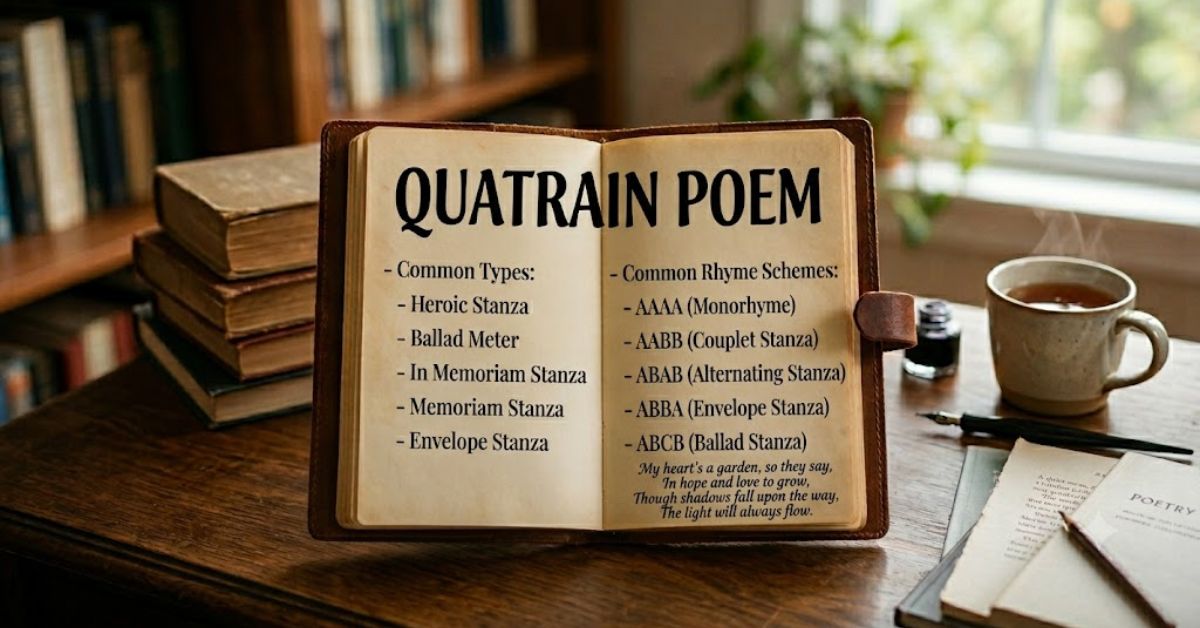
A quatrain is a poem consisting of four lines of verse with a specific rhyming scheme. The rhyme scheme is the pattern of end-rhymes across those four lines, identified by assigning a letter to each rhyming sound. Here are the five most common patterns.
ABAB | Alternate Rhyme
Lines one and three rhyme with each other, and lines two and four rhyme with each other. This is the most widely used quatrain rhyme scheme in English poetry. It creates a flowing, interlocking feel the two rhymes weave together rather than landing in pairs. You find it in Shakespeare’s sonnets, Longfellow’s narrative poems, and countless hymns.
AABB | Coupled Rhyme
Lines one and two rhyme with each other, and lines three and four form their own separate rhyming pair. This scheme feels more immediate and punchy because rhymes arrive back-to-back. It is common in children’s poetry, comic verse, and William Blake’s early work such as The Tyger.
ABBA | Envelope Rhyme
This four-line verse with an ABBA rhyme scheme is known as an envelope quatrain due to the first and fourth rhyming lines enclosing the rhyming second and third lines. The outer lines “wrap around” the inner pair, creating a sealed, reflective quality. It appears in the Italian or Petrarchan sonnet form and is famously used in Alfred, Lord Tennyson’s In Memoriam.
ABCB | Ballad Rhyme
In this pattern, only lines two and four rhyme. Lines one and three are unrhymed and free. This is the ballad stanza, the workhorse of storytelling poetry. It has a loose, conversational feel perfect for narrative poems that need to keep moving. Emily Dickinson used this scheme almost exclusively throughout her career.
AAAA | Monorhyme
All four lines share a single end rhyme. This creates an insistent, chant-like effect. It is less common in English poetry but appears frequently in Persian and Georgian traditions. When used well, it builds intensity; when used poorly, it can feel forced.
Types of Quatrain Poems You Should Know
Beyond rhyme scheme, certain quatrain types are defined by a combination of rhyme and meter the rhythmic pattern of stressed and unstressed syllables in each line. Here are the most important named types.
Heroic Stanza (Elegiac Stanza):
This stanza form uses a rhyme scheme of ABAB with a metrical pattern of iambic pentameter. Each line has ten syllables alternating between unstressed and stressed beats. It is associated with grand or serious subject matter: war, death, nature, public figures. Thomas Gray’s Elegy Written in a Country Churchyard is the defining example.
In Memoriam Stanza:
Named for Alfred, Lord Tennyson’s masterpiece, In Memoriam A.H.H., this stanza form uses the rhyme scheme of ABBA with iambic tetrameter. The iambic tetrameter means eight beats per line instead of ten, giving it a slightly quicker, more intimate feel than the heroic stanza.
Petrarchan (Italian) Quatrain:
Made popular by the Italian poet Petrarch and used in Petrarchan sonnets, these stanzas follow a rhyme scheme of ABBA with the metrical pattern of iambic pentameter. It is the opening movement of the Petrarchan sonnet, which presents a problem or question that the closing set then answers.
Rubaiyat Stanza:
An AABA rhyme scheme written in iambic pentameter. The third line does not rhyme with the others, which creates a subtle interruption before the fourth line returns to resolve the pattern. The form is borrowed directly from the Persian Ruba’i and popularised in English by FitzGerald’s translation of Khayyám.
Ballad Stanza:
An ABCB scheme, often combining iambic tetrameter in odd lines with iambic trimeter in even lines. It is the stanza of folk songs, narrative poems, and popular hymns.
How Meter Works Inside a Quatrain Poem
Meter is the rhythmic heartbeat of a poem. The meter of a quatrain is the pattern of stressed and unstressed syllables within each line. Understanding the meter helps you hear why some quatrains feel fast and energetic while others feel slow and weighty.
The two most common meters in English quatrain poetry are iambic tetrameter (four pairs of unstressed-stressed syllables per line, giving eight beats total) and iambic pentameter (five pairs, giving ten beats). Shorter lines feel quicker and more song-like; longer lines allow for more complex thought.
You do not have to master every technical term to write or enjoy a quatrain poem. But reading a few aloud tapping out the beats with your finger will train your ear to hear the difference between a line that scans cleanly and one that feels off. That instinct is the most practical skill a beginning poet can develop.
Famous Quatrain Poem Examples From Literature
Some of the most beloved poems in the English language are built entirely from quatrains. Here is a brief look at the most important examples.
“Stopping by Woods on a Snowy Evening” by Robert Frost uses an AABA rhyme scheme (the Rubaiyat form) with each stanza rhyming three lines and leaving one unrhymed to link into the next. The final stanza repeats its last line twice — “And miles to go before I sleep” — giving the poem its haunting, hypnotic close.
“Because I Could Not Stop for Death” by Emily Dickinson is composed in ballad stanzas with an ABCB scheme. Dickinson’s use of the quatrain form is deceptively simple; the loose rhyme and alternating line lengths make the poem feel conversational, even as the subject matter (a carriage ride with Death) is anything but ordinary.
“The Tyger” by William Blake uses an AABB rhyme scheme across six quatrains, building a relentless, hammering rhythm that mirrors the image of the tiger’s forging on an anvil.
“A Psalm of Life” by Henry Wadsworth Longfellow employs an ABAB pattern across nine quatrains, delivering its inspirational message in clear, forward-moving lines. One of its most famous phrases — “Footprints on the sands of time” — arrives inside a perfectly constructed quatrain stanza.
“In Memoriam” by Alfred, Lord Tennyson gave its name to an entire stanza type. The ABBA envelope scheme creates a sense of grief folding inward, perfectly matching the poem’s subject: the poet’s mourning for his closest friend.
The Rubáiyát of Omar Khayyám remains the most celebrated collection of quatrain poems in world literature 101 four-line meditations on fate, pleasure, and mortality, originally composed in Persian and translated into English by Edward FitzGerald in 1859.
How to Write Your Own Quatrain Poem
Writing a quatrain poem is one of the best entry points into formal poetry because the rules are clear, the structure is short, and the results can be genuinely moving. Follow these steps.
Choose your subject
Pick something specific: a person, a feeling, a moment in nature, a memory. The more concrete your subject, the easier it will be to write with real detail.
Choose your rhyme scheme
If you want a natural, storytelling feel, start with ABCB (ballad style). For something more formal and interlocking, try ABAB. For something reflective and enclosed, use ABBA. For punchy, direct verse, try AABB.
Write your four lines
Do not worry about perfection yet. Get the idea down in roughly four lines. Then count syllables and adjust to create a consistent rhythm.
Check your end rhymes
Read the last word of each line aloud. Do the rhyming pairs land cleanly without feeling forced? If a rhyme requires twisting the meaning unnaturally, replace it.
Read the poem aloud in full
The voice reveals everything. A line that looks fine on the page will stumble if the syllable count is off or the stress pattern is wrong. Adjust until it reads smoothly.
Consider whether a single quatrain is enough
Some ideas fit neatly in four lines. Others need two or three stanzas. If you continue, keep the same rhyme scheme across all stanzas for a unified feel.
Common Mistakes to Avoid When Writing a Quatrain
Even experienced writers fall into predictable traps with this poetic form. Here are the most common ones to avoid.
Forcing a rhyme
If you write a line backward or use an obscure word just to make it rhyme, the poem loses authenticity. A near-rhyme (also called a slant rhyme) is far better than a forced exact rhyme. Emily Dickinson built her entire style on slant rhymes.
Ignoring rhythm
A quatrain with a consistent rhyme scheme but no metrical pattern feels unbalanced. Even in free verse quatrains, you want some rhythmic regularity lines of roughly similar length, or a clear reason why they differ.
Writing only in abstractions
Phrases like “life is beautiful” or “love is strong” carry no weight on their own. Anchor your quatrain in a concrete image: a cracked window, a red coat, the smell of rain on pavement.
Making every stanza feel the same
If you write a multi-stanza poem, vary the emotional content across quatrains even while keeping the form consistent. Each stanza should move the poem forward.
Why Poets Still Choose the Quatrain Poem Today
In an era when free verse dominates, the quatrain poem has not disappeared. Contemporary poets return to it for the same reasons their predecessors did: constraint generates creativity. When you commit to four lines and a rhyme scheme, you are forced to choose every word with precision.
The versatility of a quatrain is attractive to poets. One variation of a quatrain can carry a light, punchy poem, while another supports a heavier sonnet. The form scales across moods, subjects, and skill levels. A nursery rhyme for a child and a grief elegy for a lost parent can both be written as quatrains and both can be beautiful.
There is also the matter of memorability. Rhyme and rhythm make poetry easier to remember, and the four-line block is a natural unit of memory. Think of how easily you can recall a verse from a hymn or a folk song that is the quatrain at work.
Quatrain Poem vs Other Stanza Forms | Key Differences
Understanding what makes a quatrain distinct helps you recognise it in the wild and use it intentionally.
A couplet is two rhyming lines half the size of a quatrain. It delivers a single, sharp punch. A quatrain has more room to breathe.
A tercet (or triplet) has three lines. It creates an odd, slightly unresolved feeling by nature. The quatrain resolves that tension with its fourth line.
A quintet has five lines, and a sestet has six. These longer stanzas allow for more complexity but can lose the tight discipline that makes the quatrain so effective.
The quatrain sits at a sweet spot between too short and too long. It is the stanza form that best mirrors how people naturally think and speak in connected, completed thoughts.
How the Quatrain Poem Appears in Songs and Pop Culture
The connection between the quatrain poem and music is deep and ancient. The ballad stanza ABCB in iambic tetrameter-trimeter alternation is the direct ancestor of the verse-chorus structure used in folk songs, country music, blues, and pop. When you listen to a traditional folk ballad, you are hearing the quatrain in sonic form.
Hymns in the Christian tradition are almost universally built from quatrains. “Amazing Grace,” one of the most recognised songs in the English-speaking world, is composed entirely of four-line stanzas with an ABAB rhyme scheme. The lyric poetry of the Psalms, another foundation of Western literary culture, also follows quatrain-like parallelism in its original Hebrew structure.
In contemporary popular music, the verse section of most songs follows a four-line pattern with alternating or coupled rhymes a direct inheritance from the poetic quatrain tradition, even when songwriters have never studied formal poetry.
Tips for Teaching Quatrain Poems in the Classroom
The quatrain poem is one of the best tools in a writing teacher’s toolkit because it gives students a clear, achievable goal: write four lines that make sense together.
Start by reading famous examples aloud before students write. Let them hear the rhythm of a ballad stanza and feel the difference between an ABAB and an ABBA pattern. Ask them to clap the beats that make the meter physical and memorable.
For a first writing exercise, give students a first line and ask them to complete a quatrain in the ABCB pattern. The loose rhyme scheme means they only need to find one rhyming pair, reducing the pressure while still introducing structure.
Older or more advanced students can be challenged to write in iambic tetrameter four beats per line and to choose between different rhyme schemes for different emotional effects. Comparing two versions of the same quatrain (one AABB, one ABBA) and discussing how the rhyme scheme changes the feeling is an excellent critical thinking exercise.
Always encourage students to read their quatrains aloud before considering them finished. The ear catches what the eye misses.
FAQs
What is the simplest definition of a quatrain poem?
A quatrain poem is a stanza or an entire poem made up of exactly four lines. The lines usually follow a rhyme scheme (a pattern of end-rhymes), though some quatrains are written in free verse without rhyme. The word comes from the French quarter, meaning four.
What is the most common rhyme scheme in a quatrain poem?
The ABAB scheme also called alternate rhyme is the most commonly used pattern in English-language quatrain poetry. Lines one and three rhyme with each other, and lines two and four rhyme with each other. It appears in Shakespeare’s sonnets, Longfellow’s narrative poems, and most traditional hymns.
What is the difference between a quatrain and a ballad stanza?
A ballad stanza is a specific type of quatrain. It uses an ABCB rhyme scheme where only the second and fourth lines rhyme and is often written in alternating lines of iambic tetrameter and iambic trimeter. All ballad stanzas are quatrains, but not all quatrains are ballad stanzas. Emily Dickinson used the ballad stanza throughout her career.
Can a quatrain poem be written without rhyme?
Yes. While most traditional quatrains use some form of rhyme, a quatrain can also be written in free verse with no end-rhymes at all. What makes it a quatrain is the four-line structure, not the presence of rhyme. Many contemporary poets use the quatrain as a visual and rhythmic unit without committing to a strict rhyme scheme.
What are some of the most famous quatrain poems in literature?
Some of the most celebrated examples include “Stopping by Woods on a Snowy Evening” by Robert Frost, “Because I Could Not Stop for Death” by Emily Dickinson, “The Tyger” by William Blake, “Elegy Written in a Country Churchyard” by Thomas Gray, “In Memoriam” by Alfred, Lord Tennyson, and The Rubáiyát of Omar Khayyám. All of these poems are built on four-line stanza structures that showcase the form’s range and power.
Final Thoughts
The quatrain poem is not just a classroom exercise or a relic from centuries past. It is one of the most alive, flexible, and enduring forms that poetry has ever produced. From the desert meditations of Omar Khayyám to the New England woods of Robert Frost, from ancient Chinese verse to 21st-century song lyrics the four-line stanza has carried human thought and emotion across thousands of years and dozens of cultures.
If you are new to poetry, the quatrain poem is the perfect place to start. It is simple enough to learn in an afternoon and deep enough to spend a lifetime exploring. Pick a subject, choose a rhyme scheme, count to four, and begin. Some of the most memorable lines in all of literature were written inside that small, powerful container.
Recent Article : Happiness Poems: Joyful Verses That Lift Your Soul

Jennifer Aston is a passionate poetry curator and writer with a deep love for the written word. She believes poetry has the power to heal, inspire, and connect people across all walks of life. Through PoemSteric, she brings together timeless and modern verses for every emotion and every moment.