
Introduction
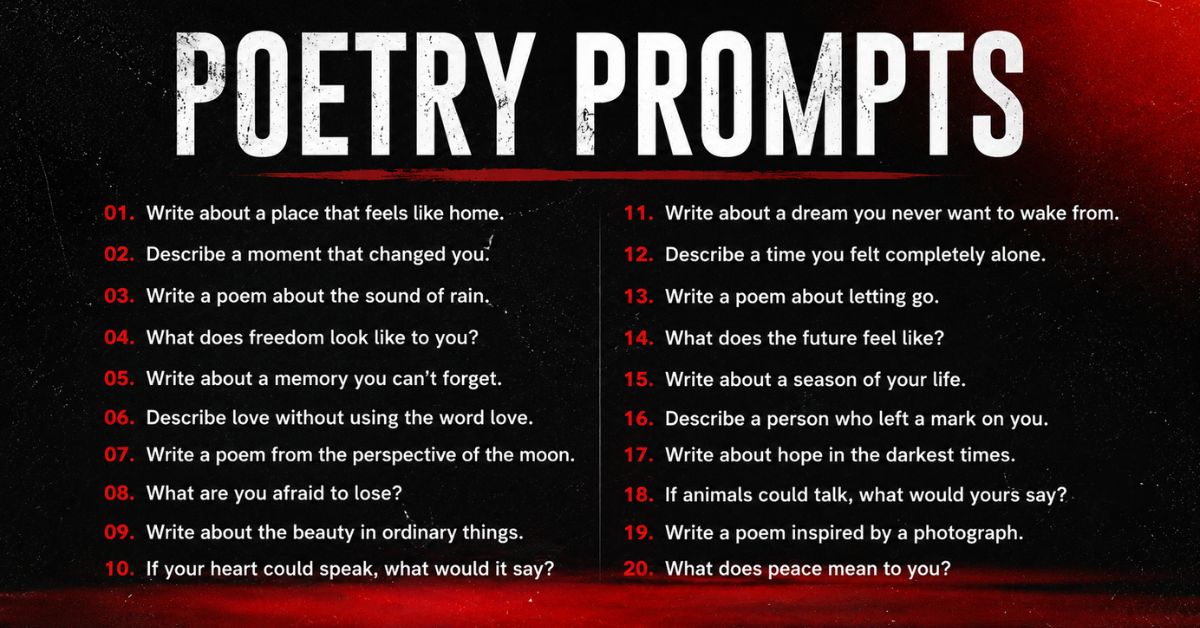
Poetry prompts are short creative constraints: a word, image, memory, or rule that give you a concrete starting point for a poem so you’re not facing a blank page. The best ones combine a specific subject with a small formal or emotional constraint, which is why the strongest poetry prompts do more than say “write about love.” They tell you how to approach it.
That gap of vague prompts with no follow-through is exactly where most lists online fall short. In my own experience running poetry workshops, the writers who get stuck aren’t short on ideas; they’re short on a clear next step after the idea. This guide fixes that. Below, you’ll find prompts organized by poetic form, by theme, and by use case, plus a worked example, a mid-article FAQ, and a full reference FAQ section at the end.
Key Takeaways
A poetry prompt works best when it pairs a concrete image with a small rule, not just an open-ended theme.

Setting a timer for 10–15 minutes removes the pressure to write something "good" right away.

Different situations call for different prompts: beginners need constraints that limit decisions, while experienced writers often need prompts that add friction.

Understanding a form's actual structure, line count, rhyme, repetition makes a prompt far more useful than a vague instruction to "write a sonnet."

The gap between a flat first draft and a real poem is almost always one image pushed one layer deeper, as shown in the worked example below.
How to Use Poetry Prompts: A Step-by-Step Method
A prompt is a door, not a finished room. Simply reading a list of poetry prompts rarely produces a poem on its own; what matters is the process you run once you’ve picked one. Below is the two-step method I recommend to writers who feel stuck before they even begin.
1 : Set a Timer, Not a Target
Give yourself 10 to 15 minutes of uninterrupted writing before you judge anything you’ve written. As a result, you remove the pressure of producing something polished on the first pass. Poems that survive editing almost always start out messy, so treat this stage as raw material collection rather than composition.
Turn off notifications, and resist the urge to reread each line as you go. If you stall, keep your pen or cursor moving by writing the same word twice until the next one arrives. Momentum matters more than quality here.
2 : Answer the Prompt Literally, Then Push Deeper
Once your timer ends, read back what you wrote and answer the prompt literally, in plain language, in one or two lines. For example, if the prompt is “write about the way someone says your name,” your literal answer might simply describe the tone of voice.
Then ask what’s underneath that observation. Is there an image, an object, a gesture, a sound that captures the same feeling without stating it outright? That second layer is where most real poems actually begin, and it’s the step that separates a journal entry from a poem.
Poetry Prompts by Form: A Structural Guide
Knowing a form’s actual mechanics makes a poetry prompt far more useful than a bare instruction like “write a sonnet.” Below, each form is explained with its real structural rules, followed by two prompts you can use immediately.
Common Poetic Forms Explained
Haiku
Traditionally 3 lines following a 5-7-5 syllable pattern, often built around a seasonal image.
- Write a haiku about the last thing you noticed before falling asleep.
- Write a haiku that never mentions the season directly, only implies it.
Sonnet
14 lines, traditionally in iambic pentameter, often containing a “turn” (volta) around line 9. Shakespeare’s sonnets use an ABAB CDCD EFEF GG rhyme scheme, while the earlier Petrarchan form splits into an octave and sestet.
- Write a sonnet where the first eight lines describe a problem and the final six offer an answer you don’t fully believe.
- Write a sonnet addressed to a decision you’re still not sure you made correctly.
Villanelle
19 lines across five tercets and one closing quatrain, built on two alternating refrains Dylan Thomas’s “Do Not Go Gentle into That Good Night” is the best-known modern example.
- Write a villanelle around a sentence someone told you that you’ve never stopped hearing.
- Write a villanelle where the two refrains contradict each other by the final stanza.
Sestina
Six stanzas of six lines plus a three-line envoi, using the same six end-words in a rotating pattern instead of rhyme; Elizabeth Bishop’s poem “Sestina” is a widely studied example.
- Pick six nouns from your kitchen and write a sestina where those words end every line.
- Write a sestina using the six most common words from your last group text conversation.
Ghazal
A series of independent couplets unified by a repeated word or phrase (the radif) at the end of each couplet’s second line, a form with roots in classical Persian and Urdu poetry.
- Write a ghazal where every couplet ends on the same short phrase but means something different each time.
- Write a ghazal about waiting, where each couplet describes waiting for something unrelated to the last.
Pantoum
Built from repeating lines, where lines 2 and 4 of each stanza reappear as lines 1 and 3 of the next stanza.
- Write a pantomime about a place you keep almost going back to.
- Write a pantomime where the repeated lines start out comforting and end up unsettling.
Acrostic
The first letter of each line spells a word or name vertically.
- Write an acrostic using a word you associate with your childhood home not your own name.
- Write an acrostic spelling out a feeling you’ve never said out loud.
Free verse
No fixed meter or rhyme scheme; structure instead follows breath, image, or thought, as pioneered by poets like Walt Whitman and later William Carlos Williams.
- Write a free-verse poem where every line is a single unfinished sentence.
- Write a free-verse poem using only short, declarative sentences with no commas allowed.
Ekphrastic poem
A poem written in direct response to a specific piece of visual art; John Keats’s “Ode on a Grecian Urn” is a classic historical example.
- Find a painting or photograph you’ve never looked at closely and write a poem addressed to someone inside the image.
- Write an ekphrastic poem about a photo from your own phone’s camera roll.
Poetry Prompts by Theme
Organizing poetry prompts by theme rather than form helps when you already know what you want to write about but not how to begin. Each theme below includes eight prompts, moving from the concrete to the more abstract.
Nature and Love Prompts
Nature
- Write about the exact moment a season changes where you live, not the season itself, the turning point.
- Write a poem from the point of view of the last leaf on a tree.
- Describe a body of water you’ve never actually stood beside.
- Write about weather as if it’s a character with intentions.
- Write a poem that starts with the smallest living thing you can see right now.
- Write about a plant that has outlived several of its owners.
- Write a poem set during the hour just before sunrise.
- Describe your least favorite weather as if trying to convince someone to love it.
Love
- Write a love poem that never uses the word “love.”
- Write about the specific way someone says your name.
- Write a poem to someone you loved before you knew what the word meant.
- Describe an argument entirely through objects in the room.
- Write about the version of a relationship that existed only in your head.
- Write a poem about loving someone’s flaws more than their strengths.
- Write about the first time you noticed someone’s hands.
- Write a poem that describes love as a physical location instead of a feeling.
Grief, Identity, and Memory Prompts
Grief
- Write about an object that outlived the person who owned it.
- Write a poem addressed to someone who will never read it.
- Describe grief as weather, not as an emotion.
- Write about the last ordinary conversation you had with someone before everything changed.
- Write a poem where absence is described through what’s still physically present.
- Write about a voicemail, message, or note you’ve kept and never deleted.
- Write a poem set at a funeral, but focus only on the small, mundane details.
- Write about grief arriving late, months after everyone expected it to.
Identity and memory
- Write about a name you were almost given.
- Write a poem in the voice of yourself at ten years old, talking to yourself now.
- Describe your hands and everything they’ve learned to do.
- Write about a language, accent, or word your family uses that outsiders don’t understand.
- Write a poem built entirely from smells that return you to childhood.
- Write about the first lie you remember telling.
- Write a poem exploring a scar, real or emotional, and where it came from.
- Write about a version of yourself you’ve outgrown but still recognize.
Everyday Life and Social Prompts
Everyday life
- Write about the walk from your front door to the nearest street corner, in exhausting detail.
- Write a poem set entirely in a waiting room.
- Describe the contents of your bag or pockets as if cataloging evidence.
- Write about the last text message you didn’t send.
- Write a poem about doing laundry that is secretly about something else.
- Write about the sound your home makes when everyone else is asleep.
- Write a poem structured as a grocery list that reveals something personal.
- Write about the space between two alarms on a snoozed phone.
Social and political
- Write a poem about a headline that upset you, without naming the event directly.
- Write from the perspective of someone whose story usually goes untold in the news.
- Write about a rule you were taught that you no longer believe.
- Describe a protest, real or imagined, through a single pair of shoes in the crowd.
- Write a poem about a border, real or invisible.
- Write about a job that no one thanks you for doing.
- Write a poem addressed to a future generation reading it decades from now.
- Write about silence as a form of protest.
Poetry Prompts for Beginners
If you’ve never written a poem before, the best poetry prompts for beginners remove decision-making almost entirely so you can focus on simply getting words down. Choice, not talent, is usually what stalls new writers, so these prompts are deliberately narrow.
- Write ten lines, each starting with “I remember.”
- Pick any object in the room and write five lines about it using only your senses, no metaphors yet.
- Write a poem that is just a list of things you’re afraid to say out loud.
- Finish this line five different ways: “Nobody told me that…”
- Write about your morning routine as if it were a ritual with hidden meaning.
- Rewrite a text message you sent recently as a poem, line by line.
- Write a poem using only questions, no statements at all.
- Describe your reflection in a mirror as if it belonged to someone else.
- Write a poem where every line is exactly five words long.
- Write about the last thing that made you laugh, unexpectedly.
- Write a poem built from the last five things you searched online.
- Describe a room in your house without naming what the room is used for.
Poetry Prompts for Kids and Students
These prompts work well in a classroom, at home, or in a writing group with younger writers, since they lean on play and imagination rather than emotional excavation.
- Write a poem about your favorite animal pretending to be human for a day.
- Make a list of five tiny things you can see right now and write a poem connecting them.
- Write a poem where every line rhymes with your first name.
- Write an “if I were” poem if I were the weather, if I were a color, if I were a sound.
- Write a poem that tells the story of your day as if it were a fairy tale.
- Write a poem from the point of view of your favorite toy.
- Write a silly poem about a food you secretly dislike.
- Write a poem describing your best friend without naming them.
- Write about what you think your pet dreams about.
- Write a poem imagining what your school looks like at night when it’s empty.
Poetry Prompts for Writer’s Block and Daily Practice
Use these poetry prompts specifically when you’ve been staring at a blank page too long, or when you want a low-stakes daily writing habit rather than a single finished poem.
- Open any book near you to a random page, circle the first noun and verb you see, and use both within the first two lines of a poem.
- Set a timer for five minutes and write without lifting your pen or backspacing once, no matter what comes out.
- Take a poem you’ve already written and rewrite it, removing every adjective.
- Write a poem entirely in questions.
- Write the worst possible opening line you can think of, then write the poem that redeems it.
- Pick a word you dislike the sound of and build a poem around making it feel beautiful.
- Write a poem using only one-syllable words.
- Rewrite a nursery rhyme you know from memory, changing only the ending.
- Write a poem in exactly two minutes, then read it aloud once, unedited.
- Write a poem that starts with the last line of the poem you wrote yesterday.
- Pick a color and write a poem without naming it, describing only its effects.
- Write a poem based on the first sound you hear after closing your eyes for thirty seconds.
From Prompt to Poem: A Worked Example
Take the prompt: “Write about the specific way someone says your name.” A first, literal pass might read:
My mother says my name like a question, even when she already knows the answer.
That’s a reasonable start, but it still explains the feeling instead of showing it. Pushing further, and asking what’s underneath, might produce this instead:
My mother says my name the way you’d knock twice on a door you already have a key to.
Notice what changed. The second version replaces the abstract idea “like a question” with a concrete image: knocking on a door you have a key to. That image carries the same emotional truth, a mix of familiarity and strange, lingering politeness, without stating it outright. That’s the move most poetry prompt lists never demonstrate: write the obvious line first, then search for the image that says the same thing without naming it directly.
FAQ Spotlight – What Makes a Poetry Prompt Actually Work?
A poetry prompt works when it does two things at once: it narrows your options enough that you can start immediately, and it leaves enough open that the poem can still surprise you. A prompt like “write about nature” fails the first test; it’s too open, so you freeze. A prompt like “describe the exact color of the sky at 6:47 p.m.” passes both tests, because it’s specific enough to picture instantly, yet still leaves room for whatever memory or feeling that image pulls up.
In practice, the strongest poetry prompts usually include one concrete, sensory detail rather than an abstract concept. For example, “write about loss” is harder to start than “write about the chair no one sits in anymore.” The second version gives you an image to stand on. As a result, your first line arrives faster, and the poem tends to stay grounded rather than drifting into generalities.
Where to Find Poetry Prompts Every Day
Many working poets keep a running list of poetry prompts and pull one at random each morning, rather than searching for a new source every time. However, a running list isn’t the only option, and several reliable habits can supply a fresh prompt daily without much effort.
- Open a book at random. Flip to any page, circle a striking word or phrase, and build a poem from it. This method removes the pressure of picking your own topic.
- Follow National Poetry Month. Held every April in the United States, this annual observance is when many literary organizations release daily prompt sets, making it an easy time to build a habit.
- Join a writing group or workshop. Prompts shared in a group setting come with built-in accountability, since you’re expected to bring something written to the next session.
- Keep a “phrase jar.” Jot down any striking sentence you overhear during the week, then draw one out whenever you need a starting point.
- Revisit old journal entries. A sentence you wrote months ago, read with distance, often works better as a poetry prompt than a prompt from a stranger’s list.
Can AI Tools Help With Poetry Prompts?
AI tools can generate a starting image or constraint quickly, and for that narrow purpose, they function similarly to flipping open a book at random or pulling a phrase from a jar. Used this way, an AI-generated poetry prompt is simply one more low-cost way to get an idea onto the page.
However, the poem itself, the specific images, memories, and language that make it worth reading still has to come from your own attention and experience. An AI tool can suggest that you write about “a childhood kitchen,” but only you know the exact smell of that room, the sound the refrigerator made, or who was standing at the stove. Treat any AI-generated prompt exactly as you’d treat a prompt from this list: a door, not a draft.
FAQs
Q: What are good poetry prompts?
A: Good poetry prompts a specific, sensory detail with a small constraint, rather than offering a broad theme like “write about nature.” For example, “describe the sound your front door makes” works better than “write about home,” because the sensory detail gives you something concrete to picture and start from immediately, rather than forcing you to invent a starting image yourself.
Q: How do I start writing a poem from a prompt?
A: Set a timer for 10 to 15 minutes and write the first, most obvious response to the prompt without editing anything. Once the timer ends, reread what you wrote and look for one image or phrase you can push further that second, deeper pass is usually where the actual poem begins, rather than the literal first draft you produced.
Q: Are poetry prompts good for beginners?
A: Yes, poetry prompts are especially useful for beginners because they remove the hardest part of starting a poem: deciding what to write about. Beginners tend to benefit most from prompts with a built-in limit, such as a list format, a syllable count, or a repeated sentence starter, since narrow constraints reduce the number of decisions you have to make before writing a single word.
Q: Where can I find poetry prompts every day?
A: Many poets keep a running list of poetry prompts and pull one at random, or build a habit around recurring events like National Poetry Month each April. You can also generate a prompt on the fly by opening any book to a random page and building a poem from the first striking word or phrase you notice on it.
Q: Can I use AI to help with poetry prompts?
A: Yes, AI tools can generate a quick starting image or constraint, similar to flipping open a book at random for inspiration. That said, the poem’s actual language, memory, and detail still need to come from you, since an AI-generated prompt only supplies the door, not the room behind it you still have to walk in and describe what you find.
Q: How long should I spend on a single poetry prompt?
A: Ten to fifteen minutes is usually enough for a first, unedited draft from a single poetry prompt. Spending longer before you’ve finished a rough draft often leads to overthinking individual lines instead of getting the whole idea down, so it’s generally more productive to write quickly first and revise afterward, once the raw material exists.
Final Thoughts
The poetry prompts above will only get you as far as the first ten minutes. What actually makes a poem good isn’t the prompt itself; it’s what you notice while you’re inside it, and what you’re willing to look at closely once you’ve started. Pick one prompt from this guide, set a timer, and don’t stop until it goes off. Then read back what you wrote, find the one image worth keeping, and build the rest of the poem around that.
Recent Article : What is a Poet’s Life Really Like? The Honest Answer

Jennifer Aston is a passionate poetry curator and writer with a deep love for the written word. She believes poetry has the power to heal, inspire, and connect people across all walks of life. Through PoemSteric, she brings together timeless and modern verses for every emotion and every moment.