
Introduction
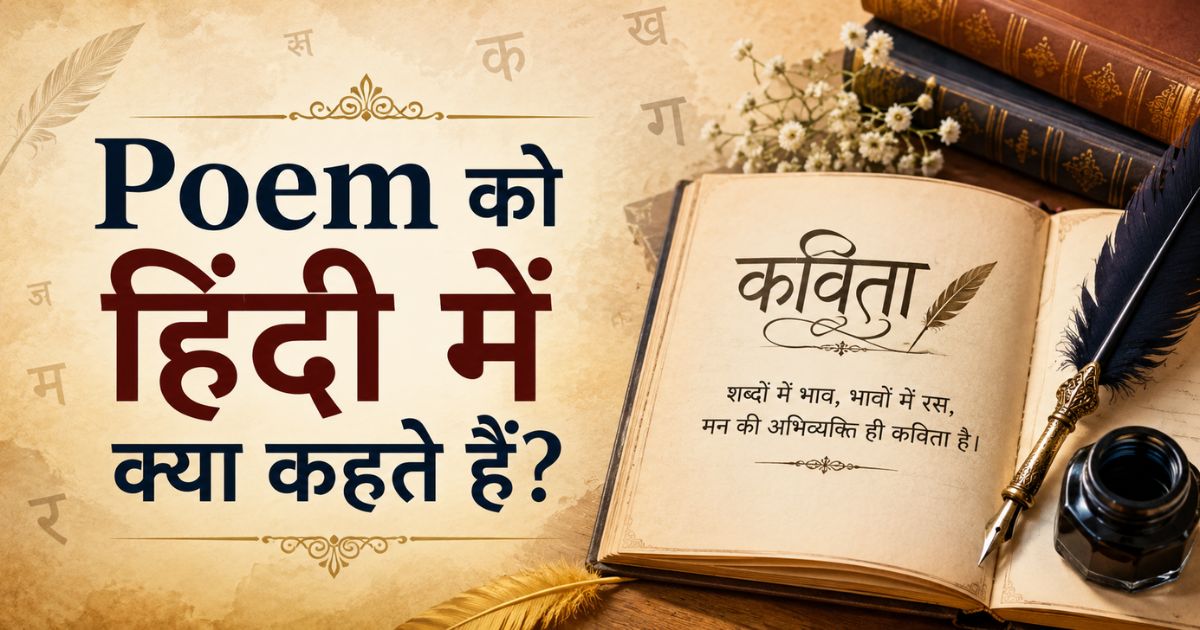
Poem ko hindi mein kya kahate hain? The direct and simple answer is कविता (kavita). A poem is a piece of writing that uses rhythm, images, and carefully chosen words to share feelings or ideas. In Hindi, people most often call it kavita.
This word comes from Sanskrit roots linked to the idea of a poet or creative maker. Readers who search this question usually want a clear translation, correct pronunciation, and a bit of cultural context. This article gives exactly that, plus practical examples and tips anyone can use.
Key Takeaways
- The most common Hindi word for a poem is कविता.
- Related terms include काव्य, पद्य, and शायरी, each used in a slightly different context.
- Kavita focuses on emotion and musical language rather than plain facts.
- Students need this term for exams, spoken practice, and reading Hindi literature.
- Pronunciation is simple once broken into parts: ka-vi-taa.
Knowing related terms builds stronger vocabulary. For example, the person who writes a poem is a कवि (kavi), and a collection of poems may be called a कविता संग्रह. These small details make conversations and reading far easier.
In daily life, people use kavita for short emotional pieces and kavya for longer or more formal works. This distinction appears often in textbooks and literary discussions, so keeping both words ready improves accuracy. Learning the Hindi name also opens doors to a rich tradition that stretches from ancient Sanskrit verse to today’s free-style poems shared online.
Kavita: Meaning and Simple Definition in Everyday Hindi
Kavita means a creative piece of writing that expresses feelings through rhythm and word pictures. Unlike ordinary sentences, it often arranges lines so the sound itself carries meaning. Hindi speakers use this word for both short modern poems and traditional verses.
In simple terms, when someone says “main ek kavita likh raha hoon,” they mean they are writing a poem. The focus stays on the beauty of language and emotional impact. Dictionaries list synonyms such as काव्य and पद्य, yet kavita remains the everyday choice.
Scholars note that the word traces back to the Sanskrit “kavitā,” linked to the root for the poet. This history shows how the idea of making art with words has stayed strong for centuries. In classrooms across India, teachers introduce the term early because it appears in every board exam syllabus.
Consider a real classroom moment: a student reads a four-line nature piece and asks the teacher for the Hindi name. The reply is almost always “yeh ek kavita hai” a short exchange that builds confidence.
Kavita also covers a wide emotional range. A poem about rain can feel gentle, while one about struggle can feel powerful. The same word works for both, which makes it useful for learners at every level. Writers choose special tools inside a kavita repeating sounds, creating vivid pictures, or leaving space for the reader’s imagination and these choices turn ordinary language into something memorable.
Different Words for Poem in Hindi Language and Literature
Hindi offers several related words, each with a slightly different shade of meaning. Kavita is the broad, everyday term. Kavya often points to more formal or classical poetry. Padya stresses the verse form as opposed to prose (gadya).
Shayari usually refers to Urdu-influenced or romantic verse that many people still enjoy in mushairas. Nazm is another common word for a structured poem, especially in the ghazal tradition. Padyakavya combines the idea of verse and poetry into one formal label.
Here is a short comparison for clarity:
- Kavita – general, emotional, modern or traditional
- Kavya – literary, often longer or classical
- Padya – stresses the metrical or lined form
- Shayari – lyrical, often romantic or philosophical
These differences matter when reading older texts. A medieval work might be called mahakavya (great poem), while a short social-media post is simply called a kavita. Knowing the range prevents confusion.
In spoken Hindi, people sometimes mix the terms freely. A grandmother might say “sunao ek shayari” when she means any short poem, while a literature teacher chooses the most precise word. Both approaches are valid in the right setting. Historical records show that Sanskrit used kāvya for ornate court poetry as early as the early centuries CE; Hindi inherited and adapted the term, and over time kavita became the more flexible everyday option.
How to Pronounce and Write Kavita Correctly
Break the word into three clear parts: ka – vi – taa. The first syllable sounds like the “ca” in “car.” The middle “vi” is short, like the “v” in “victory.” The final “taa” stretches a little, similar to “ta” in “father” but held longer.
In Devanagari script it is written कविता – क, then वि, then ता. Practice writing it slowly at first; many free online tools let you type in Roman letters and convert to Hindi script.
Listen to native speakers on short videos or language apps. The stress falls evenly rather than on one heavy syllable, and once you hear it a few times, the rhythm becomes natural. Common mistakes include saying “kaveeta” with an extra-long middle vowel or writing the wrong matra checking a reliable dictionary or textbook model helps correct these quickly.
For English speakers, linking the sound to a familiar phrase helps: think of “ka-vi-taa” as similar in length to “ca-vi-ty” but with a softer ending. Repeat it aloud while looking at the Devanagari form. Parents teaching children often use the same method pointing to the written word, saying it slowly, and asking the child to repeat. Within a few sessions the pronunciation becomes automatic.
Types of Poetry and Poem Forms Common in Hindi
Classical and Traditional Forms
Traditional Hindi poetry includes doha (two-line couplets), chaupai (four-line stanzas), and longer narrative forms. Kabir’s dohas remain popular because they pack wisdom into short, memorable lines, while Meera’s pads express deep devotion in a lyrical style.
These forms often follow a strict metre and rhyme, and the structure itself becomes part of the beauty. Readers of older texts learn to recognise the pattern as soon as they see the line length. Epic-style works, sometimes called mahakavya, tell long stories of heroes or gods; they demand more time and attention but reward the reader with rich language and moral depth.
Modern and Free Verse Styles
Contemporary poets frequently choose free verse. They drop strict rhymes and let the natural flow of Hindi guide the lines, with themes ranging from city life and personal feelings to social issues.
This style appears in magazines, blogs, and spoken-word events. Young writers find it easier to start because the rules are fewer, and the focus stays on clear images and honest emotion. Both classical and modern forms still share the same core name kavita. The difference lies in technique, not in the basic identity of the piece.
What Does Poem Mean in Hindi? Quick Answer for Students
Students searching “what does poem mean in hindi” usually need a one-line classroom answer: poem means कविता. A longer definition is a rhythmic piece of writing that shares feelings or ideas through carefully chosen words.
Exams often ask for the Hindi term, a short meaning, and one example. Keeping the answer ready in simple language saves marks, and teachers also expect students to know that the writer is called a kavi. Practice by translating a short English nursery rhyme into Hindi and calling the result a kavita the exercise builds both vocabulary and confidence.
Step-by-Step Guide to Understanding a Simple Hindi Poem
- Read the poem once slowly without stopping.
- Note any words you already know.
- Look up two or three new words in a simple dictionary.
- Read the poem aloud a second time, listening for rhythm.
- Ask yourself what feeling the lines create.
- Summarise the main idea in one plain sentence.
- If possible, share the poem with a friend and discuss it.
This method works for both short modern pieces and classical dohas. Each step builds understanding without overwhelm, and after a few poems the process becomes faster and more enjoyable.
Real-Life Examples and Famous Hindi Kavita Lines
Kabir’s famous doha begins “Bura jo dekhan main chala…” and reminds listeners to look at their own faults first. People still quote it in daily conversation.
A simple nature line might read “Hare-bhare pedon ki chhaya…,” painting a clear picture of cool shade. Such images stay in the mind long after reading. In school assemblies, children often recite short patriotic or moral poems, and the shared experience turns the abstract word “kavita” into a living moment.
Online platforms now host thousands of new poems. A young writer posts four lines about monsoon rain and receives comments within minutes. The same word kavita covers both the five-hundred-year-old doha and the brand-new digital piece.
Why Knowing the Hindi Word for Poem Matters for Learners
Accurate vocabulary improves reading speed and speaking confidence. When a textbook or conversation uses “kavita,” the learner who already knows the word moves ahead smoothly.
Cultural appreciation grows too. Hindi literature is full of poems that shape values and history, and knowing the correct term lets a person join discussions without hesitation. Language exams and competitive tests regularly include poetry questions, so a solid grasp of the basic word and its relatives gives an edge.
In daily life the knowledge appears in unexpected places: song lyrics, festival greetings, or a friend’s social media post. Each encounter reinforces the learning.
FAQs
Q: Poem ko hindi mein kya kahate hain?
A: Poem ko hindi mein kavita kahate hain. This is the most common and natural word used by speakers of all ages. You will also meet related terms such as kavya or padya in literary settings, but kavita works for almost every everyday situation. Learning this single word immediately unlocks textbooks, conversations, and online poetry.
Q: What is the easy meaning of kavita?
A: Kavita means a poem, a short or long piece of writing that uses rhythm and vivid language to share feelings or ideas. It is not ordinary prose; instead, it aims to create an emotional or mental picture. School children and adults use the same word for both simple and complex works.
Q: How do you say a poem in Hindi correctly?
A: Say “kavita” with three clear parts: ka-vi-taa. Write it in Devanagari as कविता. Practice aloud while looking at the script native speakers stress the syllables evenly, and once you hear it a few times in videos or classroom reading, the pronunciation settles naturally.
Q: Is there any difference between kavita and kavya?
A: Yes, a small one. Kavita is the everyday word for almost any poem, while kavya often points to more formal, classical, or longer literary works. In casual talk people use them almost interchangeably, but in textbooks the distinction appears more clearly. Knowing both terms improves precision.
Q: Why should students learn the Hindi name for a poem?
A: Students meet the word in every Hindi exam, textbook chapter, and literary discussion. Knowing that poem ko hindi mein kya kahate hain is kavita saves time and builds confidence. It also helps when reading famous lines or writing short answers, supporting both language marks and cultural understanding.
Q: Can I use shayari instead of kavita?
A: Shayari is a related word, often linked to romantic or philosophical verse with an Urdu flavour. It is correct in many contexts, yet kavita remains the broader and more neutral term. Choose the word that matches the style of the piece you are describing.
Final Thoughts
The Hindi word for the poem is कविता (kavita). Once that fact is clear, a whole tradition opens up. It stretches from Kabir’s old dohas to today’s free verse. Learners grow by practising pronunciation and reading short poems. Related words like kavya, padya, and shayari add extra depth. This single word connects a school recital to a modern Instagram post. Poetry rewards attention in any language, and Hindi is no different. The rewards are clearer communication and deeper cultural insight. There’s also the quiet pleasure of a well-turned line. Starting with one short kavita today the path only gets easier from here.
Recent Article : What is the Central Idea of the Poem Amanda? Clear Answer

Jennifer Aston is a passionate poetry curator and writer with a deep love for the written word. She believes poetry has the power to heal, inspire, and connect people across all walks of life. Through PoemSteric, she brings together timeless and modern verses for every emotion and every moment.