
Introduction
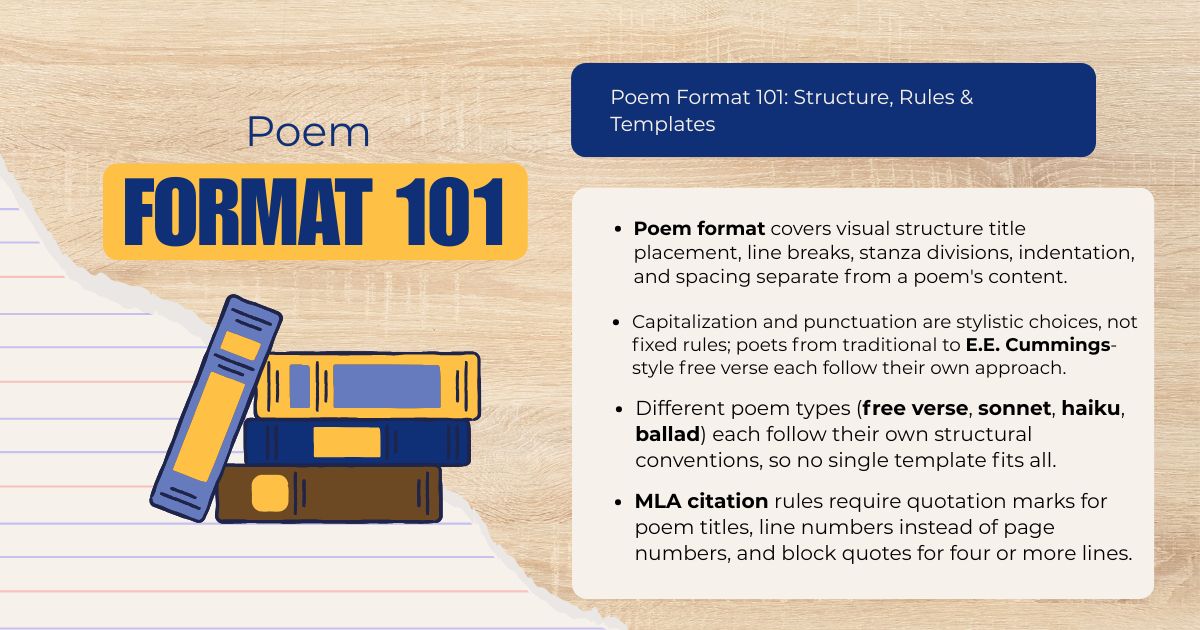
Poem format refers to how a poem is visually and structurally arranged on the page: its title placement, line breaks, stanza divisions, capitalization, indentation, and spacing. There’s no single universal poem format required for every poem, but there are consistent conventions for submitting work to literary magazines, formatting poems in academic papers using MLA style, and organizing a poem’s visual structure to support its meaning. This guide breaks down every major formatting decision you’ll need to make, with templates you can copy directly.
Key takeaways
Poem format covers both structural choices (line breaks, stanza divisions, indentation) and citation conventions (how to format a poem title and quote it correctly in MLA style).

The Modern Language Association (MLA) style guide specifies that a poem's title takes quotation marks when referenced within a larger work, while a standalone published poetry collection's title is italicized.

Most literary magazines request submissions in a standard 12-point serif font like Times New Roman, single-spaced within a poem, with the poet's original line breaks and stanza spacing preserved exactly.

Capitalization and punctuation in poetry are stylistic choices, not fixed rules; poets from E.E. Cummings to contemporary free-verse writers have deliberately abandoned traditional capitalization for specific artistic effect.

Different poem types, from sonnets to haiku to free verse, each carry their own structural conventions, which is why a single formatting template rarely fits every kind of poem.
What is the poem format, exactly?
Poem format is the set of visual and structural choices that shape how a poem appears on the page, separate from its content or meaning. This includes decisions like where lines break, how stanzas are grouped and spaced, whether lines are indented, how the title is displayed, and how capitalization and punctuation are (or aren’t) applied throughout.
Unlike prose, which flows according to standard paragraph and sentence rules, poetry gives the writer direct control over nearly every visual element on the page. A poet decides exactly where each line ends, rather than letting a line wrap naturally based on page width, and that decision itself becomes part of the poem’s meaning and rhythm.
In my own experience helping writers prepare submissions, the most common confusion isn’t about creative formatting choices within the poem itself, it’s about the more technical, conventional side: how to format a poem correctly for a class assignment, a literary magazine submission, or a citation in an academic paper. Both sides matter, and this guide covers each of them directly.
Poem format basics: title, stanzas, and line breaks
Every poem, regardless of style, involves the same basic structural building blocks. Understanding how each one works gives you a foundation for formatting almost any poem correctly.
Title placement. A poem’s title is typically centered above the poem, though left-aligned titles are also common and acceptable, particularly in more contemporary or experimental formatting. If a poem is untitled, it’s conventionally referred to by its first line, a practice you’ll frequently see in anthologies covering poets like Emily Dickinson, many of whose poems were originally untitled.
Stanza breaks. A stanza is a grouped set of lines, functioning similarly to a paragraph in prose. Stanzas are separated by a single blank line, and consistent stanza length (for example, four-line stanzas throughout, called quatrains) often signals a deliberate formal structure, while irregular stanza lengths are common in free verse.
Line breaks. Where a line ends is one of the most important formatting decisions in any poem, since it controls pacing, emphasis, and rhythm. A line can end at a natural grammatical pause, or it can break mid-sentence, a technique called enjambment, to create tension or carry the reader’s eye forward into the next line.
Capitalization and punctuation choices
Traditional poetry, particularly work written before the twentieth century, commonly capitalizes the first word of every line regardless of grammar, a convention you’ll see throughout poets like William Wordsworth and Alfred, Lord Tennyson. However, this isn’t a fixed rule; many modern and contemporary poets capitalize only where standard grammar requires it, treating each line more like a segment of continuous prose broken by line breaks.
Punctuation follows a similar pattern of stylistic choice rather than fixed requirement. Poet E.E. Cummings became famous for abandoning both standard capitalization and punctuation almost entirely, using line breaks and spacing themselves to control pacing instead. As a result, when formatting your own poem, the key isn’t following one “correct” system, it’s applying your chosen approach to capitalization and punctuation consistently throughout the piece.
Indentation and spacing rules
Indentation typically signals a continuation of the previous line rather than a new poetic line, most often used when a single sentence or thought runs longer than fits comfortably on one line and needs to wrap. This is different from a genuinely new line break, which the poet has deliberately chosen for rhythm or emphasis.
For example, in formal verse forms like the sonnet, indentation sometimes marks a shift between the octave (the first eight lines) and the sestet (the final six lines) in a Petrarchan sonnet, visually reinforcing the poem’s argumentative turn. However, many contemporary poets use indentation more freely, shifting margins mid-poem purely for visual and rhythmic effect rather than following a formal convention.
Poem format templates by type
Different poem types carry their own structural expectations, so a single formatting approach won’t fit every kind of poem you might write or submit. The templates below cover the most commonly requested formats.
1. Free verse poem format
- No fixed rhyme scheme or meter required.
- Line breaks are chosen deliberately by the poet, not determined by a formal pattern.
- Stanza length can vary throughout the poem.
- Capitalization and punctuation are stylistic choices, applied consistently.
2. Sonnet format
- Fourteen lines total, traditionally in iambic pentameter.
- A Shakespearean (English) sonnet uses three quatrains and a final couplet, with an ABAB CDCD EFEF GG rhyme scheme.
- A Petrarchan (Italian) sonnet divides into an eight-line octave and a six-line sestet, typically ABBAABBA followed by a varied sestet pattern like CDECDE.
3. Haiku format
- Three lines total, traditionally following a 5-7-5 syllable pattern in English adaptations.
- No title is required, though many contemporary haiku include one.
- Typically focuses on a single, concrete image rather than an extended narrative.
4. Ballad format
- Written in quatrains (four-line stanzas), commonly with an ABCB or ABAB rhyme scheme.
- Tells a story, often with a refrain repeated across stanzas.
- Alternates between lines of four and three metrical feet in traditional versions.
Formatting a poem for MLA-style academic citation:
- Poem title: Place the poem’s title in quotation marks when it appears within a larger collection or anthology (for example, “Mother to Son”). Italicize the title only if the poem was published as a standalone book-length work.
- In-text quotations of one to three lines: Quote directly within your sentence, using a forward slash ( / ) to indicate each line break, with a space before and after the slash.
- In-text quotations of four or more lines: Set the quotation off as a block quote, indented half an inch from the left margin, preserving the poet’s original line breaks exactly rather than running them together.
- Line numbers: Cite specific line numbers in parentheses after the quotation, for example (lines 3-5), rather than page numbers, since poems are conventionally cited by line rather than page.
- Works Cited entry: List the poet’s last name first, followed by the poem’s title in quotation marks, the container (anthology or collection) in italics, editor, publisher, and publication date, following standard MLA container formatting.
Formatting a poem for literary magazine submission:
- Use a standard, readable font. Times New Roman or a similar serif font at 12-point size is the most widely accepted default across literary magazines.
- Single-space within the poem. Unlike prose manuscripts, which are typically double-spaced, poems are conventionally single-spaced, with a blank line separating stanzas.
- Preserve your exact line breaks and indentation. Submission platforms can sometimes alter spacing during upload, so it’s worth checking a PDF preview before submitting to confirm your formatting is transferred correctly.
- Include your title, and check the publication’s specific formatting guidelines. Some magazines request a header with your name and contact information; others request anonymous submissions without any identifying details on the poem itself.
- Follow the specific publication’s submission guidelines exactly. Formatting expectations vary meaningfully between magazines, so always check individual guidelines rather than assuming one standard applies everywhere.
However you use these templates, checking a target publication’s or instructor’s specific guidelines before finalizing your poem format remains the single most reliable way to avoid a rejected or returned submission over a formatting technicality rather than the writing itself.
FAQs
Q: What is the correct poem format for a school assignment?
A: Most instructors expect a poem’s original line breaks, stanza spacing, and indentation preserved exactly as written, with the title centered above the poem. If you’re quoting or citing a poem in an essay, follow MLA formatting: quotation marks around the poem’s title, a forward slash between quoted lines, and line numbers rather than page numbers in your citation.
Q: Do poems need to be capitalized at the start of every line?
A: No. Capitalizing the first word of every line was common in traditional poetry before the twentieth century, but it isn’t a fixed rule. Many modern and contemporary poets, including E.E. Cummings deliberately uses lowercase throughout for stylistic effect, so poem format regarding capitalization is a creative choice rather than a strict requirement.
Q: How should I format a poem for a literary magazine submission?
A: Use a standard 12-point serif font like Times New Roman, single-space within the poem, and preserve your exact line breaks and stanza spacing. Always check the specific publication’s submission guidelines first, since expectations around headers, anonymity, and file formats vary meaningfully between different literary magazines.
Q: What’s the difference between a stanza and a line in poem format?
A: A line is a single row of text within a poem, while a stanza is a grouped set of lines separated from other groups by a blank line, functioning similarly to a paragraph in prose. Consistent stanza lengths, like four-line quatrains, often indicate a deliberate formal poem format, while irregular stanza lengths are common in free verse.
Q: How do you cite a poem in MLA format?
A: In MLA format, place the poem’s title in quotation marks if it appears in a larger collection, and cite specific line numbers in parentheses rather than page numbers. For quotations of four or more lines, set the text off as an indented block quote, preserving the poet’s original line breaks instead of running them together into continuous prose.
Q: Is there one universal poem format that works for every type of poem?
A: No single poem format applies universally, since structural expectations vary by poem type: a sonnet follows fourteen lines with a specific rhyme scheme, a haiku typically follows a three-line, 5-7-5 syllable pattern, and free verse follows no fixed structure at all. The right format depends entirely on which poetic form you’re writing in and, separately, whether you’re formatting for creative purposes, academic citation, or magazine submission.
Final thoughts
At its core, poem format is a tool, not a test. The rules around title placement, stanza breaks, and MLA citation exist to make your work easy to read and easy to submit correctly, not to box in your creativity. Once you understand the basic building blocks covered above, you can bend or break them the way E.E. Cummings did, as long as the choice serves the poem rather than confusing the reader.
If you’re formatting for a class assignment or a magazine submission, treat the guidelines as non-negotiable. If you’re formatting your own creative work, treat them as a starting point. Either way, the goal of poem format is the same: making sure the structure on the page supports what the poem is actually trying to say. When in doubt, read your poem aloud exactly as it’s laid out if the line breaks and spacing match the rhythm you hear, your formatting is doing its job.
Recent Article : Mother to Son Poem: Meaning, Themes & Analysis

Jennifer Aston is a passionate poetry curator and writer with a deep love for the written word. She believes poetry has the power to heal, inspire, and connect people across all walks of life. Through PoemSteric, she brings together timeless and modern verses for every emotion and every moment.