
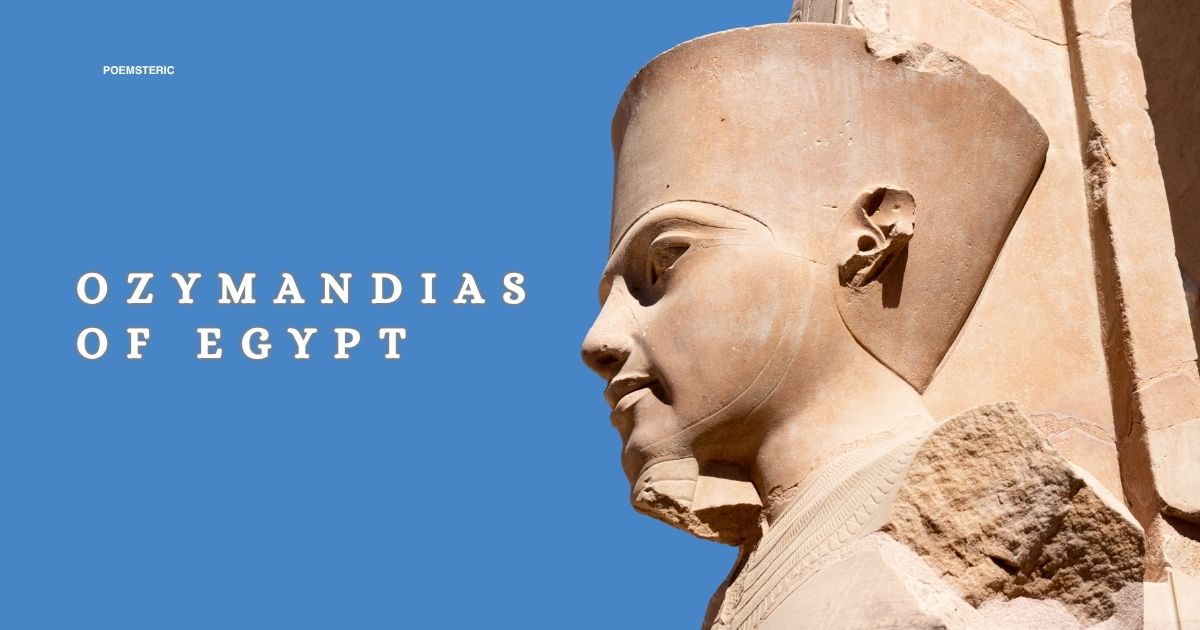
The primary speaker in Percy Bysshe Shelley’s “Ozymandias” (often studied as Ozymandias of Egypt) is an anonymous first-person narrator who meets a traveller from an antique land. That narrator reports the traveller’s description of a ruined statue in the desert. A third voice appears through the inscription attributed to Ozymandias himself. This layered structure creates distance and heightens the poem’s irony about power and time.
Key Takeaways from the Speakers in Ozymandias
Understanding the speakers unlocks the poem’s central message. The anonymous narrator frames the entire sonnet with just a few words: “I met a traveller from an antique land, Who said…” Everything after that quotation mark belongs to the traveller until the inscription appears.
The traveller provides the vivid description of the two vast and trunkless legs of stone, the shattered visage with its frown, wrinkled lip and sneer of cold command, and the surrounding lone and level sands. This second voice carries almost the whole poem.
Ozymandias speaks only through the carved words on the pedestal: “My name is Ozymandias, King of Kings; Look at my Works, ye Mighty, and despair!” Those lines form the third voice.
Together the three voices create deliberate distance. Readers never see the statue directly. They hear about it second-hand, then third-hand through the inscription. This structure reinforces the theme that even the greatest power fades. In my own reading of the poem with secondary-school students, this layered approach consistently helps learners grasp why the king’s boast feels so hollow.
The poem was first published on 11 January 1818 in The Examiner under the pen name Glirastes. Shelley wrote it in late 1817 as part of a friendly competition with Horace Smith. Both poets drew on a description by the ancient Greek historian Diodorus Siculus of a massive statue of Ramesses II.
These facts matter because they show Shelley deliberately chose an indirect narrative method rather than a simple first-person description of the ruins. The result is a compact fourteen-line sonnet that still rewards close attention more than two centuries later.
Readers who master the speakers also master the irony. The king wanted eternal glory. The speakers deliver only fragments and emptiness. That contrast remains the poem’s lasting power.
Multiple Voices in Ozymandias of Egypt Explained
The poem contains three distinct speakers, each serving a clear purpose.
The Narrator as Primary Speaker
The opening voice is the classic first-person narrator. This speaker appears only long enough to introduce the traveller and then largely disappears. We learn almost nothing about the narrator’s identity, location or feelings. The narrator simply reports the meeting and hands the story over.
This framing device is common in Romantic poetry yet unusually brief here. By limiting the narrator’s role, Shelley prevents any personal emotion or interpretation from colouring the account. The reader receives the story almost as pure reportage.
The Traveller’s Detailed Account
Once the quotation begins, the traveller takes over. This second speaker describes the physical remains with striking precision: two vast and trunkless legs of stone standing in the desert, a half-sunk shattered visage nearby, the frown and wrinkled lip, the sneer of cold command.
The traveller also comments on the sculptor’s skill. The passions stamped on the lifeless stone still survive. The hand that mocked them and the heart that fed them are both long gone, yet the expression remains. Finally the traveller notes the empty landscape: nothing beside remains; round the decay of that colossal wreck the lone and level sands stretch far away.
The traveller functions as an eyewitness whose reliability we must accept. We have no way to verify the scene. That uncertainty adds to the poem’s atmosphere of remote antiquity.
How the Inscription Adds a Third Voice
The third speaker is Ozymandias himself, present only through the words carved on the pedestal. The traveller quotes the inscription, creating a nested quotation.
Those two lines form the emotional and thematic centre of the sonnet. The king announces his name and rank, then commands other powerful figures to look on his works and despair. The command was meant to inspire awe. In the context of the ruined statue it produces the opposite effect.
The inscription is historically based. Diodorus Siculus recorded a similar boast on a statue of Ramesses II: “King of Kings Ozymandias am I. If anyone wants to know how great I am and where I lie, let him outdo me in my work.” Shelley adapted the wording for greater poetic force.
By giving the dead king a direct voice, Shelley lets hubris speak for itself. No narrator needs to explain the irony. The empty desert does that work.
Why Shelley Used Layered Speakers
Many readers ask why the poem does not simply describe the statue from a single viewpoint. The layered structure serves several artistic purposes.
First, it multiplies the distance between the modern reader and the ancient king. The story passes from Ozymandias to the sculptor, to the traveller, to the narrator, and finally to us. Each step weakens the king’s original claim to permanent power.
Second, the structure mirrors the theme of transmission and loss. Just as the statue has crumbled, so has direct knowledge of the king. We receive only fragments filtered through other voices.
Third, the method allows Shelley to keep the sonnet short while still packing historical and philosophical weight. A single descriptive voice would have required more space to achieve the same effect of remote grandeur reduced to dust.
The technique also aligns with Romantic interest in the picturesque and the sublime. A direct description might feel touristic. A reported encounter feels like a chance discovery, more mysterious and powerful.
Step-by-Step Guide to Identifying Speakers in the Poem
Students can follow a simple process every time they analyse the speakers.
- Read the first line carefully. Note the pronoun “I” and the introduction of the traveller. Mark this as the narrator’s voice.
- Locate the opening quotation marks or the phrase “Who said.” Everything that follows until the inscription belongs to the traveller.
- Identify the pedestal words. These form the third voice and are usually set off by further quotation marks or a clear introduction (“these words appear”).
- Count the lines each speaker occupies. The narrator has roughly one and a half lines. The traveller has most of the remaining lines. Ozymandias has two lines.
- Ask what each voice contributes to the theme. The narrator frames, the traveller describes, the king boasts.
- Note any shifts in tone. The traveller’s language is observational and somewhat awed. The inscription is arrogant. The final lines return to quiet emptiness.
Practising these steps turns a potentially confusing poem into a clear structure.
Historical Background of Ozymandias and Ramesses II
Ozymandias is the Greek form of the throne name of the Egyptian pharaoh Ramesses II, who ruled from approximately 1279 to 1213 BCE. He was one of Egypt’s most powerful and long-reigning rulers, famous for military campaigns and massive building projects.
The Ramesseum, his mortuary temple on the west bank of the Nile at Thebes, once held a colossal statue. By Shelley’s time the statue lay in ruins. In 1816 the British Museum acquired a large fragment of a similar statue of Ramesses II, generating public interest in London.
Shelley and Horace Smith both responded to this cultural moment by writing sonnets on the same subject. Shelley’s version appeared first and has remained better known. The historical facts confirm that the poem is not pure invention. It grows from real archaeological remains and an ancient literary source.
Understanding this background helps readers see why the speaker structure matters. Shelley could have written a straightforward tourist’s account of the British Museum fragment. Instead he chose an imagined encounter with a traveller from the antique land itself, preserving a sense of mystery and temporal distance.
Literary Techniques That Shape the Speakers
Several devices support the multi-voiced design.
The sonnet form itself is irregular. It blends features of Petrarchan and Shakespearean sonnets, refusing a neat octave-sestet or quatrain-couplet division. This formal freedom matches the narrative freedom of nested speakers.
Alliteration and assonance appear in the traveller’s description: “boundless and bare,” “lone and level.” These sound patterns slow the reader and emphasise emptiness.
Irony operates at every level. The king’s words are undercut by the scene the traveller describes. The very survival of the inscription becomes ironic because the works it commands us to admire have vanished.
The poem also uses enjambment and caesura to control pace. The traveller’s long sentences flow across lines, creating a sense of continuous recollection, while the inscription stands out in shorter, more declarative phrases.
These techniques work together with the speakers. Without the layered voices the technical devices would lose much of their force.
Common Misconceptions About the Speaker
One frequent error is to treat the traveller as the only speaker. Some classroom summaries simply say “a traveller describes a statue.” That account erases both the framing narrator and the inscribed voice.
Another misconception is to identify the speaker with Shelley himself. While the poet invents the narrator, the poem never claims the “I” is autobiographical. Treating it as pure personal experience reduces the deliberate artifice.
A third mistake is to ignore the inscription as a separate voice. Students sometimes paraphrase the pedestal lines as part of the traveller’s opinion rather than as the king’s own words. Doing so softens the irony.
Correcting these misunderstandings restores the poem’s full complexity. The three speakers are not decorative. They are essential to the meaning.
Comparing Shelley’s Ozymandias with Horace Smith’s Version
Horace Smith’s competing sonnet also uses a framing device, but the effect is different. Smith’s poem begins with a more elaborate imaginative reconstruction of the statue’s original setting and ends with a vision of a future traveller finding the ruins of London.
Shelley’s version stays tightly focused on the single desert scene and the triple-voiced report. The result feels more compressed and more devastating. Smith’s poem is interesting as a historical companion piece, yet Shelley’s remains the more frequently studied because its speaker structure is both simpler and more radical.
The comparison shows that the choice of speakers is never neutral. Different narrative frames produce different thematic emphases.
Practical Classroom Tips for Analysing the Speakers
Teachers and students can use several practical approaches.
- Read aloud with three voices. Assign one student the narrator’s lines, another the traveller’s long speech, and a third the inscription. The change in tone becomes immediately audible.
- Build a three-column table headed Narrator, Traveller, and Ozymandias. List the exact words each speaks and the number of lines. Visual organisation clarifies the proportions.
- Rewrite as a single voice. Ask students to rewrite the poem as a single first-person description by the traveller alone, then compare the two versions. Most students notice that the original gains force from the extra layers of distance.
- Connect to the theme in writing. Pose the question: “How does the use of three speakers strengthen the idea that power does not last?” This forces synthesis rather than mere identification.
These activities turn abstract literary analysis into concrete practice.
FAQs
Q: Who is the main speaker in Ozymandias?
A: The main speaker is the anonymous first-person narrator who opens the poem with “I met a traveller from an antique land.” This narrator frames the story but speaks only briefly. Most of the poem consists of the traveller’s reported words. Understanding this distinction is essential when answering who is the speaker in the poem ozymandias of egypt for exam purposes.
Q: How many speakers are there in the poem Ozymandias?
A: There are three speakers. The narrator introduces the scene, the traveller describes the statue and the desert, and Ozymandias speaks through the inscription on the pedestal. Each voice adds a layer of distance that strengthens the theme of faded power.
Q: What does the traveller say about the statue?
A: The traveller describes two vast and trunkless legs of stone standing in the desert, a half-sunk shattered visage with a frown, wrinkled lip and sneer of cold command, and the surrounding empty sands. He also notes the sculptor’s skill in capturing the king’s passions. This detailed account forms the bulk of the poem.
Q: Who is Ozymandias in the poem?
A: Ozymandias is the Greek name for the Egyptian pharaoh Ramesses II. In the poem he appears only through the boastful inscription on the ruined statue. The contrast between his words and the desolate scene creates the central irony. Knowing this background helps clarify who is the speaker in the poem ozymandias of egypt.
Q: Why does the poem use more than one speaker?
A: The multiple speakers create successive layers of distance between the reader and the ancient king. This structure emphasises how power and memory both erode over time. It also allows the king’s own arrogant words to condemn him without authorial commentary. The technique remains one of the most effective features of the sonnet.
Q: Is the speaker the same as the poet Shelley?
A: No. While Shelley wrote the poem, the first-person narrator is a literary device, not a direct self-portrait. Treating the speaker as Shelley himself misses the deliberate artifice of the nested voices. Accurate identification of who is the speaker in the poem ozymandias of egypt requires separating the historical poet from the fictional narrator.
Final Thoughts
The question of who is the speaker in the poem Ozymandias of Egypt has a clear yet layered answer. An anonymous narrator introduces a traveller, the traveller describes the ruined statue, and the inscription lets the long-dead king speak for himself.
This structure is not an accident of composition. It is the method by which Shelley turns a historical anecdote into a lasting meditation on time, pride and art. Once readers recognise the three voices, the poem’s irony becomes sharper and its emotional impact deeper.
The same recognition also equips students for other multi-voiced poems. The skills practised here transfer directly. In the end, the speakers of “Ozymandias” do more than tell a story. They enact the very process of memory and forgetting that the poem describes.
Recent Article : How to Write a Poem for School: Easy Winning Tips

Jennifer Aston is a passionate poetry curator and writer with a deep love for the written word. She believes poetry has the power to heal, inspire, and connect people across all walks of life. Through PoemSteric, she brings together timeless and modern verses for every emotion and every moment.