
Introduction
MLA referencing for poetry follows the same core system as MLA prose citation, but with one key difference: poems are cited by line number, not page number, whenever lines are numbered in the source. In your Works Cited entry, you list the poet, poem title in quotation marks, the collection or anthology it appears in (italicized), and publication details. In your in-text citation, you use the poet’s last name and the relevant line numbers, like this: (Frost, lines 3-5). Get these two pieces right, and you have mastered most of what MLA poetry citation requires.
That single sentence answers the question most readers type into Google. However, poetry citation has enough exceptions and edge cases translated poems, poems with no numbered lines, poems pulled from a website instead of a printed book that it deserves a full walkthrough. In my own experience reviewing student papers, the errors are rarely about creativity. They’re about small formatting details that are easy to miss under deadline pressure.
This guide covers every situation you’re likely to encounter, from a single sonnet in a classroom anthology to a multi-poem citation project for a thesis. As a result, you should be able to find your exact scenario below and copy the correct format directly into your paper.
Key Takeaways
MLA poetry citation uses line numbers in-text, not page numbers, whenever a poem's lines are numbered or can be counted.

The Works Cited entry always includes the poet's name, the poem title in quotation marks, the source title in italics, and full publication information.

Quotations of one to three lines stay in your paragraph with a forward slash (/) marking each line break.

Quotations of four or more lines must be formatted as a block quote, indented and without quotation marks.

If a poem has no line numbers, you cite by page number instead, following standard MLA prose rules.

Translated poems require you to credit both the original poet and the translator in your Works Cited entry.

A poetry citation generator can save time, but it should never replace a manual check against the current MLA handbook.
What Is MLA Style and Why It Matters for Poetry
MLA style is the citation system published by the Modern Language Association, and it is the standard format used across most literature, humanities, and English composition courses in North America. For poetry specifically, MLA referencing matters because poems are structured differently than prose paragraphs. A novel is cited by page; a poem, when its lines are numbered, is cited by line, because line breaks carry meaning that page breaks do not.
Readers often tell us that citation rules feel arbitrary until they understand the reasoning behind them. In poetry, the line itself is a unit of meaning chosen deliberately by the poet. Citing a page number for a two-page poem would tell a reader almost nothing about where a specific phrase appears; citing “lines 12-14” tells them exactly where to look, even across different printings of the same poem.
MLA referencing poetry also protects academic integrity. When you attribute a quoted line correctly, you show your instructor or reader that the words and ideas belong to the original poet, not to you. This is especially important in literature courses, where close reading of specific lines is often the entire basis of an argument. A precise citation lets your reader verify your interpretation against the original text.
Finally, consistent formatting builds trust with your audience. A paper full of inconsistent citations, some with page numbers, some with none at all, some missing quotation marks around titles signals carelessness, even if the analysis itself is strong. Getting the mechanics right frees your reader to focus on your ideas instead of your formatting.
MLA Poetry Citation Basics You Need to Know
Before diving into specific scenarios, it helps to understand the two building blocks of any MLA poetry citation: the in-text citation and the Works Cited entry. These two pieces always work together. The in-text citation is a short pointer that appears right after your quotation; the Works Cited entry is the full bibliographic record at the end of your paper.
In-Text Citations for Poems
An in-text citation for a poem typically includes the poet’s last name and the line number(s), separated by a comma: (Angelou, line 7) for a single line, or (Angelou, lines 7-9) for a range. If you’ve already named the poet in your sentence for example, “Angelou writes…” you can drop the name from the parentheses and cite only the line numbers.
On the first citation from a poem, spell out the word “line” or “lines” in full. For every citation after that, you can shorten it, since MLA style assumes your reader now understands the pattern. This keeps your paper from feeling cluttered with repeated words.
Works Cited Entries for Poems
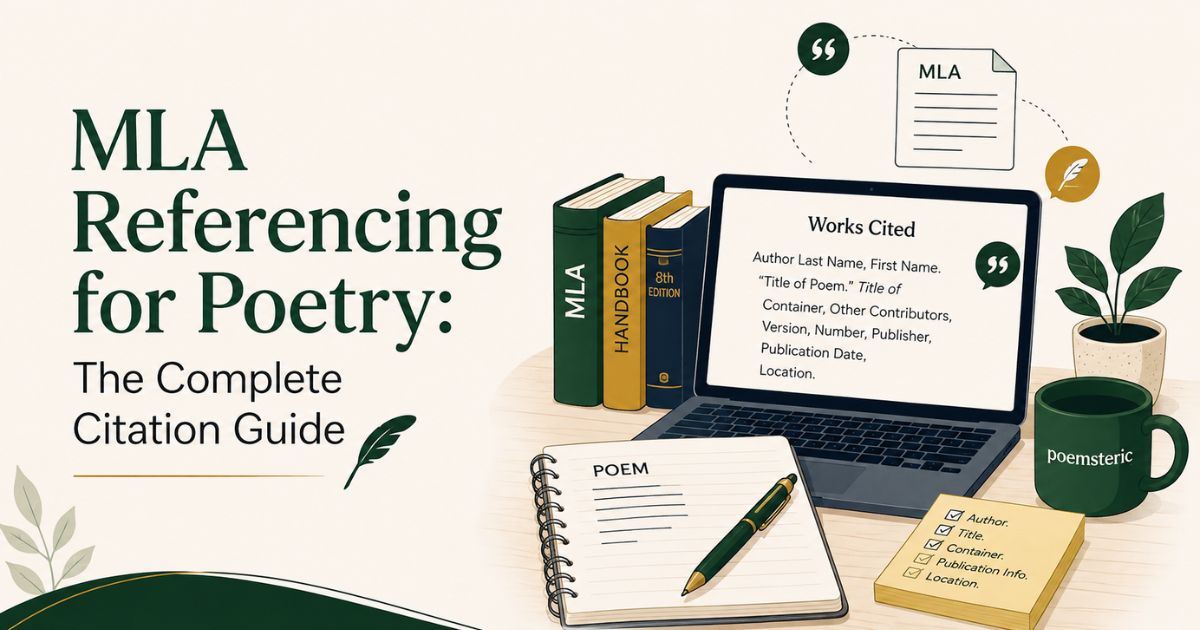
A Works Cited entry for a poem generally follows this order: Poet’s Last Name, First Name. “Title of Poem.” Title of Book or Anthology, edited by Editor’s Name, Publisher, Year, page numbers. For example: Frost, Robert. “The Road Not Taken.” The Poetry of Robert Frost, edited by Edward Connery Lathem, Henry Holt, 1969, p. 105.
Notice that the poem title takes quotation marks, while the larger source the book, anthology, or website takes italics. This distinction matters because it tells your reader at a glance which is the smaller piece of work and which is the larger container it lives inside.
How to Cite a Poem in an Anthology
Anthologies are one of the most common sources for poetry citations, especially in introductory literature classes. Here is the step-by-step process for citing a poem found inside a multi-author collection.
- Start with the poet, not the editor. List the poet’s last name first, followed by their first name, even though the anthology’s editor is credited elsewhere in the entry.
- Add the poem title in quotation marks. Copy the exact capitalization used in the source.
- Italicize the anthology title. This is the “container” that holds the individual poem.
- Credit the editor. Use the phrase “edited by” followed by the editor’s full name.
- List the publisher and year. Use the shortest recognizable form of the publisher’s name.
- Include the page range. Anthology poems almost always use page numbers in the Works Cited entry, even though your in-text citations use line numbers.
For example: Dickinson, Emily. “Because I Could Not Stop for Death.” The Norton Anthology of American Literature, edited by Robert S. Levine, 9th ed., W. W. Norton, 2017, pp. 88-89. As a result, anyone with access to that specific edition can locate your exact quotation within seconds.
How to Cite a Single-Author Poetry Collection
When a poem comes from a collection written entirely by one poet rather than a mixed anthology the format shifts slightly because there is no separate editor to credit in most cases. List the poet’s name, the poem title in quotation marks, the collection title in italics, the publisher, and the year.
For example: Plath, Sylvia. “Lady Lazarus.” Ariel, Harper & Row, 1965, pp. 6-9. If the collection was edited or introduced by someone else, such as a posthumous edition assembled by a literary executor, add “edited by” and that person’s name after the collection title, just as you would for an anthology.
Single-author collections are especially common in upper-level literature courses, where students analyze a poet’s full body of work rather than a single famous piece. In these cases, keeping consistent formatting across every poem you cite from the same book makes your Works Cited page easier to read and easier to fact-check.
How to Cite a Poem Found Online or in a Digital Database
Poems sourced from websites or databases follow the same basic structure, with a few additions. After the container title (the website or database name, italicized), include the publisher or sponsoring organization if it differs from the website name, the date of publication, the URL, and the date you accessed the page if the source is likely to change over time.
For example: Hughes, Langston. “Harlem.” Poetry Foundation, Poetry Foundation, 1951, www.poetryfoundation.org/poems/46548/harlem. Note that the URL should be copied without “https://” at the start, per current MLA guidance, and the entry ends with a period after the closing element.
Digital sources rarely include numbered lines the way print anthologies do. In that case, cite by paragraph number if the site provides one, or simply reference the poet’s name alone in your in-text citation. This is one of the areas where MLA referencing poetry requires the most judgment, since online poetry archives are formatted inconsistently across different publishers.
How to Quote Poetry Correctly in MLA Format
Quoting poetry accurately is just as important as citing it correctly, because a misquoted line undermines your credibility even if the citation itself is flawless. MLA style splits poetry quotations into two categories based on length, and each has its own formatting rules.
Quoting One to Three Lines of Poetry
When you quote one, two, or three lines of a poem, keep the quotation inside your regular paragraph and use a forward slash with a space on each side ( / ) to show where each line break occurs in the original. For example: Frost writes that he “took the one less traveled by, / And that has made all the difference” (lines 19-20).
This method preserves the poem’s structure without breaking your paragraph’s flow. However, you must copy capitalization and punctuation exactly as it appears in the source, since poets often use unconventional formatting on purpose.
Quoting Four or More Lines (Block Quotes)
Once your quotation reaches four or more lines, MLA style requires a block quote. Start the quotation on a new line, indent the entire passage half an inch from the left margin, and remove the quotation marks entirely. Line breaks are preserved exactly as they appear in the original poem, rather than using slashes.
The parenthetical citation goes after the final punctuation mark of the block quote, not inside it. This is a small detail that many students get backward, so it’s worth double-checking every time you use a longer quotation.
MLA In-Text Citation for Poetry: Line Numbers vs. Page Numbers
One of the most common points of confusion in MLA referencing poetry is choosing between line numbers and page numbers. The rule is straightforward: use line numbers whenever the poem’s lines are numbered in the source, or when you can reliably count them yourself from a clearly formatted text.
Use page numbers instead when the poem spans several pages without numbered lines, when you are citing prose poetry, or when the source itself only provides page references. Some anthologies number lines every five or ten lines in the margin; if your source does this, follow that same numbering system exactly, rather than recounting from scratch.
For long narrative poems such as epics, some instructors prefer canto and line numbers together, formatted as (Dante 3.14-16) to indicate Canto 3, lines 14 through 16. Always check your instructor’s specific preference for long-form poems, since MLA allows some flexibility here as long as your format stays consistent throughout the paper.
Common Mistakes Students Make When Citing Poetry in MLA
Even careful writers slip up on poetry citations because the rules differ from standard prose formatting. Here are the mistakes that show up most often in student papers, based on patterns we see repeatedly in academic writing support.
- Using page numbers for numbered poems. If the source numbers the lines, MLA expects you to cite by line, not page.
- Forgetting the forward slash in short quotations. Line breaks must be marked with a slash when a quotation stays inside your paragraph.
- Adding quotation marks to block quotes. Once a quotation becomes a block quote, the quotation marks are removed entirely.
- Mixing up italics and quotation marks. The poem title takes quotation marks; the book or anthology title takes italics.
- Citing the anthology editor instead of the poet. The poet’s name always leads the Works Cited entry, not the editor’s.
- Skipping the translator’s name on translated works. Translated poems need both the original poet and the translator credited.
Correcting these six issues resolves the vast majority of poetry citation errors we encounter in student and early-career academic writing.
MLA Poetry Citation Examples for Popular Poets
Seeing real examples often clarifies the format faster than reading rules alone. Below are correctly formatted MLA citations for several widely studied poets, covering different source types.
- Anthology: Poe, Edgar Allan. “The Raven.” The Norton Anthology of Poetry, edited by Margaret Ferguson et al., 6th ed., W. W. Norton, 2018, pp. 712-15.
- Single-author collection: Whitman, Walt. “Song of Myself.” Leaves of Grass, Modern Library, 1993, pp. 25-77.
- Website: Angelou, Maya. “Still I Rise.” Poetry Foundation, 1978, www.poetryfoundation.org/poems/46446/still-i-rise.
- Translated poem: Neruda, Pablo. “Tonight I Can Write.” Translated by W. S. Merwin, Twenty Love Poems and a Song of Despair, Penguin Classics, 2004, pp. 30-31.
For example, if you were quoting three lines from “Still I Rise,” your in-text citation would read (Angelou, lines 1-3), since the Poetry Foundation version numbers its lines clearly. Matching your in-text citation format to your Works Cited entry is what ties the whole system together.
How to Cite a Translated Poem in MLA Format
Translated poems require an extra layer of credit, since two people contributed to the version you’re reading: the original poet and the translator. MLA style asks you to include both names, with the translator introduced by the phrase “Translated by.”
For example: Rilke, Rainer Maria. “The Panther.” Translated by Stephen Mitchell, The Selected Poetry of Rainer Maria Rilke, Vintage International, 1989, pp. 24-25. In your in-text citation, you still use the original poet’s last name, not the translator’s, unless your analysis specifically focuses on translation choices.
If your paper discusses the translation itself as a creative act, some instructors prefer citing the translator’s name in-text as well. As a result, it’s worth clarifying this preference with your instructor before submitting a paper that leans heavily on translated source material.
How to Cite a Poem With No Line Numbers
Not every poem you encounter will have numbered lines, particularly older printed editions, scanned PDFs, or poems reproduced casually on non-academic websites. When line numbers are unavailable, MLA style allows you to fall back on page numbers, following the same format used for prose.
If the source has neither line numbers nor page numbers a single-page poem on a plain webpage, for instance you can cite the poet’s last name alone in your in-text citation, without any number at all. For example: (Oliver). This is a valid MLA format when no more specific location marker exists in the source.
However, if you’re quoting from a source with unnumbered lines but the poem is short enough that a reader could easily locate the passage, some instructors still prefer that you count and cite line numbers manually. When in doubt, ask your instructor which approach they expect, since this is one of the few areas where MLA style intentionally leaves room for discretion.
MLA Poetry Citation for Multiple Poems by the Same Author
When you cite two or more poems by the same poet in one paper, MLA style requires you to distinguish between them in your in-text citations, since a bare last name would no longer tell your reader which poem you mean. Add a shortened version of the poem title after the author’s name, separated by a comma.
For example: (Frost, “Mending Wall,” lines 1-3) and (Frost, “Birches,” lines 10-12) would appear as two separate citations within the same paper, each pointing to a different Works Cited entry. Both poems still need their own full entry in your Works Cited list, arranged alphabetically by title under the poet’s name.
This distinction matters most in essays comparing multiple works by the same writer, a common assignment format in poetry-focused literature courses. Keeping the shortened titles consistent throughout your paper is always “Mending Wall,” never switching to “Wall” or a different shorthand prevents confusion for your reader.
MLA Referencing for Poetry in Essays and Research Papers
Beyond the mechanics of individual citations, MLA referencing poetry also shapes how you build an argument in a full essay or research paper. Every time you introduce a new poem, briefly signal the shift with a sentence like “In ‘Ode to a Nightingale,’ Keats explores…” so your reader isn’t relying solely on the citation to track which poem you’re discussing.
Integrate quotations smoothly into your own sentences rather than dropping them in as standalone blocks of text. For example, instead of writing a quotation followed by an unconnected explanation, weave the quoted lines directly into a sentence that explains their significance to your argument.
Research papers that cite many poems benefit from a consistent shorthand system established early and used throughout. As a result, readers can follow a complex argument across a dozen citations without losing track of which poem, edition, or translation is being discussed at any given point.
How to Format Your Works Cited Page for Poetry Sources
Your Works Cited page follows the same universal MLA formatting rules regardless of source type: a centered title reading “Works Cited,” alphabetical order by the author’s last name, a hanging indent on every entry after the first line, and double spacing throughout with no extra space between entries.
For poetry sources specifically, alphabetize by the poet’s last name, not the anthology editor’s name, even when the editor’s name appears prominently on the book cover. If you cite multiple poems by the same poet, list them alphabetically by poem title underneath a single instance of the poet’s name, using three hyphens in place of the repeated name for every entry after the first.
Double-check that every in-text citation in your paper has a matching entry on the Works Cited page, and that every Works Cited entry is actually cited somewhere in your text. This two-way check catches most formatting errors before submission.
Quick Reference Table: MLA Poetry Citation Formats
| Source Type | In-Text Citation | Works Cited Format |
| Anthology poem | (Poet, lines X-Y) | Poet. “Poem.” Anthology, edited by Editor, Publisher, Year, pp. X-Y. |
| Single-author collection | (Poet, lines X-Y) | Poet. “Poem.” Collection, Publisher, Year, pp. X-Y. |
| Website | (Poet, lines X-Y) or (Poet) | Poet. “Poem.” Website Name, Date, URL. |
| Translated poem | (Poet, lines X-Y) | Poet. “Poem.” Translated by Translator, Collection, Publisher, Year, pp. X-Y. |
| No line numbers | (Poet) or (Poet, page X) | Same structure, cited by page instead of line. |
This table condenses the entire guide into a scannable comparison you can reference while drafting, without flipping back through every section above.
MLA Poetry Citation Tools and Generators: Do They Work?
Citation generators can speed up the process of formatting a Works Cited entry, and many are accurate for straightforward sources like a single poem from a well-known anthology. However, most generators struggle with poetry-specific details, such as distinguishing between the poem title and the container title, or correctly formatting translated works.
In my own reading of student papers that relied entirely on automated tools, the most common errors involved missing italics on collection titles and incorrect handling of edited anthologies. A generator will rarely catch that a poem needs line numbers instead of page numbers in-text, since that distinction depends on the actual formatting of your specific source.
The safest approach is to use a generator as a starting draft, then manually check the result against the current MLA Handbook or a guide like this one. This hybrid approach saves time without sacrificing accuracy, which matters most when your grade or publication depends on getting the details right.
Poetry Citation Checklist Before You Submit
Before turning in any paper that quotes poetry, run through this quick checklist to catch the most common errors described earlier in this guide.
- Does every in-text citation use line numbers, unless the source has none available?
- Is every quotation of four or more lines formatted as an indented block quote without quotation marks?
- Do all quotations shorter than four lines use a forward slash to mark line breaks?
- Is the poem title in quotation marks and the source title in italics throughout?
- Does every Works Cited entry begin with the poet’s name, not the editor’s or translator’s?
- Are translated poems credited to both the original poet and the translator?
- Does every in-text citation have a matching entry on the Works Cited page?
Working through this list takes only a few minutes but catches the majority of formatting mistakes before a reader or a grader ever sees them.
FAQs
Q: How do you cite a poem in MLA in-text?
A: You cite a poem in-text using the poet’s last name followed by the relevant line numbers, formatted as (Poet, lines X-Y). If the poem has no numbered lines, use page numbers instead, or the poet’s name alone if no page or line markers exist. Spell out “line” or “lines” on your first citation, then shorten it for later ones. This is the core mechanic behind all MLA referencing for poetry, regardless of source type.
Q: What is the correct MLA format for a poem title?
A: A poem title is placed in quotation marks, while the larger work it appears in a collection, anthology, or website is italicized. For example, “The Road Not Taken” appears in quotation marks, while Mountain Interval, the collection it was published in, is italicized. This distinction between quotation marks and italics is one of the most frequently missed details in MLA poetry citation.
Q: How do you quote more than four lines of a poem in MLA?
A: Quotations of four or more lines require a block quote: indent the entire passage half an inch, remove quotation marks, and preserve the poem’s original line breaks exactly. Place your parenthetical citation after the final punctuation mark, outside the block quote itself. This format keeps longer quotations visually distinct from your own analysis.
Q: Do you cite poems by line number or page number in MLA?
A: You cite poems by line number whenever the source numbers or clearly allows counting of the lines, since MLA referencing for poetry treats the line as the poem’s basic structural unit. Use page numbers only when line numbers are unavailable, such as with unnumbered prose poems or informal web reproductions. Always match your citation style to what the specific source actually provides.
Q: How do you cite a translated poem in MLA style?
A: Credit both the original poet and the translator, using the phrase “Translated by” before the translator’s name in your Works Cited entry. List the poet first, followed by the poem title, translator credit, collection title, publisher, and year. Your in-text citation still uses the original poet’s last name unless your essay specifically analyzes the translation.
Q: Can you use a citation generator for MLA poetry references?
A: Citation generators can help with simple, well-known sources, but they frequently mishandle poetry-specific rules like line-number citations and translated-work credits. Use a generator as a starting point, then manually verify the result against the current MLA Handbook or a detailed guide. This combined approach is faster than manual citation while still catching poetry-specific errors that automated tools tend to miss.
Final Thoughts
MLA referencing for poetry is not fundamentally different from citing prose, but its small deviations line numbers instead of page numbers, slashes for short quotations, block quotes for longer ones require deliberate attention. Once you internalize the poet-first, title-in-quotes, container-in-italics structure, most citations become close to automatic.
The examples, checklist, and quick reference table in this guide are designed to be reused across every poetry assignment you encounter, from a single quoted couplet to a full research paper built around one poet’s body of work. Keep this page bookmarked, and you’ll rarely need to search for a poetry citation format twice.
Recent Article : 50 Best Phrases About Poetry From Famous Poets & Writers

Jennifer Aston is a passionate poetry curator and writer with a deep love for the written word. She believes poetry has the power to heal, inspire, and connect people across all walks of life. Through PoemSteric, she brings together timeless and modern verses for every emotion and every moment.