
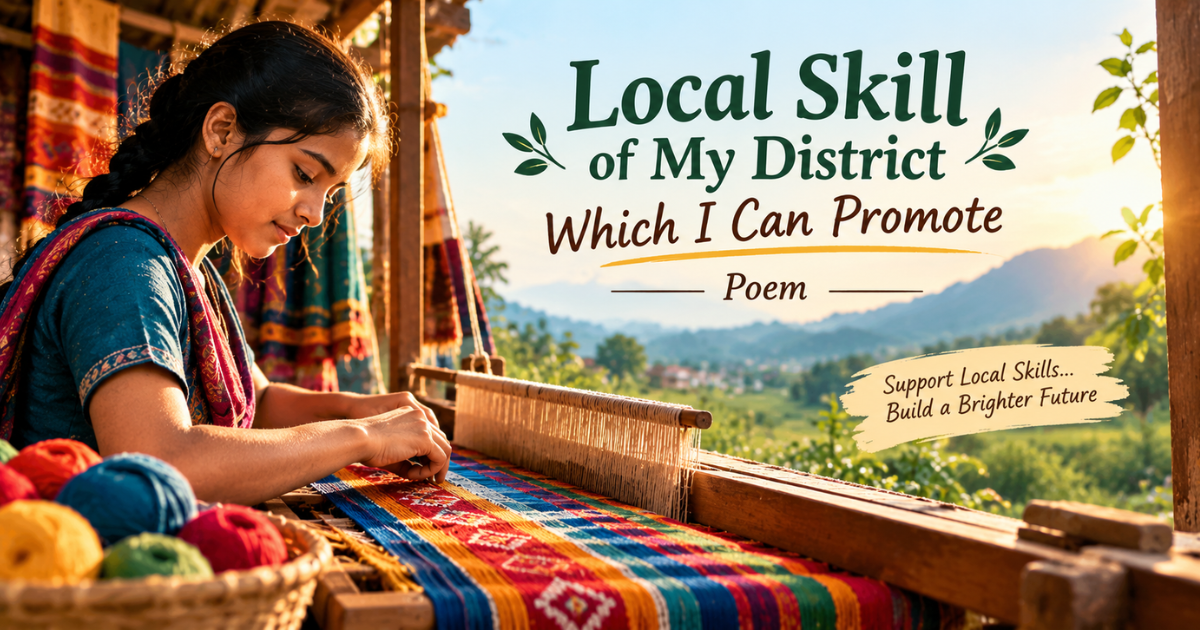
Introduction
The “local skill of my district which I can promote” poem topic comes from CBSE’s Expression Series, a school writing and art competition. It isn’t an existing published poem you can look up and analyze. Students choose this topic to write an original poem (or essay, or painting) about a traditional skill or craft from their own district that deserves wider recognition.
This guide explains where the topic comes from, how to pick a strong local skill to write about, and includes one complete original example poem you can use as a model. Readers often ask for a ready-made poem to copy directly that defeats the purpose of the assignment, so instead, this guide shows you how to build your own genuinely original entry.
Key Takeaways
- This topic isn’t a famous poem, it’s a CBSE Expression Series writing prompt for Classes 6 to 8, under the theme “Skill Development in India: From Local to Global.”
- Students could choose between this topic and an alternative one, “Kabaad se Jugaad,” and could submit a poem, a 400-word essay, or a painting.
- There’s no single correct poem; this guide provides one original, adaptable example rather than a “definitive” version.
- Strong local-skill choices include weaving, pottery, embroidery, regional cuisine, folk music or dance, and traditional farming techniques.
- Always swap in your own district’s real details that’s what makes an entry original rather than generic.
What Is the Local Skill of My District Which I Can Promote Poem Assignment?
This exact phrase comes from CBSE’s Expression Series for the 2023–24 school session. Under the overall theme “Skill Development in India: From Local to Global,” Classes 6 to 8 could choose between two topics for their essay, painting, or poem entry: “According to me, the best example of Kabaad se Jugaad is…” or “Local skill of my district which I can promote.” The essay option carried a 400-word limit; the poem and painting options weren’t tied to a strict word count in the same way.
If you’ve found this page while working on a current-year assignment, it’s worth double-checking your own school’s latest circular, since CBSE changes its Expression Series theme and topics from one session to the next. What doesn’t change is the underlying task: identify a real skill or craft from your district, explain why it matters, and make the case for promoting it in verse, for the poem option.
How to Choose and Write Your Poem, Step by Step
Picking the right skill to write about makes the rest of the poem far easier, so it’s worth spending real time on this step before you start writing lines.
- List every local skill you already know or ask family members, teachers, or neighbors if you’re not sure what your district is known for.
- Pick the one you can describe with real detail a skill you’ve actually seen practiced will always beat one you only know from a Google search.
- Note two or three concrete images: the sound of a loom, the smell of a particular dish, the colors used in local art.
- Decide on your poem’s structure: a simple rhyming pattern (AABB, as used in the example below) is easiest to control for a school assignment.
- Write a rough draft first, then revise it once for rhyme and once for meaning, rather than trying to perfect every line on the first pass.
Popular Local Skills You Can Choose From
If you’re not sure what to write about yet, these categories cover most districts in India and give you a reliable starting point:
- Handloom weaving or textile dyeing
- Pottery, terracotta, or clay work
- Embroidery or needlework traditions
- A regional dish, sweet, or food-preservation method
- Folk music, dance, or instrument-making
- Farming or irrigation techniques passed down locally
Quick Research Tips Before You Start Writing
Talk to someone who actually practices the skill if you can, even a short conversation gives you details no article will. If that’s not possible, a local library, a district tourism website, or a grandparent’s memory of the craft usually gives you enough specific, real detail to avoid a generic-sounding poem.
Original Poem: A Local Skill of My District Which I Can Promote
Here is one complete, original example poem written specifically for this guide. It uses weaving as its example craft and treats every specific detail as something to replace with your own district’s real skill.
A Local Skill of My District
In my district, hands still know the art our grandparents used to show Threads of cotton, dyed with care, woven patterns everywhere.
Behind each home a small loom hums, A quiet song of skillful thumbs, Colors dance in threads that hold Stories new and stories old.
The world moves fast on screens and speed, but here, a craft still serves a need. I want to learn it, keep it strong, and help it travel, help it belong.
So I will learn the weave, the art, and carry forward this steady heart. A skill first taught so close to home deserves the chance to rise and roam.
How to Adapt This Poem for Your Own District
Treat the poem above as a structural template, not a final answer; a teacher will notice a generic entry immediately. Replace “weaving” and “loom” with your district’s actual skill: swap in a specific dish name, an instrument, a farming method, or a craft technique, and use a real, local detail wherever the example uses a general one.
If your school offers the essay option instead of the poem, the same research and structure still apply: open by naming the skill and your district, explain how it’s traditionally practiced, argue why it deserves wider promotion, and close with a concrete idea for how that promotion could actually happen a school exhibition, a social media page, or a partnership with local artisans, for example.
FAQs
Q: What is the local skill of my district where I can promote poem topics?
A: It’s a CBSE Expression Series writing topic, not an existing published poem. Students in Classes 6 to 8 could choose it for their 2023–24 session entry, writing a poem, essay, or painting about a traditional skill or craft from their own district and making the case for promoting it. Because it’s a creative-writing prompt rather than a fixed text, there’s no single “correct” poem, only original entries that reflect a real, specific local skill.
Q: Which class is this topic meant for in CBSE’s Expression Series?
A: This particular topic chooses the local skill of my district which I can promote, alongside the alternative “Kabaad se Jugaad” option was offered to Classes 6 to 8 in the 2023–24 Expression Series cycle. Other class bands (3–5, 9–10, and 11–12) had their own separate topics under the same overall “Skill Development in India: From Local to Global” theme, so it’s worth confirming which topic applies to your specific class and session.
Q: How long should a poem for this topic be?
A: CBSE’s circular set a 400-word limit for the essay option in this category, but didn’t specify a strict word or line count for the poem option. A reasonable target is 12 to 20 lines, long enough to properly describe the skill and make a case for promoting it, but short enough to stay focused and avoid padding. The original example poem in this guide runs 16 lines as a useful reference length.
Q: What are some good local skill ideas to write about?
A: Strong choices tend to be skills you can describe with real, specific detail rather than a generic Google search summary: handloom weaving, pottery or terracotta work, embroidery, a regional dish or food-preservation method, folk music or dance, or traditional farming techniques. The best entries usually come from something the student has actually seen practiced, even briefly, rather than a skill picked purely because it sounds impressive.
Q: Can I write an essay instead of a poem for this topic?
A: Yes, CBSE’s Expression Series offered students a choice between a poem, a 400-word essay, or a painting on the same topic. The same research and planning steps in this guide apply either way: pick a specific local skill, gather concrete details, explain its value, and make a clear case for how it could be promoted further, whether that argument takes the form of verse or prose.
Final Thoughts
The local skill of my district where I can promote poem topics rewards specific, personal detail far more than polished-sounding generic lines. Since it’s a CBSE Expression Series writing prompt rather than a text with one fixed answer, the strongest entries are always the ones built around a real craft the student actually knows something about.
Use the step-by-step approach and the original example poem in this guide as a starting structure, not a script to copy. Swap in your own district’s real skill, a genuine local detail, and your own reason for wanting to see it promoted, and the result will read like an original student poem rather than a template which is exactly what this assignment is meant to produce.
Recent Article : Aunt Jennifer’s Tigers: The Tone Explained Clearly

Jennifer Aston is a passionate poetry curator and writer with a deep love for the written word. She believes poetry has the power to heal, inspire, and connect people across all walks of life. Through PoemSteric, she brings together timeless and modern verses for every emotion and every moment.