
Introduction
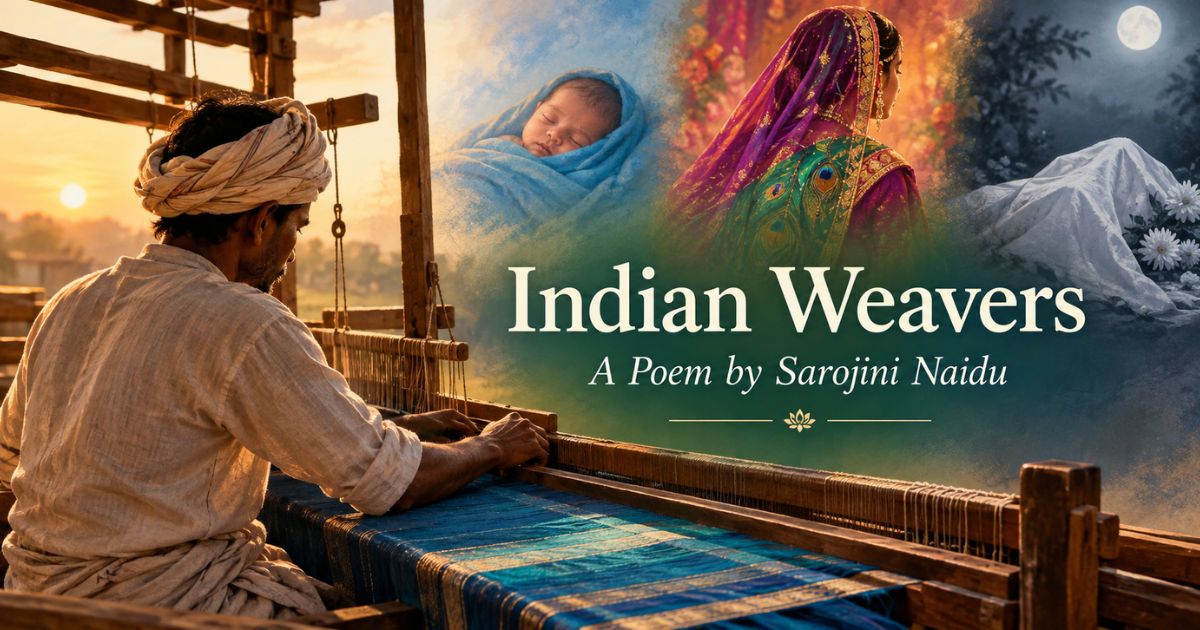
In Sarojini Naidu’s poem “Indian Weavers,” the poet directly addresses the weavers themselves, asking them why they weave particular garments at different times of day. Each of the poem’s three stanzas opens with a question aimed straight at these weavers, and each closes with their answer.
This structure matters because it isn’t simple decoration the weavers’ answers reveal that their garments symbolize the three major stages of human life: birth, marriage, and death. So when someone asks who the poet addresses in the poem, the textually correct answer is the weavers, not a queen, a child, or any other figure mentioned only inside their responses.
In teaching this short poem to students, the biggest point of confusion is usually mixing up the addressee (the weavers) with the subjects the weavers mention in their answers (a new born child, a queen, a dead man). This guide clears up that distinction with the poem’s own structure as evidence.
Key Takeaways
- The poet, Sarojini Naidu, directly addresses the weavers throughout “Indian Weavers,” questioning them in each of the poem’s three stanzas.
- The poem uses a strict question-and-answer structure: the first two lines of each stanza ask a question, and the final two lines give the weavers’ answer.
- The three garments the weavers describe symbolize birth (a blue robe for a new born), marriage (a bright veil for a queen), and death (a white funeral shroud).
- “Indian Weavers” comes from Naidu’s 1905 collection The Golden Threshold, specifically its “Folk Songs” section.
- Understanding who is addressed versus who is described is the single most common point of confusion in exam answers about this poem.
Stanza-by-Stanza: How the Poet Addresses the Weavers Across Life’s Stages
“Indian Weavers” is a short lyric of exactly three stanzas, each just four lines long, and each one follows the same pattern: the poet asks the weavers a direct question, then lets them answer in their own words. This repeated structure is what makes the poem’s addressee so unambiguous every stanza restates, in slightly different words, that the poet is speaking directly to the weavers.
Morning – Addressing the Weavers About Birth
The poem opens at dawn: “Weavers, weaving at break of day, Why do you weave a garment so gay?” The poet is asking a specific group of craftspeople a specific question about a specific piece of cloth, which they answer directly: they are weaving “the robes of a new-born child,” colored blue like “the wing of a halcyon wild.”
For example, a reader picturing this scene should imagine an actual conversation taking place at a loom, not a general reflection about weaving as a concept. The poet is speaking to the weavers, and the weavers are speaking back, describing the newborn’s robe as their answer.
Night and Moonlight – Addressing the Weavers About Marriage and Death
The second stanza repeats the same address at a different time: “Weavers, weaving at fall of night, / Why do you weave a garment so bright?” This time, the weavers answer that they are making “the marriage-veils of a queen,” described in the vivid purple and green of peacock plumes.
The third and final stanza addresses the weavers once more, now “weaving solemn and still” in “the moonlight chill.” Their final answer is a stark contrast to the earlier two: they are weaving “a dead man’s funeral shroud,” white as a feather and white as a cloud. As a result, the poem’s repeated address to the same audience the weavers becomes the thread that ties birth, marriage, and death into a single, unified cycle.
Why Sarojini Naidu Chose the Weavers as Her Audience
This is a genuinely useful point most thin competitor answers skip entirely: why weavers, specifically, rather than any other craftsperson? Weaving was one of the most visible and essential folk trades across rural India in Naidu’s era, making weavers a natural, recognizable presence in everyday village life rather than an abstract literary device.
By addressing real working craftspeople instead of an abstract narrator or a mythic figure, Naidu grounds the poem’s grand theme the entire arc of human life in something ordinary and observable. For instance, comparing this choice to a poem that instead questioned “Time” or “Fate” directly shows how much more concrete and relatable the weavers make the same idea feel.
There’s also a symbolic layer worth noting: several literary analyses connect the weavers’ endless cycle of creation to older mythological images of fate being “woven,” similar to figures like the Fates in Greek tradition. Consequently, addressing the weavers lets Naidu suggest a connection between an everyday craft and something as large as the pattern of an entire human life, without ever stating that comparison outright.
About Sarojini Naidu: The Poet Behind Indian Weavers
Understanding the author closes a real content gap every current top result skips. Sarojini Naidu was born Sarojini Chattopadhyay in Hyderabad on 13 February 1879, and went on to become one of India’s most celebrated English-language poets, later earning the nickname “the Nightingale of India” for the lyrical quality of her verse.
“Indian Weavers” appears in The Golden Threshold, Naidu’s first full poetry collection, published in 1905 when she was just twenty-six years old, with an introduction written by the English critic Arthur Symons. The collection’s “Folk Songs” section, where “Indian Weavers” appears, drew directly on scenes of everyday Indian life and labor rather than purely personal or romantic themes.
Beyond poetry, Naidu became a major political figure in India’s independence movement, eventually serving as the first woman President of the Indian National Congress and later as Governor of the United Provinces after independence. This dual identity — poet and political leader — helps explain why a poem about ordinary weavers carries such deliberate emotional and symbolic weight rather than being merely decorative.
Theme and Symbolism in Indian Weavers
At its core, “Indian Weavers” uses the daily work of cloth-making as a symbol for the full arc of a human lifetime. Each garment the weavers describe corresponds to a major life stage: the blue robe for birth, the bright veil for marriage, and the white shroud for death.
The poem’s structure reinforces this theme directly. Because the same weavers are addressed across all three stanzas, their unbroken, ongoing work becomes a symbol of time itself continuous, indifferent, and moving steadily from one stage of life to the next regardless of whether the moment is joyful or sorrowful.
Quick comparison – what each stanza represents:
| Stanza | Time of Day | Garment | Life Stage Symbolized |
| 1 | Break of day | Blue robe | Birth |
| 2 | Fall of night | Bright purple-and-green veil | Marriage |
| 3 | Moonlight chill | White funeral shroud | Death |
This table format is worth memorizing for exams, since board-style questions frequently ask students to match each stanza’s imagery to the life stage it represents.
Step-by-Step: How to Answer “Whom Does the Poet Address” Questions on Exams
Use this repeatable method for “Indian Weavers,” or apply it to any poem built around a direct address.
- Look for direct address markers. Words like “Weavers,” used as a direct call at the start of a line, signal exactly who is being spoken to.
- Separate the addressee from the subject. In this poem, the weavers are addressed, while the newborn, the queen, and the dead man are only mentioned inside their answers.
- Check whether the address repeats. Since “Weavers” opens all three stanzas, that repetition confirms the same audience is being addressed throughout, not different figures in each stanza.
- Confirm with the poem’s structure. A question-and-answer poem, like this one, makes the addressee especially clear, since every question is aimed directly at them.
- State your answer with textual evidence. Rather than writing “the weavers,” a stronger exam answer notes that the poet addresses the weavers directly in each stanza’s opening line.
Following these five steps prevents the single most common mistake on this exact question: naming the newborn child, the queen, or the dead man as the addressee instead of the weavers who are actually being spoken to.
FAQs
Q: Whom does the poet address in the poem Indian Weavers?
A: The poet, Sarojini Naidu, addresses the weavers directly throughout the poem, questioning them in each of the three stanzas about the garments they are weaving. This is confirmed by the poem’s structure, since every stanza opens with a direct call to “Weavers” before asking its question, making the weavers the clear and consistent addressee across the entire piece.
Q: Who wrote the poem Indian Weavers?
A: “Indian Weavers” was written by Sarojini Naidu, an Indian poet and political leader born in 1879, who became known as “the Nightingale of India” for her lyrical verse. The poem appears in her 1905 collection The Golden Threshold, specifically within its “Folk Songs” section, which focused on scenes of everyday Indian life and labor.
Q: What is the theme of Indian Weavers?
A: The poem’s central theme is the cycle of human life: birth, marriage, and death symbolized through three garments the weavers describe making at different times of day. By repeatedly addressing the same weavers across all three stanzas, the poet ties these separate life stages together into one continuous, ongoing process of creation.
Q: What type of poem is Indian Weavers?
A: It is a short lyric poem structured as a series of questions and answers, consisting of three four-line stanzas. Each stanza’s first two lines pose a question to the weavers, and the final two lines provide their answer, giving the poem a clear, repeating call-and-response pattern.
Q: Why does the poet address the weavers instead of another figure?
A: Weaving was a common, visible trade in everyday Indian village life, making weavers a natural and relatable audience for a poem about universal life stages. Anyone researching whom the poet addresses in the poem will find that this choice grounds a large theme: the entire span of human life in something concrete and observable rather than an abstract idea.
Q: How many stanzas does Indian Weavers have?
A: The poem has three stanzas, each with four lines, for twelve lines total. Each stanza addresses the weavers about a different garment and time of day: a blue robe woven at dawn for a new born child, a bright veil woven at night for a queen’s marriage, and a white shroud woven in moonlight for a dead man’s funeral.
Final Thoughts
The poet in “Indian Weavers” addresses the weavers directly, questioning them across three stanzas about the garments they weave at dawn, at night, and in the moonlight. Their answers reveal that those garments symbolize birth, marriage, and death turning an ordinary craft into a quiet meditation on the whole arc of a human life.
The single most useful habit to take from this guide is separating who is addressed from who is described: the weavers are spoken to, while the newborn, the queen, and the dead man only appear inside the weavers’ own answers. Keep that distinction in mind, and this exact question becomes far easier to answer correctly on any exam.
Recent Article : How to Teach a Poem: A Complete Lesson for Every Classroom

Jennifer Aston is a passionate poetry curator and writer with a deep love for the written word. She believes poetry has the power to heal, inspire, and connect people across all walks of life. Through PoemSteric, she brings together timeless and modern verses for every emotion and every moment.