

Life feels heavy sometimes. A few beautiful words can lift your spirit faster than you expect. Happy poems work like small doses of joy you can take anytime, anywhere. Whether you need quick energy in the morning, comfort during a hard day, or peace before sleep, the right poem changes everything. This guide brings you carefully chosen happy poems from classic masters and modern voices. You will find verses that make you smile, think, and feel grateful to be alive. Keep reading to discover poetry that truly boosts your mood.
What Are Happy Poems?
Happy poems are verses that spark joy, warmth, and positivity in your heart. They capture moments of delight, gratitude, and contentment through words that touch your deepest emotions. These poems celebrate life, simple pleasures, and beauty found in everyday moments. Unlike poetry that explores sadness or complexity, happy poems focus on goodness that exists in the world around you.
The tradition of happy poetry spans centuries and cultures. Ancient Chinese poets wrote about spring blossoms. Modern poets write about morning coffee and friendship. What makes a poem truly happy is its power to shift your emotions. When you read a happy poem, your shoulders relax, your breathing slows, and a gentle smile forms on your face. This magic happens because poetry connects directly to your feelings through language.
William Wordsworth understood this power completely. He wrote that poetry comes from “emotion recollected in tranquillity.” This means happy poems do not ignore life’s difficulties. Instead, they transform how you see challenges through memory and reflection. Real joy often exists alongside struggle. Happy poems make moments of light feel even more precious because you understand the darkness they overcome.
How Happy Poems Instantly Improve Your Mood
Reading happy poems creates real changes in your brain and body. When you read uplifting verses, your brain releases dopamine. This chemical brings pleasure and reward. You feel this change within moments of reading. This explains why you feel better after just a few lines of poetry. The rhythm and musical quality of poems also activate brain areas linked to relaxation. This creates a calming effect similar to meditation.
Research from the Journal of Palliative Medicine shows that poetry reduces pain and increases hope better than other art forms. Another study in the International Journal of Psychology found that poetry therapy greatly improves mental wellbeing and reduces trauma symptoms. These studies confirm what poetry lovers always knew. Words have healing power. When you read a happy poem, you do more than enjoy entertainment. You practice therapy that humans used for thousands of years.
The Cambridge University Poetry and Memory Project found that 63% of people who memorized poems used them for comfort during hard times. This shows happy poems work best when they become part of your daily tools. You can access them whenever you need emotional support. The poet Paul Celan wrote beautifully about this connection. He said, “I cannot see any basic difference between a handshake and a poem.” Both represent human contact, understanding, and warmth between people who may never meet.
Happy poems also improve your mood by changing your perspective. When negative thoughts trap you, a good poem breaks the cycle. It introduces new images and possibilities. Mary Oliver often wrote about how nature rescues us from despair. Her work proves that happy poems need grand subjects. They find greatness in ordinary moments. A grasshopper eating sugar, the sun rising over a field, or simply being alive becomes magnificent. This perspective shift happens immediately. Keeping happy poems nearby is one of the simplest self-care practices you can follow.
Short Happy Poems for Quick Happiness
Sometimes you need joy quickly. Life does not always give time for long reading. But it almost always gives time for a poem. Short happy poems fit these moments perfectly. The coffee break, the commute, the pause between meetings. They deliver strong emotions through compression. They pack deep meaning into just a few lines. The best short happy poems stay with you long after reading. They become mantras you repeat when you need a quick boost.
The power of short poetry cannot be overstated. When a poet distils happiness to its essence, the result often beats longer works. Look how much emotion William Carlos Williams creates in sixteen words: “so much depends upon a red wheel barrow glazed with rain water beside the white chickens.” This poem never mentions happiness directly. Yet it creates joy through attention and presence. It reminds you that beauty lives in simple objects when you truly see them.
Short happy poems work well for modern readers. They respect your limited time while delivering full emotional experiences. You can read one while waiting for tea to steep. You can read one while standing in line. You can read one while breathing deeply before a hard conversation. These small moments of poetic joy add up over time. They create a reserve of positivity you can use throughout your day. Keep these poems easy to reach. Save them on your phone. Write them on sticky notes. Memorize your favorites so they stay available when you need them most.
Very Short Happy Poems
The shortest happy poems work like emotional espresso shots. They are small, intense, and immediately effective. These verses often have just two to four lines. Yet they contain entire worlds of meaning. The Japanese haiku tradition mastered this art. It teaches that seventeen syllables can capture a season, a moment, or a feeling. Matsuo Basho, the famous haiku master, wrote: “An old silent pond / A frog jumps into the pond / Splash! Silence again.” In these few words, you experience surprise, humor, and peaceful return to stillness.
Very short happy poems excel at capturing sudden moments of awareness. They copy how joy actually arrives in your life. Joy does not come as a lasting state. It comes as brief flashes of recognition. When you read a two-line poem that perfectly captures sunlight on your face or a loved one’s laughter, you feel what psychologists call “positive resonance.” This is the immediate, physical recognition of something good. It can change your whole day’s direction.
The best very short poems use concrete images instead of abstract statements about happiness. Rather than telling you to “be happy,” they show you a specific image that naturally creates joy. This approach respects your intelligence and allows personal interpretation. A poem about “the first peach of summer” might remind one reader of childhood. It might remind another of a recent farmers market visit. Both feel the warmth and satisfaction in the image. This personal connection makes very short poems powerful mood boosters.
Short Happy Poems About Life
Life itself fills countless happy poems. These works celebrate the messy, beautiful reality of being human. Unlike poems that focus on specific moments of joy, life-affirming happy poems take a wider view. They acknowledge difficulties while keeping gratitude for existence itself. These poems help most during challenging times. They remind you that life, with all its complications, remains worth celebrating.
Walt Whitman, the great American poet of joy, showed this approach in his work. He wrote with excitement about the body, nature, democracy, and simply being alive. His poem “Song of Myself” contains the famous line: “I celebrate myself, and sing myself.” This is not selfishness. It recognizes that each individual life contains multitudes worth honoring. Whitman’s poetry invites you to join this celebration. It helps you see your ordinary life as an extraordinary event worthy of poetry.
Short happy poems about life often focus on daily habits and small victories. They find poetry in making breakfast, walking the dog, or watching children play. This focus on everyday life is deeply democratic. It suggests you do not need to climb mountains or win awards to deserve happiness. Your life, exactly as it is right now, holds enough material for endless poems. This realization liberates you. It shifts your attention from what you lack to what you already have.
Short Happy Poems About Joy & Gratitude
Joy and gratitude connect closely in poetry. Many effective happy poems combine these two emotions. Gratitude poetry focuses on appreciating what you have. Joy poetry captures the excitement of positive experiences. Combined, they create stable, lasting happiness that does not depend on outside circumstances. These poems teach you that joy often follows naturally when you practice gratitude. Both emotions grow through attention and intention.
Ross Gay, a contemporary poet known for his book Catalog of Unabashed Gratitude, mastered this combination. His work celebrates small pleasures with such intensity that they become profound. He writes about gardening, friendship, and food with contagious joy. His poetry reminds you that gratitude is not passive thankfulness. It is an active delight. When you read his poems, you want to pay closer attention to your own life. You want to notice what you might feel grateful for right now.
Short poems about joy and gratitude use sensory details to ground abstract emotions in physical experience. Rather than simply stating “I am grateful,” they describe specific textures, colors, sounds, or tastes that create gratitude. This technique makes emotion tangible and accessible. When a poet describes “the weight of a warm mug in cold hands” or “the particular green of new leaves in April,” they create an experience you can share. This shared sensory joy is one of poetry’s greatest gifts.
Famous Happy Poems by Classic Poets
English literature contains many poems that brought joy to readers for generations. These works survived because they speak to universal human experiences with honesty and beauty. Classic happy poems offer special comfort. They remind you that people hundreds of years ago felt the same emotions you feel today. They too sought solace and joy in poetry. Reading these poems connects you to a long tradition of humans using language to celebrate life.
Classic poets often found happiness in nature, love, friendship, and creating art. Their work shows that human joy sources remained consistent across centuries. While language and specific references differ, underlying emotions feel fresh and immediate. This is why a poem written in the 1800s can still make you smile today. The best classic happy poems transcend their time to speak directly to your heart.
I Wandered Lonely as a Cloud : William Wordsworth
William Wordsworth’s “I Wandered Lonely as a Cloud,” commonly known as “Daffodils,” stands as perhaps the most famous happy poem in English. Written in 1804, it describes the poet’s encounter with a field of daffodils that left lasting joy. The poem opens with famous lines: “I wandered lonely as a cloud That floats on high o’er vales and hills, When all at once I saw a crowd, A host of golden daffodils.” These lines immediately contrast the speaker’s initial loneliness with the joyful discovery waiting ahead.
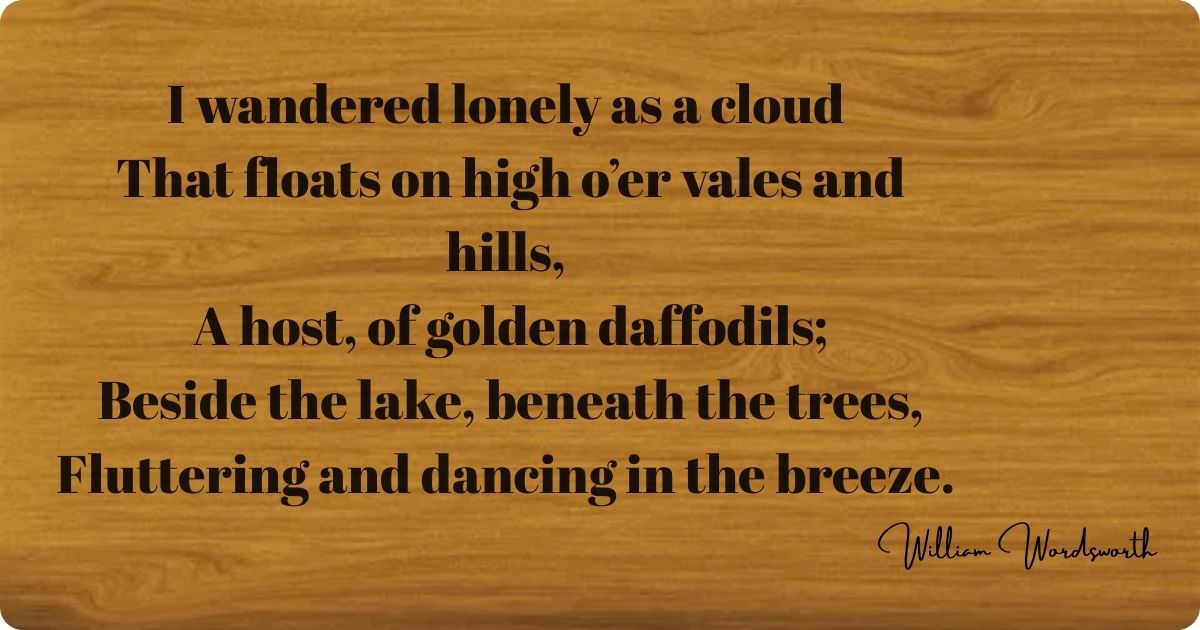
The poem’s power lies in describing how memory preserves and increases joy. Wordsworth explains that later, when lying “in vacant or in pensive mood,” the daffodil memory returns naturally: “They flash upon that inward eye which is the bliss of solitude; And then my heart with pleasure fills, And dances with the daffodils.” This final image of the heart dancing captures the physical nature of remembered happiness. Interestingly, Mary Hutchinson, Wordsworth’s wife, actually wrote the two lines about the “inward eye.” Wordsworth considered them the poem’s best lines.
What makes this poem enduringly happy is its message that you can store joy and access it later. The daffodils themselves were beautiful. But their true gift was the lasting happiness they provided through memory. This suggests you can build joy reserves by paying attention to beautiful moments as they happen. You can return to them mentally whenever you need comfort. Wordsworth’s poem teaches you to collect happiness, gathering moments that sustain you through difficult times.
Hope Is the Thing with Feathers : Emily Dickinson
Emily Dickinson’s “‘Hope’ is the thing with feathers” turns an abstract concept into a living, singing bird. The poem begins: “Hope is the thing with feathers that perches in the soul, And sings the tune without the words, And never stops at all.” In these few lines, Dickinson creates a metaphor that resonated with readers for over a century. The image of hope as a small, persistent bird suggests optimism is natural, resilient, and needs no outside validation to continue singing.
The poem continues emphasizing hope’s endurance through hard times: “And sweetest in the gale is heard; And sore must be the storm That could abash the little bird That kept so many warm.” Here, Dickinson suggests hope becomes most precious during difficult times. Just as a bird’s song stands out most clearly against storm noise, hope shines brightest in darkness. The final stanza reinforces this resilience: “I’ve heard it in the chilliest land, And on the strangest sea; Yet, never, in extremity, It asked a crumb of me.” Hope, according to Dickinson, gives freely without demanding payment or conditions.
This poem brings happiness by reassuring you that hope always stays available, regardless of circumstances. The bird imagery makes this abstract quality feel tangible and alive. You can imagine this small creature within yourself, continuing to sing even when you feel most alone. Dickinson’s characteristic dashes and unusual capitalization add energy. They create movement and vitality matching the subject. For anyone feeling hopeless, this poem offers a gentle reminder that hope capacity is built into your soul.
Still I Rise : Maya Angelou
Maya Angelou’s “Still I Rise” celebrates triumph and self-worth, inspiring millions since its 1978 publication. The poem answers oppression with defiant joy. It asserts the speaker’s dignity against attempts to diminish her. The famous refrain “But still, like dust, I’ll rise” and later “But still, like air, I’ll rise” turns elements that might suppress the speaker into symbols of her indestructibility. Dust and air cannot be kept down. Neither can the human spirit Angelou describes.
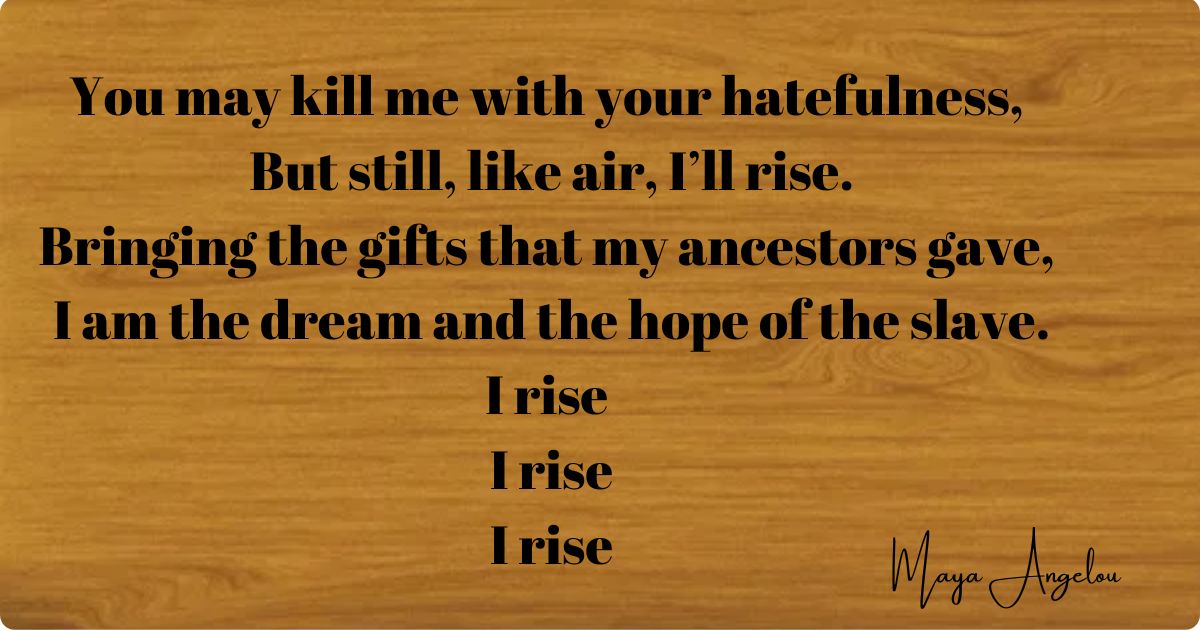
The poem’s happiness comes from its unshakeable confidence and refusal to let others define the speaker’s value. Lines like “Does my sassiness upset you? / Why are you beset with gloom? ‘Cause I walk like I’ve got oil wells Pumping in my living room” use humour and confidence to dismiss haters. Angelou connects her personal resilience to larger natural cycles: “Just like moons and like suns, / With the certainty of tides, Just like hopes springing high, Still I’ll rise.” This cosmic imagery elevates the poem from personal testimony to universal truth.
The final stanzas build to a powerful climax: “Out of the huts of history’s shame I rise Up from a past that’s rooted in pain I rise, I’m a black ocean, leaping and wide, Welling and swelling I bear in the tide.” The repetition of “I rise” becomes a mantra, a spell of self-creation. The poem concludes with the speaker identifying as “the dream and the hope of the slave,” connecting individual survival to collective history. This is happiness not as ignorance of pain but as transcendence through it a deeper, more durable joy that comes from knowing you cannot be destroyed.
Modern Happy Poems Readers Love in 2026
Contemporary poetry embraces happiness with new enthusiasm. It moves away from the irony and sadness that dominated much late twentieth-century verse. Today’s poets write openly about joy, gratitude, and contentment without embarrassment. This shift reflects broader cultural recognition that positivity deserves artistic expression. Happy poems can be just as complex and meaningful as sad ones. The best modern happy poems combine emotional honesty with craft. They create work that feels both authentic and artful.
Readers in 2026 want poems that acknowledge real-world difficulties while maintaining hope. They want poetry that validates their struggles but refuses to surrender to despair. This balanced approach makes happy poems feel trustworthy rather than naive. Modern poets achieve this balance through specificity, detailed, grounded observations that feel true to life rather than vague platitudes about “looking on the bright side.”
Contemporary Feel Good Poems
Contemporary feel-good poems often focus on connection and community. They celebrate friendship, family, and unexpected kindness from strangers. These poems remind you that happiness rarely stays solitary. It grows when shared. Poets like Ada Limón, Ocean Vuong, and Mary Oliver (whose work stays contemporary in spirit though she died in 2019) excel at finding connection moments in everyday life. Their poems feel like conversations with a wise friend who sees the world clearly but chooses to focus on its beauty.
The language of contemporary happy poems tends to be conversational and accessible. These poets avoid old-fashioned vocabulary and complex forms. They choose instead to speak directly to you. This accessibility does not mean simplicity. It represents confidence that profound truths can be expressed in ordinary language. When a modern poet writes about happiness, they want you to understand immediately. They want you to feel the warmth they describe without needing a literature degree to decode it.
Contemporary feel-good poems also reflect current values, including diversity, environmental awareness, and mental health consciousness. They celebrate happiness found in sustainable living, cross-cultural understanding, and the courage to seek therapy or practice self-care. These poems feel relevant to modern life because they address current challenges and opportunities. They maintain poetry’s timeless goal: to make you feel less alone.
Simple Poems That Make You Smile
Some of the most effective happy poems work through humor, surprise, or pure charm. These are poems that make you smile unexpectedly. They catch you off guard with their wit or warmth. They might describe a pet’s ridiculous behavior, a child’s logic, or adult life’s absurdity. This humor is never cruel. It laughs with rather than at, creating shared human folly that brings readers together.
Simple smile-inducing poems often use unexpected comparisons or surreal images. They might describe emotions as physical objects. They might imagine impossible scenarios that somehow feel emotionally true. This slight reality distortion creates delight in your brain. It gives a small burst of pleasure at seeing the world reimagined. The best of these poems balance absurdity with genuine feeling. The humor serves emotional truth rather than distracting from it.
These poems are particularly valuable because they offer relief from serious concerns without requiring you to ignore them. You can acknowledge life’s difficulties while still finding room for laughter. This is the wisdom of the clown, the trickster, the fool in Shakespeare who speaks truths through jest. Simple happy poems that make you smile are essential emotional health tools. They provide regular light doses that prevent you from sinking into despair.
Happy Poems for Different Moments
Life needs different happiness types at different times. The poem you need when you wake up anxious differs from what you need when celebrating success. Wise readers build happy poem collections for various occasions. They curate personal anthologies of comfort and joy. This practice recognizes that happiness is not one-size-fits-all. It is situational and personal.
The best poems for specific moments often share qualities with those moments themselves. Morning poems tend to be energetic and forward-looking. Evening poems are more reflective and peaceful. Poems for difficult times acknowledge pain while offering hope. Poems for celebrations lean fully into joy without reservation. Understanding these nuances helps you choose the right poem for your current emotional needs.
Happy Poems When You Feel Sad
When sadness weighs heavily, happy poems can serve as a lifeline back to emotional balance. However, the most effective poems for sad moments do not deny sadness or suggest you should “just cheer up.” Instead, they acknowledge pain while gently redirecting attention toward possibility. These poems act as patient friends who sit with you in sorrow while reminding you that sorrow is not permanent.
Mary Oliver’s poetry excels at this delicate balance. In “The Wild Geese,” she writes: “You do not have to be good. / You do not have to walk on your knees / for a hundred miles through the desert repenting. You only have to let the soft animal of your body love what it loves.” These lines offer permission to simply exist, to be imperfect and still worthy of love. The poem continues with wild geese heading home, suggesting that you too belong somewhere. You are part of a larger pattern that continues regardless of your individual struggles.
Poems for sad moments often use nature imagery to place personal grief in a larger context. They remind you that seasons change, night becomes morning, and flowers grow from dirt. This is not toxic positivity. It is grounding in natural cycles that have continued for millennia. When you read these poems, you connect to something larger than your individual pain. This connection provides the perspective needed to begin healing.
Morning Happy Poems to Start Your Day
Morning sets the tone for everything that follows. Starting with poetry creates a foundation of mindfulness and intention. Morning happy poems tend to be energetic and full of possibility. They celebrate new beginnings, fresh starts, and the simple miracle of waking to another day. These poems help you transition from sleep to wakefulness with grace rather than rushing into stress.
Billy Collins, former U.S. Poet Laureate, writes morning poems that are accessible and warm. His poem “Today” begins: “If ever there were a spring day so perfect, so uplifted by a warm intermittent breeze that it made you want to throw open all the windows in the house.” This invitation to openness sets exactly the right morning tone. Collins’s poems rarely demand intense emotional labor. Instead, they offer gentle observations that help you notice the world with fresh eyes.
Morning poems work best when they become ritual. Reading the same poem each morning creates continuity and grounding. Alternatively, reading a new poem daily provides variety and surprise. The key is giving yourself this beauty moment before daily demands intrude. Even five minutes with a happy poem creates a positivity buffer. It protects you from morning stress and helps you approach tasks with greater calm and creativity.
Calm & Peaceful Poems Before Sleep
Evening poetry serves a different function than morning verse. Where morning poems energize, evening poems soothe. They help you release daily tensions and prepare your mind for rest. Calm poems before sleep often focus on stillness, darkness, and the natural world at rest. They slow your breathing and quiet your thoughts, creating conditions for peaceful sleep.
Wendell Berry’s “The Peace of Wild Things” works perfectly for evening reading: “When despair for the world grows in me and I wake in the night at the least sound in fear of what my life and my children’s lives may be, I go and lie down where the wood drake rests in his beauty on the water, and the great heron feeds.” The poem continues describing how wild things “do not tax their lives with forethought of grief,” offering a presence model humans can follow. The final lines “For a time I rest in the grace of the world, and am free” provide exactly the release needed before sleep.
Sleep poems often use repetition and rhythm to mimic settling down. They might describe gradual sky darkening, heartbeat slowing, or comfort of familiar surroundings. These sensory details help your body recognize rest time. Reading such poems aloud enhances their effect. The physical act of speaking slowly and breathing deeply triggers your parasympathetic nervous system. A good evening poem is a lullaby for adults. It reminds you that you did enough today and that rest is not only permitted but necessary.
Best Happy Poems to Share with Others
Happiness multiplies when shared. Poetry provides a beautiful medium for spreading joy to others. Sharing a happy poem is an act of care. It says “I thought of you” or “I understand what you’re going through” or simply “I want you to have a good day.” In this digital communication age, receiving a poem feels special and intentional. It breaks from the usual notifications and updates stream.
The best poems to share match the recipient’s situation and your relationship with them. A poem for a close friend might be intimate and personal. A poem for a colleague might be more general but equally warm. Selecting a poem for someone requires thinking about what they need. This is itself a form of connection. When you share poetry, you participate in a human communication tradition that predates social media by thousands of years.
Short Happy Poems for Instagram & Pinterest
Social media platforms became unexpected poetry venues. Short happy poems perform particularly well there. Instagram’s visual format pairs beautifully with concise verses. It creates posts that stop scrolling and offer reflection moments. Pinterest users save these poems to inspiration, self-care, and daily motivation boards. They return to them repeatedly for positivity boosts.
The most successful poems for social media combine visual appeal with emotional resonance. They look good on phone screens and feel good in their hearts. Lines from poets like Rupi Kaur, Atticus, and Lang Leav dominate these platforms. They understand how to write for digital spaces. Their poems are brief enough to read in seconds, relatable enough to feel personally addressed, and uplifting enough to want to share.
When sharing happy poems on social media, consider creating original graphics that enhance the words. A poem about morning light paired with a sunrise photo, or a poem about friendship overlaid on a coffee cup image, creates a complete sensory experience. Always credit the poet when sharing their work. Consider adding your own brief reflection on why the poem matters to you. This personal touch transforms simple sharing into genuine connection.
Happy Poems for WhatsApp Status
WhatsApp status updates disappear after twenty-four hours. This makes them perfect for sharing poems that capture specific moments or moods. Happy poems for this format need to be extremely short ideally two to four lines so contacts checking your status can read them quickly. These poems function like emotional weather reports. They let your network know what you are feeling. They might inspire others to feel similarly.
The temporary nature of WhatsApp status creates intimacy. You are not building a permanent archive. You are sharing a fleeting thought, a momentary joy. This impermanence encourages honesty. You might share a poem you would not post permanently on Instagram or Facebook. The best status poems feel like secrets whispered to friends. They are small beauty gifts that vanish but leave impressions.
Consider using WhatsApp status poems to mark transitions: Monday motivation, Wednesday encouragement, Friday celebration. Or use them to share unexpected beauty moments encountered during your day. A poem about rain when it is pouring, or about sunshine when skies clear. These small poetic gestures maintain connections with friends and family. They do not require lengthy conversation, though they often spark meaningful exchanges when someone replies asking about the poem.
How to Use Happy Poems in Daily Life
Integrating poetry into your daily routine does not require extensive time or literary expertise. Small, consistent practices work better than occasional marathon reading sessions. The goal is making happy poems as accessible as your phone or morning coffee. Create triggers that remind you to pause and read. Over time, these small moments accumulate into significantly improved life quality.
Start by identifying your natural daily transition points: waking up, commuting, lunch break, afternoon slump, evening wind-down, bedtime. Assign a poem or poet to each moment. You might read Mary Oliver with morning coffee, Langston Hughes during your commute, and Wendell Berry before sleep. This association between specific times and specific poems creates a rhythm. Your body and mind will begin anticipating and craving it.
Keep poetry physically accessible. Download a poetry app on your phone. Keep a slim volume in your bag. Post poems on sticky notes around your workspace. The easier accessing a poem is, the more likely you are to actually read one when needed. Consider memorizing a few short favorites so they stay with you always. Even when your phone dies or you find yourself without reading material, poetry in your memory is like carrying a personal pharmacy of emotional remedies.
Write Your Own Happy Poem (Easy Prompts)
Reading happy poems naturally leads to wanting to write them. Creating your own poetry does not require formal training or special talent. It simply requires honesty and attention. Writing happy poems helps you process your own joy experiences. It makes them more vivid and memorable. It also connects you to the long tradition of humans using language to celebrate life.
Start with simple prompts focusing on sensory details rather than abstract emotions. Instead of trying to write about “happiness,” write about the specific thing that made you happy: rain smell on hot pavement, a friend’s laugh sound, ripe strawberries’ color. Describe these things with as much concrete detail as possible. Let the emotion emerge naturally from the description.
Try these prompts to start: Write about a color that always makes you feel good. Describe your perfect morning in six lines. Thank an object you use every day but rarely notice. Capture a moment when you felt unexpectedly at peace. Write an ode to your favorite food. Describe it with the reverence usually reserved for religious experience. These prompts ground your writing in reality while leaving room for the mysterious transformation when experience becomes art.
Remember that your happy poems do not need to be perfect. They do not need to rhyme or follow any specific form. They simply need to capture something true about your joyful experience. Share them with friends if you feel comfortable. Keep them private as personal goodness records if you prefer. Either way, writing them makes you more attentive to daily life happiness. This is perhaps the greatest benefit of all.
FAQs
What exactly makes a poem “happy”?
A happy poem creates positive emotions in you through its content, tone, and imagery. These poems typically focus on joy, gratitude, beauty, hope, or contentment rather than sorrow or conflict. However, the best happy poems often acknowledge difficulty while choosing to emphasize the positive. They create nuanced happiness that feels authentic rather than forced.
Can reading happy poems actually improve my mental health?
Yes, research supports poetry’s mental health benefits. Studies show that poetry can reduce stress, lower blood pressure, decrease pain perception, and increase hope feelings. Poetry’s rhythmic nature activates your parasympathetic nervous system. It creates a relaxation response similar to meditation. Regular engagement with uplifting poetry can be a valuable mental wellness routine component.
How do I choose the right happy poem for my current mood?
Consider what you need most at the moment. If you need energy, choose poems with strong rhythm and active imagery. If you need comfort, select poems that acknowledge difficulty while offering gentle hope. If you need perspective, read poems that place personal concerns in larger natural or cosmic contexts. Trust your intuition you will know when a poem resonates with your current state.
Are there happy poems by famous poets, or is all serious poetry sad?
Many of history’s most famous poets wrote joyful, uplifting work. William Wordsworth, Emily Dickinson, Walt Whitman, Maya Angelou, and countless others created powerful happy poems that remain widely read today. Serious literature absolutely includes serious joy. Happiness is as complex and worthy of artistic exploration as any other emotion.
How can I memorize happy poems for times when I need them?
Start with short poems or extracts from longer works. Read the poem aloud several times, paying attention to its rhythm and sound patterns. Write it out by hand, as the physical writing act aids memory. Practice reciting it during routine activities like walking or cooking. Soon the poem will become part of your mental furniture, available whenever you need it.
Where can I find audio recordings of happy poems?
Many poetry organizations offer free audio recordings of classic and contemporary poems. The Poetry Foundation, Poets.org, and various poetry podcasts provide high-quality recordings. You can listen during commutes or before sleep. Hearing poems read aloud, especially by the poets themselves, adds emotional connection dimensions that silent reading cannot match.
Is it legal to share happy poems on social media?
Poems published before 1928 are generally in the public domain and can be freely shared. For contemporary poems, sharing short extracts usually falls under fair use, especially if you credit the author and do not use the material commercially. When in doubt, link to the poet’s official website or a licensed publication rather than copying the full text.
Can I write happy poems even if I’m not a “real” poet?
Absolutely. Poetry is a human birthright, not a specialized profession. Your happy poems may not be published in literary journals, but they can still bring you and your loved ones genuine joy. The poetry writing act changes how you see the world. It makes you more attentive to beauty and more grateful for small pleasures. This benefit exists regardless of whether anyone else ever reads your work.
Final Thoughts: Read One Happy Poem Today
You have now explored the happy poems landscape, from classic masterpieces to modern joy celebrations. You learned how these poems work to improve your mood, when to read them for maximum effect, and even how to begin writing your own. The only remaining step is acting on this knowledge by reading a happy poem today.
Choose one poem from this article that called to you. Or find another that speaks to your specific situation. Read it slowly, aloud if possible, letting the words settle into your consciousness. Notice how your body responds your breathing, your posture, your face expression. This is poetry doing its work. It connects you to centuries of human experience. It reminds you that joy is always available, even in difficult times.
Make this practice regular. Build a small happy poems collection you can return to, adding new discoveries as you find them. Share them with others when you sense they might need a boost. Write your own when the spirit moves you. In this way, you participate in the ancient and ongoing human project of using language to create, preserve, and share happiness. One poem at a time, you can build a life that is more mindful, more grateful, and more joyfully connected to the world around you.
As poet Mary Oliver asked, “Tell me, what is it you plan to do with your one wild and precious life?” Reading happy poems might seem like a small answer to this large question, but small things accumulate. A poem read today becomes a memory tomorrow, becomes a perspective next year, becomes a life lived with greater attention and delight. Start now. Open a poem. Let it make you happy.
Related to the article : Christian Poems: Verses of Faith, Hope & Devotion

- 50+ Best Poems About God | Inspirational, Short & Famous Verses - April 1, 2026
- 30 Types of Poems | Complete Guide with Examples for Every Poet - March 28, 2026
- Long Distance Love Poems | 33 Heartfelt Poems for Every Emotion - March 27, 2026