
Introduction
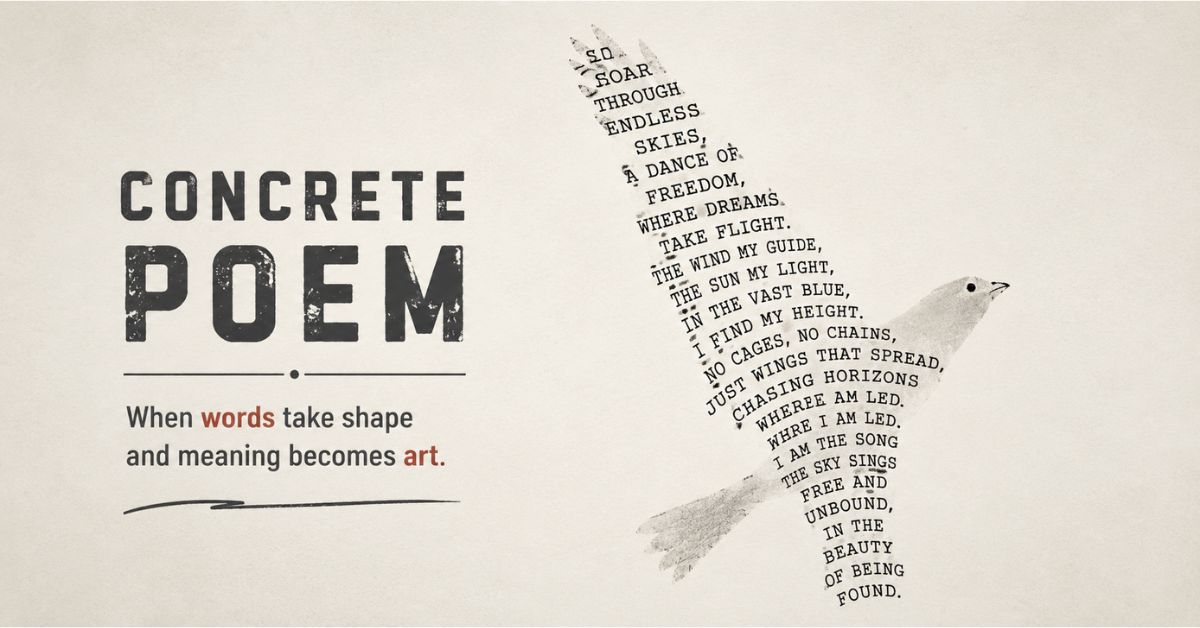
Have you ever seen a poem shaped like a tree, a heart, or a falling raindrop? That is what concrete poems are all about. Unlike regular poems that sit in neat lines on a page, concrete poems use the way words look on the page as part of the poem itself. The shape and the meaning work together to create something truly unique: a piece of writing that is also a piece of art.
Concrete poems are one of the most exciting and accessible forms of poetry. They are used in schools, art galleries, and published collections around the world. Whether you are a student trying to finish an assignment, a teacher looking for a creative project idea, or a writer who wants to try something new, this guide will walk you through everything you need to know from the definition and history to step-by-step instructions for writing your own.
By the end of this article, you will understand what concrete poems are, why they matter, who the famous poets behind them were, and exactly how to write one yourself. Let’s get started.
Key Takeaways
• Concrete poems are poems where the visual layout of words creates a picture or pattern that adds meaning to the text.
• They are also called shape poems or visual poetry.
• The history of concrete poems goes back to ancient Greece, but the modern movement started in 1950s Brazil.
• There are two main types: outline poems and line poems.
• Famous examples include ‘Easter Wings’ by George Herbert and ‘The Mouse’s Tale’ by Lewis Carroll.
• You can write concrete poems using simple tools, even just pencil and paper.
• Concrete poems are excellent tools for teaching creativity to children and students of all ages.
What Are Concrete Poems?
Concrete poems are a form of visual poetry where the physical arrangement of text on the page creates an image or shape that relates to the poem’s subject or meaning. In other words, the poem does not just tell you about something it shows you, through the way the words are placed, what it is about.
A concrete poem sometimes also called a shape poem or pattern poetry blends the literary and the visual arts. The words themselves carry meaning, but so does the way they are arranged. If you are writing a concrete poem about a butterfly, the words might be arranged to look like butterfly wings. If you are writing about rain, the words might fall diagonally down the page like raindrops.
What makes concrete poems different from other types of poems is that you cannot fully experience them without seeing them. You can listen to a haiku or a sonnet and still understand it. But with a concrete poem, the visual representation is part of the poem itself. The typography, spacing, layout, and sometimes even the color of the words all play a role in how the reader experiences the poem.
It is also important to note that not all concrete poems look like a physical object. Some concrete poems use word arrangement in more abstract ways, for example, repeating a word in a spiral or arranging letters to create a sense of movement. The key is that the visual element is intentional and meaningful, not just decorative.
The History of Concrete Poems: From Ancient Greece to Modern Art
The story of concrete poems is much older than most people realize. This form of poetry has roots that go back more than 2,000 years, but its modern identity was shaped in the mid-twentieth century by a passionate group of avant-garde artists and writers.
Ancient Roots: Greek and Latin Pattern Poetry
The earliest known examples of visual poetry come from ancient Greece, dating back to the 3rd and 2nd centuries BC. Greek poets in Alexandria began arranging their letters and words in shapes that matched the subject of their poems. These were often written on physical objects an ax handle, a statue’s wings, an altar, or even an egg. These early pattern poems were not just literary creations; they were also objects of beauty and devotion.
This tradition of shaping words into meaningful visual forms continued through the Latin literary tradition and into the medieval period. Monks and scribes created elaborate shaped texts as part of religious manuscripts. The idea that words could take a form that enhanced their meaning was alive and well long before the printing press existed.
The 1950s Noigandres Movement in Brazil
The term ‘concrete poetry’ as we know it today was born in the 1950s. A group of Brazilian writers and artists associated with a literary magazine called Noigandres including Augusto de Campos, Décio Pignatari, and Haroldo de Campos began experimenting with the visual presentation of words on a page. They were interested in how typography, layout, and graphic space could change the way a reader experienced a poem.
In 1956, the Noigandres group held an international exhibition of their work, which brought concrete poems to the attention of the wider art and literary world. They also developed a manifesto that defined the style, giving it the name ‘concrete poetry’ for the first time. Their work was part of a broader avant-garde movement that was pushing the boundaries of both literature and visual art.
Concrete Poetry Spreads Around the World
From Brazil, the concrete poetry movement spread to Europe, North America, and beyond. Scottish poet Ian Hamilton Finlay became one of the most celebrated figures in the movement, creating concrete poems that played with language in deeply original ways. In the United States, poets like Mary Ellen Solt helped document and expand the form. The movement crossed language barriers because its power was visual as much as verbal; a concrete poem could communicate even to someone who did not speak the poet’s native language.
Today, concrete poems are studied in schools and universities, exhibited in galleries, and celebrated as a unique bridge between literature and visual art. The experimental poetry tradition started by the Noigandres group lives on in everything from children’s picture books to high-concept gallery installations.
Types of Concrete Poems You Need to Know
Not all concrete poems look the same. In fact, the form is remarkably flexible, and poets have developed different approaches over the centuries. Understanding the different types of concrete poems will help you both appreciate the ones you read and decide which approach you want to take when you write your own.
Outline Concrete Poems
An outline concrete poem uses the words of the poem to create the outer edge or silhouette of a shape. The words form a border or outline, and the shape is defined by where the text begins and ends. A famous example of an outline concrete poem is ‘Easter Wings’ by the Welsh poet George Herbert, written in 1633. In this poem, the lines of text are arranged so that the poem tapers in the middle and widens at both ends, creating the shape of a pair of wings. The visual shape reinforces the poem’s spiritual themes of rising, falling, and resurrection.
Line Concrete Poems
A line concrete poem uses the lines and rows of words to draw or fill in a shape, rather than just outlining it. The text literally draws the image on the page. Think of it like a dot-to-dot drawing, but instead of dots, you have words. A well-known example is ‘White Rose’ by Mary Ellen Solt, where the words trace the petals and structure of a rose. Line concrete poems tend to feel more immersive and intricate than outline poems because the entire shape is built from text.
Sound and Typographic Concrete Poems
Some concrete poems go beyond shape and focus on the visual and sonic qualities of individual letters and words. Typographic concrete poems experiment with font size, weight, spacing, and repetition to create a visual and emotional effect. Sound concrete poems associated with artists like Henri Chopin were meant to be performed aloud, with the sounds of the words becoming as important as their shapes. These experimental poetry forms pushed the boundaries of what a poem could be, treating text as image and image as text. They are less common in school settings but are fascinating examples of just how far the form can be stretched.
Famous Concrete Poems Every Reader Should Know
One of the best ways to understand concrete poems is to look at the classics. These famous examples show the full range of what the form can do from playful children’s literature to serious avant-garde art.
“Easter Wings” by George Herbert (1633):
This is arguably the most famous early concrete poem in the English language. Written by the Welsh metaphysical poet George Herbert, the poem is printed in the shape of two pairs of wings. The shape reflects the poem’s themes of spiritual humility and the desire to rise toward God. Because of its age and elegance, it is still one of the first examples most students encounter.
“The Mouse’s Tale” by Lewis Carroll (1865):
Found inside Alice’s Adventures in Wonderland, this concrete poem is shaped like a long, winding mouse’s tail. The shape is a visual pun: the word ‘tale’ sounds like ‘tail’ and the lines grow smaller and smaller as the tail tapers to a point. It is one of the most playful and accessible examples of a concrete poem, and it shows how visual poetry can work perfectly within a story.
“Forsythia” by Mary Ellen Solt (1965):
This striking concrete poem spells out the word FORSYTHIA vertically and uses each letter as the beginning of a line that branches outward, mimicking the shape of the forsythia flower’s branches. It is a perfect example of how concrete poems can make the meaning of words visible through their arrangement.
Works by the Noigandres Group:
The Brazilian poets Augusto de Campos, Décio Pignatari, and Haroldo de Campos created some of the most innovative concrete poems of the twentieth century. Their work used color, repetition, and typographic experimentation to blur the line between poetry and visual art. Their work is now housed in major galleries and collections worldwide and remains hugely influential in the world of experimental poetry.
How to Write Concrete Poems
Writing concrete poems is a deeply rewarding creative exercise. Unlike most poetry, it requires you to think visually as well as verbally. The process takes a little patience, but the results can be stunning. Follow these six steps and you will be well on your way to creating your own concrete poem.
Choose Your Theme or Subject
Start by choosing a subject for your concrete poem. The best subjects for concrete poems are things that have a recognizable shape, objects like a tree, a heart, a cloud, a star, or an animal. You can also choose something more abstract, like love or freedom, but you will need to decide on a shape that represents that idea (a heart for love, a bird for freedom, etc.). Think about what you want the reader to feel when they look at the poem. The subject and shape should work together. A concrete poem about the ocean might take the shape of a wave. A poem about loneliness might spiral inward toward a single word at the center.
Brainstorm Words and Phrases
Now that you have your subject, brainstorm as many words and phrases as you can that relate to it. Think about sensory details: what does it look like, sound like, feel like, smell like? Think about the emotions it creates. Think about verbs that describe what it does. For example, if your subject is a tree, you might brainstorm words like: roots, branches, leaves, rustling, growing, reaching, shade, bark, acorn, seasons, swaying, green, tall, ancient, life. Do not worry about making a perfect poem yet just get words on the page. You can trim and shape them later. Having a rich bank of words to work with gives you much more flexibility when you start fitting them to your shape.
Sketch the Shape
Before you start writing the actual poem, draw a rough sketch of the shape you want your text to follow. Use a pencil so you can erase and adjust. Keep the outline simple at first you can add detail later. If you are making an outline poem, draw just the outer border of the shape. If you are making a line poem, sketch the full form, including any internal lines or details the words will trace. Think about how large or small the shape needs to be to fit all your words comfortably. A very complex shape with lots of fine detail will need more words or smaller text. A simple, bold shape works well for shorter poems. Some writers use graph paper to help keep their lines straight and their spacing even.
Write Your Poem Draft
Using the words you brainstormed, write a first draft of your poem. At this stage, focus on getting the words in a logical, expressive order. Do not worry too much about fitting the shape perfectly yet that comes next. Your concrete poem does not need to rhyme, but it should have rhythm and flow when read aloud. Think about line breaks: where one line ends and another begins can create pauses, emphasis, or surprises for the reader. Read your draft out loud to see how it sounds. The words should feel natural and carry genuine meaning, because the text has to work both as a poem (to be read) and as an image (to be seen).
Fit the Words to the Shape
Now comes the most distinctive and fun part of creating concrete poems: placing your words along the lines of your sketch. Write your poem draft along the outline or interior of the shape, adjusting the spacing and size of letters as needed. Some parts of the shape will need more words than others, so you may need to add extra lines, repeat certain words, or use punctuation creatively to fill space. If there are gaps, adding sound-effect words or small details can help fill them naturally. You can do this step by hand on paper, or digitally using a program like Microsoft Word (using the Text Box or WordArt feature), Adobe Illustrator, or even a basic online design tool.
Refine and Polish
Once you have placed your words in the shape, step back and look at the whole poem as an image. Does the shape read clearly? Does it look like what it is supposed to represent? Read the poem’s text again does it still make sense as a poem? You may need to adjust both the words and the layout. Erase your sketch lines so only the words remain. Check that the shape is clearly defined by the text alone. Look at font size, letter spacing, and line breaks to make sure everything is balanced and readable. Ask someone else to look at it and tell you what shape they see if they recognize it immediately, you have succeeded.
Concrete Poems for Kids: Tips for Teachers and Parents
Concrete poems are one of the best poetry activities for children because they combine writing with drawing. Kids who struggle with ‘traditional’ poetry often fall in love with concrete poems because they feel more like art than homework. The form encourages creativity, vocabulary development, and visual thinking all at once.
For younger children (preschool to second grade), start with very simple shapes like a circle, a star, or a basic animal outline. Pre-drawn templates with a shape to fill in work really well for beginners. Let them write any words they like inside the shape, even just describing words. The goal at this age is engagement and fun, not poetic perfection.
For older students (third grade and up), you can introduce the distinction between outline poems and line poems, discuss famous examples like ‘Easter Wings’ and ‘The Mouse’s Tale,’ and encourage them to create both the shape and the text independently. Books like Wet Cement: A Mix of Concrete Poems by Bob Raczka are excellent classroom resources that show concrete poems in action in a fun, approachable way.
One great classroom technique is to write one concrete poem together as a class first choosing the subject, brainstorming words, sketching the shape on the board, then filling it in together before asking students to create their own. This scaffolding helps even the most hesitant students feel confident. Sharing finished concrete poems on a class display wall also motivates students by celebrating their work as actual art.
Tools and Software to Create Concrete Poems Digitally
While pencil and paper is the most traditional way to create concrete poems, many poets and students today use digital tools to get more precise, professional-looking results. Knowing the right tools makes the process much easier.
Microsoft Word offers Text Box and WordArt features that allow you to curve, rotate, and place text in custom positions on the page. It is accessible and familiar for most students and teachers, making it a great starting point for digital concrete poems. You can also use the Draw tab to sketch a rough shape as a guide, type your poem over it, then delete the sketch.
Adobe Illustrator and Canva give you much more precise control over text placement, font size, spacing, and layout. Illustrator’s ‘Type on a Path’ feature allows you to make text follow any curved or custom shape automatically, which is perfect for complex concrete poems. Canva (which is free for basic use) offers easy drag-and-drop text tools that work well for simpler shapes.
For students, word-processing software with basic text wrapping features or even Google Slides can work surprisingly well. The important thing is not the tool, it is the creative intention behind the words. Some of the most beautiful concrete poems ever made were written entirely by hand.
Common Mistakes to Avoid When Writing Concrete Poems
Even experienced writers make missteps when first trying concrete poems. Knowing what to avoid will save you time and frustration.
The most common mistake is choosing too complex a shape. A shape with lots of tiny details requires an enormous number of words to fill in correctly, and it often ends up looking messy rather than impressive. Start with bold, simple shapes and add complexity as you gain confidence.
Another mistake is ignoring the text in favor of the image. A concrete poem must work both visually and verbally. If your poem is just a jumble of random words that happen to form a shape, it is not really a poem, it is just a word picture. The text should be expressive, rhythmic, and meaningful when read as a poem on its own.
Writers also sometimes try to force rhyme into their concrete poems. While rhyme can work, it is not necessary and can actually make your text harder to fit naturally into a shape. Focus on rhythm, imagery, and meaning instead of rhyme.
Finally, do not rush the revision process. The best concrete poems go through multiple drafts. The shape might need adjusting. The words might need to be rearranged. That is completely normal, and each revision gets you closer to a final piece you will be proud of.
Why Concrete Poems Matter in Literature and Art
Concrete poems occupy a unique and important place at the intersection of language and image. They challenge the idea that poetry is purely a verbal art form, and they invite readers to experience a poem with their eyes as well as their ears and minds. In doing so, they break down the barrier between literary and visual art.
In educational settings, concrete poems are powerful tools because they engage learners who might not respond to traditional poetry. Students who are visual thinkers or who love drawing often find that concrete poems give them a way into creative writing they never had before. The form also reinforces critical thinking: to create a good concrete poem, a student must think carefully about what words mean, how they look, and how they relate to a visual concept.
In the wider literary and artistic world, concrete poems were part of a revolutionary avant-garde movement that permanently expanded our understanding of what poetry can do. The experimental poetry tradition started by the Noigandres group in Brazil and expanded by poets like Ian Hamilton Finlay and Mary Ellen Solt changed the way artists think about the relationship between text as image and image as text.
Even in today’s digital age, concrete poems remain vital and relevant. Artists and poets continue to experiment with typographic poetry in everything from Instagram posts to large-scale public art installations. The form is as alive and evolving as it has ever been, and the best is still to come.
FAQs
What is the difference between a concrete poem and a shape poem?
The terms are often used interchangeably, and in most contexts they mean the same thing. ‘Shape poem’ tends to be the more common term in primary school settings, while ‘concrete poem’ is used more in literary and academic discussions. Technically, ‘concrete poetry’ is broader and can include typographic or sound-based experiments that go beyond simple shapes, whereas ‘shape poem’ almost always refers specifically to text arranged in a visual shape.
Who invented concrete poems?
While shaped poetry has existed since ancient Greece (3rd–2nd century BC), the term ‘concrete poetry’ was first used in the 1950s by the Brazilian Noigandres group, specifically Augusto de Campos, Décio Pignatari, and Haroldo de Campos. They held an international exhibition in 1956 and wrote a manifesto defining the form. So the name is modern even though the concept is ancient.
Do concrete poems have to rhyme?
No, concrete poems do not need to rhyme. The visual arrangement of words is the defining feature, not the rhyme scheme. Many excellent concrete poems use free verse with no rhyme at all. In fact, forcing a rhyme can sometimes make it harder to shape the text naturally. Focus instead on word choice, rhythm, and imagery.
What are some easy concrete poem ideas for beginners?
Great starter ideas include: a poem about a tree shaped like a tree, a poem about rain shaped like falling drops, a poem about the sun shaped like a circle with rays, a poem about a cat shaped like a sitting cat, or a poem about a heart shaped like a heart. Simple, bold shapes with clear outlines are best for beginners. The subject and shape should naturally match each other.
Can I make a concrete poem on a computer?
Yes, absolutely. Microsoft Word’s Text Box and WordArt tools let you place text in custom positions. Adobe Illustrator has a ‘Type on a Path’ feature that makes text follow any shape you draw. Canva is a free, beginner-friendly option for simpler designs. Google Slides can also work for basic concrete poems. Many poets prefer working digitally because it makes revisions much easier.
Recent Article : Poems for Middle School: Best Poems, Activities, and Teaching Tips

Jennifer Aston is a passionate poetry curator and writer with a deep love for the written word. She believes poetry has the power to heal, inspire, and connect people across all walks of life. Through PoemSteric, she brings together timeless and modern verses for every emotion and every moment.