
Introduction
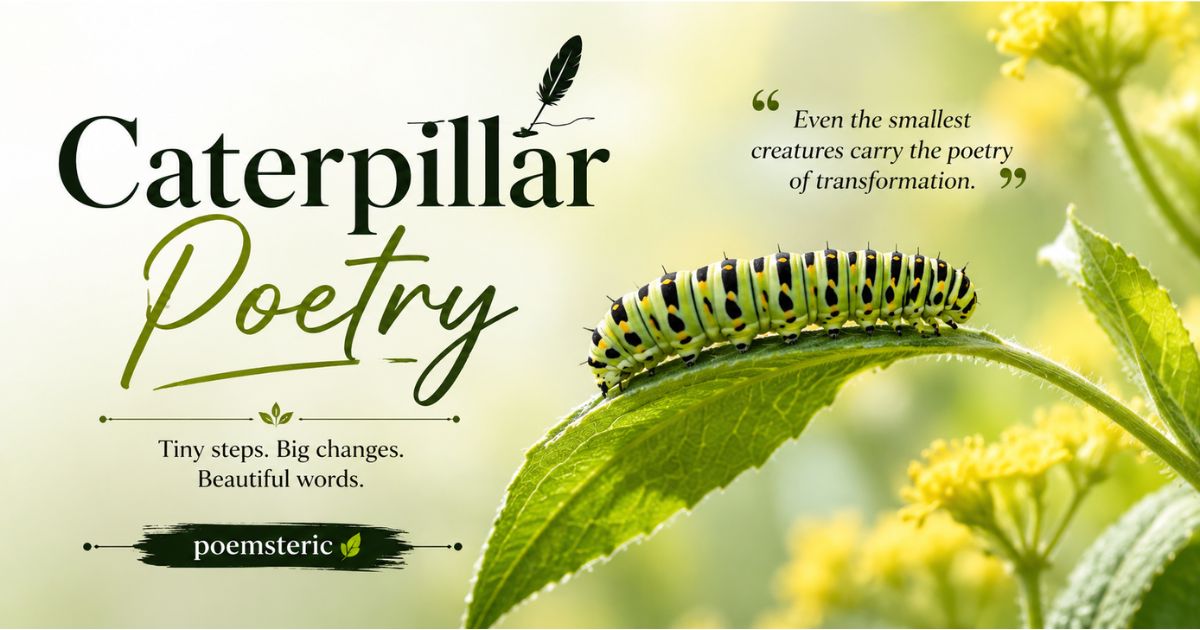
Caterpillar poetry uses the insect’s slow crawl and its eventual transformation into a butterfly as a symbol for patience, change, and hidden potential. Poets have returned to this image for centuries from Christina Rossetti’s Victorian nursery rhyme to Robert Graves’ meditation on mortality because a caterpillar quietly carries the entire arc of a life story inside one small body. This guide walks through nine famous caterpillar poems, explains what each one is really saying beneath the surface, and shows you how to write one yourself.
Key Takeaways
Caterpillar poetry is a small but rich corner of nature poetry. It spans over 350 years, from Robert Herrick's era through Bashō's 17th-century haiku, Rossetti's Victorian children's verse, and contemporary poets still publishing today. Most caterpillar poems fall into two broad camps: gentle, rhyming pieces written for children, and reflective, symbolic pieces written for adult readers thinking about change, mortality, or self-doubt.

In my own reading of dozens of these poems, the caterpillar rarely stays "just an insect" for long within a few lines, it almost always becomes a stand-in for something the poet is really trying to say about waiting, becoming, or letting go. Readers searching for caterpillar poetry are usually looking for one of two things: a short, sweet poem for a child, or a  poem whose meaning goes deeper than what's printed on the page. This guide covers both.
What Is Caterpillar Poetry?
Caterpillar poetry is any poem that uses a caterpillar its appearance, movement, or life cycle as its central image or subject. Unlike a poem that simply describes an insect for its own sake, most caterpillar poetry leans on the creature’s built-in life story: it eats, it hides, it spins a cocoon, and it emerges changed. That structure gives poets a ready-made metaphor for transformation without having to explain it outright.
Some caterpillar poems stay literal and playful, especially those written for children Christina Rossetti’s “Brown and furry” is a good example of this style. Others use the caterpillar as a vehicle for something heavier: mortality, self-doubt, or the discomfort of not yet knowing who you’ll become. Robert Graves’ poem, for instance, has the caterpillar itself questioning whether transformation is even worth the wait.
Why Poets Keep Returning to the Caterpillar as a Symbol
There are three reasons this particular insect shows up again and again in poetry. First, its transformation is visible and dramatic unlike most animals, a caterpillar physically becomes something else, which makes it a natural fit for poems about change. Second, its slowness makes it a symbol for patience; readers often tell us the caterpillar’s unhurried crawl feels like a quiet rebuke to how fast modern life moves. Third, its vulnerability soft-bodied, slow, easy prey gives poets an entry point into themes of fear, hiding, and survival before growth.
Caterpillar Poetry vs. Butterfly Poetry: What’s the Real Difference?
These two categories often get lumped together, but they carry different emotional weight. Butterfly poetry tends to focus on the result freedom, beauty, arrival. Caterpillar poetry, however, sits in the discomfort of the process. It’s about the waiting, the hiding, the not-yet.
This distinction matters if you’re searching for the right poem. If you want something about achievement or release, look for butterfly poems. If you want something about the in-between the part of a transformation nobody wants to sit through caterpillar poetry is the better fit. Robert Graves captures this tension directly: his caterpillar isn’t sure the wings are worth the wait at all, closing with genuine uncertainty rather than triumph. That kind of doubt almost never appears in butterfly poems, which is exactly why the two categories feel so different despite describing the same creature at two points in its life.
The Meaning Behind Caterpillar Poetry: Patience, Change, and Hidden Potential
At its core, caterpillar poetry is about what isn’t visible yet. A caterpillar carries a butterfly inside it long before anyone can see it and that’s the emotional engine behind almost every poem on this list. Poets use it to talk about grief that hasn’t resolved, ambition that hasn’t paid off, or identity that hasn’t settled.
For example, Emily Dickinson’s caterpillar poems treat the insect almost scientifically, watching it closely as if trying to catch the exact moment ordinary movement becomes something stranger. As a result, her poems read less like nature writing and more like quiet philosophy dressed up as observation. Meanwhile, Bashō’s haiku takes the opposite approach: instead of describing transformation, it captures a caterpillar that has run out of time to transform before winter a small, sharp meditation on missed chances.
Quick FAQ
What is the most famous caterpillar poem?
Christina Rossetti’s “Caterpillar (Brown and Furry)” is the most widely known, largely because it’s short, rhyming, and commonly used in children’s education. Robert Graves’ “The Caterpillar” is the most famous version for adult and literary readers.
Is there a short caterpillar poem for kids?
Yes, both Rossetti’s poem and C Richard Miles’ “Caterpillar, Caterpillar” were written specifically with young readers in mind and work well for classroom read-alouds.
9 Famous Caterpillar Poems and What They Really Mean
Here are nine caterpillar poems worth knowing, spanning from the 17th century to today, with a short breakdown of what each one is actually saying underneath its imagery.
1. “Caterpillar (Brown and Furry)” by Christina Rossetti
Published in 1893 in Sing-Song: A Nursery Rhyme Book, this is the caterpillar poem most people encounter first, usually as children. On the surface, it’s a gentle instruction to a caterpillar to hide from predators. Underneath, it’s Rossetti quietly teaching a lesson about mortality dressed as a lullaby: die to the old form, live again as something new.
2. “The Caterpillar” by Robert Graves
Written in 1918, right after Graves survived the First World War, this poem takes a stranger, more skeptical tone. The caterpillar in the poem isn’t sure wings are better than a “sound sleep” as a corpse. Given the year it was written, it’s hard not to read Graves’ own war-shaken uncertainty about resurrection and meaning into every line.
3. “How Soft a Caterpillar Steps” by Emily Dickinson
Dickinson observes the caterpillar’s movement with almost clinical precision, then pivots to something larger about how carefully any fragile thing must move through the world to survive. It’s short, but it rewards a second read.
4. “A Fuzzy Fellow, Without Feet” by Emily Dickinson
A second Dickinson caterpillar poem, this one leans playful, almost riddle-like, describing the caterpillar without naming it outright. It’s a good example of how Dickinson could make even a small garden insect feel mysterious.
5. “Caterpillar Haiku” by Matsuo Bashō
Translated by Robert Hass, this three-line 17th-century haiku describes a caterpillar found deep in autumn too late in the year to become a pupa. In just a few words, Bashō captures the pathos of a transformation that’s run out of time, which is part of why this haiku still gets quoted in modern essays on lost potential.
6. “Caterpillar, Caterpillar – A Children’s Poem” by C Richard Miles
A contemporary, rhyme-driven poem written explicitly for young readers. It follows the same instructional tone as Rossetti’s classic but with simpler, more modern vocabulary useful for teachers looking for something current rather than Victorian.
7. “A Caterpillar” by Ivy Christou
A modern poem that reimagines the caterpillar-to-butterfly image through a more personal, emotional lens, connecting the transformation to a real relationship and loss rather than nature in the abstract. It’s a good example of how contemporary poets are still finding new angles inside an old symbol.
8. “Caterpillar” by A.L. Grimnir
Another contemporary example, proving caterpillar poetry hasn’t stayed frozen in the Victorian era poets are still actively publishing new work using this same image today.
9. “Caterpillar” by Ian Sanborn
Published in Poetry magazine and presented as an ASL poem via The Poetry Foundation, this is one of the more recent and formally distinctive entries on this list, showing that caterpillar poetry continues to evolve in both language and form.
Caterpillar Poems for Kids vs. Caterpillar Poems for Literary Readers
Not every caterpillar poem belongs in the same reading list. If you’re a teacher or parent, Rossetti’s and Miles’ poems are the safest starting points short, rhyming, and easy to memorize, with themes of hiding and change that are simple enough for early readers to grasp. If you’re reading for depth, Graves, Dickinson, and Bashō reward slower reading and closer attention, since their real meaning sits underneath the literal description rather than on the surface. Knowing which category you want before you search saves time a query like “caterpillar poetry” pulls both types of results, and they serve very different purposes.
How to Write Your Own Caterpillar Poem
If these nine poems have inspired you to write your own, here’s a simple approach:
- Pick your angle first. Decide whether your poem is about the caterpillar itself, or whether the caterpillar is standing in for something else grief, ambition, fear, change.
- Choose one moment, not the whole life cycle. The strongest caterpillar poems (Bashō’s haiku especially) focus on a single instant rather than trying to cover crawling, cocooning, and flying all in one poem.
- Use concrete, sensory detail. “Fuzzy,” “slow,” “hidden under a leaf” specific physical details make the metaphor land harder than abstract language does.
- Decide whether the transformation happens. Not every caterpillar poem needs a butterfly ending. Graves’ poem works precisely because it refuses to resolve.
- Read it aloud. Caterpillar poems, especially shorter ones, often rely on rhythm mimicking the slow, deliberate movement of the insect itself.
FAQs
Q: What is caterpillar poetry?
A: Caterpillar poetry refers to poems that use a caterpillar’s appearance, movement, or life cycle as their central image, often as a symbol for patience, hidden potential, or transformation. Caterpillar poetry ranges from simple rhyming poems for children, like Christina Rossetti’s classic, to more reflective adult poems like Robert Graves’ “The Caterpillar.”
Q: What is the most famous caterpillar poem?
A: Christina Rossetti’s “Caterpillar (Brown and Furry),” published in 1893, is the most widely known caterpillar poem, largely due to its use in children’s poetry collections. For adult readers, Robert Graves’ 1918 poem “The Caterpillar” is considered the most notable literary example.
Q: What does a caterpillar symbolize in poetry?
A: In poetry, a caterpillar most often symbolizes patience, hidden potential, and transformation — the idea that something significant is developing beneath an unremarkable surface. Poets also use it to explore vulnerability and mortality, since the caterpillar must survive predators and its own dramatic change before it can emerge as a butterfly.
Q: Are there caterpillar poems suitable for kids?
A: Yes. Christina Rossetti’s “Caterpillar (Brown and Furry)” and C Richard Miles’ “Caterpillar, Caterpillar – A Children’s Poem” are both short, rhyming, and written with young readers in mind, making them popular choices for classroom reading and memorization.
Q: How is caterpillar poetry different from butterfly poetry?
A: Caterpillar poetry usually focuses on the process of change waiting, hiding, uncertainty while butterfly poetry tends to focus on the result: freedom, beauty, and arrival. This is why caterpillar poems, like Graves’, often carry more doubt and tension than the typically celebratory tone of butterfly poems.
Q: Are poets still writing caterpillar poems today?
A: Yes. Contemporary poets including Ivy Christou, A.L. Grimnir, and Ian Sanborn have published caterpillar poems in recent years, proving the symbol hasn’t stayed locked in the Victorian era and continues to find new angles, including experimental forms like ASL poetry.
Final Thoughts
Caterpillar poetry looks small on the surface a short poem about a garden insect but it’s carried some of poetry’s biggest ideas: patience, mortality, self-doubt, and hidden potential. What separates a good caterpillar poem from a forgettable one is usually the same thing: whether the poet lets the metaphor stay a little uncomfortable, the way Graves does, instead of rushing straight to the butterfly. Whether you’re reading these nine poems for a classroom, a personal project, or your own writing, the caterpillar’s real gift to poetry is its refusal to be finished yet.
Recent Article : Poetry and Metaphor: 10 Famous Examples That Prove Its Power

Jennifer Aston is a passionate poetry curator and writer with a deep love for the written word. She believes poetry has the power to heal, inspire, and connect people across all walks of life. Through PoemSteric, she brings together timeless and modern verses for every emotion and every moment.