M
Love Poems Technology AI-Technology

Central Idea of a Poem: How to Find It (With Examples)
What is the central idea of a poem student running to class illustration.

Introduction The central idea of a poem is the main point or message the poet wants readers to understand after finishing the poem. It is not the same as a summary of events, and it is more focused than a general theme. If someone asks you “what is the main idea of a passage” or … Read more
What Is a Poem? The Ultimate Guide to Poetry

What is a poem open notebook with handwritten verses and pen.

Introduction So, what is a poem? At its simplest, a poem is a piece of writing that uses rhythm, sound, and carefully chosen imagery to express an idea or emotion in fewer words than ordinary prose would need. A poem doesn’t have to follow standard grammar or paragraph structure; poets break lines on purpose, repeat … Read more

Elements of Poetry Anchor Chart: Ideas, Steps & Templates

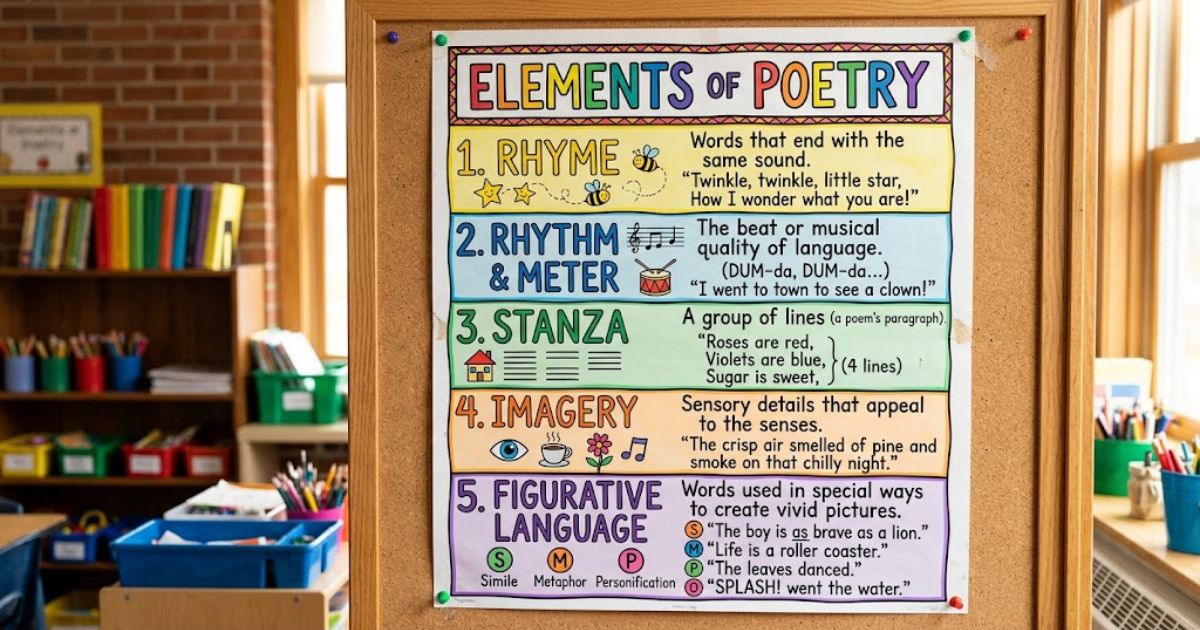
Elements of poetry anchor chart showing rhyme, rhythm, stanza, imagery, and figurative language.

Introduction An element of the poetry anchor chart is a classroom poster that breaks poetry down into its core building blocks rhyme, rhythm, stanza, imagery, and figurative language so students always have a visual reference nearby. It turns abstract vocabulary into something a student can point to instead of guess at. Teachers hang these charts … Read more

Diction in Poetry: The Secret to Powerful Word Choice

Diction in poetry — the secret to powerful word choice, shown with an annotated book and pen.

Introduction Diction in poetry refers to the specific words a poet chooses and how those choices shape a poem’s tone, meaning, and emotional effect. Two poets can describe the exact same scene: a rainstorm, a goodbye, a quiet kitchen yet produce completely different poems simply because one reaches for plain, everyday words while the other … Read more

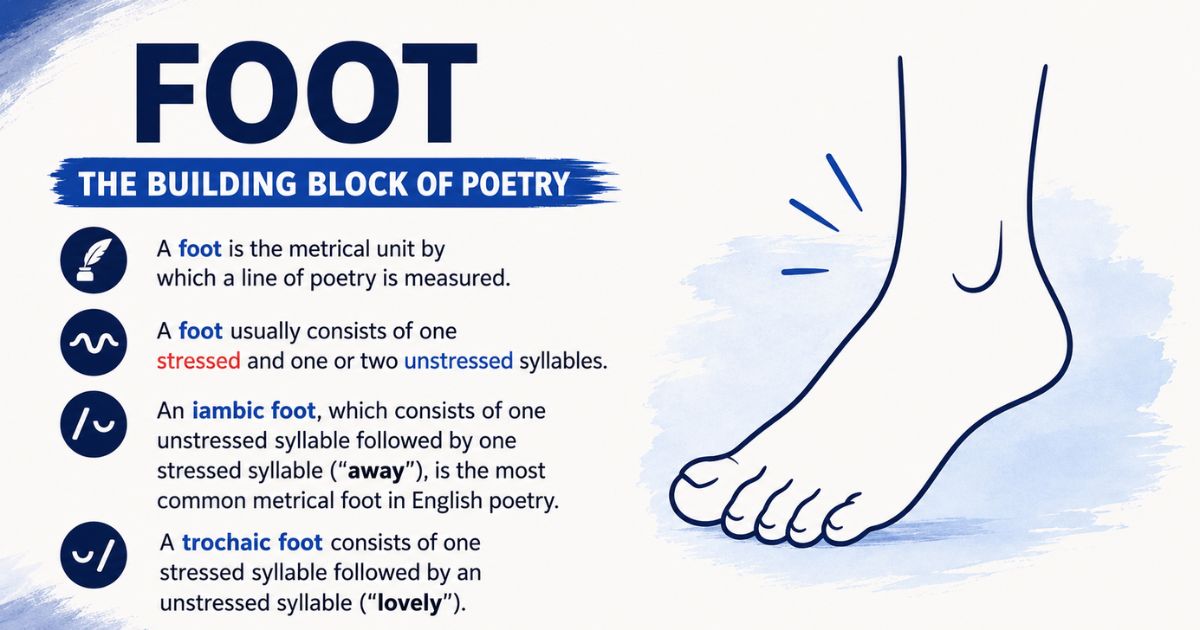
Foot of Poetry Explained: The Best Beginner’s Guide

Foot of poetry infographic explaining iambic and trochaic metrical units.

Introduction A foot of poetry is the smallest repeating unit of rhythm in a line of verse, made up of a specific pattern of stressed and unstressed syllables. Poets combine several feet to build a line’s meter; for example, five iambic feet in a row create iambic pentameter, the rhythm behind most of Shakespeare’s plays. … Read more

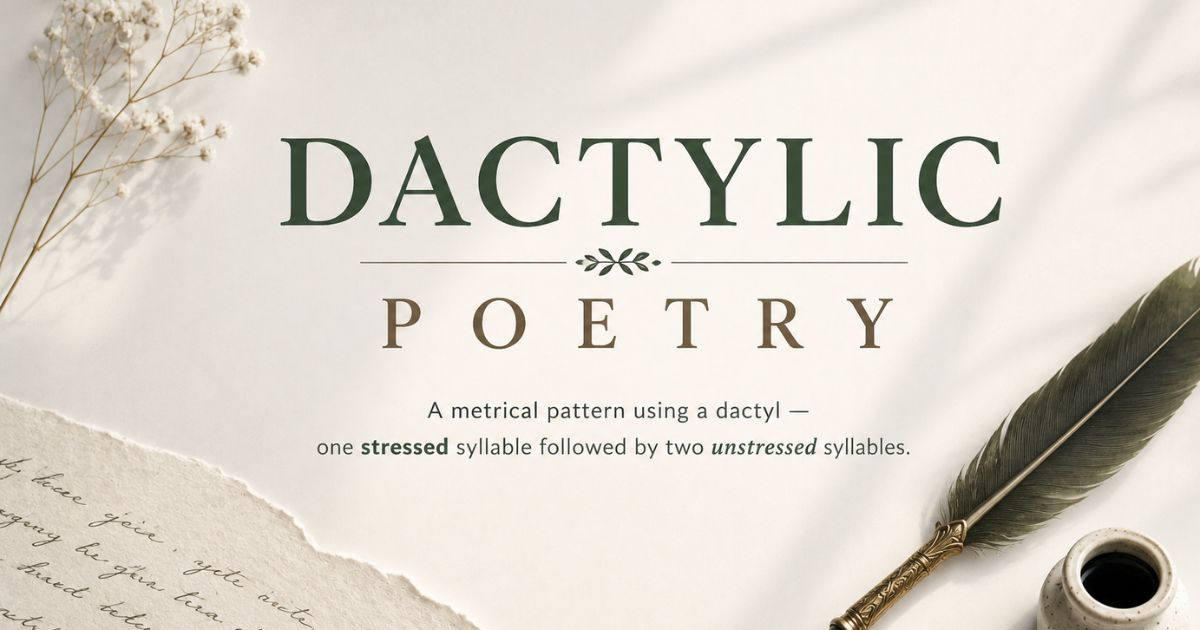
Dactylic Poetry Explained: Meter, Rhythm & Famous Examples

Dactylic poetry definition, a stressed syllable followed by two unstressed syllables, illustrated with quill and parchment.

Introduction Dactylic poetry is verse built from dactyls, a metrical foot made of one stressed syllable followed by two unstressed syllables, giving lines a galloping, “DUM-da-da” rhythm. It’s the meter behind Homer’s Iliad and Odyssey, Virgil’s Aeneid, and later English poems like Longfellow’s Evangeline and Tennyson’s The Charge of the Light Brigade. In my own … Read more

Dead Poets Society Quotes That Will Change How You See Poetry

Teacher inspires students in classroom, echoing dead poets society poetry quotes.

Introduction Dead poets’ society poetry quotes send more people searching for real poems than almost any other film reference online, and that’s because the 1989 movie doesn’t invent its poetry it borrows real, historic verse to make its point about living fully. The two poems it leans on hardest are Walt Whitman’s “O Captain! My … Read more

Poetry Submission Cover Letter: Proven Template That Works

Poetry submission cover letter guide with lavender flowers and handwritten letter background - Poemsteric.

Introduction A poetry submission cover letter is a short, professional note you send alongside your poems that tells an editor who you are, what you’re submitting, and why your work belongs in their journal. It should run no more than 150–250 words, follow standard business-letter etiquette, and never summarize or explain the poems themselves. In … Read more

Contemporary Poetry: The Ultimate Guide to Modern Verse

Contemporary poetry featured image with abstract modern wave design - blog banner for Poemsteric.

Introduction Contemporary poetry is poetry written roughly from the 1950s to today, marked by free verse, personal voice, and themes drawn from everyday modern life. Unlike classical verse, it rarely follows fixed rhyme or meter, giving writers more freedom to experiment with form and language. Readers turn to this style because it speaks directly to … Read more

Characters of Poetry Explained: Elements and Types

Students reading books illustrating characters of poetry — elements and types explained.

Introduction The characters of poetry are the voices, speakers, and figures a poet creates or borrows to carry a poem’s emotion, argument, or story. Every poem you’ve ever read, even a short lyric with no plot has at least one character: the speaker. Once you learn to spot these characters and understand the different types, … Read more