
Introduction
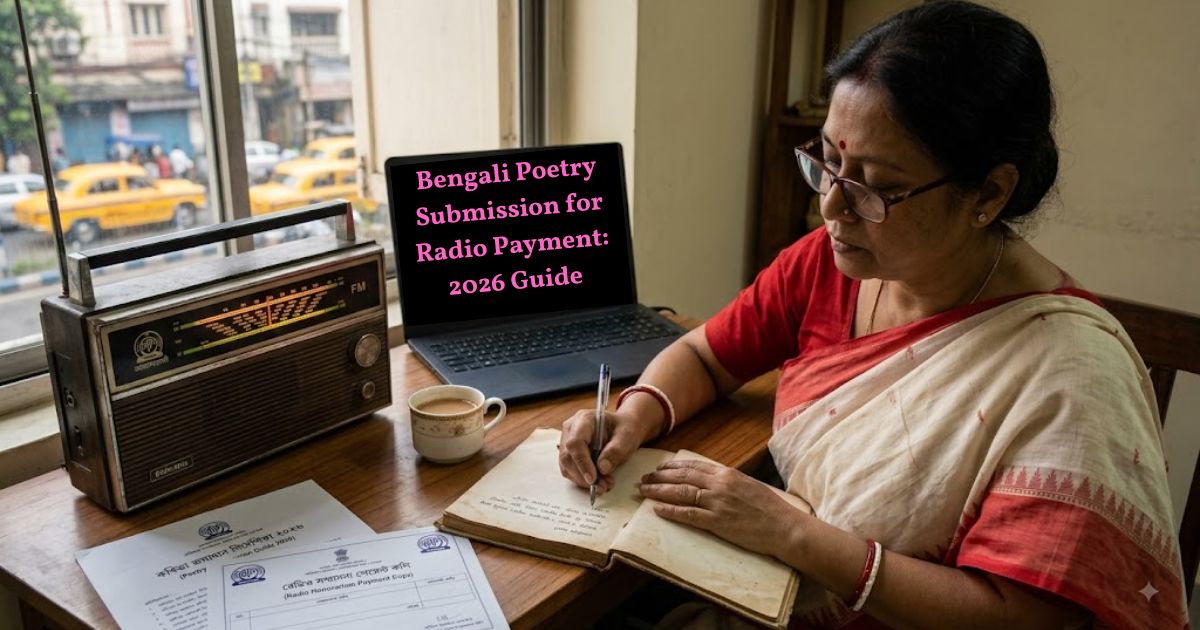
Bengali poetry submission for radio payment is possible through stations like Akashvani (All India Radio) Kolkata and Bangladesh Betar, but it isn’t a single, standardized process with a public price list; instead, poets go through station-specific empanelment or submission channels, and any honorarium is agreed locally rather than published online.
This guide explains, honestly and specifically, how that process actually works, where to send your poems, and what realistic steps increase your chances of both broadcast and payment. Readers often tell us the biggest source of confusion isn’t the poetry itself, it’s not knowing which department to contact or what to expect once a poem is submitted.
Because so much online advice on this topic recycles vague, unsourced claims, this guide focuses only on what can actually be verified from official broadcaster documentation, alongside clear notes wherever a detail, like an exact payment figure, simply isn’t public information.
Key Takeaways
Bengali poetry submission for radio payment happens mainly through Akashvani (All India Radio) Kolkata in India and Bangladesh Betar in Bangladesh, though neither publishes a public poetry-specific fee schedule.

Prasar Bharati, the parent body of Akashvani, does publish detailed rate cards for many casual-assignee and artist categories, but poetry honoraria are set locally by each station rather than centrally listed.

Getting a poem broadcast typically starts with contacting the station's programme or talks section directly, not with an online submission form.

Payment, when offered, is usually processed as a one-time honorarium after broadcast, arranged through the specific producer or Programme Executive who accepted the piece.

Because exact current rates aren't public, always confirm payment terms directly with the station in writing before finalizing a submission.
Why Bengali Poetry Submission for Radio Payment Isn’t a Standardized Process
Unlike submitting a manuscript to a publisher with a clear editorial calendar, Bengali poetry submission for radio payment runs through each station’s own internal programming decisions. As a result, there’s no single national portal, application form, or public rate card that covers poetry specifically, even though both Akashvani and Bangladesh Betar do regularly broadcast literary content in Bengali.
In my own research into Prasar Bharati’s public documents, I found detailed, itemized fee schedules covering dozens of roles, video editors, dialogue writers, anchors, dancers, and more, but no line item for poetry submissions or literary honoraria. This doesn’t mean poets aren’t paid; it means the payment is negotiated station by station, based on the specific programme, the poet’s experience, and local budget decisions, rather than being fixed in advance.
How Radio Honorarium Systems Actually Work
Public broadcasters like Akashvani generally pay contributors through what’s called a casual honorarium, a one-time fee tied to a specific assignment rather than a salary. For staff categories like video editors or production assistants, Prasar Bharati publishes exact figures per assignment. For literary contributions like poetry, however, the honorarium is typically approved by the local Head of Programme on a case-by-case basis, which is why you won’t find a fixed number published anywhere official.
Why Payment Rates Aren’t Publicly Listed
Because literary and cultural programming varies so much by region, language, and audience, station-level committees are given discretion to set honoraria rather than following a single national figure. This flexibility helps stations pay appropriately for different formats, a thirty-second poem reading versus a longer literary segment, but it also means poets need to ask directly rather than relying on a published rate. If you see a website or article quoting a specific, confident payment figure for Bengali poetry on the radio without citing an official source, treat that number with real skepticism.
This lack of a public figure isn’t unique to poetry. Even Prasar Bharati’s published rate cards, which do list exact fees for dozens of production roles, explicitly build in negotiation and committee approval for categories that don’t fit neatly into a fixed schedule. Literary content, being highly variable in length, format, and purpose, tends to fall into that flexible category rather than a fixed one. Understanding this structure helps set realistic expectations: a station isn’t hiding a secret poetry rate from you; in most cases, that rate genuinely doesn’t exist until a specific piece is discussed with a specific producer.
Where Bengali Poets Can Submit Work for Radio Broadcast
Bengali poetry submission for radio payment realistically runs through a small number of established broadcasters, each with its own contact process.
Akashvani (All India Radio) Kolkata
Akashvani Kolkata is the primary Bengali-language station under Prasar Bharati, India’s public broadcaster, and it regularly airs literary and cultural programming. Submissions and inquiries about literary segments should go through the station’s programme office rather than a general inbox; correspondence can be addressed to the Head of Office, All India Radio, Akashvani Bhavan, Kolkata – 700001, though poets should first try to identify the specific Programme Executive handling literary or talks content for the most direct response.
Bangladesh Betar
Bangladesh Betar, the country’s state-run national radio broadcaster headquartered in Dhaka, also airs Bengali literary content, including poetry readings, as part of its cultural programming. Unlike Akashvani, I could not locate a public, standardized submission process or fee schedule for Bangladesh Betar during this research, so poets interested in submitting should contact the station’s programme department directly to ask about current literary segment opportunities and honorarium terms.
Yuva Vani and Youth-Focused Slots
Akashvani’s Yuva Vani service, aimed at younger listeners, has historically been one of the more accessible entry points for new writers, including poets, since it actively looks for fresh voices rather than only established names. If you’re a newer poet without a broadcast track record, asking specifically about Yuva Vani or similar youth-focused programming at your local Akashvani station is often a more realistic starting point than approaching flagship literary programmes directly.
Beyond these national and state broadcasters, some community and campus radio stations in West Bengal and Bangladesh also air Bengali-language literary content, though these are typically volunteer-run or low-budget operations that may not offer any payment at all. For poets specifically focused on paid opportunities, sticking to established public broadcasters like Akashvani and Bangladesh Betar, and asking directly about honorarium terms, remains the more reliable path.
How to Submit Bengali Poetry to Radio
Because there’s no universal application form, following a clear process improves your odds significantly.
- Identify the right station and department. Confirm whether you’re targeting Akashvani Kolkata, Bangladesh Betar, or another regional Bengali-language station, then find the specific programme or talks section handling literary content.
- Contact the station directly to ask about current submission guidelines. Guidelines and honorarium terms change, so always confirm the current process rather than relying on older articles or forum posts.
- Prepare a clean, typed manuscript. Include your full name, contact details, and a short author bio alongside the poem itself.
- Submit through the confirmed channel. This may be email, post, or an in-person visit, depending on the station’s current preference; follow their instructions exactly.
- Follow up politely after a reasonable interval. If you haven’t heard back within several weeks, a brief, courteous follow-up is appropriate.
- Confirm payment terms in writing before broadcast, if a poem is accepted. Ask specifically how and when the honorarium will be paid.
What to Include in Your Submission Packet
A strong submission typically includes the poem itself, cleanly formatted; a short cover note explaining why the piece suits the specific programme you’re targeting; your contact information; and a brief writing background, even if you’re new, mentioning any relevant experience or publications. As a result, station staff can quickly see both the work and the context behind it, which makes a faster response more likely.
It’s also worth keeping a simple record of what you’ve submitted, where, and when. Because response times vary widely and stations rarely send automated confirmations, a personal log helps you know when a polite follow-up is reasonable and prevents you from accidentally sending the same poem to the same department twice.
Does Radio Payment for Poetry Really Exist?
Yes, but it’s handled as a discretionary honorarium rather than a guaranteed fee. Public broadcasters like Akashvani do pay casual contributors, including writers, for accepted material, and this can include poetry used in literary or cultural programming. However, because the amount and even the availability of payment depend on the specific station, programme, and budget at the time, no poet should assume a fixed payment before broadcast; instead, treat any payment discussion as a separate conversation to have once a piece has actually been accepted.
What to Expect After You Submit
After submitting, expect a review period that can take anywhere from a few weeks to a couple of months, since literary content is typically evaluated alongside a station’s broader programming schedule rather than on a fixed timeline. If your poem is accepted, a producer or Programme Executive will usually contact you to discuss recording details, timing, and any honorarium.
If you don’t hear back, this doesn’t necessarily mean rejection; understaffed programme departments sometimes take longer to respond, especially to unsolicited submissions. A polite follow-up after several weeks is reasonable and won’t hurt your chances. However, if a station explicitly states they aren’t currently accepting literary submissions, it’s worth checking back periodically rather than submitting repeatedly in a short window.
It also helps to ask, at the point of acceptance, exactly how payment will be processed, whether that’s by bank transfer, cheque, or another method, and roughly how long it typically takes after broadcast. Getting this in writing, even in a simple email, protects both sides and avoids the kind of vague verbal promises that are easy to misremember months later.
Common Mistakes Poets Make When Submitting to Radio
A few recurring mistakes slow down or derail otherwise strong submissions.
- Sending work to a general inbox instead of the relevant department. This often means your poem never reaches anyone who actually programs literary content.
- Assuming a fixed payment rate exists before confirming with the station. This leads to disappointment or confusion if the actual terms differ from what was expected.
- Submitting without a clear author bio or contact details. Missing information slows down, or ends, the review process.
- Following up too aggressively. Frequent, repeated messages can work against you rather than speeding up a response.
- Ignoring current guidelines in favor of older, outdated information found online. Processes change, so always verify directly with the station before submitting.
How to Improve Your Chances of Acceptance and Payment
Because Bengali poetry submission for radio payment depends heavily on local decision-making, building a relationship with the station matters as much as the poem itself. Attending station-organized literary events, if available, or engaging with existing programming as a listener before submitting can help you understand what a given slot is actually looking for.
It also helps to target your submission precisely. A poem written generically for “radio” is less compelling than one clearly suited to a specific programme’s tone, whether that’s a youth-focused slot like Yuva Vani or a more traditional literary segment. As a result, tailoring your cover note to explain exactly why your poem fits that particular programme often makes a stronger impression than submitting the same generic packet everywhere.
Finally, patience matters. Because payment and acceptance decisions happen station by station, building a track record, even starting with a single accepted piece, often makes future submissions and payment conversations easier. Poets who treat their first successful placement as proof of credibility, rather than a guarantee of future terms, tend to navigate this process with far less frustration.
FAQs
Q: Do radio stations actually pay for Bengali poetry submissions?
A: Yes, public broadcasters like Akashvani and Bangladesh Betar do sometimes pay contributors for literary content, including accepted poems, through a discretionary honorarium. However, bengali poetry submission for radio payment isn’t governed by a single published rate; payment terms are set locally by each station and confirmed only after a piece is accepted, so poets should always verify directly rather than assuming a fixed fee in advance.
Q: How much do radio stations pay for a poem?
A: There is no publicly listed, standardized rate for poetry honoraria at Akashvani or Bangladesh Betar. Prasar Bharati publishes exact fees for many production roles, but literary contributions are approved case by case by local programme committees. Anyone claiming a specific, fixed rate for bengali poetry submission for radio payment without citing an official source should be treated with caution.
Q: How do I submit a Bengali poem to Akashvani Kolkata?
A: Start by identifying the specific programme or talks section at Akashvani Kolkata handling literary content, rather than sending a poem to a general inbox. Prepare a clean, typed manuscript with your contact details and a short bio, then submit through the channel the station currently recommends, since submission methods and guidelines can change over time.
Q: Is there a public submission portal for Bangladesh Betar?
A: Based on available research, Bangladesh Betar does not appear to operate a public, standardized submission portal or fee schedule for freelance poetry. Poets interested in Bengali poetry submission for radio payment through Bangladesh Betar should contact the station’s programme department directly to ask about current opportunities and terms.
Q: How long does it take to hear back after submitting a poem to the radio?
A: Response times vary widely, from a few weeks to a couple of months, since literary submissions are typically reviewed alongside a station’s broader programming schedule. A polite follow-up after several weeks is reasonable if you haven’t heard back, but frequent or repeated messages can work against you rather than speeding up a response.
Final Thoughts
Bengali poetry submission for radio payment is a real, achievable path for writers, but it works through direct relationships with specific stations and departments rather than a single, published process. Akashvani Kolkata and Bangladesh Betar both broadcast Bengali literary content, and both do pay contributors through discretionary honoraria, but neither publishes a fixed rate poets can rely on in advance. The most reliable approach is straightforward: identify the right department, submit a clean and well-targeted manuscript, and confirm payment terms directly once your work is accepted, rather than trusting any secondhand number you find online, including in general guides like this one.
If you’re serious about this path, treat your first submission as the start of a relationship with that station rather than a one-time transaction. Poets who stay in touch, respond professionally to feedback, and continue submitting quality work over time are the ones most likely to see both consistent broadcast opportunities and fair payment down the road. Ultimately, anyone pursuing Bengali poetry submission for radio payment should expect a process built on direct contact and patience, not a quick online form.
Recent Article : April in Poetry: The Best Poems to Read This Spring

Jennifer Aston is a passionate poetry curator and writer with a deep love for the written word. She believes poetry has the power to heal, inspire, and connect people across all walks of life. Through PoemSteric, she brings together timeless and modern verses for every emotion and every moment.