
Introduction
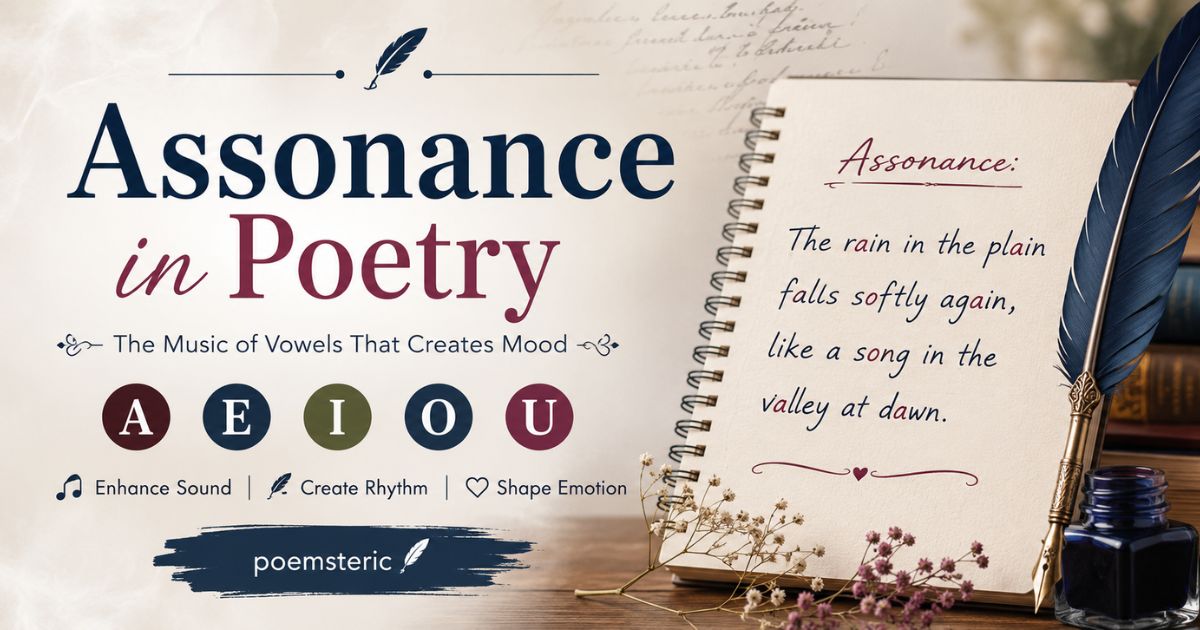
Assonance in poetry is the repetition of similar vowel sounds in nearby words, without the surrounding consonants matching as in “lake” and “fate.” Unlike rhyme, which repeats both vowel and consonant sounds, assonance creates a subtler internal echo. That echo shapes rhythm, mood, and musicality inside a single line, long before the reader ever notices why the words feel connected.
Most articles on this topic define assonance and stop there. This guide goes further. You’ll learn the actual phonetic mechanics behind the effect, see it broken down line by line in real poems, and walk through a step-by-step process for using it in your own writing.
Key Takeaways
Assonance repeats vowel sounds, not consonants; that's what separates it from rhyme.

It works best on stressed syllables that sit close enough together for the ear to catch the echo.

Poets use it to build rhythm, set a mood, and create a subtler alternative to end-rhyme.

The device has two working modes: classic assonance (single vowel sounds) and diphthong assonance (blended vowel sounds).

Overusing it flattens a poem's music; used sparingly, it's one of the most powerful tools a poet has.
What Is Assonance in Poetry?
Assonance in poetry describes the deliberate repetition of a vowel sound across two or more nearby words, where the consonants around that vowel differ. The word comes from the Latin assonare, meaning “to answer with the same sound” a fitting origin, since assonance really does work like an echo answering back within a line.
Take the phrases “lake” and “fate.” Both share the long “a” sound, but the surrounding consonants — k versus t — don’t match. That’s assonance. Compare that to “lake” and “fake,” where both the vowel and the final consonant match: that’s rhyme, not assonance. This distinction trips up more writers than any other part of the definition, and it’s the reason so many online explanations feel unsatisfying; they name the difference but never show you how to hear it.
Historically, assonance predates rhyme as an organizing device in poetry. In the Old French epic Chanson de Roland (composed around 1090 CE), each stanza, or laisse, closes on a shared vowel sound rather than a full rhyme. The same pattern shows up in early Spanish and Provençal verse, where assonance served as the primary structural glue of a poem long before end-rhyme became the European standard. In my own reading of medieval verse, this vowel-based structure is easy to miss if you’re only trained to listen for rhyme; you have to retune your ear to catch it.
The Phonetic Mechanism: How Vowel Sounds Actually Match
Here’s the part most guides skip entirely: assonance is a phonetic phenomenon, not a spelling one. It depends on how a vowel sounds, not how it’s written. “Cough” and “off” share the same vowel sound despite looking nothing alike, while “bear” and “fear” look similar but don’t share a matching vowel sound at all. As a result, spotting assonance requires reading aloud, not just scanning the page.
Linguists describe true assonance as vowel matching within stressed syllables specifically. A stressed syllable is the one you naturally emphasize when you say a word the “TEA” in “reTREAT,” for example. Two words can technically share a vowel letter, but if that vowel falls on an unstressed syllable in one word and a stressed syllable in the other, the ear won’t register it as an assonance. This is why “about” and “cloud” feel different even though both contain an “ou” sound the emphasis lands in different places.
Stressed vs. Unstressed Syllables
Consider Tennyson’s line from “The Lotos-Eaters”: the recurring long “a” sound in “faces pale” repeats on stressed syllables in both words, which is exactly why the phrase lingers in the reader’s ear. If the same vowel appeared buried in an unstressed syllable, the effect would vanish almost entirely, even though the letters on the page hadn’t changed.
This is also why assonance interacts directly with meter and scansion the study of stressed and unstressed syllable patterns in verse. A poet building a line in iambic pentameter, for instance, will often place assonant vowel sounds precisely on the stressed beats, reinforcing the meter’s rhythm rather than fighting against it. Understanding this relationship is the difference between noticing assonance by accident and being able to build it deliberately.
Classic Assonance vs. Diphthong Assonance
Assonance splits into two working types. Classic assonance repeats a single, pure vowel sound, like the short “i” in “flick” and “fist.” Diphthong assonance repeats a blended, two-part vowel sound a diphthong such as the “oy” sound gliding from “oh” to “ee” in words like “toy” and “voice.”
Diphthongs are trickier to catch because they’re already a moving sound, so two diphthongs have to glide the same way to count as matching. A word like “heartbeat” actually contains a diphthong within a single syllable, which is why it’s often used to teach the concept that the vowel sound itself is already doing two things at once before you even compare it to another word.
Assonance vs. Rhyme, Alliteration, and Consonance
These four sound devices get confused constantly, largely because competitor explanations describe each one in isolation instead of side by side. Here’s a direct comparison:
| Device | What Repeats | Example |
| Rhyme | Vowel + final consonant | lake / fake |
| Assonance | Vowel sound only | lake / fate |
| Consonance | Consonant sound (any position) | pitter / patter |
| Alliteration | Initial consonant sound | wild and woolly |
Alliteration is the most obvious of the four; it’s loud, front-loaded, and easy to spot, which is why advertising slogans lean on it so heavily. Assonance works the opposite way: it’s quiet, internal, and often felt before it’s consciously noticed. Consonance sits in between, repeating consonant sounds anywhere in a word rather than just at the start. Rhyme is the strictest of the group, requiring both the vowel and the consonant after it to match exactly.
Knowing this table cold is genuinely useful; it’s one of the fastest ways to correctly identify which device a poem is using on a first read, rather than defaulting to “rhyme” for anything that sounds connected.
FAQ: Quick Answers About Assonance in Poetry
Is assonance the same as slant rhyme?
Not quite. Slant rhyme (also called near rhyme) usually involves partial matches in both vowel and consonant sounds. Assonance specifically isolates the vowel match and doesn’t require the consonants to be close at all.
Does assonance only work at the end of lines?
No. Assonance can appear anywhere at the start, middle, or end of a line and some of its strongest uses occur mid-line, well away from where rhyme typically sits.
Can assonance span more than one line?
Yes. A vowel sound can be carried across an entire stanza to build a sustained mood, not just linked between two adjacent words.
Why Assonance Makes Poetry “Sound Good”: Rhythm, Mood, and Memory
Assonance does three jobs at once, and separating them out explains why the effect feels so satisfying to the ear. First, it builds rhythm: repeated vowel sounds naturally guide which syllables a reader stresses, even in free verse without a fixed meter. Second, it sets mood: long, open vowel sounds (like “o” and “ah”) tend to slow a line down and create a heavier, more mournful tone, while short, tight vowel sounds (like “i” and “e”) speed a line up and create urgency or brightness.
Third, and most overlooked, assonance aids memory. This is the same mechanical reason proverbs and slogans stick in your head “no pain, no gain” isn’t rhyme, it’s an assonance on the long “a” sound, and that repetition makes the phrase easier to recall than a version without it. Readers often tell us that a poem “just sounds right” without being able to explain why; more often than not, assonance is doing that work quietly in the background.
After centuries where end-rhyme dominated English verse, assonance along with consonance and alliteration has become more prominent in contemporary poetry precisely because it achieves this same musical, memorable effect without rhyme’s more obvious, sometimes sing-song quality.
Assonance in Classic Poetry: Poe, Frost, and Wordsworth
Canonical poetry offers the clearest teaching examples because these poems have been studied and annotated so extensively that the assonant patterns are well documented, not just impressionistic.
“The Raven” by Edgar Allan Poe
Poe was famously deliberate about sound engineering in his verse, and “The Raven” (1845) is frequently cited for its use of assonance to reinforce the poem’s mournful tone. The long “o” sound that recurs through end-words like “Lenore” and “nevermore” creates an internal echo that functions almost like a drone note underneath the poem’s actual rhyme scheme, deepening the sense of loss well beyond what the rhymes alone accomplish.
“Stopping by Woods on a Snowy Evening” by Robert Frost
Frost’s 1922 poem layers assonance underneath its more obvious end-rhyme. Within individual lines, recurring long “o” sounds echo the poem’s snow-laden imagery, reinforcing the poem’s hushed, drowsy atmosphere on a level separate from its formal rhyme scheme. It’s a good example of assonance working as a supporting device rather than a poem’s primary structural feature.
Assonance in Contemporary Poetry and Song Lyrics
Assonance didn’t stay confined to nineteenth-century verse; it’s arguably more visible today than ever, largely because of hip-hop and spoken-word poetry, where internal rhyme and vowel matching are central craft techniques rather than occasional flourishes. Rap verses frequently chain assonant vowel sounds across multiple words within a single bar, building a dense internal rhythm that a listener feels more than consciously tracks the same underlying mechanism Poe was using in 1845, just applied at a much faster rhythmic pace.
Contemporary page poets and spoken-word performers use the same technique deliberately when reading work aloud at events, since assonance is one of the few sound devices that reads even more powerfully out loud than it does silently on the page. If you want to train your ear for this, listen to any recorded poetry reading with the text in front of you and mark every vowel sound that repeats within three or four words you’ll start noticing patterns you’d never catch from silent reading alone.
How to Write Assonance in Your Own Poetry: A Step-by-Step Guide
Most advice on “using” assonance is vague encouragement to “play with vowel sounds.” Here’s an actual process:
- Write your line in plain language first. Don’t try to force sound devices before you know what the line needs to say.
- Identify the stressed syllables. Read the line aloud and tap out which syllables naturally get emphasis.
- Pick one vowel sound to anchor. Choose based on mood: long, open vowels (o, ah) for weight and sadness; short, tight vowels (i, e) for speed and energy.
- Swap word choices to match that vowel on stressed syllables only. Keep the meaning intact; change only the word that carries the sound.
- Read it aloud again. If the echo is audible without you having to point it out, it’s working. If you have to explain it, the vowels aren’t close enough together.
- Check your consonants aren’t accidentally rhyming. If they match too, you’ve written rhyme instead of assonance which isn’t wrong, but it’s a different tool with a different effect.
Working through these steps deliberately, even once, makes the pattern far easier to spot automatically in your future drafts.
How Much Assonance Is Too Much?
Assonance loses its power the moment it becomes noticeable as a device rather than felt as a mood. As a rough guide, most successful uses repeat a vowel sound two to four times within a line or short cluster of lines enough to register subconsciously, not so much that the line starts to feel like a tongue-twister (which is a different, more comedic effect, as in “she sells seashells by the seashore”).
If a reader can immediately name the pattern you’re using, you’ve likely overshot. The goal is a line that “sounds right” on an intuitive level. As a result, the best editing test is distance: draft the line, set it aside for a day, then read it aloud fresh. If the vowel pattern still feels natural rather than engineered, you’ve calibrated it correctly.
Common Mistakes When Identifying Assonance
- Confusing spelling with sound. “Bear” and “fear” share letters but not vowel sounds; “cough” and “off” share a sound but not letters.
- Counting unstressed syllables. A shared vowel buried in an unstressed syllable usually won’t register as an assonance to a listener.
- Mistaking rhyme for assonance. If the consonant after the vowel matches too, you’re looking at rhyme, not assonance.
- Missing diphthongs. Blended vowel sounds (like “oy” or “ow”) need to glide the same way to count as a match, not just start on a similar note.
- Assuming it only appears at line-ends. Some of the most effective assonance sits mid-line, away from the more obvious end-rhyme position.
Working through real poems with these five traps in mind will catch most of the misidentifications beginning readers make.
FAQs
Q: What is assonance in poetry?
A: Assonance in poetry is the repetition of similar vowel sounds in nearby words, where the surrounding consonants differ. It’s distinct from rhyme, which requires both the vowel and the following consonant to match. Poets use it to build rhythm and mood without relying on full end-rhyme, creating a subtler, more internal musical effect within a line.
Q: What is an example of assonance in poetry?
A: A clear example appears in Poe’s “The Raven,” where the recurring long “o” sound links words like “Lenore” and “nevermore,” deepening the poem’s mournful tone. A simpler everyday example is the phrase “no pain, no gain,” where the long “a” sound repeats without matching consonants the definition of assonance in action.
Q: What is the difference between assonance and alliteration?
A: Assonance repeats vowel sounds within or between words, while alliteration repeats the initial consonant sound at the start of nearby words, as in “wild and woolly.” Alliteration is generally more obvious and percussive; assonance is subtler and works more like an internal echo than an upfront sonic pattern.
Q: What is the difference between assonance and consonance?
A: Assonance repeats vowel sounds specifically. Consonance repeats consonant sounds, but unlike alliteration, those consonants can appear anywhere in the word, not just at the start as in “pitter” and “patter.” The two devices often appear together in the same line, reinforcing each other’s effect.
Q: Why do poets use assonance instead of full rhyme?
A: Full rhyme can sound sing-song or overly formal if used too heavily, especially in contemporary free verse. Assonance offers a subtler alternative that still builds musicality, rhythm, and cohesion between words, without locking a poem into an obvious rhyme scheme. It also gives poets more flexibility in word choice since only the vowel sound needs to match.
Q: Can assonance appear in prose, not just poetry?
A: Yes. Assonance shows up in literary prose as well, though it’s less common than in poetry since prose rhythm is generally looser. Authors use it in the same way poets do to reinforce mood and create a subtle musical undertone in a passage, particularly in descriptive or emotionally weighted scenes.
Final Thoughts
Assonance in poetry rewards close, patient listening more than any other sound device on this list. It rarely announces itself the way alliteration does, and it’s easy to walk past it entirely if you’re only reading silently on the page. But once you retrain your ear to catch stressed vowel sounds echoing across nearby words, you’ll start hearing it everywhere in centuries-old ballads, in Poe’s most famous lines, and in the internal rhyme schemes built into modern song lyrics.
The real skill isn’t memorizing the definition. It’s learning to read poetry out loud, slowly, and noticing which words seem to answer each other in sound. That’s the entire craft, in one sentence.
Recent Article : Nikki Giovanni’s Poetry: 15 Poems That Define Her Legacy

Jennifer Aston is a passionate poetry curator and writer with a deep love for the written word. She believes poetry has the power to heal, inspire, and connect people across all walks of life. Through PoemSteric, she brings together timeless and modern verses for every emotion and every moment.