
Introduction
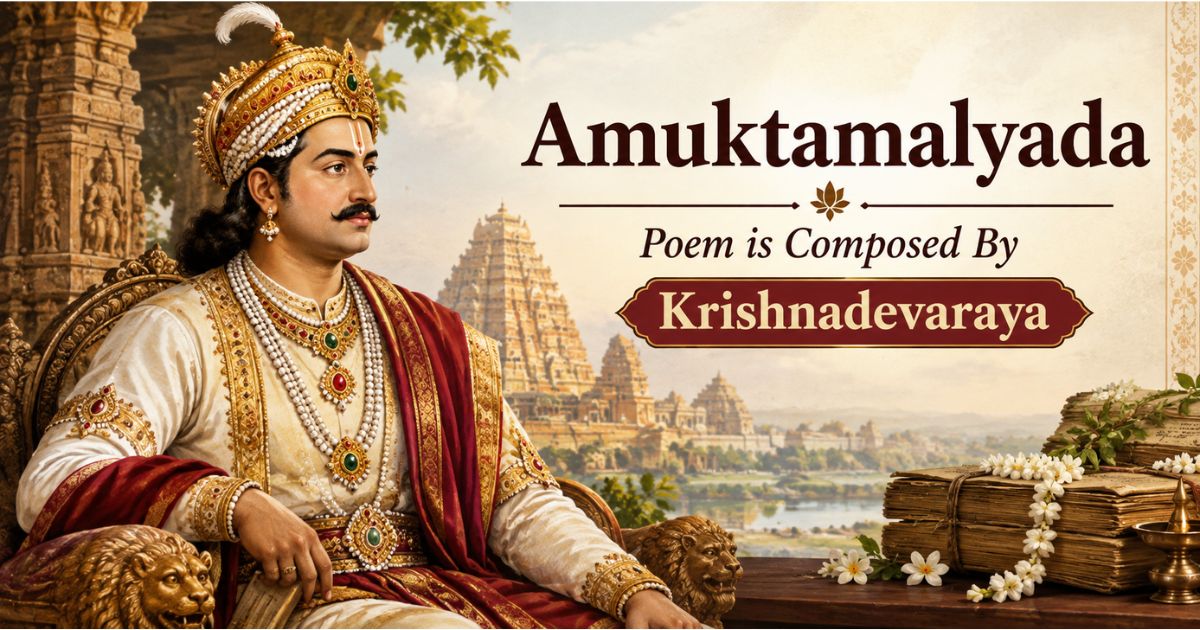
Amuktamalyada poem is a Telugu epic poem composed by Krishnadevaraya, the most celebrated emperor of the Vijayanagara Empire, who reigned from 1509 to 1529. Written in the early sixteenth century, the work is a masterpiece of the ornate prabandha style of courtly Telugu poetry. It narrates the life and devotion of Andal, the Tamil Alvar saint-poetess revered for her unwavering love for Lord Vishnu.
Tradition holds that Krishnadevaraya undertook the composition after the deity Andhra Vishnu appeared to him in a dream, commanding him to tell Andal’s story in Telugu. Today, Amuktamalyada stands as one of the five greatest classics of Telugu literature, admired both for its poetic artistry and for the depth of philosophical and political thought woven into its verses.
Key Takeaways
- Amuktamalyada was composed by Emperor Krishnadevaraya of the Vijayanagara Empire.
- Written in Telugu, it belongs to the ornate prabandha style of courtly poetry.
- The poem tells the story of Andal (Godadevi), a Tamil Alvar saint devoted to Vishnu.
- Tradition holds that Krishnadevaraya wrote it after the deity Andhra Vishnu appeared to him in a dream.
- Beyond devotion, it contains a well-known raja-niti section offering advice on kingship.
- It is counted among the Pancha Maha Kavyas, the five great classics of Telugu literature.
- Krishnadevaraya, of the Tuluva dynasty, carried the titles “Andhra Bhoja” and “Mooru Rayara Ganda.”
What Does the Title “Amuktamalyada” Mean?
The word Amuktamalyada translates loosely to “she who gives away the garland she has already worn.” It refers to a well-loved episode in Andal’s life: before sending flower garlands to be offered to the deity at the temple, she would first wear them herself, admiring how they looked, and only then send them on. What might have seemed like an innocent, almost mischievous habit for an ordinary devotee became, in Krishnadevaraya’s telling, the ultimate symbol of intimate devotion — a love for the divine so personal that formal ritual gave way to something closer to a private relationship.
Who Was Krishnadevaraya?
Krishnadevaraya belonged to the Tuluva dynasty and is counted as its third ruler, presiding over the Vijayanagara Empire during what many historians describe as its political and cultural high point. Under his rule, the empire expanded after victories over the Sultans of Bijapur and Golconda, the Bahmani Sultanate, and the Gajapati kingdom of Odisha, earning him the title Mooru Rayara Ganda, or “conqueror of three kings.”
His deep engagement with literature and the arts, meanwhile, earned him the epithet Andhra Bhoja, comparing him to the legendary poet-king Bhoja of Sanskrit tradition. He is also remembered by the phrase sahiti-samarangana-sarvabhauma as an emperor equally at home on the battlefield and in the world of letters.
The Divine Dream Behind the Poem
According to tradition, Amuktamalyada was not simply a work Krishnadevaraya decided to write; it came to him in a dream. While visiting a temple on the banks of the river Krishna, he is said to have had a vision of the deity Andhra Vishnu, who instructed him to compose, in Telugu, the story of his own wedding to Andal at Srirangam.
When the emperor reportedly asked why the poem should be written in Telugu rather than Sanskrit, the god is said to have answered in verse, declaring himself a Telugu king who ruled over Telugu land, and asserting after listening to kings converse in many tongues that Telugu was the finest of all regional languages.
This declaration, remembered in Telugu as “Desa Bhashalandu Telugu Lessa,” became one of the most quoted lines in the language’s literary history, and it explains why Krishnadevaraya, though equally fluent in Sanskrit, Kannada, and Tamil, chose to write his most personal work in Telugu.
Krishnadevaraya the Literary Patron: The Ashtadiggajas
Krishnadevaraya’s court, known as the Bhuvanavijayam, brought together eight of the finest Telugu poets of the age, collectively remembered as the Ashtadiggajas, or “eight elephants” a reference to the eight mythical elephants believed to support the cardinal directions of the earth. The group included Allasani Peddana, Nandi Thimmana, Dhurjati, Madayyagari Mallana, Ayyalaraju Ramabhadrudu, Pingali Surana, Ramarajabhushanudu, and Tenali Ramakrishna, the last of whom is still celebrated in folklore for his wit. Under this patronage, Telugu poetry entered what is often called its golden age, and Krishnadevaraya himself, rather than merely funding the work of others, wrote Amuktamalyada as a poet among poets.
Structure and Poetic Style
Amuktamalyada is composed in the prabandha style, an ornate narrative form that was at the height of its popularity in the Vijayanagara period, known for elaborate description, rich metaphor, and technical virtuosity. The poem unfolds across roughly fourteen cantos, moving between different classical Telugu meters such as utpalamala, sisa, and kanda padya to vary its rhythm and tone.
Its most celebrated passage is a thirty-verse portrait of Andal’s beauty, composed in the keshadi-padam style literally “from hair to foot” which describes her appearance in careful, unhurried detail from the crown of her head to the soles of her feet, weaving in imagery drawn from the changing seasons.
The Story of Amuktamalyada
The poem opens in Srivilliputhur, home to Vishnuchitta, a humble and devoted gardener-priest also known by his Tamil name, Periyalvar. When the king of the Pandya country calls for scholars to settle a religious debate, Vishnuchitta guided by Vishnu himself travels to the royal court in Madhura and defeats its assembled pandits, winning wealth and royal favor. His greater discovery, however, comes at home: beneath a tulsi plant in his garden, he finds an infant girl, whom he raises as his own daughter, Godadevi the saint later known to history as Andal.
As she grows, her devotion to Vishnu deepens into something closer to romantic longing, and she comes to see herself as destined to be his bride. The narrative follows her yearning and eventual union with Ranganatha, a form of Vishnu, in a celestial wedding at the temple town of Srirangam which is why the work is also sometimes called Vishnuchitteeyam, “the story of Vishnuchitta.”
A Treatise on Kingship: The Raja-Niti Sections
Amuktamalyada is remembered for more than its love story. Within the narrative, Vishnu instructs Vishnuchitta on how a just ruler ought to govern counsel that scholars have long read as Krishnadevaraya’s own reflections on statecraft, shaped by decades of real experience ruling a vast and contested empire. This raja-niti, or “policy of kings,” section covers themes such as fair taxation, the treatment of subjects, the conduct expected of ministers, and the responsibilities a monarch owes to dharma.
Historians have connected this material to Krishnadevaraya’s prolonged rivalry with the Gajapati ruler Prataparudradeva, suggesting that the emperor’s own hard-won understanding of power and leadership found its way into the poem. Krishnadevaraya is said to have governed accordingly, touring his empire personally to hear grievances and oversee justice rather than relying solely on reports from his officials.
Amuktamalyada Among the Pancha Maha Kavyas
Telugu literary tradition honors five works as its Pancha Maha Kavyas, or “five great epics,” and Amuktamalyada is consistently named among them a mark of its lasting literary stature. It is most often grouped with Manucharitramu by Allasani Peddana, Vasucharitramu by Ramarajabhushanudu, and Parijatapaharanamu by Nandi Thimmana, though the identity of the fifth work varies slightly depending on the tradition consulted, with Srinatha’s Sringara Naishadhamu and Tenali Ramakrishna’s Panduranga Mahatmyam both cited in different listings. What remains constant across every version of the list is Amuktamalyada’s place in it.
Krishnadevaraya’s Other Literary Works
Amuktamalyada was not Krishnadevaraya’s only literary undertaking. He was also a capable Sanskrit scholar and is credited with several shorter Sanskrit works, including Jambavati Kalyanamu, Madalasa Charitam, Satyavadu Parinayam, Rasamanjari, and the encyclopedic Sakalakatha Sarasangrahamu.
Of these, only Amuktamalyada survives in relatively complete form today, which is part of why it has come to define his literary legacy so thoroughly later readers and scholars simply have far more of it to study than his other compositions.
Why Amuktamalyada Still Matters
Amuktamalyada occupies a unique place in Indian literary history because of the cultural bridge it builds. Andal’s story belonged originally to the Tamil Sri Vaishnava tradition, closely tied to her own compositions, the Tiruppavai and the Nachiyar Tirumoli. By retelling her life in Telugu, at the court of a Kannada-speaking Tuluva dynasty, Krishnadevaraya carried a devotional tradition across three linguistic communities at once, reflecting the genuinely cosmopolitan character of the Vijayanagara Empire.
The poem also offers historians a rare window into how a sixteenth-century South Indian monarch understood religion, court life, and the responsibilities of power not through official chronicles, but through his own literary voice.
Reading Amuktamalyada in English Today
For readers who do not know Telugu, the most widely recommended way to experience Amuktamalyada is Srinivas Reddy’s English translation, Giver of the Worn Garland, first published by Penguin in 2010. Reddy, a scholar and classical musician, is generally credited with rendering the poem’s imagery and rhythm into English while keeping it genuinely readable, and the translation remains the standard entry point for students and general readers exploring the work outside Telugu-speaking regions.
FAQs
Q: Amuktamalyada poem is composed by whom?
A: Amuktamalyada was composed by Krishnadevaraya, the Vijayanagara emperor who reigned from 1509 to 1529. He wrote it in Telugu, and it remains his most celebrated literary work.
Q: In which language was Amuktamalyada written?
A: Amuktamalyada was written in Telugu, in the ornate prabandha style typical of Vijayanagara-era courtly poetry.
Q: Who is the central figure in Amuktamalyada?
A: The poem centers on Andal, also called Godadevi, a Tamil Alvar saint whose devotion to Lord Vishnu forms the heart of the story.
Q: What does the title “Amuktamalyada” mean?
A: It means “she who gives away the garland she has already worn,” referring to Andal’s practice of wearing temple garlands before offering them to Vishnu.
Q: Does Amuktamalyada contain anything besides the love story of Andal?
A: Yes. It includes a well-known raja-niti section in which Vishnu advises on good governance, widely read as Krishnadevaraya’s own thoughts on kingship.
Q: Is there a reliable English translation available?
A: Yes, Srinivas Reddy’s Giver of the Worn Garland (Penguin, 2010) is the most widely recommended English translation.
Final Thoughts
The answer to “Amuktamalyada poem is composed by whom” is straightforward Krishnadevaraya, the Vijayanagara emperor whose reign is remembered as much for its literary flowering as for its military strength. But the poem itself repays a closer look: a divine dream that set it in motion, a heroine borrowed from the Tamil bhakti tradition and reimagined in Telugu verse, a hidden treatise on how to rule justly, and a lasting place among the five great classics of Telugu literature. Few works of medieval Indian poetry manage to be at once so personal, so devotional, and so political which is exactly what makes Amuktamalyada endure, five centuries after it was composed.
Recent Article : Compulsion Poem by Zinda Kaul: Meaning Explained

Jennifer Aston is a passionate poetry curator and writer with a deep love for the written word. She believes poetry has the power to heal, inspire, and connect people across all walks of life. Through PoemSteric, she brings together timeless and modern verses for every emotion and every moment.