
Introduction
“Light, oh where is the light” is Song 27 from Rabindranath Tagore’s Gitanjali. It shows a devotee crying out for spiritual light while a storm rages around him and his own heart. Tagore first wrote it in Bengali between 1904 and 1910, then translated it into English prose for the 1912 edition of Gitanjali, published as Song Offerings.
Key Takeaways
- The poem is Song 27 in Tagore’s Gitanjali, first published in English translation in 1912.
- It is a prose poem it does not follow rhyme or a fixed meter.
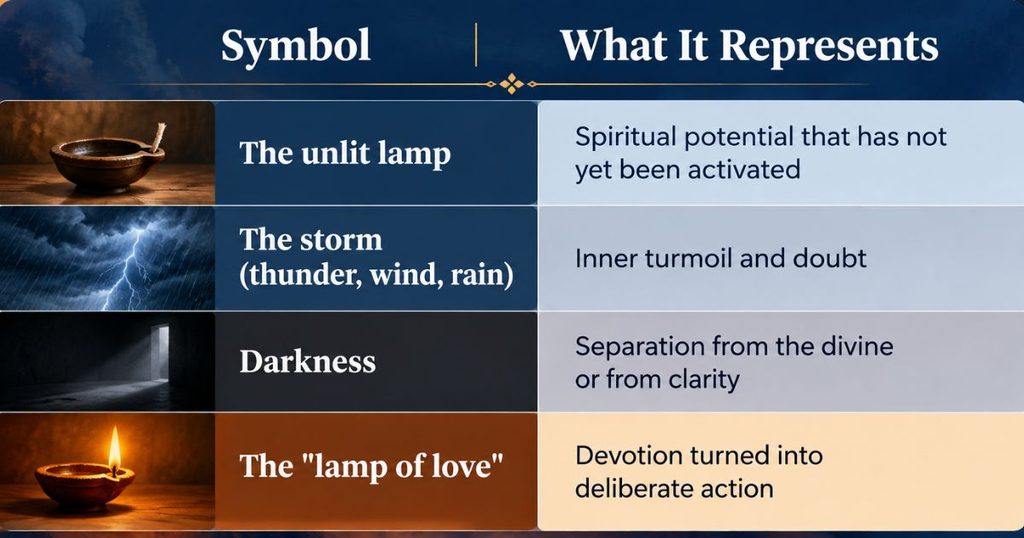
- The central image is a lamp that has no flame, standing for spiritual longing.
- The poem closes with a decision to act rather than wait passively in the dark.
- Gitanjali won Tagore the Nobel Prize in Literature in 1913, the first for an Asian writer.
Who Wrote “Light, Oh Where Is the Light”?
Rabindranath Tagore, the Bengali poet, philosopher, and Nobel laureate, wrote this poem. Born in Calcutta in 1861, Tagore composed the original Bengali verses of Gitanjali between 1904 and 1910. He translated many of them into English prose himself before a trip to England in 1912. The English collection, Gitanjali (Song Offerings), was published by the India Society in London in November 1912, with a wider edition released by Macmillan in 1913. That same year, the Swedish Academy awarded Tagore the Nobel Prize in Literature, making him the first non-European to receive it.
What Is the “Light Oh Where Is the Light” Poem About?
The poem follows a devotee searching for divine light during a dark, stormy night. He owns a lamp, but it holds no flame, and his heart feels abandoned without direction. As thunder and wind grow louder outside, he slowly realizes that sitting still will not bring the light he wants. The poem ends on his decision to kindle a “lamp of love” through his own effort instead of waiting for someone else to light it.
The Poem’s Place in Gitanjali
Gitanjali contains 103 short song-poems built around devotion, longing, and the bond between the soul and the divine. Song 27 sits roughly a third of the way through the collection, following several poems that deal with restlessness and self-doubt. Readers often notice that this placement fits a larger pattern in Gitanjali, where despair is usually followed by a moment of quiet resolve.
Original Publication and Translation
Tagore chose to render his Bengali verses into free English prose rather than rhymed English poetry. This decision has drawn both praise and debate among scholars. In my own reading of the poem, the short, breathless sentences do a good job of carrying over the emotional urgency of the Bengali original, even without a formal rhyme scheme.
Quick definition: A prose poem is a piece of writing that uses the imagery, rhythm, and emotional compression of poetry, but is printed and structured like prose, without line breaks or a fixed meter.
How the Poem Unfolds: A Section-by-Section Walkthrough
The poem moves through four connected moments:
- The cry for light. The speaker calls out for light and admits his lamp has no flame, comparing his condition to a kind of living death.
- The message in misery. He hears that his “lord” is awake and calling him toward union, even through the darkness of night.
- The storm deepens. Clouds, rain, and a flash of lightning make the darkness feel heavier rather than lighter, and the speaker admits he does not fully understand what is happening within him.
- The resolve. Amid thunder and screaming wind, the speaker refuses to let the hours pass in the dark. He decides to kindle his own “lamp of love” instead of waiting.
Line-by-Line Meaning of the Poem
- The opening cry shows a soul aware of its own spiritual emptiness it has the means (the lamp) but not yet the will or clarity (the flame) to reach the divine.
- The reference to misery knocking suggests that hardship itself carries a message: the divine is not absent, only waiting.
- The storm imagery (clouds, rain, lightning, wind) mirrors inner confusion. External chaos and internal doubt rise together.
- The final lines mark a turning point. The speaker stops waiting for an outside light and commits to creating one from his own devotion.
Major Themes in the Poem
- Spiritual longing: the ache to reach something greater than the self.
- Doubt and confusion: shown through the storm and the speaker’s admission that he does not understand his own feelings.
- Human effort versus divine grace: the poem suggests both matter the divine calls, but the devotee must still act.
- Transformation through love: the closing image reframes love as an active force, not a passive feeling.
Symbols to Notice
FAQs
Q: Who wrote “Light, oh where is the light”?
A: Rabindranath Tagore wrote this poem. It appears as Song 27 in his collection Gitanjali, first published in Bengali and later translated by Tagore himself into English prose for the 1912 edition, Gitanjali (Song Offerings). Tagore won the Nobel Prize in Literature in 1913, largely on the strength of this collection.
Q: What does “light oh where is the light” mean?
A: The poem expresses a devotee’s search for spiritual clarity during a night of literal and emotional darkness. Light stands for divine guidance and inner peace, while the unlit lamp shows a soul that has the capacity for devotion but has not yet acted on it. By the end, the speaker resolves to create that light himself through love.
Q: Is “Light, oh where is the light” a prose poem?
A: Yes. Like most of Gitanjali, this piece is written as a prose poem, it uses poetic imagery and emotional rhythm but does not follow a formal rhyme scheme or fixed meter, matching the style Tagore used across his English translations.
Q: Which collection does this poem belong to?
A: It belongs to Gitanjali (Song Offerings), Tagore’s most famous collection, published in English in 1912. The Bengali originals were written between 1904 and 1910, and the collection later earned Tagore the 1913 Nobel Prize in Literature.
Q: What is the “lamp of love” in the poem?
A: The “lamp of love” is a metaphor for devotion turned into action. Rather than waiting passively for an external light, the speaker chooses to kindle this lamp himself, showing that spiritual awakening in the poem requires personal effort alongside faith.
Final Thoughts
“Light, oh where is the light” captures a moment familiar to anyone who has felt lost and unsure how to move forward. Tagore builds this feeling through darkness, storm, and an unlit lamp, then resolves it with a simple, active choice: kindle the lamp of love with your own life. Read alongside the rest of Gitanjali, the poem shows why Tagore’s quiet, devotional voice still speaks to readers more than a century after it first appeared in English.
Recent Article : Who Wrote Kavitavatara? The Complete, Fact-Checked Answer

Jennifer Aston is a passionate poetry curator and writer with a deep love for the written word. She believes poetry has the power to heal, inspire, and connect people across all walks of life. Through PoemSteric, she brings together timeless and modern verses for every emotion and every moment.