
Introduction
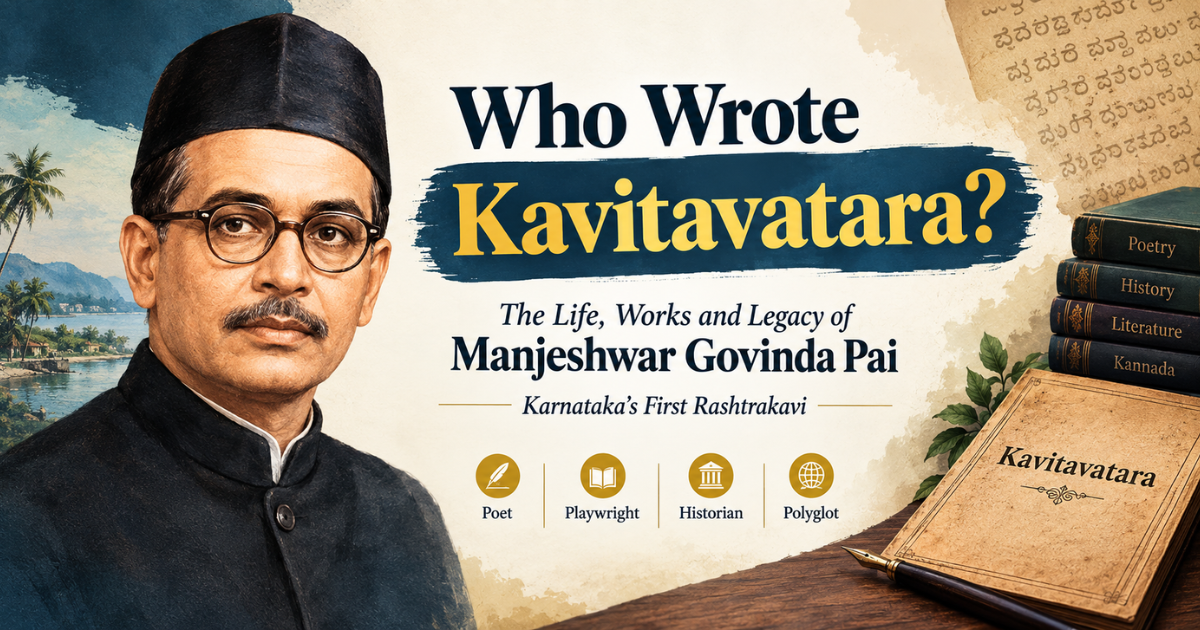
Curious minds often ask who wrote Kavitavatara and the answer is Manjeshwar Govinda Pai, the Kannada poet celebrated as Karnataka’s first Rashtrakavi. This attribution appears consistently across Karnataka general-knowledge and competitive-exam sources, making it one of the most frequently asked literary trivia questions in the state.
Below is the most detailed, accurate profile of Govinda Pai available in one place including details that don’t show up in the usual copy-paste trivia pages, and an honest note on why Kavitavatara itself is so thinly documented.
Who Wrote Kavitavatara – And Where Does It Actually Fit?
“Who wrote the poem book Kavitavatara?” is a recurring multiple-choice question in Karnataka GK quizzes and competitive-exam banks, typically presented alongside distractor options such as D.R. Bendre, Masti Venkatesh Iyengar, and B.M. Srikantaiah all major Kannada literary figures. Across these exam-prep sources, the accepted answer is uniformly Govinda Pai.
That consistency is worth noting because, unlike his acknowledged masterworks, Kavitavatara does not appear in Govinda Pai’s standard bibliographies, including his Sahitya Akademi monograph summaries a gap that’s worth being upfront about rather than glossing over.
Manjeshwar Govinda Pai: The Man Behind the Title
Early Life and a Formative Education
Govinda Pai was born on 23 March 1883 into a Konkani Goud Saraswat Brahmin family at his maternal grandfather’s house in Manjeshwar, then part of South Canara district in the Madras Presidency and now in Kerala’s Kasaragod district. He was the first son of Mangalore-based Sahukaar Thimmappa Pai and Devaki Amma.
His schooling took him through a Mission School and then Canara High School in Mangalore. What’s less commonly reported is a detail from his university years: he enrolled at Madras Christian College for his BA, where he topped the university in English and won a gold medal and where one of his classmates was S. Radhakrishnan, who would later become President of India. That academic run was cut short when the sudden death of his father forced him to return home before completing his studies in Madras.
A Genuine Polyglot
Govinda Pai’s linguistic range is one of the most striking facts about him. He could read and write fluently in roughly 25 languages, including Tulu, Malayalam, Sanskrit, Telugu, Tamil, Marathi, Bengali, Persian, Pali, Urdu, Greek, and Japanese, besides Kannada, Konkani, and English, and he even translated Japanese literary works into Kannada. The scale of his personal reading is preserved today in the Govinda Pai Grantha Bhandara in Udupi, which holds his collection of 4,734 books spanning 36 languages.
From Rhyme to Blank Verse: How His Poetry Evolved
Early in his career, Govinda Pai wrote in the conventional rhymed style of the time. His first poem, “Suvasini,” appeared in a journal of the same name, and poems such as “Subhadra Vilapa” and “Kaliya Mardana” were published with initial rhyme in the journal Swadeshabhimani between 1903 and 1910. But he began questioning whether rhyme was essential to good poetry at all, noting that neither Sanskrit nor English verse relied on it.
While living in Baroda in 1911, he finally decided to abandon rhyme in his own writing a break from convention that, over time, reshaped the direction Kannada poetry itself would take. He is also credited with introducing the sonnet form into Kannada literature.
His Major Works
Poetry Collections
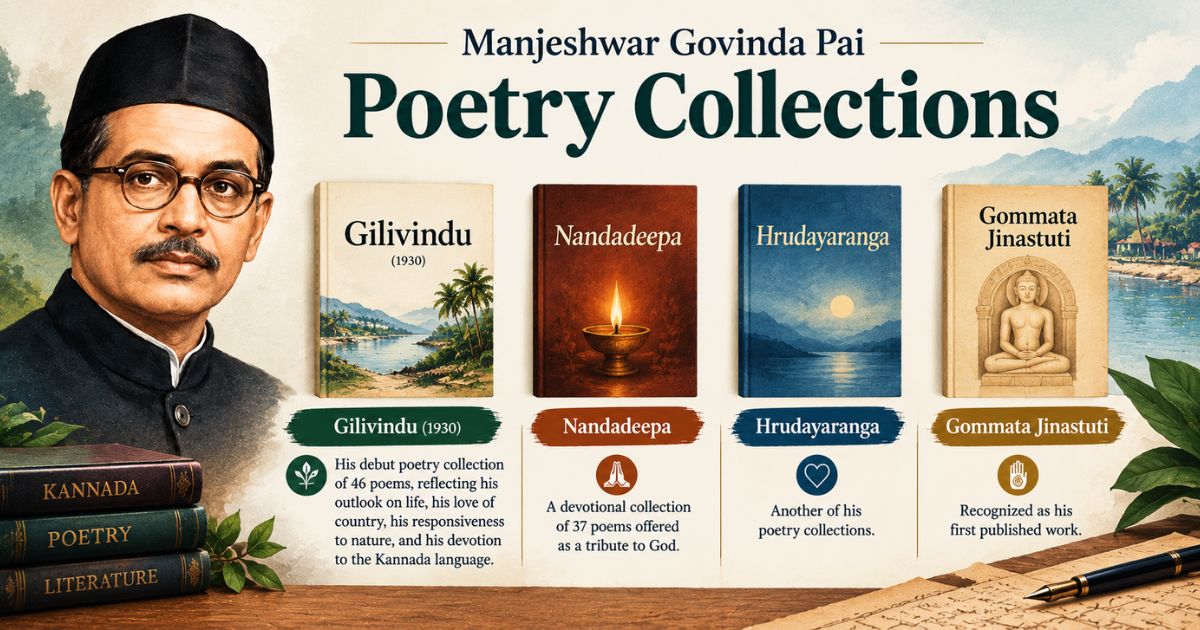
- Gilivindu (1930) his debut poetry collection of 46 poems, reflecting his outlook on life, his love of country, his responsiveness to nature, and his devotion to the Kannada language.
- Nandadeepa a devotional collection of 37 poems offered as a tribute to God.
- Hrudayaranga another of his poetry collections.
- Gommata Jinastuti recognized as his first published work.
The Four Panegyrics: His Signature Achievement
Govinda Pai’s most celebrated writing came in the form of long narrative poems (panegyrics) built around the final days of major historical and religious figures. He wrote Golgotha in 1931, an extended narrative poem on the Passion of Christ that opens with Pilate’s judgment, and it was later issued in its definitive blank-verse form in 1937. Its reception was significant enough that he followed it with three more panegyrics Vaishakhi, Prabhasa, and Dehali covering the last days of the Buddha, Krishna, and Gandhi respectively.
Of these, Golgotha, Vaisakhi (1946), and Hebberalu (1946) are considered his three greatest works in blank verse, securing him a lasting place among Kannada’s finest poets. Hebberalu retells the Mahabharata episode of Ekalavya and his guru Drona.
Other notable pieces include Chitrabhanu (inspired by the Quit India movement), Mannina Sogadu, and Taayi.
Prose and Historical Research
Beyond poetry, his earliest prose work was Srikrishna Charita, written in 1909. He was also a serious historian an authority on the chronology of the Alupa dynasty that ruled coastal Karnataka from roughly the second to the fifteenth century, and he published extensively on the Punnata, Kadamba, Ganga, and Satavahana dynasties.
In one notable piece of scholarship, he argued that the king who accompanied the Jain sage Bhadrabahu to Shravanabelagola was not Chandragupta Maurya but a later ruler, Samprati Chandragupta of Ujjain. His collected articles and research now fill a single volume running to roughly 1,550 pages.
Becoming Karnataka’s First Rashtrakavi
In 1949, the Madras Government honored him with the Rashtrakavi (“National Poet”) title the first time a Kannada writer had received it. A detail rarely mentioned: the honor was conferred jointly on Govinda Pai and the celebrated Malayalam poet Mahakavi Vallathol.
The title was later extended to only one other Kannada writer, Kuvempu, underlining how rare the recognition was. Govinda Pai went on to preside over the Kannada Sahitya Sammelana held in Bombay in 1951.
So Where Does Kavitavatara Actually Fit?
Here’s the honest gap in the record: Kavitavatara is not listed among Govinda Pai’s works in his standard biographical sources or the major Kannada literary archives available in English. Its authorship attribution comes almost entirely from Karnataka GK and competitive-exam question banks, where it’s treated as settled fact which is different from it being independently documented in literary history. It’s worth knowing this distinction if you’re citing the fact for something more than a quiz answer.
One small linguistic note, offered as context rather than confirmed history: in Sanskrit poetics, “kavitavatara” literally translates to something like “the descent (or advent) of poetry,” and the term has historically been used as a title for works discussing the origin and theory of poetic composition. Given Govinda Pai’s extensive scholarly writing on literary history and Kannada poetics, a piece or lecture under this title discussing the nature of poetry itself would fit his body of work but this is an informed inference, not a documented fact, and should be treated that way.
His Lasting Legacy
Govinda Pai died on 6 September 1963 at age 80. His memory is preserved today through several institutions: the Govind Pai Research Institute in Udupi, the Govind Pai Memorial College under Kannur University in Manjeshwar, and Gilivindu a heritage and cultural memorial complex at his ancestral home, developed jointly by the governments of Kerala and Karnataka with support from Indian Oil Corporation.
FAQs
Q. Who wrote Kavitavatara?
A. Manjeshwar Govinda Pai, per Karnataka literature exam and GK reference sources though independent literary documentation of this specific title is limited.
Q. Who was Manjeshwar Govinda Pai?
A. A Kannada poet, playwright, and historian (1883–1963) from Manjeshwar, honored in 1949 as the first Rashtrakavi (National Poet) by the Madras Government, an honor he shared with the Malayalam poet Vallathol.
Q. What language did he write in?
A. Primarily Kannada, though he read and wrote fluently in around 25 languages, including Konkani, English, Sanskrit, Tulu, and Japanese.
Q. What are his most celebrated works?
A. Golgotha, Vaisakhi, and Hebberalu three narrative poems in blank verse considered the peak of his poetic achievement.
Q. Why is he called Rashtrakavi?
A. The Madras Government gave him this title in 1949 in recognition of his contribution to Kannada literature, making him the first Kannada writer honored this way.
Recent Article : Sylvia Plath: Remarkable Life Behind Her Poetry

Jennifer Aston is a passionate poetry curator and writer with a deep love for the written word. She believes poetry has the power to heal, inspire, and connect people across all walks of life. Through PoemSteric, she brings together timeless and modern verses for every emotion and every moment.