
Introduction
What is a couplet poem? A couplet is a pair of consecutive lines in poetry that function together as a unit, often through rhyme, rhythm, meaning, or all three. Some couplets form complete poems by themselves, while others appear as parts of longer poems.
Couplets are among the simplest poetic structures, but poets have used them for everything from storytelling and humor to philosophical statements and dramatic endings.
Key Takeaways
- A couplet consists of two consecutive poetic lines.
- The two lines usually work together in meaning, rhythm, or rhyme.
- A couplet does not always have to rhyme.
- A rhyming couplet commonly uses an AA rhyme pattern.
- A heroic couplet traditionally uses rhymed iambic pentameter.
- Geoffrey Chaucer, William Shakespeare, Alexander Pope, and other poets used couplets extensively.
- A couplet can stand alone or form part of a longer poem.
- A couplet and a stanza are related concepts but are not always identical.
What Is a Couplet Poem? Definition and Meaning
A couplet poem is a poem consisting of two lines that are designed to function together. The two lines may rhyme, share a metrical pattern, complete one another grammatically, or express one unified thought.
The simplest definition is:
A couplet is a pair of consecutive lines that form a recognizable poetic unit.
The word couplet comes from the idea of something being coupled or joined. In poetry, this joining can happen through sound, syntax, meter, or meaning.
For example:
The moon shines softly through the night,
And fills the silent world with light.
The two lines form a clear unit and use end rhyme: night/light.
A couplet can be part of a sonnet, narrative poem, satire, or longer poetic work. It can also function as a complete two-line poem.
How Is a Couplet Structured?
The basic structure of a couplet is simple: two consecutive lines.
However, poets can organize those lines in different ways. The lines may have matching meter, rhyme at the end, or complete a single thought.
One common pattern is:
Line 1 – A
Line 2 – A
This is often called an AA rhyme scheme.
A couplet can also be unrhymed:
Line 1 – A
Line 2 – B
In this case, the connection between the lines may come from rhythm, grammar, imagery, or meaning rather than end rhyme.
Rhyming and Non-Rhyming Couplets
Rhyming couplets are particularly common in English poetry. The final words of the two lines rhyme, creating a strong sense of closure.
For example:
The river moves beneath the sky,
While silent clouds go drifting by.
Here, sky/by creates the rhyme.
However, rhyme is not an absolute requirement. A couplet can be recognized through its two-line structure and close relationship between the lines.
This distinction is important because some readers assume that every couplet must rhyme. In reality, rhyme is a common feature, not the only defining feature.
Closed and Open Couplets
A closed couplet expresses a complete thought within the two lines. The grammatical and semantic structure reaches a natural ending.
An open couplet, by contrast, continues its thought into the following line or section. The two lines may still function as a pair, but the meaning does not necessarily stop at the end of the second line.
This difference is useful when analyzing how poets control pace and emphasis.
What is the Purpose of a Couplet Poem?
Couplets can serve many purposes because the structure is flexible.
A poet may use a couplet to:
- Express a complete idea
- Create rhyme and musicality
- Emphasize a statement
- Deliver a joke or witty observation
- Conclude a stanza
- Summarize an argument
- Create dramatic closure
- Move a narrative forward
- Present a memorable moral or observation
Because two lines can create a strong sense of completion, couplets are particularly effective for endings.
A poet may build a long poem and then finish with a couplet that gives the reader a final image or thought.
Types of Couplets in Poetry
Several kinds of couplets appear in English literature.
Rhyming couplet: Two consecutive lines that rhyme.
Heroic couplet: Two rhymed lines of iambic pentameter. The form became especially important in English poetry during the Restoration and eighteenth century.
Closed couplet: Two lines that form a grammatically and conceptually complete unit.
Open couplet: Two connected lines whose meaning continues beyond the pair.
Octosyllabic couplet: A couplet in which each line commonly contains eight syllables, particularly in some medieval and later poetic traditions.
These categories can overlap. For instance, a heroic couplet is normally also a rhyming couplet, but not every rhyming couplet is heroic.
Famous Examples of Couplets
Couplets appear throughout English literary history.
Geoffrey Chaucer used rhyming couplets extensively in The Canterbury Tales. His verse helped establish the heroic couplet as an important English poetic form.
William Shakespeare frequently used rhyming couplets, particularly near the ends of scenes and sonnets. His final couplets can provide summary, contrast, irony, or dramatic closure.
Alexander Pope became especially famous for his use of the heroic couplet. Works such as An Essay on Criticism and The Rape of the Lock demonstrate how the form can carry argument, satire, wit, and polished observation.
Robert Frost also used couplets in different contexts, showing that the basic two-line unit remained useful in modern poetry.
The important point is that couplets are not restricted to one period or literary movement. Their simplicity allows them to adapt to many poetic styles.
Couplet vs Stanza: What Is the Difference?
A couplet specifically refers to two lines working together. A stanza is a larger grouping of lines that functions as a unit within a poem.
Therefore, every two-line stanza can be described as a couplet in a structural sense, but the terms emphasize different things.
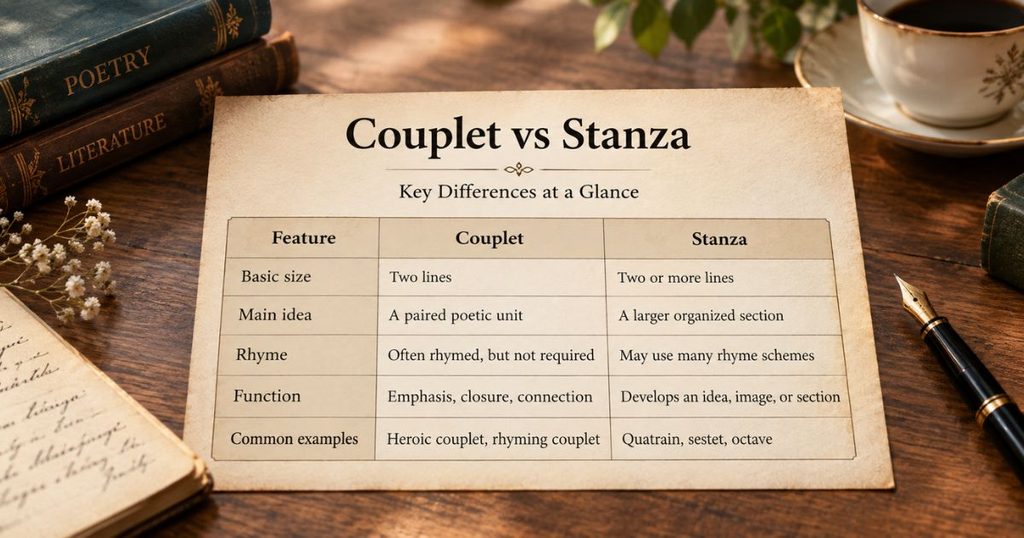
A stanza may contain several couplets. For example, a six-line stanza could contain three pairs of lines while functioning as one larger stanza.
How to Identify a Couplet Poem
When reading a poem, use a few simple steps to determine whether you are looking at a couplet.
First, count the lines. If the complete poem contains only two lines, it may be a couplet poem.
Second, examine the relationship between the lines. Look for a shared idea, grammatical connection, rhythm, or rhyme.
Third, check the rhyme. Words at the ends of the lines may rhyme, although this is not essential.
Fourth, look at the meter. If the poem uses a regular meter, the two lines may form a particularly recognizable traditional couplet.
Finally, consider closure. Does the second line complete, contrast with, or emphasize the first? If so, the pairing is likely deliberate.
Common Misconceptions About Couplets
The first misconception is that every couplet must rhyme. Many traditional couplets rhyme, but rhyme alone does not define the form.
Another misconception is that a couplet must always be a complete poem. It can be a complete two-line poem, but it can also appear inside a much longer work.
It is also incorrect to assume that all couplets use iambic pentameter. That description applies specifically to the traditional heroic couplet, not to every couplet in poetry.
Finally, two lines placed next to each other do not necessarily create a meaningful couplet. The lines normally have some structural, rhythmic, grammatical, or semantic relationship that makes them function as a pair.
FAQs
Q: What is a couplet poem?
A: A couplet poem is a poem made up of two lines that function together as a poetic unit. The lines often rhyme and may share a regular rhythm or meter, but rhyme is not mandatory. A couplet can express a complete thought, create a humorous effect, summarize an idea, or provide poetic closure.
Q: How many lines are in a couplet?
A: A couplet contains two consecutive lines. The defining feature is the pairing of the lines, although the lines may also be connected through rhyme, meter, grammar, or meaning. Longer poems can contain many couplets arranged within larger stanzas.
Q: Does a couplet have to rhyme?
A: No. Rhyming is common, especially in traditional English poetry, but it is not an absolute requirement. A
Recent Article : What is a Didactic Poem: Essential Definition & Examples

Jennifer Aston is a passionate poetry curator and writer with a deep love for the written word. She believes poetry has the power to heal, inspire, and connect people across all walks of life. Through PoemSteric, she brings together timeless and modern verses for every emotion and every moment.