
Introduction
The main theme of “My Hobby: Reading” is the value of reading and its power to develop thoughts, imagination, knowledge, emotional understanding, and a strong society. The poet, Arunachalam Chandrasekaran, presents reading as more than a leisure activity: it becomes a way to expand the mind and understand life. The poem is included in the Tamil Nadu Class 8 English curriculum.
From the opening line, the poet makes his subject clear: reading is his hobby. He then explains how this habit influences his thinking. Reading helps him in “thought breeding,” takes his imagination to places both near and far, and keeps his rational mind open to new ideas.
The poem also presents reading as an emotional experience. Books can make the reader laugh, cry, imagine, and travel mentally without physically going anywhere. Therefore, the poet connects reading with both intellectual growth and emotional development.
The final part gives the poem a wider social purpose. The poet wishes that all children could read because an educated and reading-minded generation can help construct a vigorous and successful society. Thus, the poem moves from a personal hobby to a social vision.
In simple terms, the poem says that reading improves the individual and, when widely practiced, can also help improve society.
Key Takeaways
The poem’s message can be understood through a few central ideas. The poet does not describe reading merely as something to do during free time. Instead, he presents it as an activity that changes the way a person thinks, imagines, feels, and understands the world.
- Poet: Arunachalam Chandrashekharan
- Poem: “My Hobby: Reading”
- Main theme: The educational, imaginative, emotional, and social value of reading
- Central idea: Reading develops the mind and opens it to new thoughts.
- “Thought breeding”: Developing and cultivating ideas through reading
- “Near and far”: Reading allows the mind to explore different places and experiences.
- “Rational doors ajar”: Reading keeps the mind open to logical and intelligent thinking.
- “Without wings it lets me fly”: Books allow imagination to travel without physical movement.
- Social message: Educated and reading children can contribute to a strong and successful society.
- Overall lesson: Reading can develop both individuals and communities.
The poem is particularly suitable for students because its message is direct. It connects a familiar activity, reading, with larger ideas such as imagination, education, reasoning, and social progress.
The textbook materials also explain that the poem contains fifteen lines and uses rhyming pairs such as reading–breeding, far–ajar, cry–fly, and read–succeed.
What Is the Theme of the Poem My Hobby Reading?
The central theme is that reading is a powerful habit that develops the mind, expands imagination, deepens emotional understanding, and contributes to the development of a strong society. The poem begins with the poet’s personal love of books but gradually develops into a wider message about education and social progress.
The first important idea is intellectual growth. The poet says reading helps him in “thought breeding.” This means that books stimulate his mind and help him develop new thoughts and ideas. A person who reads regularly encounters different opinions, situations, cultures, characters, and forms of knowledge.
Reading also takes the poet to places “near and far.” This does not mean that he physically travels whenever he opens a book. Instead, his imagination travels through what he reads. A book about another country can allow a reader to picture its people and landscapes, while a historical book can mentally transport the reader into another period.
Reading Opens the Mind
Another major theme is the expansion of the mind. The poet says reading keeps his “rational doors ajar.” Here, the doors are not literal doors. They represent the doors of the mind, while “ajar” means slightly open.
The image suggests that reading keeps the mind receptive to ideas. At the same time, the word “rational” connects reading with intelligence and logical thinking. A regular reader can encounter different viewpoints and learn to think carefully instead of accepting every idea without question.
For example, a student reading about science may learn facts that challenge an earlier assumption. A reader studying history may discover different perspectives on the same event. In this way, reading encourages curiosity and thoughtful judgment.
The poem therefore treats books as a doorway to knowledge rather than merely a source of entertainment.
Reading Gives Imagination and Emotional Freedom
The poem then moves from thinking to feeling. The poet says reading teaches him “to cackle and cry.” In other words, books can make him experience happiness and sadness.
This is important because reading does not only increase information. Stories can also help readers understand emotions and imagine experiences different from their own. A joyful story may make a reader laugh, while a tragic story may create sympathy or sadness.
The phrase “without wings It lets me fly” develops this idea further. The poet does not mean that reading gives him literal wings. Instead, books allow his imagination to travel freely.
In my reading of the poem, this is one of its strongest images because it explains why books can make a person feel as if they have travelled without leaving their room. A physical body may remain in one place, but the mind can explore countless worlds.
The poem therefore connects reading with knowledge, imagination, emotion, and freedom of thought.
Reading, Education and the Vision of a Strong Society
The poem becomes broader in its final lines. After explaining what reading does for him personally, the poet expresses a wish that all children should be able to read. This changes the poem from a personal statement into a social message.
The phrase “all the children could read” can be understood in two connected ways. First, it refers to literacy and access to education. Every child should have the opportunity to learn to read and receive an education.
Second, it suggests that children should develop reading as a continuing habit. Literacy allows a child to access information, while a lasting reading habit can encourage independent learning and broader thinking.
The poet then connects this with the construction of a “vigorous society.” In the poem’s context, a vigorous society means a strong, active, educated, and progressive society.
The idea can be understood through a simple chain:
Reading → knowledge → wider thinking → educated people → stronger society
This does not mean that reading alone solves every social problem. Rather, the poet presents reading and education as important foundations for personal and collective development.
For students, this message is especially relevant. A child who develops a regular reading habit can learn outside the limits of a classroom. Books can introduce new subjects, improve language, encourage imagination, and help students understand different people and cultures.
The poem therefore gives reading both a personal purpose and a social purpose.
Personally, reading helps the poet think, imagine, travel mentally, and experience emotions. Socially, widespread literacy and education can help create an informed population.
The final idea, “Then we shall succeed,” expresses the poet’s optimism. Success is presented as something that can be shared by society when children receive education and develop their minds.
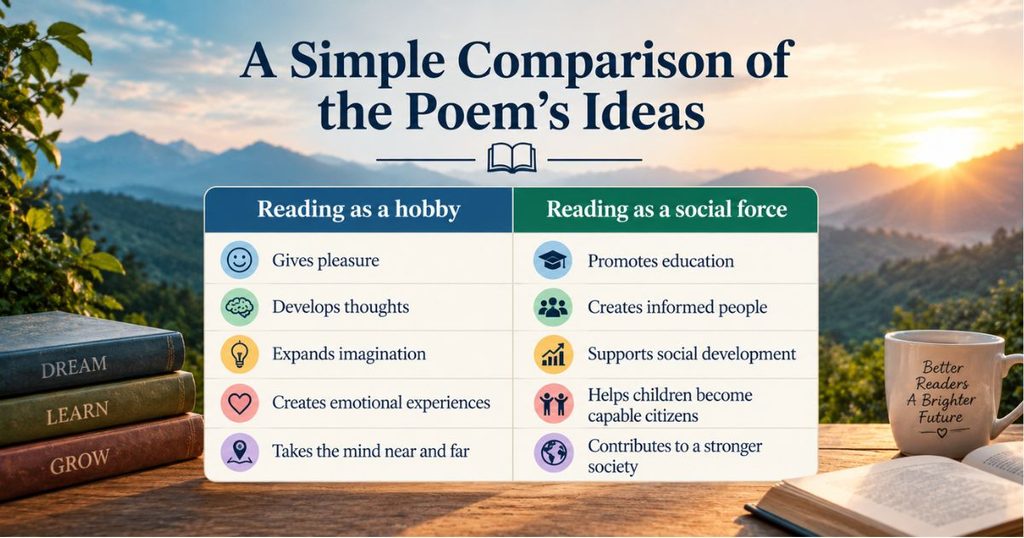
This progression is what gives the poem its depth. It begins with “my” hobby but ends with “we” shall succeed. The movement from individual experience to collective success is central to the poem’s overall meaning.
FAQs
Q: What is the theme of the poem my hobby is reading?
A: The theme of the poem my hobby is reading is the importance of reading in developing thoughts, imagination, emotional understanding, and education. Arunachalam Chandrashekharan presents reading as a hobby that can take the mind to places near and far, keep rational thinking open, and allow imagination to “fly.” The poem finally connects reading and literacy with the creation of a strong and successful society.
Q: Who wrote the poem “My Hobby: Reading”?
A: The poem “My Hobby: Reading” was written by Arunachalam Chandrashekharan. It is included in the Tamil Nadu State Board Class 8 English curriculum. The poem describes the poet’s love of reading and explains how books develop his thoughts, imagination, emotions, and understanding. Educational materials associated with the textbook identify Chandrashekharan as the poet.
Q: What does reading help the poet do in the poem?
A: Reading helps the poet develop thoughts, explore places through imagination, keep his mind open to rational ideas, experience happiness and sadness, and mentally “fly” without physical wings. The phrase “thought breeding” suggests the development of new ideas, while “rational doors ajar” suggests an open and intelligent mind. Thus, reading is presented as a source of both knowledge and imagination.
Q: What does “without wings it lets me fly” mean?
A: The expression means that reading allows the poet’s imagination to travel without physical movement. A person can sit in one place while a book takes the mind to another country, historical period, fictional world, or unfamiliar experience. Therefore, “flying” is a metaphor for the freedom of thought and imagination that reading provides. The poet uses this image to show that books can expand mental horizons.
Q: How does reading help construct a vigorous society?
A: The poet believes that if all children can read and receive education, they can contribute to a strong and successful society. Reading develops knowledge and thinking, while education gives children the ability to understand and participate in the world around them. The poem therefore connects personal learning with collective progress. Its final message is optimistic: educated and thoughtful children can help society move toward success.
Q: What is meant by “rational doors ajar” in the poem?
A: “Rational doors ajar” is an image for an open and intelligent mind. The poet imagines the mind as a room whose doors remain slightly open. Reading allows new ideas and knowledge to enter while encouraging logical thinking. The phrase does not refer to a real physical door. Instead, it suggests that reading keeps the mind receptive, curious, and capable of reasoning.
Final Thoughts
The answer to what is the theme of the poem, my hobby reading can be expressed simply: the poem celebrates reading as a habit that develops the mind, expands imagination, deepens emotional experience, and supports education.
Arunachalam Chandrashekharan begins with his own love of reading, but the poem gradually becomes much larger. Books help him develop thoughts, explore distant places through imagination, keep his rational mind open, and experience both happiness and sorrow.
The final lines extend this personal experience to all children. The poet imagines that widespread literacy and reading can help construct a vigorous society. Therefore, the poem’s message is not simply that reading is enjoyable. It presents reading as a meaningful habit that can help individuals grow and contribute to a better society.
For students, the lasting lesson is clear: a good reading habit can open the mind, strengthen imagination, increase knowledge, and help us succeed together.
Recent Article : Who Is the Poet of ‘Teamwork’? Summary & Moral Explained

Jennifer Aston is a passionate poetry curator and writer with a deep love for the written word. She believes poetry has the power to heal, inspire, and connect people across all walks of life. Through PoemSteric, she brings together timeless and modern verses for every emotion and every moment.