
Introduction
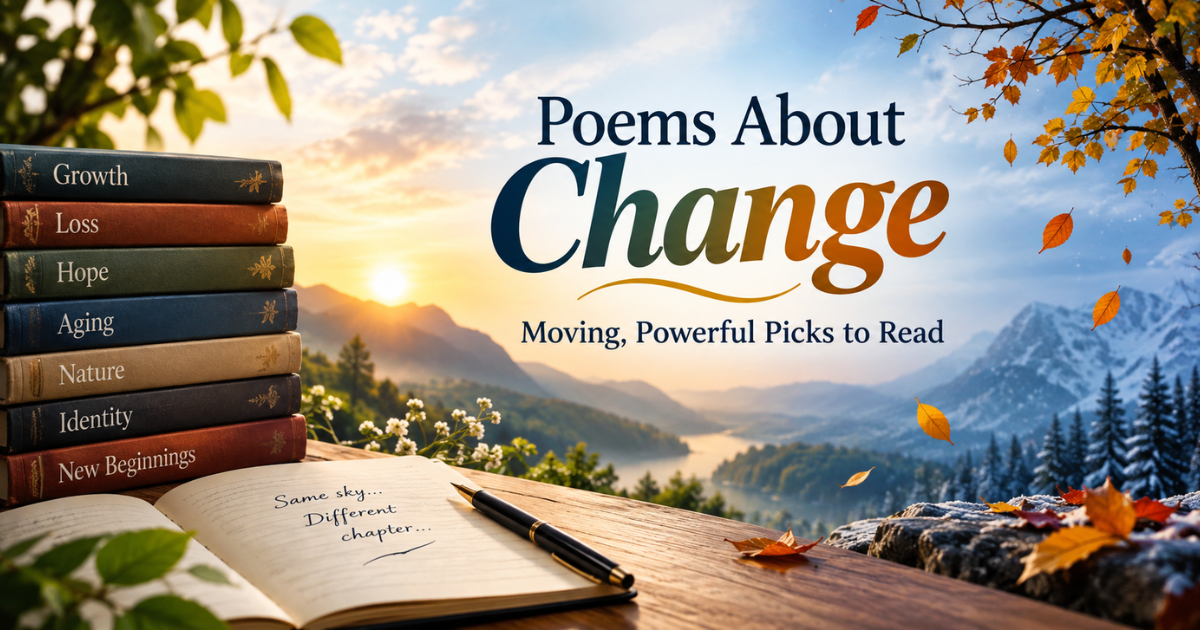
Poems about change explore the transformations that shape human life, including growing older, losing people, starting again, changing identity, and watching nature move through its seasons. Some poems present change as hopeful and necessary, while others focus on grief, uncertainty, or the difficulty of letting go.
Change is one of poetry’s most enduring subjects because almost every human experience involves some form of transition. Childhood becomes adulthood, familiar places disappear, relationships evolve, and seasons return in altered forms.
The poems below are organized by meaning rather than simply listed as famous titles. They include works by poets such as Robert Frost, William Shakespeare, Dylan Thomas, William Wordsworth, Walt Whitman, Maya Angelou, and others whose writing gives different perspectives on transformation.
Key Takeaways
- Change can represent growth, loss, renewal, aging, or social transformation.
- Nature poetry often uses seasons, flowers, trees, and landscapes as symbols of change.
- Poems about personal change frequently explore identity and self-discovery.
- Aging poems connect change with memory, time, and mortality.
- Social poetry can present change as resistance, liberation, or a struggle for recognition.
- Robert Frost’s “Nothing Gold Can Stay” presents the briefness of beauty and youth.
- Dylan Thomas’s “Do Not Go Gentle into That Good Night” approaches aging and death through resistance.
- Shakespeare’s Sonnet 73 connects seasonal imagery with human aging.
- Short poems can communicate change through a single image or metaphor.
- For study, examining imagery, symbolism, tone, and structure can reveal how a poet represents transition.
Poems About Change and Personal Growth
Some of the most meaningful poems about change focus on the individual. They explore leaving familiar circumstances, discovering a new identity, accepting difficult experiences, or deciding to move forward.
Robert Frost’s “The Road Not Taken” is often discussed as a poem about choices and their consequences. The speaker encounters two roads in a wood and must choose one. Its ending has become widely associated with individual decision-making, although the poem is more complex than the simple message that people should always choose an unconventional path.
Frost’s “The Pasture” offers a gentler form of transition. The speaker repeatedly invites another person to come along while he performs ordinary farm tasks. Its recurring movement toward the pasture gives the poem a feeling of renewal and return.
Another useful work is “When You Are Old” by W. B. Yeats. The poem imagines a future in which the beloved looks back on her life and recognizes the difference between superficial admiration and deeper love. Aging becomes the framework through which emotional change is understood.
Poems About Hopeful Change
Hopeful change often appears through images of movement, awakening, or new beginnings. These poems do not necessarily claim that change is easy. Instead, they show how transformation can create possibility.
Walt Whitman’s “Song of the Open Road” presents movement as an expansive experience. The road becomes more than a physical route; it represents independence, possibility, and the continuing journey of life.
Mary Oliver’s “The Summer Day” also encourages reflection on how a person should spend a finite life. Its famous grasshopper observation leads toward questions about attention, existence, and how we use the time available to us.
For younger readers, “Hope is the thing with feathers” by Emily Dickinson offers another perspective. Dickinson compares hope to a bird that continues singing despite difficult conditions. The metaphor makes emotional endurance visible through a natural image.
Poems About Painful Change
Not every transformation feels positive. Some changes involve death, separation, disappointment, displacement, or the end of a relationship.
Dylan Thomas’s “Do Not Go Gentle into That Good Night” confronts the approach of death. The repeated call to resist the dying of the light creates a forceful emotional structure. Thomas wrote the poem as a villanelle, a form built around recurring lines and a tightly controlled rhyme scheme.
Elizabeth Bishop’s “One Art” takes a different approach to loss. The poem repeatedly examines the act of losing things, moving from ordinary objects toward increasingly serious emotional losses. Its controlled form creates tension between the speaker’s insistence that loss can be mastered and the pain underneath that claim.
These poems demonstrate an important principle: poetry about change does not have to offer comfort. Sometimes its purpose is to give precise language to an experience that cannot be easily resolved.
Poems About Change in Nature and Seasons
Nature provides poets with a powerful vocabulary for transformation. Spring, summer, autumn, and winter naturally create a cycle of emergence, maturity, decline, and renewal.
Robert Frost’s “Nothing Gold Can Stay” is one of the clearest examples. The poem compresses the idea of impermanence into a short meditation on how quickly beautiful beginnings disappear. Its opening image of nature’s first green becoming something less permanent gives the poem its central tension.
William Wordsworth’s “Lines Written in Early Spring” uses a natural setting to reflect on humanity. The speaker observes birds, flowers, and other elements of the landscape while considering human behavior. Nature becomes a way to think about what people have gained or lost.
Percy Bysshe Shelley’s “Ode to the West Wind” offers a more dramatic image of change. The west wind carries dead leaves away but also helps scatter seeds. Therefore, destruction and renewal appear together rather than as completely separate experiences.
Seasonal poetry is particularly effective because readers already understand that nature changes continuously. A falling leaf can therefore become an image for aging, separation, memory, or the end of one stage of life.
The same technique appears across many literary traditions. Instead of directly announcing “everything changes,” poets can show a flower opening, a river moving, snow disappearing, or daylight fading.
Poems About Aging, Time, and Mortality
Time creates some of literature’s most persistent questions: What remains when youth disappears? Can beauty survive? How should people respond to mortality?
Shakespeare’s Sonnet 73 is a particularly strong example. The speaker compares his stage of life to late autumn, twilight, and a dying fire. These three images progressively narrow from season to day to flame, creating a powerful meditation on mortality.
Shakespeare’s Sonnet 60 takes another approach. It compares human life to waves moving toward a shore and describes time as an unavoidable force. The poem ultimately considers whether poetry can preserve something against time’s destructive power.
Dylan Thomas’s “Do Not Go Gentle into That Good Night” approaches the same subject with a radically different tone. Instead of quiet acceptance, the poem urges resistance. Its repeated refrain gives emotional intensity to the speaker’s confrontation with death.
Thomas Hardy’s poetry frequently returns to memory, change, and the passage of time. In “The Darkling Thrush,” the bleak winter landscape reflects uncertainty, while the unexpected song of the thrush introduces a small possibility of hope.
These poems are useful for study because they demonstrate how the same subject can produce very different tones. Time may be presented as beautiful, cruel, inevitable, mysterious, or strangely hopeful.
Poems About Social Change and Identity
Change can also happen beyond the individual. Poets have long written about cultural identity, discrimination, freedom, migration, gender, race, war, and changing social conditions.
Maya Angelou’s “Still I Rise” presents resistance and self-affirmation in the face of oppression. Its repeated language creates momentum as the speaker asserts dignity despite attempts to diminish her.
Langston Hughes’s “I, Too” addresses racial exclusion and anticipates a future in which the speaker will claim a fuller place within American society. The poem’s relatively simple language gives its vision of change considerable force.
Claude McKay’s “If We Must Die” responds to racial violence and persecution with a call for dignity and resistance. Its formal structure demonstrates how traditional poetic techniques can be used to express urgent political and social concerns.
Identity can also change internally. A person may move between cultures, languages, communities, or stages of life and discover that identity is not completely fixed.
When studying social-change poetry, it is important to consider historical context. The meaning of a poem often becomes clearer when readers understand the social conditions, literary movements, and experiences surrounding its composition.
Short Poems About Change to Share
Short poetry can express change without requiring a long narrative. A single image may be enough to suggest an entire transition.
Here are several original mini-prompts for readers who want to write or share short poems about change:
- A leaf: Write about the final day a leaf remains attached to a tree.
- An old photograph: Describe two people who have changed since the photograph was taken.
- A doorway: Write about the moment before someone enters a completely different life.
- A clock: Let a clock describe what it has witnessed.
- An empty room: Show that someone has left without directly saying they are gone.
- A river: Describe how the river remains itself while everything around it changes.
These ideas work because they use concrete objects to represent abstract experiences. Rather than explaining change directly, the writer allows the reader to infer it.
For social sharing, a short poem is often more effective when it focuses on one emotional movement. A few precise images can create more impact than several general statements about life.
Poems About Change for Study and Reflection
For students, researchers, and general readers, poems about change offer several useful literary concepts to examine.
Start by identifying the central change. Ask what is different at the beginning and end of the poem. The change might be physical, emotional, psychological, social, or seasonal.
Next, examine the imagery. Does the poet use roads, seasons, rivers, flowers, darkness, light, buildings, or journeys? Concrete images often carry the poem’s larger meaning.
Then examine the tone. Is the speaker hopeful, nostalgic, angry, fearful, accepting, defiant, or uncertain? A poem can describe positive change while maintaining a sad tone.
Finally, study form and sound. Repetition can suggest cycles or persistence. Rhyme can create order. A disrupted rhythm can reflect uncertainty. A sonnet can place an apparently personal experience inside a highly structured tradition.
A useful study method is:
- Identify the change.
- Find the central metaphor or image.
- Examine the speaker’s emotional response.
- Look for repetition and contrast.
- Connect the poem to its historical context.
- Explain how form reinforces meaning.
In my own reading of poetry, the most interesting poems about change rarely present transformation as simply good or bad. They often hold opposing emotions together: grief with hope, fear with excitement, or loss with renewal.
FAQs
Q: What are some famous poems about change?
A: Several widely studied poems explore change through different subjects. Robert Frost’s “Nothing Gold Can Stay” examines impermanence, while Shakespeare’s Sonnet 73 explores aging through seasonal and natural imagery. Dylan Thomas’s “Do Not Go Gentle into That Good Night” confronts mortality and resistance. Walt Whitman’s “Song of the Open Road” connects movement with possibility. Together, these works show that change can involve nature, personal growth, aging, choice, and mortality.
Q: Which poem is best for studying change and personal growth?
A: There is no single poem that represents every form of personal growth. Robert Frost’s “The Road Not Taken” is useful for studying choices and their consequences, while Walt Whitman’s “Song of the Open Road” emphasizes movement and independence. W. B. Yeats’s “When You Are Old” examines how people and relationships look different across time. The most useful choice depends on whether your assignment focuses on decisions, maturity, identity, or emotional transformation.
Q: What poems about change focus on nature?
A: Robert Frost’s “Nothing Gold Can Stay” is a concise example because it uses natural change to explore impermanence. Percy Bysshe Shelley’s “Ode to the West Wind” connects destruction with renewal through the movement of leaves and seeds. William Wordsworth’s “Lines Written in Early Spring” uses nature as a setting for reflection on human life. These poems demonstrate how seasons and natural processes can become metaphors for emotional or philosophical change.
Q: What poem is about aging and the passage of time?
A: Shakespeare’s Sonnet 73 is one of the clearest examples. The speaker uses three connected images—late autumn, twilight, and a dying fire—to represent different aspects of aging. Shakespeare’s Sonnet 60 also examines the destructive movement of time. Dylan Thomas’s “Do Not Go Gentle into That Good Night” approaches mortality differently, emphasizing resistance rather than quiet acceptance. These poems provide useful contrasts in tone and poetic technique.
Q: Why do poets write poems about change?
A: Change is central to human experience, so poetry gives writers a way to examine experiences that can be difficult to explain directly. A poet can use seasons to represent aging, a road to represent choice, or a disappearing landscape to represent memory. As a result, poems about change can communicate several meanings at once. They also allow readers to connect a specific poetic image with their own experiences of transition.
Q: How can I write my own poem about change?
A: Begin with one specific transition rather than the broad idea of change. Choose an object, place, memory, person, or natural image that represents what is changing. Then describe what it looked like before, what is happening now, and what might happen next. Avoid explaining the lesson too early. Instead, use imagery and contrast so readers can discover the emotional meaning. Reading the draft aloud can also help you identify weak rhythm or unnecessary lines.
Final Thoughts
Poems about change remain powerful because change is both universal and deeply personal. A season changes, a child grows, a relationship ends, a society evolves, and every person eventually confronts time.
The strongest poems do not always tell readers whether change is good or bad. Instead, they explore its contradictions through imagery, symbolism, rhythm, memory, and voice.
From Frost’s fragile natural beauty to Shakespeare’s reflections on aging and Thomas’s resistance to mortality, these works show how differently poets can approach transformation. Reading them closely can help students understand poetry while giving every reader language for life’s transitions.
When choosing a poem, look beyond its title. Ask what changes, why it changes, how the speaker responds, and what the poet’s images reveal about that experience.
Recent Article : Rhyme Generator: Fast, Accurate Rhymes for Better Writing

Jennifer Aston is a passionate poetry curator and writer with a deep love for the written word. She believes poetry has the power to heal, inspire, and connect people across all walks of life. Through PoemSteric, she brings together timeless and modern verses for every emotion and every moment.