
Introduction
A lipogram poem is a poem written without using one or more chosen letters. The writer deliberately avoids the forbidden letter throughout the poem, creating a challenging form of constrained writing. For example, a poet might write a short poem without using the letter e.
The word lipogram comes from Greek roots associated with leaving out a letter. Although the technique can be used in prose, it is especially interesting in poetry because every word choice affects rhythm, meaning, sound, and line length.
Lipograms are closely connected with Oulipo, the French literary movement founded in 1960 by writer Raymond Queneau and mathematician François Le Lionnais. Oulipo explored writing through strict formal constraints and treated limitations as a way to generate new creative possibilities.
Key Takeaways
- A lipogram deliberately excludes a chosen letter.
- A lipogram poem applies this restriction to poetry.
- The forbidden letter may appear nowhere in the finished poem.
- Common challenges involve avoiding frequently used letters such as e.
- Lipograms are examples of constrained writing.
- Oulipo helped make constraint-based writing widely associated with modern literary experimentation.
- Georges Perec’s La Disparition is a famous example of an entire novel written without the letter e.
- The best lipograms remain meaningful rather than becoming word puzzles alone.
What Is a Lipogram Poem?
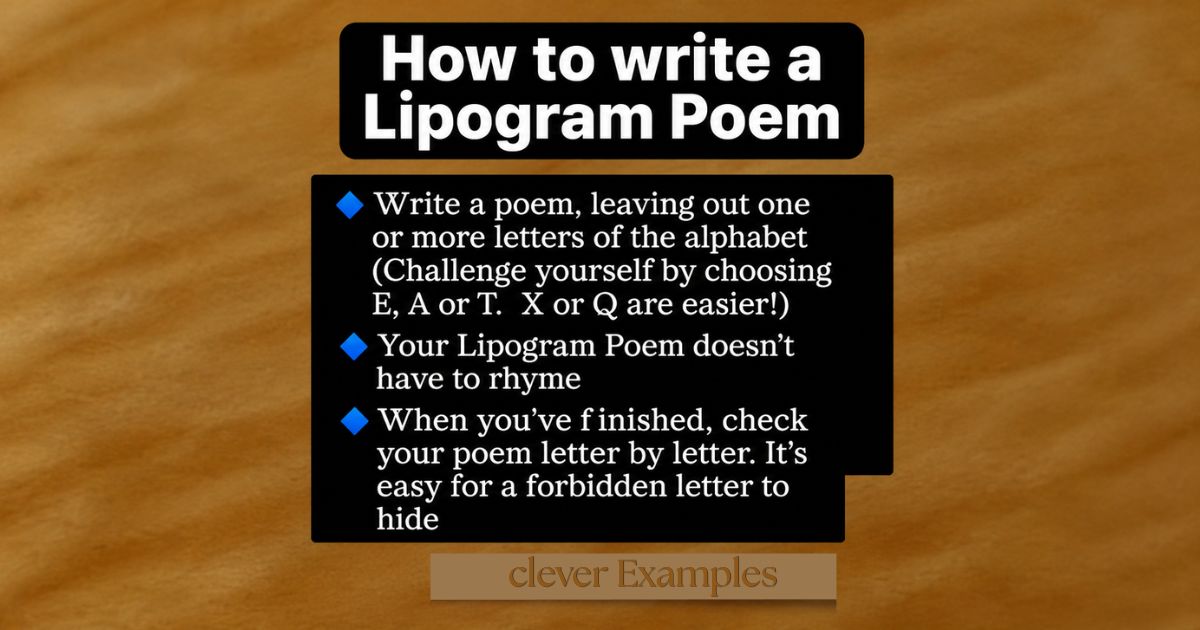
A lipogram poem is a poem in which the writer intentionally leaves out a particular letter or group of letters.
For instance, imagine that you choose e as the forbidden letter. Every word in the finished poem must avoid that letter. A simple example could be:
Soft rain falls
Clouds drift by
Birds fly low
Night draws near
This example does not use the letter e. The challenge is not simply avoiding one symbol. The writer must still create understandable lines with appropriate rhythm and imagery.
That makes a lipogram different from an ordinary writing prompt. A prompt might tell you to write about rain, while a constraint tells you how you must construct the language.
Lipograms can therefore produce surprising vocabulary. If the word you first want is forbidden, you have to search for another word with a similar meaning. This process can lead to unexpected images and expressions.
Why Avoiding One Letter Is Difficult
Some letters occur far more frequently than others. In English, e is particularly difficult to avoid because it appears in many ordinary words and grammatical forms.
Consider words such as the, people, before, where, and because. Avoiding one common letter can remove a large portion of your natural vocabulary.
The difficulty becomes greater when you try to write a poem that still sounds natural.
You must think about:
- Vocabulary
- Grammar
- Sentence structure
- Rhythm
- Rhyme
- Meaning
- Spelling
- Repeated letters
A single accidental letter can break the constraint. Therefore, revision is essential.
The challenge can also become productive. When a normal word is unavailable, you are forced to consider alternatives. Oulipo writers have used this kind of constraint deliberately to create literary possibilities that might not emerge through unrestricted writing.
Famous Lipogram Examples
One of the most famous lipogrammatic works is Georges Perec’s 1969 novel La Disparition, which avoids the letter e throughout the original French text. Its English translation, A Void, also maintains the central restriction.
Perec’s achievement is important because he is extremely common in French. The constraint therefore affects vocabulary, grammar, and the way the narrative can be expressed.
Perec was also a member of Oulipo, a group dedicated to literary experimentation through formal constraints. The movement’s work demonstrates that restrictions do not necessarily reduce creativity; they can provide a framework for producing unexpected language.
For poetry, lipograms can be much shorter and more accessible. A beginner can start with four or six lines rather than attempting an entire book.
Lipogram vs. Other Constrained Writing Forms
A lipogram belongs to the larger world of constrained writing, but it is not the only form.
| Form | Main constraint |
| Lipogram | Avoid a chosen letter |
| Acrostic | Initial letters create a word or phrase |
| Sestina | Repeats six end words in a prescribed pattern |
| Snowball poem | Lines follow a progressively increasing word pattern |
| N+7 | Replaces nouns according to a dictionary-based rule |
Oulipo is particularly associated with these kinds of structured experiments. The Academy of American Poets explains that Oulipo writers explored verse and literature through mathematical or structural constraints.
A lipogram is therefore different from an acrostic. An acrostic tells you where to place letters, while a lipogram tells you which letters not to use.
The distinction matters because each constraint creates a different writing problem.
How to Write Your First Lipogram Poem
Writing your first lipogram poem is easier if you begin with a short target rather than attempting a long composition.
Choose a theme, select one forbidden letter, and write several lines while constantly checking your vocabulary.
A practical process is:
- Choose a simple topic.
- Select one forbidden letter.
- Make a list of useful words that avoid it.
- Write a rough draft.
- Replace words that contain the forbidden letter.
- Check grammar and meaning.
- Scan the complete poem for accidental uses.
- Read it aloud and revise the rhythm.
Do not worry about making the poem impressive immediately. The first goal is to satisfy the constraint while preserving meaning.
Choose the Forbidden Letter and Topic
For your first attempt, avoid choosing an extremely difficult letter such as e unless you want a serious challenge.
A less common letter can give you more freedom.
You might choose:
- A poem about rain without r
- A poem about school without s
- A poem about night without n
- A poem about friendship without f
The topic also matters. Concrete subjects such as weather, animals, seasons, or a particular place can provide useful vocabulary.
Once you become comfortable, increase the difficulty by choosing a common letter or adding another restriction.
Draft, Revise, and Check Every Word
The first draft should focus on getting ideas onto the page. During revision, examine every word for the forbidden letter.
A useful method is to use a text editor’s Find function. Search for the restricted letter and inspect every result. Remember to check both uppercase and lowercase forms.
Then read the poem aloud.
A technically correct lipogram can still sound awkward. Replace unnatural expressions where possible while preserving the restriction.
In my own approach to constrained writing, the most useful question is not simply, “Did I avoid the letter?” It is, “Does the poem still communicate something worth reading?”
Lipogram Examples for Beginners
Here are a few original mini-examples to show how the technique works.
Example 1: Without “e”
Dark clouds drift
Soft rain falls
Birds fly low
Night wraps all
The poem avoids e while maintaining a simple image of an approaching night.
Example 2: Without “a”
Cold winds blow
Snow fills roofs
Trees bend low
Birds seek food
Here, the writer must avoid one of the most common vowels while still creating a recognizable winter scene.
Example 3: Without “o”
Soft rain falls
Birds lift wings
Mist fills air
Night feels near
These short examples show why word choice is central to a lipogram. A writer cannot always use the first word that comes to mind.
For beginners, four to eight lines are enough. Once the process becomes comfortable, try writing a longer poem with a stricter constraint.
FAQs
Q: What is a lipogram poem?
A: A lipogram poem is a poem that deliberately avoids a particular letter or group of letters. The writer must construct every line without using the forbidden character. This makes the poem a form of constrained writing and can produce unusual vocabulary, imagery, and sentence structures.
Q: What is an example of a famous lipogram?
A: Georges Perec’s La Disparition, published in 1969, is one of the best-known examples. The original French novel avoids the letter e throughout. Its English translation, A Void, was also created under the same central constraint.
Q: Why are lipograms difficult to write?
A: Lipograms are difficult because common letters occur naturally in many everyday words. When a forbidden letter cannot be used, the writer must find alternative vocabulary while preserving grammar, meaning, rhythm, and tone. The challenge becomes particularly demanding when the excluded letter is very common.
Q: Is a lipogram poem a type of Oulipo writing?
A: Lipograms are strongly associated with Oulipo because the movement made literary constraints a central part of its practice. However, the technique itself predates the formation of Oulipo in 1960. Oulipo helped renew interest in constraint-based literary experimentation.
Q: How do you write a lipogram poem?
A: Choose a topic and one forbidden letter first. Then draft several short lines while avoiding that letter. During revision, replace unsuitable words, check every occurrence of the restricted character, and read the poem aloud to improve its rhythm. A short poem is the easiest starting point.
Q: Which letter is hardest to avoid in English?
A: The letter e is one of the hardest letters to avoid because it occurs very frequently in English. That is why avoiding e creates a particularly demanding lipogrammatic challenge. The difficulty can vary depending on the subject, vocabulary, and length of the poem.
Final Thoughts
A lipogram poem turns a simple restriction into a creative writing challenge. By removing one letter, you are forced to reconsider ordinary vocabulary and discover alternative ways to express an idea.
Start small with four or six lines, choose a manageable forbidden letter, and revise carefully. As your skills improve, try more difficult constraints.
The real value of a lipogram is not merely proving that you can avoid a letter. It is discovering how a limitation can change the language, rhythm, and possibilities of a poem.
Recent Article : Blackout Poetry: Creative Guide to Make One Easily

Jennifer Aston is a passionate poetry curator and writer with a deep love for the written word. She believes poetry has the power to heal, inspire, and connect people across all walks of life. Through PoemSteric, she brings together timeless and modern verses for every emotion and every moment.