
Introduction
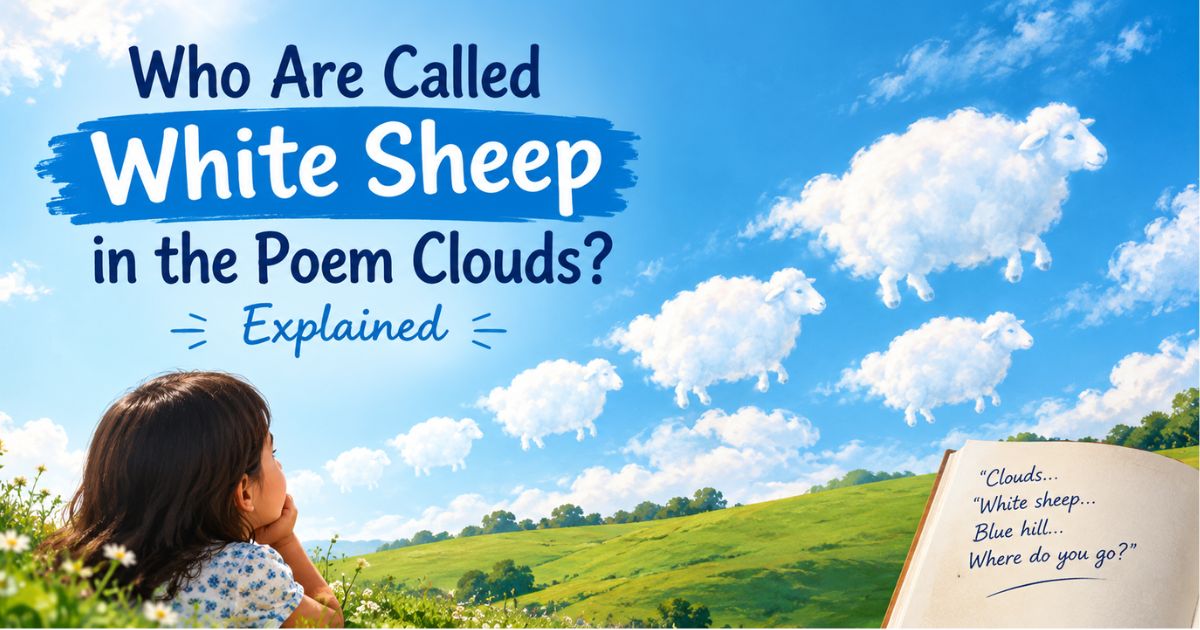
The clouds are called “white sheep” in the poem “Clouds” because their soft, white shapes resemble a flock of sheep moving across a blue sky. The comparison creates a simple and memorable picture of clouds as they stand still when the wind stops and slowly move when the wind blows.
The poem presents the sky as a peaceful landscape. The blue sky becomes a “blue hill,” while the white clouds appear like sheep standing or walking across it. This imaginative comparison makes an ordinary sight in nature easy for young readers to understand.
The poem is commonly associated with Christina Rossetti, although attribution is not completely consistent across sources. The Academy of American Poets currently presents the poem as “Anonymous” and separately notes that it is sometimes attributed to Rossetti.
The main question, however, has a very direct answer: the “white sheep” are the clouds. The poet uses a metaphor based on their white, fluffy appearance and their slow movement through the sky.
Key Takeaways
The comparison between clouds and sheep is the central image of the poem. It is not meant to suggest that clouds are actually animals. Instead, it helps the reader visualize their appearance and movement.
Here are the main points to remember:
- White sheep = clouds
- Blue hill = blue sky
- Wind = the force that moves the clouds
- Still clouds = clouds when the wind stops
- Moving sheep = clouds drifting with the wind
- The poem uses metaphor and visual imagery.
- Its language is simple, playful, and suitable for young readers.
The image works because clouds can look soft and fluffy, just like woolly sheep. They also appear to move together across the sky, especially when wind pushes them.
Why Are Clouds Compared With Sheep?
The comparison is mainly based on appearance and movement. White clouds can look like wool, while a group of sheep can appear as a white flock against a landscape.
The poem turns the sky into a natural scene where the clouds seem to behave like sheep. When the wind stops, they remain still. When the wind blows, they appear to walk slowly away.
What Does the Image Add to the Poem?
The metaphor makes the poem more visual and imaginative. Instead of simply saying that clouds move through the sky, the poet gives readers an image they can easily picture.
For a child, imagining white sheep walking across a blue hill is much more engaging than a plain description of clouds. The comparison therefore makes nature feel playful and alive.
Meaning of “White Sheep” and the Cloud Imagery
The phrase “white sheep” is a metaphor for clouds. A metaphor describes one thing in terms of another without saying that the two are literally the same.
In this poem, the visual relationship is particularly clear. Sheep are generally associated with soft wool and a flock moving together. Clouds can also appear white, soft, rounded, and grouped together in the sky.
The phrase “blue hill” strengthens the image. The sky is imagined as a hill or landscape, while the clouds become sheep moving across it. This creates a miniature pastoral scene above the reader.
The poem also connects the clouds’ movement with the wind. When the wind stops, the clouds appear still. When the wind blows, they seem to walk slowly away. This observation turns ordinary weather into an imaginative scene.
The repeated question at the end, “Where do you go?”, adds curiosity. The speaker watches the clouds disappear and wonders about their destination.
Thus, the poem is not simply identifying clouds. It encourages readers to observe nature carefully and use imagination to understand what they see.
FAQs
Q: Who are called white sheep in the poem “Clouds”?
A: The clouds are called white sheep in the poem “Clouds.” Their white, soft appearance resembles the wool of sheep, while their slow movement across the blue sky resembles a flock walking across a hill. The comparison is a metaphor that makes the clouds easier to visualize and gives the short poem a playful quality.
Q: Why are clouds called white sheep?
A: Clouds are called white sheep because they can look like fluffy white sheep moving together across the sky. The poet imagines the blue sky as a hill and the clouds as sheep walking over it. This simple comparison helps readers understand both the appearance and movement of clouds through familiar imagery.
Q: What does the blue hill represent in the poem “Clouds”?
A: The blue hill represents the blue sky. The poet creates an imaginary landscape in which clouds appear like white sheep moving across a blue hill. This metaphor makes the sky easier to visualize and gives the poem its child-friendly, imaginative character. The contrast between white clouds and the blue sky also creates a clear visual picture.
Q: What happens to the white sheep when the wind blows?
A: When the wind blows, the “white sheep,” meaning the clouds, appear to move slowly across the sky. When the wind stops, they appear to stand still. The poet uses this simple observation to describe how wind affects the movement of clouds.
Q: Who wrote the poem “Clouds”?
A: The poem “Clouds” is commonly attributed to Christina Rossetti, but the attribution is not completely settled. The Academy of American Poets currently lists the poem as Anonymous and notes that it is sometimes attributed to Christina Rossetti. Therefore, when accuracy is important, it is safer to mention the attribution issue rather than present Rossetti’s authorship as completely certain.
Final Thoughts
The white sheep in the poem “Clouds” are the clouds themselves. The poet compares their soft white appearance and slow movement to a flock of sheep travelling across a blue hill.
The image makes the poem simple, visual, and enjoyable. It also encourages children to look at ordinary natural scenes creatively. In short, the metaphor of white sheep transforms clouds into a playful flock moving across the blue sky.
Recent Article : Chitre Translation Which Poem in English? Says Tuka Explained

Jennifer Aston is a passionate poetry curator and writer with a deep love for the written word. She believes poetry has the power to heal, inspire, and connect people across all walks of life. Through PoemSteric, she brings together timeless and modern verses for every emotion and every moment.