
Introduction
The theme of the poem Custard the Dragon is that true courage is revealed in moments of crisis, not in loud boasts made in safety. Ogden Nash builds this idea by making Custard, a dragon mocked as a coward, the only character brave enough to face real danger. Readers often notice that the poem’s humor hides a sharp point about how appearances can mislead.
In my own reading of the poem, this contrast is what makes it stick with readers long after the final rhyme. Belinda’s other pets talk a big game about lions and tigers, yet they vanish the moment a real threat appears. Custard, teased for wanting a safe cage, stands his ground. That single reversal carries the entire poem’s meaning, and it is why the piece remains a classroom favorite decades after it was first written.
Key Takeaways
- The main theme of Custard the Dragon is appearance versus reality, closely tied to the idea that a crisis reveals someone’s true character.
- Custard is mocked as a coward for most of the poem, but he becomes the hero once a pirate threatens Belinda’s household.
- Ink, Blink, and Mustard boast about their bravery early on, then run and hide when danger actually arrives, exposing their hypocrisy.
- Ogden Nash uses irony, exaggeration, and onomatopoeia to build humor around a serious point about honesty and courage.
- A secondary theme is self-acceptance, since Custard remains true to his gentle nature even after proving himself brave.
- The poem was first published in 1936 and remains widely taught for its lessons on character and humility.
What Is the Theme of the Poem Custard the Dragon? A Closer Look
Every great children’s poem carries a message underneath its rhyme, and Custard the Dragon is no exception. On the surface, it is a funny story about a girl, her pets, and an unexpected pirate raid. Underneath that, Nash is making a pointed comment on how bravery is often performed rather than practiced.
The poem sets up its theme through contrast. Belinda and her three pets constantly describe themselves using bold, exaggerated comparisons: as brave as a barrel of bears, as fierce as a tiger, as fearless as lion-hunters. Custard, by contrast, is given no such boast. He is simply a coward who wants a safe, comfortable cage. This setup primes readers to expect one outcome, then flips it entirely once danger shows up at the door.
Courage vs. Cowardice as the Central Message
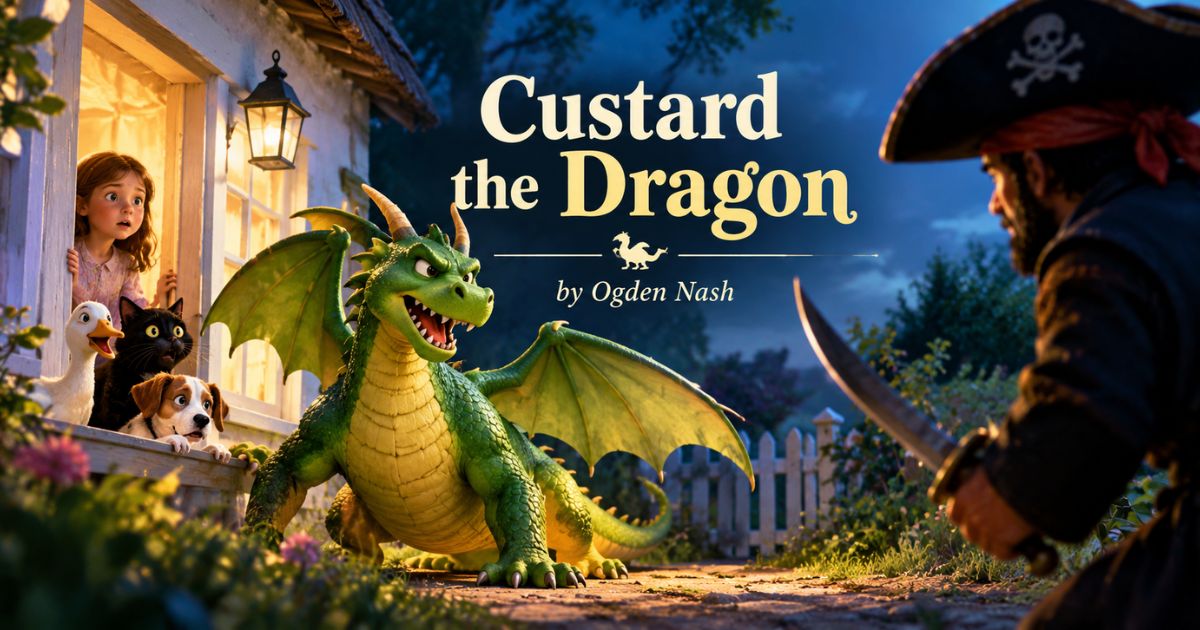
The clearest expression of the theme comes when the pirate creeps into Belinda’s little white house. Ink, Blink, and Mustard, despite their earlier bragging, scatter and hide. Custard, previously ridiculed, is the only one who stands and fights. He confronts the intruder head-on and ends the threat before anyone else even reacts.
This single event flips the poem’s moral logic. The character labeled weak turns out to be the strongest when it actually counts. Nash is not simply telling a fun bedtime story here; he is making an argument about what courage really looks like. True bravery, the poem suggests, has little to do with confident talk and everything to do with what a person, or a dragon, does when the stakes are real.
The Irony Between Appearance and Bravery
Custard looks the part of a fearsome monster. He has sharp teeth, a mouth like a fireplace, and claws described as daggers. Logically, he should be the most intimidating creature in the house. Instead, he is treated as the timid one simply because he prefers safety over swagger.
That mismatch between how Custard looks and how he is treated is the engine of the poem’s irony. Nash plays with reader expectations: a dragon should be terrifying, yet this dragon is gentle and anxious. The household pets should be harmless by comparison, yet they are the ones full of empty bravado. This reversal is what makes the theme land so effectively, because it forces readers to question their own assumptions about who counts as brave.
Who Wrote Custard the Dragon and What Inspired It
Custard the Dragon was written by Frederic Ogden Nash, an American poet who lived from 1902 to 1971. Nash was known for his playful, often absurd rhyme schemes and his gift for turning everyday situations into comic verse. His work first gained wide attention through the New Yorker magazine, and his debut poetry collection, “Hard Lines,” was published in 1931.
Over his career, Nash wrote several hundred pieces of comic verse, with his best work collected across fourteen volumes released between 1931 and 1972. Custard the Dragon, first published in 1936, fits squarely into his broader style: light rhythm, exaggerated imagery, and a twist that rewards close reading. While Nash rarely explained his poems directly, the piece reflects his consistent interest in gently mocking social pretense, whether in adults or, in this case, a household of talking pets.
Nash’s reputation as a master of unconventional, witty verse is part of why Custard the Dragon continues to appear in school curricula around the world. The poem’s playful tone makes it accessible to younger readers, while its underlying theme gives teachers and students plenty to discuss and analyze.
Plot Summary: How the Story Builds the Theme
The poem opens by introducing Belinda, a little girl who lives in a little white house with four pets: Ink, a black kitten; Blink, a grey mouse; Mustard, a yellow dog; and Custard, a pet dragon. Each pet, aside from Custard, is described with a boastful comparison to something fierce. Custard alone is called a coward, since he asks only for a nice, safe cage rather than adventure.
The middle of the poem lets each pet describe their own supposed bravery. Belinda claims to be as brave as a barrel full of bears. Ink and Blink claim they could chase lions. Mustard is described as sharp and fearless. Custard, meanwhile, keeps quietly wishing for safety, which the others treat as proof of his cowardice.
Everything changes when a pirate slips into the house one dark night, armed and dangerous. Suddenly, all the boasting evaporates. Ink hides, Blink burrows away, Mustard cowers, and even Belinda is caught off guard. Custard is the only one who reacts. He leaps forward, overpowers the pirate, and removes the threat entirely, saving the household in the process.
In the poem’s final stretch, everyone showers Custard with praise, calling him a hero. Yet Custard, ever consistent, brushes off the compliments. He still says he would rather have a safe cage than face this kind of danger again. That closing beat matters for the theme: it shows that Custard’s bravery was never about wanting glory. He acted because it was necessary, not because he sought recognition, which reinforces the poem’s larger point about the difference between real courage and performed confidence.
Secondary Themes Worth Noting in Custard the Dragon
While appearance versus reality is the dominant theme, Custard the Dragon carries a few smaller ideas worth unpacking, especially for students preparing for exams or essays. These secondary themes support the main message rather than compete with it, and they help explain why the poem still feels relevant.
One clear secondary theme is hypocrisy. Ink, Blink, and Mustard do not simply fail to act bravely; they had spent the earlier stanzas loudly claiming courage they did not actually possess. Nash uses their empty boasts to sharpen the poem’s central irony, since their words and actions directly contradict each other once real danger appears.
A second secondary theme involves humility. Custard never brags, not before the crisis and not after it. Even after saving everyone, he does not use the moment to demand respect or admiration. This restraint stands in sharp contrast to the other pets and reinforces the idea that genuine courage does not need an audience.
Self-Acceptance and Individuality
Custard’s arc also touches on self-acceptance. He never pretends to be something he is not, even when teased for it. He openly admits he wants safety rather than adventure, and he does not change his personality after becoming the household hero. This consistency suggests that being true to yourself, rather than performing a role others expect, is itself a quiet form of strength.
For younger readers, this angle offers an accessible lesson: you do not have to boast like everyone else to be valuable, and being different from the group, as Custard clearly is, does not make you less capable when it matters most.
Literary Devices That Reinforce the Theme
Nash strengthens the poem’s theme through several literary techniques, and recognizing them helps explain why the message feels so effective despite the poem’s playful tone.
- Irony: The central irony is that the fiercest-looking character is treated as the weakest, while the ordinary pets are assumed to be strong. This mismatch drives the entire theme.
- Exaggeration and hyperbole: Comparisons like being as brave as a barrel of bears are deliberately over-the-top, which makes the pets’ later cowardice funnier and more pointed.
- Onomatopoeia: Sound-based words describing the pirate’s approach and the ensuing chaos add rhythm and drama, pulling readers into the crisis moment.
- Allusion: Nash references Percival, a knight from the King Arthur legends, linking Custard’s unexpected heroism to a long literary tradition of unlikely champions.
- Rhyme and rhythm: The poem’s steady rhyming couplets give it a sing-song, ballad-like quality, which makes the sudden shift in tone during the crisis stand out even more.
Together, these devices do more than add humor. They set up reader expectations, then subvert them exactly when the theme needs to land, which is a hallmark of Nash’s style throughout his body of work.
FAQs
Q: What is the theme of the poem Custard the Dragon?
A: The theme of the poem Custard the Dragon is that true courage shows itself during real danger, not through boastful claims made in safety. Custard, mocked as a coward for wanting a safe cage, becomes the only character brave enough to face a pirate who threatens Belinda’s household. The poem also explores appearance versus reality, since the fiercest-looking character turns out to be gentle, while the ordinary pets prove hollow under pressure.
Q: Who wrote the poem Custard the Dragon?
A: The poem was written by Ogden Nash, an American poet born in 1902 and known for his witty, unconventional comic verse. Nash first became popular through his contributions to the New Yorker and published his debut collection, “Hard Lines,” in 1931. Custard the Dragon appeared in 1936 and remains one of his most recognized and widely taught works, especially in school literature curricula.
Q: Why is Custard called a coward in the poem?
A: Custard is called a coward because, unlike Belinda and her other pets, he never boasts about being fierce or fearless. He simply asks for a nice, safe cage instead of claiming he could fight lions or tigers. The other characters mistake his honesty and caution for weakness, even though his fearsome appearance suggests he could be the most dangerous creature in the house.
Q: How does Custard prove he is actually brave?
A: When a pirate breaks into the house one night, all the previously boastful pets scatter in fear, leaving Belinda unprotected. Custard is the only one who steps forward, confronts the intruder directly, and removes the threat before anyone else can react. His quiet, unclaimed bravery under real pressure is what proves the poem’s larger point about honest courage.
Q: What literary devices support the theme in Custard the Dragon?
A: Nash relies mainly on irony, exaggeration, and vivid sound imagery to support the theme of appearance versus reality. The mismatch between Custard’s frightening looks and gentle nature is the poem’s central irony, while the other pets’ exaggerated boasts make their later cowardice feel sharper by contrast. An allusion to the knight Percival also links Custard’s unexpected heroism to a wider tradition of unlikely champions in literature.
Final Thoughts
The theme of the poem Custard the Dragon endures because it captures something readers of every age recognize: talk is cheap, and real character only shows up when it is tested. Ogden Nash wraps that idea in a playful, rhyming story about a girl and her pets, but the lesson underneath is anything but childish. Custard, dismissed as a coward, becomes the household’s only true protector, while the loudest boasters prove hollow the moment danger appears.
For students and general readers alike, the poem offers a simple but lasting reminder. Confidence and bravado are easy to fake; courage under pressure is not. That is ultimately what makes Custard the Dragon more than a funny bedtime rhyme, and why its central theme continues to resonate nearly a century after Ogden Nash first put it to paper.
Recent Article : What is the Form of the Poem Adonais? (Explained)

Jennifer Aston is a passionate poetry curator and writer with a deep love for the written word. She believes poetry has the power to heal, inspire, and connect people across all walks of life. Through PoemSteric, she brings together timeless and modern verses for every emotion and every moment.