
Introduction
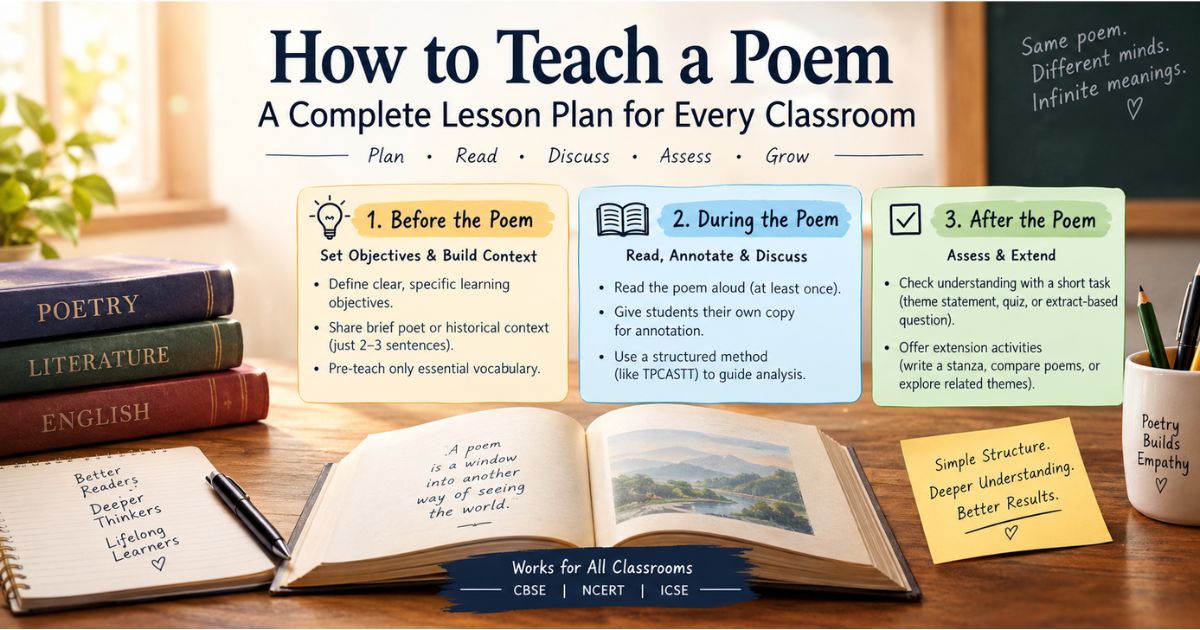
Most poetry lessons fail before the poem is even read not because students dislike poetry, but because the lesson has no real structure. Learning how to teach a poem effectively comes down to three clear stages: preparation before reading, guided reading and discussion during the lesson, and assessment or extension after it. Each stage needs a specific goal, rather than a loose collection of activities, so students build understanding step by step instead of just reacting to the poem once.
This structure works for a five-minute snippet lesson or a full period, and it adapts easily to different exam systems, including CBSE, NCERT, and ICSE classrooms, which most existing guides overlook entirely. In classrooms where I’ve seen this approach used well, the difference isn’t the activities themselves it’s that every activity is tied back to a clear objective for that stage of the lesson.
This guide walks through that full structure, then adds something most current guides skip: how to adapt it for board-specific formats like extract-based questions, a staple of Indian English exams that Western lesson-planning resources rarely mention at all.
Key Takeaways
- A complete poetry lesson plan has three stages: before (objectives and context), during (reading, annotation, discussion), and after (assessment and extension).
- The TPCASTT method (Title, Paraphrase, Connotation, Attitude, Shift, Title, Theme) is one of the most widely used structured approaches for guiding student analysis.
- CBSE, NCERT, and ICSE classrooms need specific attention to extract-based questions, a common exam format that most general teaching guides never address.
- A single 40-minute class period can realistically cover one full poem cycle if time is allocated deliberately across each stage.
- The most common planning mistake is skipping straight to analysis before students have had a chance to simply experience the poem.
How to Teach a Poem Lesson Plan From Start to Finish
Breaking a poetry lesson into three stages before, during, and after gives both new and experienced teachers a reliable structure to plan around, regardless of which poem or grade level is involved.
Before the Poem: Setting Learning Objectives and Context
Start by deciding exactly what students should be able to do by the end of the lesson, rather than simply “understanding the poem.” For example, an objective might be “identify the poem’s central metaphor and explain it in one sentence,” which gives both teacher and students a clear target.
Next, provide brief context: the poet’s background, when the poem was written, and any historical or cultural detail that would otherwise confuse students. However, keep this stage short five minutes of context is usually enough, since spending too long here delays the actual reading of the poem.
- Write one or two specific, measurable learning objectives for the lesson.
- Prepare 2–3 sentences of poet or historical background, no more.
- Pre-teach only the vocabulary that would block basic comprehension, not every unfamiliar word.
During the Poem: Reading, Annotating, and Discussing
Read the poem aloud at least once before asking any analytical questions this single step is one of the most consistently recommended practices across teaching resources, since hearing a poem’s rhythm and sound often reveals meaning that silent reading misses. Afterward, give students their own copy to annotate, marking unfamiliar words, interesting phrases, or questions they have.
A structured method like TPCASTT works well here: students identify the title’s implications, paraphrase the poem line by line, note connotations in word choice, identify the speaker’s attitude or tone, locate any shift in the poem’s direction, revisit the title with new understanding, and finally state the theme in one sentence. As a result, students move through analysis in manageable stages instead of facing the whole poem’s meaning all at once.
- Read the poem aloud once, without interruption, so students experience it as a whole.
- Distribute individual copies for annotation, encouraging students to mark reactions, not just definitions.
- Guide discussion using a structured method (TPCASTT or a similar sequence) rather than open-ended “what do you think this means” questions alone.
After the Poem: Assessment and Extension
Once the poem has been read and discussed, check understanding with a short task a one-paragraph theme statement, a quick quiz, or an extract-based question if the format is relevant to the student’s exam board. For instance, giving students four unseen lines from a related poem and asking them to identify tone and device mirrors exactly what many board exams require.
Finally, offer an extension activity for students who finish early or want to go deeper: writing an original stanza in a similar style, comparing the poem to another on a similar theme, or presenting a short analysis to the class. Consequently, the lesson ends with both a formal check on understanding and room for students who want to engage further.
Adapting Your Lesson Plan for CBSE, NCERT, and ICSE Classrooms
This is the section most competing guides skip entirely, and it’s a real gap worth closing directly. Poems in NCERT’s Class 9 Beehive textbook including “The Road Not Taken,” “Wind,” “No Men Are Foreign,” and “On Killing a Tree” are studied with a specific exam format in mind, and lesson plans that ignore this format leave students underprepared regardless of how well they understood the poem in class.
The single most important format to build into a CBSE or ICSE poetry lesson is the extract-based question: students are given an unseen excerpt from a studied poem and asked short-answer questions about meaning, tone, or literary devices, often worth significant marks on board exams. Unlike a general “analyze this poem” essay prompt common in US classrooms, extract-based questions test precise, line-level comprehension, which means classroom practice should include short excerpt drills, not just whole-poem discussion.
Quick comparison – a Western-style discussion prompt versus a CBSE-style extract question:
| Prompt Style | Example | What It Tests |
| Western discussion prompt | “What do you think this poem is really about?” | Broad interpretation and personal response |
| CBSE-style extract question | “Read the given extract and answer: What does ‘the road less traveled’ symbolize here?” | Precise, line-level comprehension and device identification |
Building both styles into a single lesson open discussion during the lesson, extract-style practice during assessment prepares students for board exams without sacrificing the deeper, more personal engagement that makes poetry worth teaching in the first place.
Common Poetry-Teaching Methods Compared
Several structured methods exist for guiding poetry analysis, and choosing the right one depends on the poem’s difficulty and the class’s familiarity with structured analysis.
- TPCASTT works well for poems with a clear tonal shift or twist, since its “Shift” step specifically asks students to locate where the poem’s direction changes.
- Close reading, where students work through a poem line by line without a fixed acronym, suits shorter or denser poems where every word choice carries weight.
- Summary-first approaches, where students paraphrase the whole poem in plain language before any device analysis, work best for younger or less confident readers who need to grasp basic meaning before tackling technique.
- Extract-drill practice, specific to board-exam preparation, works best in the weeks leading up to an exam, once students already understand the full poem from earlier lessons.
In my experience planning lessons across different class levels, mixing these approaches across a term rather than committing to just one keeps poetry lessons from feeling repetitive while still building the same underlying skills each time.
Sample Lesson Plan Outline for a 40-Minute Poetry Class
Use this time-boxed structure as a starting template, adjusting minute allocations based on the poem’s length and difficulty.
- Minutes 0–5: Share the lesson’s learning objective and give a brief poet or historical context.
- Minutes 5–10: Read the poem aloud once, without pausing for questions.
- Minutes 10–20: Distribute copies for individual annotation, followed by guided discussion using TPCASTT or close reading.
- Minutes 20–30: Discuss key literary devices and themes as a class, referencing specific lines as evidence.
- Minutes 30–35: Assign a short assessment task a theme statement, a quiz, or an extract-based practice question.
- Minutes 35–40: Wrap up with an extension prompt or preview of the next related poem or activity.
This structure gives every stage a defined time slot, which prevents the common problem of running out of time for assessment because discussion ran too long a frequent issue in less time-boxed lesson plans.
Mistakes to Avoid When Teaching a Poem
Even well-prepared teachers can fall into a few repeatable traps when planning a poetry lesson.
- Skipping the read-aloud. Jumping straight into written analysis denies students the chance to hear the poem’s rhythm and sound patterns, which often carry meaning words alone don’t convey.
- Over-explaining before students read. Giving too much context or interpretation up front removes the discovery process that makes poetry engaging in the first place.
- Treating every poem the same way. A poem built around a single striking image needs a different approach than one built around narrative structure or an extended metaphor.
- Ignoring the exam format students will actually face. A lesson that never touches extract-based questions leaves CBSE and ICSE students under-practiced for their actual assessments.
- Running out of time for assessment. Without a clear time allocation, discussion can expand to fill the entire period, leaving no time to check whether students actually understood the poem.
Avoiding these five mistakes does more to improve a poetry lesson than adding new activities on top of an already unstructured plan.
FAQs
Q: What should a how to teach a poem lesson plan include?
A: A complete way to teach a poem lesson plan should include a clear learning objective, brief context about the poet, a read-aloud, guided annotation and discussion using a structured method like TPCASTT, and a short assessment task at the end. For CBSE, NCERT, or ICSE classrooms, it should also include practice with extract-based questions, since these are central to how poetry is assessed on those boards’ exams.
Q: How do you introduce a poem to students?
A: Introduce a poem with brief context about the poet and time period, keeping this stage under five minutes so it doesn’t delay the actual reading. Then read the poem aloud once without interruption, since hearing it first often reveals rhythm and tone that students would miss reading silently on their own.
Q: How long should a poetry lesson be?
A: A single poem can realistically be introduced, read, discussed, and assessed within a standard 40-minute class period if time is deliberately allocated across each stage. Longer or more complex poems may need two periods, one for reading and discussion, and a second for deeper device analysis and assessment.
Q: What is the TPCASTT method for teaching poetry?
A: TPCASTT stands for Title, Paraphrase, Connotation, Attitude, Shift, Title, and Theme, guiding students through a structured sequence of poem analysis steps. It’s especially useful within a how to teach a poem lesson plan because it breaks a potentially overwhelming task “analyze this poem” into smaller, manageable stages students can work through independently or in pairs.
Q: What activities work best for teaching poetry to CBSE or NCERT students?
A: Alongside standard reading and discussion, CBSE and NCERT classrooms benefit specifically from extract-based question practice, since this format appears heavily on board exams but is rarely covered by general Western teaching resources. Pairing whole-poem discussion during the lesson with short excerpt drills closer to exam time prepares students for both genuine understanding and the specific way their exams will test it.
Q: What is the biggest mistake teachers make when planning a poetry lesson?
A: The most common mistake is skipping the read-aloud and moving straight into written analysis, which removes the chance for students to experience the poem’s sound and rhythm before dissecting its meaning. A close second is letting open discussion run long enough that no time remains for assessment, leaving the teacher without a clear check on whether students actually understood the poem.
Final Thoughts
A complete how to teach a poem lesson plan works through three clear stages before, during, and after and adapts that structure to the exam format students actually face, whether that’s an open-ended essay or a CBSE-style extract-based question. The single most important insight from this guide is that structure, not activity variety, is what makes a poetry lesson effective.
Plan the objective first, choose a method that fits the poem’s difficulty, and always leave time at the end to check understanding. Do that consistently, and poetry stops feeling like an unpredictable subject to teach and starts feeling like any other well-planned lesson.
Recent Article : Narrow Domestic Walls Powerful Meaning in Tagore’s Poem

Jennifer Aston is a passionate poetry curator and writer with a deep love for the written word. She believes poetry has the power to heal, inspire, and connect people across all walks of life. Through PoemSteric, she brings together timeless and modern verses for every emotion and every moment.