
Introduction
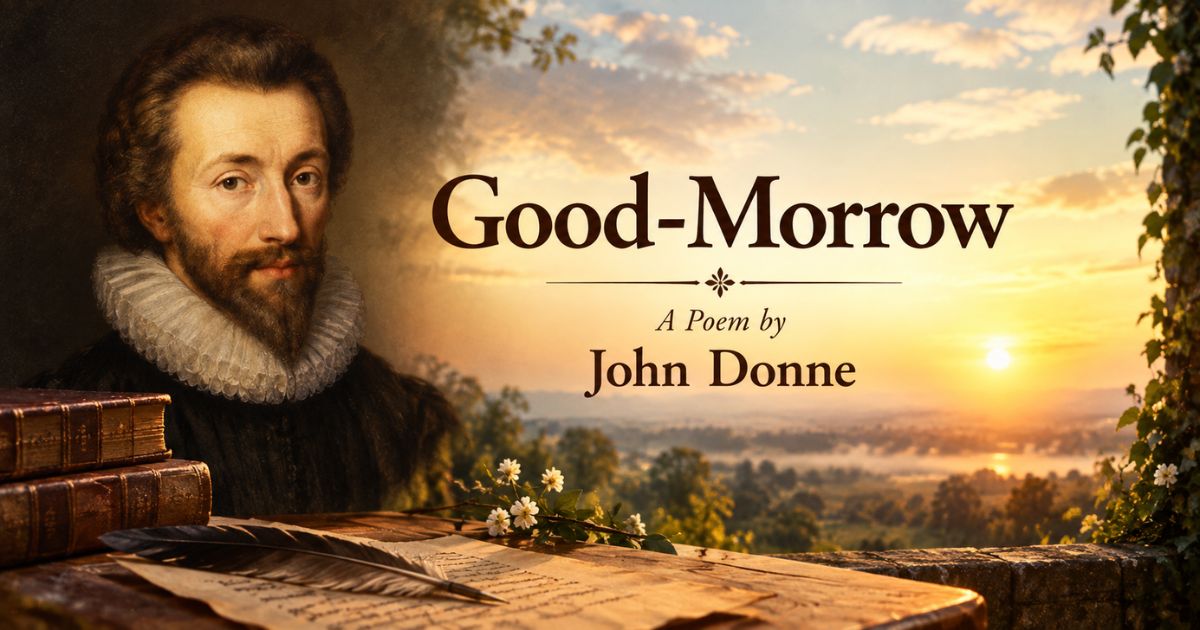
The Good-Morrow is a poem by John Donne, one of the most important poets associated with English metaphysical poetry. The poem is a celebrated love lyric in which a speaker reflects on how his relationship has transformed his understanding of life, love, and the world.
Rather than simply describing romantic affection, Donne presents love as an awakening. The lovers discover that their relationship has created a complete world of its own, making their previous experiences seem immature and incomplete. This combination of passionate emotion, intellectual argument, unusual imagery, and elaborate metaphor is characteristic of Donne’s poetry.
Key Takeaways
- The Good-Morrow was written by John Donne.
- Donne is widely regarded as a major metaphysical poet.
- The poem explores the transformative power of mutual love.
- The speaker addresses his beloved directly, opening with rhetorical questions.
- The poem contains 21 lines divided into three seven-line stanzas.
- Each stanza follows an ABABCCC rhyme pattern, written in a mix of iambic pentameter and hexameter.
- Donne uses metaphysical conceits, imagery, paradox, allusion, anaphora, and geographical imagery.
- The final stanza’s claim that their love “cannot die” draws on medieval alchemy and the theory of humor.
- The lovers’ relationship is presented as balanced, complete, intimate, and spiritually significant.
- The poem moves from a rejection of the lovers’ past to an appreciation of their present relationship and finally to confidence in its permanence.
Who Wrote The Good-Morrow?
John Donne wrote The Good-Morrow.
John Donne (1572–1631) was an English poet, writer, and Anglican cleric who became one of the defining figures of metaphysical poetry. His poetry is known for combining emotional intensity with intellectual argument, unusual comparisons, paradoxes, and extended metaphors known as conceits.
Donne’s love poetry is particularly distinctive because his speakers do not simply express emotion; they often argue about love. In The Good-Morrow, the speaker essentially constructs an intellectual case for the greatness of his relationship. He considers what his life was like before meeting his beloved, explains why their present love has transformed their world, and concludes that their perfectly balanced love can endure.
This mixture of emotional passion and reasoning is one reason the poem is so closely associated with metaphysical poetry.
What is the Literary Context of The Good-Morrow?
The Good-Morrow belongs to the tradition of metaphysical poetry, a term commonly associated with Donne and other seventeenth-century poets.
Metaphysical poetry is often characterized by:
- Intellectual argument
- Surprising comparisons
- Extended metaphors
- Paradox
- Wit
- Conversational language
- Philosophical or spiritual ideas
- The combination of physical and emotional experience
The Poetry Foundation describes Donne as a preeminent metaphysical poet and emphasizes his ability to connect emotional experience with intellectual and often unexpected imagery.
Historically, the poem was also written during the Age of Discovery, the era of intense European sea exploration running roughly from the 15th to 17th centuries. That backdrop directly shapes the poem’s second and third stanzas, with their references to sea-discoverers, new worlds, maps, and hemispheres: Donne deliberately measures the excitement of exploring new lands against the pleasures of love, and has the speaker conclude that love wins.
The Good-Morrow demonstrates the genre’s characteristics particularly well. The speaker moves from a private bedroom to geographical exploration and then to the concept of two lovers as perfectly balanced hemispheres making something intimate and personal feel intellectually expansive.
What is The Good-Morrow About?
At its center, The Good-Morrow is about the transformative power of love.
The speaker opens with a burst of rhetorical questions, asking what he and his beloved did before they truly loved each other. He jokingly suggests that their earlier lives were childish, almost like a period of sleep or unconscious existence. This colloquial, questioning opening was itself unusual for love poetry of the period — Donne breaks from more formal poetic convention by starting mid-thought, as if the reader has walked into a real conversation.
He then describes their present love as an awakening. The lovers have discovered something so complete that their small room becomes “an everywhere.” The outside world, including the discoveries of explorers and mapmakers, seems less important than the world they have created together.
In the final stanza, Donne develops the idea further by comparing the lovers’ faces and relationship to two perfect hemispheres.
The poem therefore progresses from:
Past life → awakening through love → perfect union
This development gives the poem both emotional and argumentative structure.
Who is the Speaker in The Good-Morrow?
The speaker is a lover addressing his beloved.
The poem is written in the first person, and the speaker repeatedly uses “I,” “we,” and “thou,” creating the feeling of an intimate conversation between two people.
He appears to be speaking immediately after waking beside his beloved. This is consistent with the poem’s traditional classification as an aubade a poem associated with lovers awakening or separating at dawn.
The speaker is not simply praising the woman. Instead, he considers what their relationship means for both of them. His argument is that genuine mutual love has changed their entire understanding of existence.
How Does Donne Present Love in the Poem?
Donne presents love as mutual, complete, awakening, and enduring.
The speaker believes that his previous experiences were incomplete compared with his current relationship. He even suggests that previous attractions were merely “a dream” compared with the reality of his present love.
The second stanza expands this idea. The lovers do not need to explore the entire world because their relationship itself contains a world. The famous image of a “little room” becoming “an everywhere” turns physical intimacy into something universal.
The final stanza develops the idea of equality. The speaker sees his own face reflected in his lover’s eye, and knows hers appears in his. Their heartfelt connection is made visible through their faces, and their love is presented as reciprocal rather than one-sided.
The poem ultimately suggests that true love is strongest when both partners participate equally in it.
What is the Structure of The Good-Morrow?
The Good-Morrow contains 21 lines divided into three stanzas of seven lines each. Each stanza follows an ABABCCC rhyme scheme, composed largely in iambic pentameter with occasional lines shifting into hexameter a small metrical irregularity that fits the poem’s conversational, argumentative tone rather than a strictly formal one.
The three stanzas also correspond to three stages of the speaker’s argument.
Stanza One: The Past
The speaker looks backward and questions the value of life before the lovers discover their relationship. Their previous experiences are described as childish or dreamlike.
Stanza Two: The Present
The lovers awaken to one another and discover that their private world is sufficient. The speaker uses images of exploration and geography to explain how their love has expanded their understanding of the world.
Stanza Three: The Future
The final stanza focuses on balance, equality, and permanence. The speaker argues that because their love is perfectly mutual, it can resist the kind of imbalance that leads to death.
This progression gives the poem a strong logical movement despite its conversational tone.
What Literary Devices Does Donne Use?
Donne uses several important literary devices to transform a simple love poem into an intellectually complex work.
Metaphysical Conceit
The most famous technique is the metaphysical conceit, an extended and intellectually surprising comparison. The lovers are compared to two hemispheres. Their faces become geographical images, suggesting that together they form a complete and harmonious world.
Imagery
Donne uses imagery from sleep, childhood, exploration, maps, geography, eyes and faces, and hemispheres. These images allow the speaker to move from intimate love toward universal ideas.
Allusion
The reference to the “Seven Sleepers’ den” alludes to an ancient Christian legend about seven youths who supposedly slept for centuries in a cave, waking to a changed world. The reference strengthens the speaker’s comparison between his former life and a state of sleep or unawareness.
Paradox
The poem repeatedly combines ideas that initially appear contradictory. The lovers are physically confined to a small room, yet that room becomes “an everywhere.” Their physical limitations therefore produce an enormous emotional and imaginative world.
Anaphora
In the second stanza, the repetition of “Let” at the start of successive lines (“Let sea-discoverers…”) builds rhetorical momentum as the speaker dismisses worldly exploration in favor of the world he’s already found in his beloved.
Rhetorical Questions
The poem opens with a cluster of rhetorical questions about the lovers’ past, a deliberately colloquial, almost argumentative opening that was unusual for love poetry of the period and immediately signals the poem’s intellectual, reasoning tone.
Hyperbole
The speaker deliberately exaggerates the importance of his relationship by suggesting that previous pleasures were insignificant compared with his present love. This exaggeration contributes to the poem’s passionate tone.
Scientific / Alchemical Allusion
The poem’s closing argument that their love “cannot die” rests on the medieval theory of humors and elements, the belief that death occurs when a body’s elements become unbalanced. By claiming their two loves are “mixed equally,” with no cold “North” and no “declining West,” Donne borrows the logic of 17th-century alchemy and medicine to argue, almost scientifically, for the immortality of perfectly balanced love. This is worth understanding on its own because it’s the poem’s actual closing proof, not just a decorative image; the whole argument of the final stanza hinges on this borrowed science.
Why is The Good-Morrow Considered Metaphysical Poetry?
The Good-Morrow is considered metaphysical poetry because it combines emotion with intellectual reasoning and unusual extended comparisons.
The poem does not simply say, “I love you.” Instead, Donne constructs an argument: he asks what life meant before love, redefines the lovers’ present world, compares them with explorers, and finally turns their faces into two geographical hemispheres before closing with a quasi-scientific proof of love’s permanence.
This movement from personal emotion to intellectual conceit is characteristic of Donne’s poetic method. The Poetry Foundation notes that Donne’s work is distinguished by unusual conceits and by the fusion of intellect and passion exactly what makes The Good-Morrow more complex than a conventional romantic poem.
What Is the Significance of The Good-Morrow?
The significance of The Good-Morrow comes from its unusual treatment of romantic love.
The poem presents love not merely as physical attraction but as an experience capable of transforming perception. The speaker believes that meeting his beloved has awakened him to a fuller reality.
The poem is also important because it demonstrates several qualities that made Donne influential:
- Intellectual wit
- Emotional intensity
- Metaphysical conceits
- Unusual imagery
- Conversational language
- Philosophical reflection
- Blending of physical and spiritual ideas
The poem’s enduring appeal also comes from the way it makes private love feel universal. The lovers’ small room becomes an entire world, while their mutual reflection becomes a symbol of perfect emotional equality.
The Poetry Foundation describes The Good-Morrow as an early poem that captures Donne’s characteristic interest in unusual imagery, romantic questions, and the relationship between sensual and spiritual experience.
When Was The Good-Morrow Published?
The publication history of Donne’s poetry requires some care.
Donne wrote many poems for circulation among friends and did not publish most of his poetry during his lifetime. The first printed collection of his poems appeared in 1633, two years after his death.
The Good-Morrow is generally associated with the collection Songs and Sonnets, although Donne’s poems were not originally organized into that collection as a modern reader might expect. Its precise date of composition remains uncertain, though scholars generally place it early in Donne’s career, in the early 1600s.
The dating of individual poems is also difficult because Donne’s manuscripts and later printed collections do not provide a simple chronological record. The Poetry Foundation notes that only a small number of Donne’s poems can be dated with certainty and that Songs and Sonnets was not conceived as a single unified body of poems written at one time.
Therefore, it is better to distinguish between the poem’s composition and its later printed publication.
FAQs
Q. The Good-Morrow is a poem by whom?
A. The Good-Morrow is a poem by John Donne, the major English metaphysical poet.
Q. What is the main theme of The Good-Morrow?
A. The main theme is the transformative and unifying power of mutual love. Donne presents love as an awakening that gives the lovers a new understanding of themselves and their world.
Q. How many stanzas are in The Good-Morrow?
A. The poem has three stanzas, with seven lines in each stanza, making a total of 21 lines.
Q. Is The Good-Morrow a metaphysical poem?
A. Yes. It is widely studied as an example of metaphysical poetry because of its intellectual argument, unusual imagery, paradoxes, and metaphysical conceit.
Q. What is the famous conceit in The Good-Morrow?
A. One of the poem’s central conceits compares the lovers to two perfect hemispheres. Their relationship is presented as balanced and complete, creating an imaginative world of its own.
Q. Why does the poem say their love “cannot die”?
A. The final stanza argues, using the medieval theory of humors/alchemy, that death results from imbalance. Because the lovers’ love is “mixed equally,” it has no imbalance to cause its end.
Q. What type of poem is The Good-Morrow?
A. It is a love poem and is often described as an aubade, while its structure and style are closely associated with Donne’s metaphysical poetry.
Final Thoughts
The Good-Morrow was written by John Donne, but identifying the author is only the starting point for understanding the poem.
Donne transforms a moment between two lovers into an intellectual exploration of love, identity, equality, and permanence. Through metaphysical conceits, geographical imagery, allusion, paradox, anaphora, and carefully organized stanzas, he presents love as an awakening that changes the lovers’ entire perception of reality and closes not with a romantic flourish, but with something closer to a scientific proof, borrowed from medieval alchemy, that their balanced love is built to last.
Its three seven-line stanzas, memorable images, and combination of emotional intimacy with intellectual argument make The Good-Morrow one of Donne’s most distinctive love poems. The poem’s lasting importance lies in this unusual combination: John Donne makes passionate love feel like an idea that can be examined, argued, and intellectually understood without losing its emotional power.
Recent Article : What Happens If You Read Tomino’s Hell Poem? Shocking Truth

Jennifer Aston is a passionate poetry curator and writer with a deep love for the written word. She believes poetry has the power to heal, inspire, and connect people across all walks of life. Through PoemSteric, she brings together timeless and modern verses for every emotion and every moment.