
Introduction
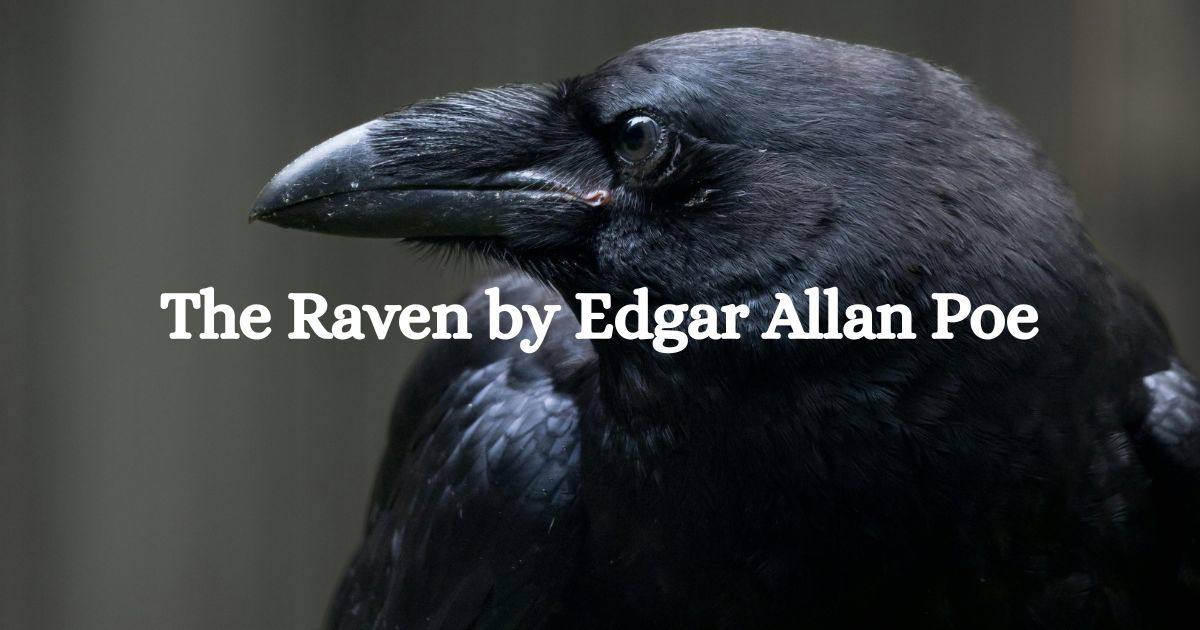
“The Raven by Edgar Allan Poe” is a narrative poem about a grieving man who is visited late one night by a mysterious raven that repeats a single word “Nevermore” in answer to every question he asks it. At its core, the poem is about grief that refuses to be comforted: the narrator, mourning a lost love named Lenore, slowly loses his grip on hope and reason as the raven’s one-word answer turns every question into a fresh wound. Published in 1845, The Raven by Edgar Allan Poe made him famous almost overnight and remains one of the most recognized poems in American literature. This guide explains the poem’s background, meaning, structure, and lasting significance in clear, simple language.
Background and Publication
Poe published “The Raven” in January 1845 in the New York Evening Mirror, and it was reprinted widely within weeks. The poem made him a household name, even though it brought him little financial reward. Poe later wrote an essay called “The Philosophy of Composition,” in which he described building the poem carefully around a single effect: sadness expressed through a repeated, unchanging refrain. Knowing this background matters, because “The Raven” isn’t just an emotional outpouring, it’s a deliberately engineered poem, built line by line to create a specific mood and rhythm.
Summary of the Poem
The poem opens with a narrator sitting alone at midnight, tired and trying to distract himself with old books after the death of his beloved, Lenore. He hears a tapping at his door, and when he opens it, no one is there, only darkness. Soon after, a raven enters through his window and perches above his chamber door, on a bust of Pallas.
The narrator, half-amused and half-unsettled, asks the raven its name, and it answers, “Nevermore.” As the narrator continues speaking first playfully, then more desperately he begins asking the raven serious questions about whether he will ever find peace or be reunited with Lenore. Each time, the bird gives the same answer. By the poem’s end, the narrator has stopped expecting comfort and instead accepts that his sorrow, symbolized by the raven’s shadow, will never lift.
Meaning of the Poem
At a basic level, “The Raven” is about the experience of grief that won’t resolve, no matter how much a person searches for an answer or an escape. The narrator doesn’t ask the raven random questions he specifically asks about hope and reunion with Lenore, and the bird’s single unchanging response transforms from a strange curiosity into a source of torment.
The poem’s meaning goes further than simple sadness, though. Because the raven always says the same word regardless of the question, it comes to represent something like an unchangeable truth the narrator can’t escape: that some losses are permanent, and no amount of asking will change that. The horror in the poem isn’t really about the bird itself, it’s about the narrator’s own mind, trapping him in the same answer over and over.
The Speaker and Setting
The speaker is an unnamed narrator, likely a scholar or student, based on his description of poring over old books late at night. He is emotionally fragile from the start, described as “weak and weary,” which sets up how vulnerable he already is before the raven ever arrives. As the poem continues, his tone shifts from mild curiosity to genuine desperation, revealing a man whose grief has left him unstable and easily shaken.
The setting is a single chamber late at night in December, described with details like a dying fire, rustling curtains, and a shadowy door. This closed, isolated setting matters: the narrator has no one else to speak to and nothing to distract him, which is exactly the condition that allows the raven’s repeated word to take over his thoughts so completely.
Themes: Grief and Loss
The dominant theme of “The Raven” is grief that cannot be resolved through reason or hope. The narrator’s loss of Lenore isn’t simply sad background information, it’s the emotional engine driving every question he asks the raven. His grief doesn’t fade as the poem goes on; instead, it intensifies, because the raven’s answer keeps closing off any comfort he tries to imagine.
Closely tied to this is a theme of loss as something inescapable. The narrator asks the raven directly whether he will see Lenore again, hoping for some form of relief, but the poem makes clear that hope itself becomes a trap when paired with an answer that never changes. This combination of grief and inescapable loss is what gives “The Raven” its lasting emotional weight, rather than a simple gothic atmosphere alone.
Supernatural Elements and the Raven
The raven itself is the poem’s central supernatural element, though Poe never explicitly confirms whether it is truly otherworldly or simply a bird whose limited vocabulary the narrator projects meaning onto. This ambiguity is part of what makes the poem effective: it never resolves whether the raven is a genuine omen or a symbol created entirely by the narrator’s grieving, unstable mind.
Other supernatural or unsettling touches: the tapping at the door, the bust of Pallas the bird perches on, and the narrator’s fear as shadows and curtains move around him all build toward the same effect: a mind that becomes increasingly unable to separate ordinary events from something more sinister. The poem’s power comes from this uncertainty rather than from clearly supernatural events.
Tone and Mood
The tone of “The Raven” shifts gradually from tired curiosity to mounting distress. In the opening stanzas, the narrator’s tone is almost self-aware and mildly amused, muttering explanations for the tapping he hears. As the raven’s answers continue, his tone becomes increasingly desperate and finally despairing, especially once he begins asking about Lenore directly.
The mood for the reader follows this same arc, moving from a quiet, eerie atmosphere into something closer to psychological horror. Because the setting stays confined to one dark room and the raven never changes its behavior, the mood becomes claustrophobic; the reader feels trapped in the same repeating cycle as the narrator himself.
Symbolism and Imagery
The raven is the poem’s most important symbol, representing unshakeable grief and the finality of loss rather than simply serving as a strange visitor. Its perch on the bust of Pallas, a symbol of wisdom and reason is significant: the raven essentially sits on top of rational thought, suggesting that grief has overtaken the narrator’s ability to reason his way out of his sorrow.
Imagery throughout the poem reinforces this idea. The dying embers of the fire suggest fading hope and comfort, while the darkness beyond the door represents the unknown the narrator can’t control. Even small details, like the rustling curtains that frighten him, work symbolically, showing how deeply his grief has made him sensitive to his surroundings.
Rhyme, Repetition, and Meter
“The Raven” is built from eighteen six-line stanzas, most written in a rhythmic pattern known as trochaic octameter, a steady, driving beat of stressed and unstressed syllables that gives the poem a hypnotic, almost musical quality. This rhythm mirrors the poem’s psychological effect: like the narrator’s thoughts, it keeps circling back to the same beat.
Repetition plays an equally important role, especially through the raven’s single word, “Nevermore,” which closes stanza after stanza with the same unchanging sound. Combined with a rhyme scheme built around words that echo “-ore” sounds such as “Lenore,” “door,” and “before” this repetition creates a sense of inevitability, as if the poem itself can’t escape its own refrain any more than the narrator can escape his grief.
Poetic Devices
Beyond rhyme, repetition, and meter, Poe uses several other devices to strengthen the poem’s effect. Internal rhyme, where rhyming words appear within a single line rather than only at the end, adds to the poem’s musical, almost chant-like feel. Alliteration — repeated consonant sounds close together reinforces this same rhythm and makes certain lines easier to remember.
Poe also relies on a refrain, repeating the raven’s answer at the end of stanza after stanza, which builds tension the longer it continues unchanged. Together, these devices aren’t just decorative; they actively create the poem’s unsettling, almost inescapable atmosphere, reflecting the narrator’s inability to break free of his own grief.
Interpretation and Significance
Read as a whole, “The Raven” can be interpreted as a portrait of a mind that traps itself in grief by continuing to ask questions it already knows won’t bring comfort. Rather than presenting mourning as something that eventually eases, Poe shows a narrator who deliberately invites more pain, suggesting that grief can become self-perpetuating when a person cannot stop searching for answers that don’t exist.
The poem’s significance in American literature comes from both its emotional depth and its technical mastery. It demonstrated that a poem’s sound and structure could work together with its subject matter to create a unified emotional effect, influencing generations of poets who followed. Its lasting popularity from parodies to countless adaptations shows how effectively Poe captured a feeling almost everyone recognizes: grief that keeps circling back, no matter how much a person wishes it would move on.
FAQs
Q. What is “The Raven” about?
A. It’s about a grieving narrator visited by a raven that repeats the word “Nevermore,” turning his search for comfort after losing Lenore into a spiral of despair.
Q. What does the raven symbolize?
A. The raven symbolizes grief and loss that cannot be reasoned away, reinforced by its position above a bust of wisdom, suggesting sorrow overpowering rational thought.
Q. Why does the raven only say “Nevermore”?
A. The single, unchanging word transforms an ordinary bird into a symbol of permanent loss, since it answers every question including ones about hope and reunion the same way.
Q. What type of poem is “The Raven”?
A. It’s a narrative poem written in trochaic octameter, known for its musical rhythm, internal rhyme, and repeated refrain.
Q. Why is “The Raven” significant in American literature?
A. It showcased how sound, structure, and subject matter could work together for a single emotional effect, influencing later poets and making Poe internationally famous.
Final Thoughts
The Raven endures because it turns a very ordinary experience of grief that won’t resolve into something hypnotic and unforgettable through rhythm, repetition, and a single unchanging word. Whether read as a ghost story, a psychological portrait, or a technical showcase of poetic craft, the poem’s power comes from the same source: a narrator trapped by his own need for an answer that will never come.
Recent Article : Annabel Lee Poem: Meaning, Theme, and Analysis

Jennifer Aston is a passionate poetry curator and writer with a deep love for the written word. She believes poetry has the power to heal, inspire, and connect people across all walks of life. Through PoemSteric, she brings together timeless and modern verses for every emotion and every moment.