
Introduction
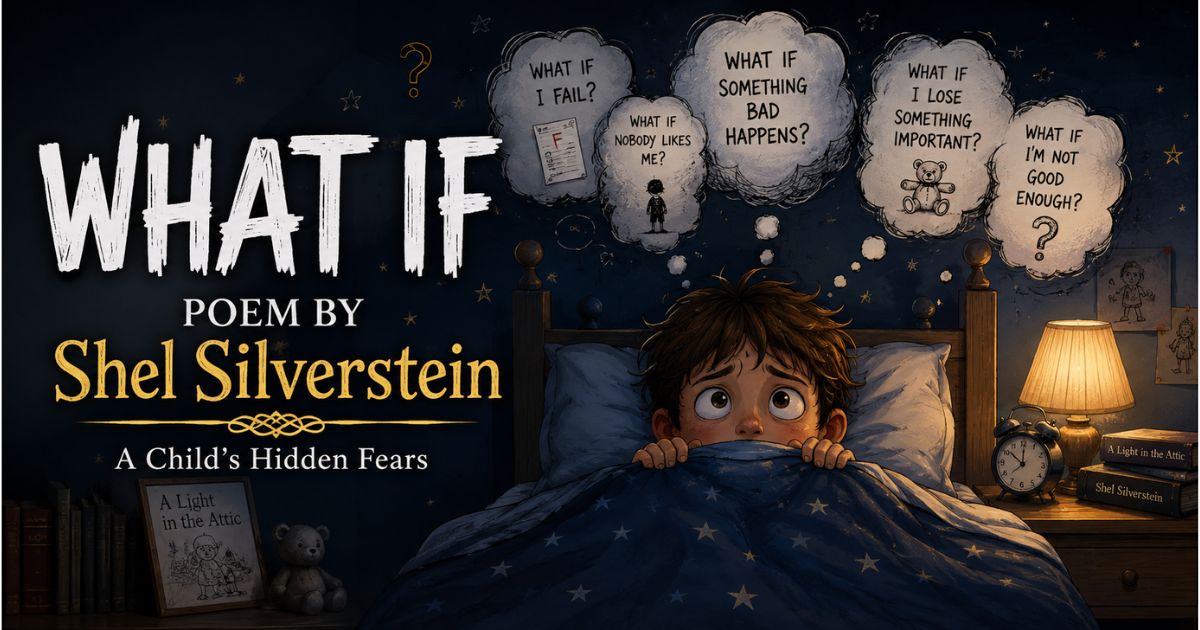
What if poem refers to Shel Silverstein’s “What if,” a playful but thoughtful poem about the fears and worries that can fill a child’s mind at night. The poem presents a speaker who imagines a long list of frightening possibilities, ranging from failure and loneliness to death and uncertainty. Despite its humorous style, the poem shows how quickly ordinary worries can grow inside the imagination.
Shel Silverstein published “What if” in A Light in the Attic in 1981. His simple language makes the poem accessible to children, yet its subject is universal. Adults also recognize the experience of lying awake and imagining everything that could go wrong.
The poem is built around repetition. The speaker repeatedly asks, “What if?” and each question introduces another possible problem. As the questions continue, the reader sees how anxiety can create one worry after another.
The important point is that the poem does not present every fear as a real danger. Instead, Silverstein shows how the mind can create frightening scenarios even when nothing bad is happening. The poem therefore combines humor, anxiety, imagination, repetition, and child psychology in a remarkably simple form.
Key Takeaways
The what if poem is memorable because it turns ordinary childhood worries into a long chain of imaginary possibilities. The speaker does not describe one specific event. Instead, the poem follows the movement of an anxious mind.
The central idea is that fear often becomes larger when we repeatedly imagine negative possibilities. One question leads naturally to another. For example, the speaker worries about failing a test, being unable to make friends, losing something important, and facing frightening situations. The concerns keep changing, but the pattern remains the same.
Several important points help explain the poem:
- Author: Shel Silverstein
- Title: What if
- Collection: A Light in the Attic
- Publication: 1981
- Speaker: A child or young person thinking about possible problems
- Main subject: Fear, anxiety, imagination, and uncertainty
- Dominant technique: Repetition of “What if?”
- Tone: Playful, humorous, nervous, and thoughtful
- Main message: The imagination can turn possibilities into powerful fears.
The poem also demonstrates why Silverstein’s poetry connects strongly with younger readers. He does not lecture the reader about anxiety. Instead, he allows readers to recognize the experience themselves.
In my own reading of the poem, its strongest quality is this balance between humor and discomfort. The questions can make a reader smile, but they also reveal something serious about how people worry.
What if Poem Meaning, Summary, and Speaker
The what if poem follows a speaker who is lying in bed at night and thinking about everything that might go wrong. Instead of falling asleep peacefully, the speaker’s imagination becomes increasingly active.
The poem begins with ordinary concerns. The speaker wonders about situations involving school, friendship, personal failure, and other everyday experiences. However, the worries gradually become more serious. This progression makes the poem feel like an accurate picture of an anxious mind.
The speaker does not solve these problems. That is important. The poem is not structured as a story in which a character faces a problem and finds a solution. Instead, it captures a mental process: question → fear → another question → another fear.
Who Is the Speaker?
The speaker appears to be a child or young person. Silverstein never gives the speaker a detailed biography, name, or background. That makes the character easy for many readers to identify with.
The speaker’s worries sound familiar because children often think about school, friendships, acceptance, failure, and safety. However, the poem’s ideas are not limited to children. Adults can also recognize the habit of imagining negative outcomes.
The speaker is therefore best understood as a representative anxious child rather than a fully developed fictional character.
What Does the Poem Mean?
At its deepest level, the poem explores anticipatory anxiety. The speaker is afraid of events that have not happened and may never happen.
This distinction matters. The poem is not mainly about actual disasters. It is about the mind’s ability to create fear from uncertainty.
For example:
- Reality: Something might go wrong.
- Imagination: What if it goes wrong in every possible way?
That movement from a small possibility to a large collection of fears creates the poem’s humor and emotional power.
Themes and Literary Devices in the What if Poem
The what if poem has a simple structure, but Silverstein uses several literary techniques to make that structure effective. The most important themes include anxiety, childhood fears, imagination, uncertainty, and the power of repeated thoughts.
Anxiety and Childhood Fears
Anxiety is the poem’s most obvious theme. The speaker repeatedly imagines situations that could produce embarrassment, failure, loneliness, danger, or disappointment.
However, Silverstein presents anxiety in a way that children can understand. Instead of using complicated psychological terminology, he shows anxiety through a stream of questions.
This makes the poem relatable. A child who has ever worried before a test or wondered whether friends still like them can recognize the speaker’s thinking.
Repetition and Imagination
The repeated “What if?” structure is the poem’s defining literary device. Repetition creates rhythm while also showing how one anxious thought produces another.
Silverstein also uses rhetorical questions, because the speaker is not really asking another person for answers. The questions represent thoughts happening inside the speaker’s mind.
The poem also uses hyperbole. Some possibilities become increasingly dramatic, showing how imagination can magnify fear.
Other important techniques include:
- Repetition: reinforces the cycle of worrying.
- Rhetorical questions: represent internal thoughts.
- Hyperbole: makes fears larger and more dramatic.
- Imagery: helps readers picture the imagined situations.
- Rhythm: gives the poem an energetic, conversational quality.
- Humor: makes difficult emotions easier to approach.
Together, these techniques create a poem that feels spontaneous while remaining carefully structured.
What if Poem Questions and Answers
Students often search for the what if poem because they need help understanding its speaker, theme, message, and literary techniques. The best way to study it is to connect each answer to something actually happening in the poem.
Who wrote “What if”?
Shel Silverstein wrote the poem. It appears in his 1981 poetry collection A Light in the Attic.
Who is the speaker in the poem?
The speaker is presented as a child or young person whose mind becomes occupied by many possible problems and fears.
What is the main theme?
The main theme is anxiety created by imagining negative possibilities. The poem shows how one fearful thought can lead to another.
Why does Silverstein repeat “What if”?
The repetition imitates the way anxious thinking works. One question quickly produces another, creating a continuous chain of worries.
Is the poem only about children?
No. Although the speaker appears young, the experience is universal. Adults can also become trapped in cycles of imagined problems.
What is the tone of the poem?
The tone is playful and humorous on the surface, but it also contains nervousness and emotional unease.
What is the message of the poem?
The poem suggests that our minds can create fear by constantly imagining things that have not happened. Its humor encourages readers to recognize this habit.
FAQs
Q: What is the what if poem about?
A: The what if poem by Shel Silverstein is about a child lying awake and imagining many things that could go wrong. The speaker worries about school, relationships, failure, danger, and other uncertain situations. The repeated questions show how one anxious thought can quickly create another. Although the subject involves fear, Silverstein uses humor, exaggeration, and playful language to make the experience understandable rather than frightening.
Q: Who wrote the Whatif poem?
A: Shel Silverstein wrote “Whatif,” one of his well-known children’s poems. It was published in his poetry collection A Light in the Attic in 1981. Silverstein was known for combining simple language, humor, unusual situations, and deeper observations about childhood. In this poem, he uses a child’s repeated questions to explore worry and uncertainty. The result is entertaining for children while also offering adults a recognizable picture of anxious thinking.
Q: What is the main theme of the Whatif poem?
A: The main theme of the what if poem is anxiety caused by imagining negative possibilities. The speaker keeps asking what might happen, even though most of the feared events have not occurred. This creates a cycle in which one worry produces another. Silverstein also explores childhood fears, imagination, uncertainty, and the difference between something that could happen and something that is actually happening.
Q: What literary devices are used in Whatif?
A: The what if poem relies heavily on repetition and rhetorical questions. The repeated phrase “What if?” creates the poem’s rhythm and represents the speaker’s anxious thought process. Silverstein also uses hyperbole to make some fears sound increasingly dramatic. Imagery helps readers imagine the situations being considered, while humor prevents the poem from becoming overwhelmingly serious. These devices work together to create a conversational and memorable style.
Q: Why is the Whatif poem popular with students?
A: The what if poem is popular with students because its language is simple and its subject is familiar. Many children understand the experience of worrying before an exam, wondering about friendships, or imagining something going wrong. The poem turns these everyday fears into a humorous sequence of questions. As a result, students can understand its theme, repetition, tone, and message without needing complicated literary language.
Q: What is the message of Whatif by Shel Silverstein?
A: The message of “Whatif” is that constant attention to possible problems can make fear grow. The poem does not suggest that every concern is meaningless. Instead, it shows how the imagination can keep producing new worries when a person focuses only on negative possibilities. By presenting this process humorously, Silverstein encourages readers to recognize the difference between a possibility and a reality.
Q: Who is the speaker in Whatif?
A: The speaker in “What if” is an unnamed child or young person who is thinking about many possible problems. Silverstein does not provide a detailed identity because the speaker is meant to represent a common childhood experience. The worries are personal enough to feel real but broad enough for many readers to recognize themselves. This unnamed perspective makes the poem more universal and relatable.
Final Thoughts
Shel Silverstein’s what if poem succeeds because it makes a complicated emotional experience feel simple. Instead of explaining anxiety through abstract ideas, Silverstein gives the reader a child’s rapidly moving thoughts. The poem’s repeated questions show how uncertainty can become exhausting. A single concern does not remain alone for long. It can lead to another possibility, then another, until the mind has created an entire collection of problems.
At the same time, Silverstein does not make the poem hopeless. Its playful rhythm and exaggerated situations give readers enough distance to smile at their own worries. That balance is one reason the poem remains useful for young readers and meaningful for adults.
The poem also teaches an important lesson about imagination. Imagination can help us create stories, solve problems, and explore possibilities. However, when imagination is controlled by fear, it can make possibilities feel like facts.
That is the lasting strength of “What if.” It does not simply tell readers not to worry. Instead, it shows what worrying looks and sounds like from inside the mind.
Recent Article : What Does the Poet Mean by Uniforms in the Poem?

Jennifer Aston is a passionate poetry curator and writer with a deep love for the written word. She believes poetry has the power to heal, inspire, and connect people across all walks of life. Through PoemSteric, she brings together timeless and modern verses for every emotion and every moment.