
Introduction
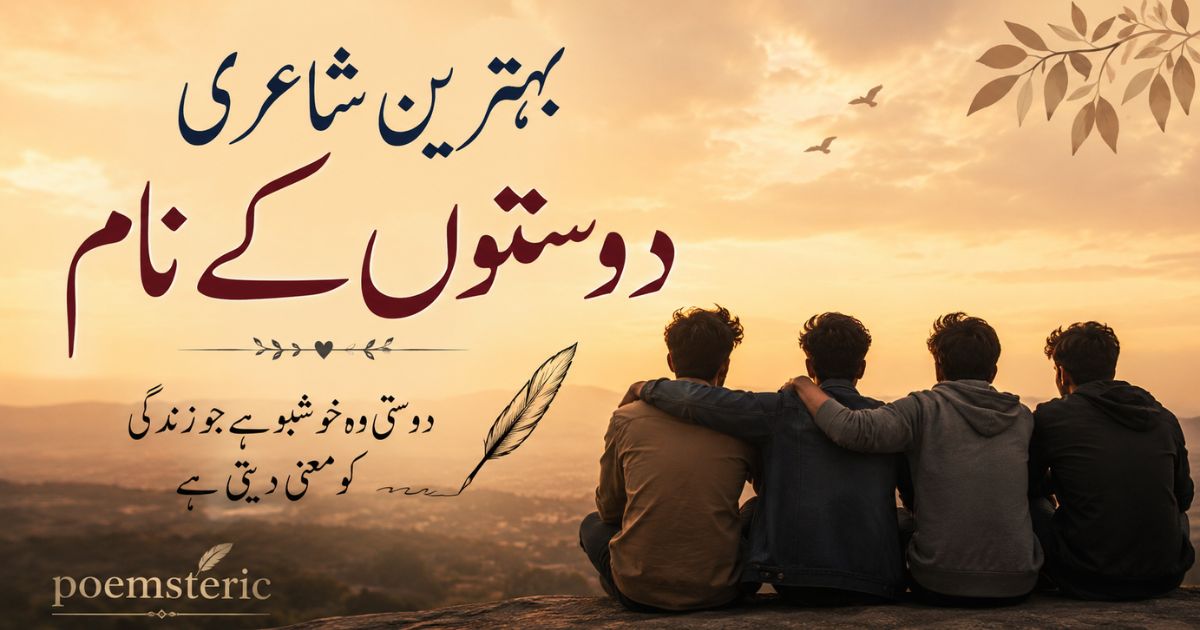
If you want the best poetry about friends in Urdu, look for shayari that pairs simple, everyday words with deep emotional weight. That combination is what has kept Urdu friendship poetry popular for generations. Urdu shayari on friendship works because it says in two lines what a long conversation often cannot. Whether you need something short for a birthday message or a longer sher for a farewell, this guide walks through the styles, poets, and categories that define the genre.
In my own reading of Urdu poetry over the years, the couplets that stay with people are rarely the most complicated ones. They are the lines that feel like something a friend would actually say. This article covers the history, the classical and modern voices behind dosti shayari, and a practical, step-by-step way to pick the right lines for your own friendships.
Key Takeaways
The best poetry about friends in Urdu usually comes from the ghazal and nazm traditions, both of which favour short, memorable lines over long narrative verse.

Classical poets built the emotional vocabulary that modern shayari writers still borrow from today.

Short, two-line shayari works best for messages and cards, while longer verses suit speeches, letters, and formal tributes.

Context matters: a sad farewell couplet does not fit a birthday card, and a playful one does not fit a eulogy.

Readers often tell us that translated shayari loses some of its rhythm, so pairing the Urdu original with a plain-language explanation helps more people connect with it.
What Makes Urdu Poetry About Friends So Powerful
Urdu shayari on friendship draws its strength from compression. A single couplet, or sher, usually contains two lines that must stand on their own while also connecting to a wider theme. As a result, writers cannot rely on lengthy descriptions; every word has to carry weight. This discipline is part of why friendship shayari in Urdu feels so precise compared to longer prose tributes.
Urdu also carries a rich vocabulary for describing loyalty, distance, and longing concepts that sit at the center of most friendship poetry. Words like rafaqat (companionship), wafa (loyalty), and judaai (separation) do not always have a single clean English equivalent. Because of this, translated dosti shayari sometimes needs a short explanation alongside it, rather than a word-for-word swap.
The Emotional Depth of Dosti Shayari
Dosti shayari tends to sit in one of two emotional registers: warmth or loss. Warm shayari celebrates shared memories, inside jokes, and mutual trust. Loss-themed shayari, on the other hand, deals with distance, disagreements, or the passing of a friend. Both registers use similar imagery roads, seasons, letters but point them in opposite emotional directions.
For example, a warm couplet might describe a friend as a lamp that never goes out during dark nights. A loss-themed couplet might use the same lamp image but describe it flickering out, or being carried by someone else down a different road. This shared imagery is part of what makes the genre feel unified even across very different poets and eras.
How Urdu Poetic Forms Capture Friendship
Two forms dominate Urdu friendship poetry: the ghazal and the nazm. A ghazal is built from independent couplets that share a rhyme and refrain but do not have to follow one continuous story, which is why single shers from a ghazal circulate widely on their own. A nazm, by contrast, is a single continuous poem built around one theme from start to finish, which makes it better suited to a full tribute or speech about a friendship.
Because ghazal couplets are self-contained, they travel easily; a single line can be shared in a message without losing its meaning. Nazms, however, need to be read in full, so they are less common in short-form sharing but far more common in printed collections and recitations.
A Brief History of Friendship Themes in Urdu Poetry
Friendship has been a recurring theme in Urdu poetry since the language’s classical period took shape in North India during the 18th and 19th centuries. Early Urdu poets often folded friendship into broader themes of loyalty, court life, and Sufi companionship, rather than treating it as a stand-alone subject the way modern poets sometimes do. As a result, many older friendship references sit inside longer ghazals about love, faith, or mortality, rather than in poems written only about friendship.
Over the 20th century, as Urdu poetry moved into newspapers, radio broadcasts, and eventually television, shorter and more direct verses about everyday relationships including friendship became more common. This shift matched a broader change in Urdu literature, where poets increasingly wrote for a mass audience rather than only for court patrons or literary salons. However, the older classical vocabulary never disappeared; it simply became more accessible.
Today, both classical-style couplets and modern free-verse friendship poems circulate side by side online, which is one reason searches for the best poetry about friends in Urdu return such a wide mix of styles.
Classical Poets and Their Legacy of Friendship Poetry
Several classical Urdu poets are closely associated with the language’s emotional vocabulary, even when their most famous verses were not written specifically about friendship. Understanding their broader reputations helps explain why their style still influences modern dosti shayari.
Mirza Ghalib’s Reputation for Themes of Loyalty
Mirza Ghalib, who wrote in Delhi during the first half of the 19th century, is widely regarded as one of the most influential Urdu poets in history. His ghazals are known for treating loyalty, longing, and human relationships with philosophical depth rather than simple sentiment. Because of this reputation, many modern friendship-themed shayari writers borrow Ghalib’s structural style of short, layered couplets even when writing entirely original lines about friends rather than quoting him directly.
Mir Taqi Mir and the Poetry of Companionship
Mir Taqi Mir, an older contemporary tradition often studied alongside Ghalib, is remembered for a plainer, more direct emotional style. His broader body of work is associated with themes of human vulnerability and connection. Writers of modern friendship shayari often point to Mir’s directness, rather than Ghalib’s philosophical density, as the closer stylistic model when the goal is a simple, heartfelt message rather than a literary showpiece.
Modern Voices in Best Poetry About Friends in Urdu
Modern Urdu shayari about friendship is shaped less by individual famous poets and more by a wide community of contemporary writers who publish primarily online, through social media, poetry apps, and self-published collections. This shift means that the best poetry about friends in Urdu today is often crowd-sourced rather than attributed to a single celebrated author, which makes it harder to trace individual couplets back to a named poet.

This modern style tends to favor shorter, two-line shards written in conversational Urdu rather than the more formal vocabulary of classical ghazals. As a result, it reads more easily to casual readers and translates more cleanly for younger audiences who may be more comfortable in Roman Urdu (Urdu written in Latin script) than in the Nastaliq script. This accessibility is a major reason friendship shayari performs well on messaging apps and social platforms.
Top Categories of Urdu Friendship Shayari
Friendship shayari generally falls into a few practical categories, based on length and tone rather than strict literary classification. Knowing these categories makes it easier to pick the right lines for a specific moment.
- Short, upbeat shayari – one or two lines, meant for quick messages or captions.
- Sad or bittersweet shayari – focused on distance, disagreement, or loss.
- Nostalgic shayari – centered on childhood or long-shared history.
- Formal or tribute shayari – longer verses suited to speeches or written letters.
- Romantic-friendship crossover shayari – verses that sit between platonic and romantic affection, common in Urdu poetry where the line between the two is often intentionally blurred.
Short Friendship Shayari
Short shayari is the most widely shared category because it fits directly into a text message or social caption. An example in this style, written to illustrate the tone rather than quote any specific poet: “Tanhaai mein bhi woh saath lagte hain, yehi to asli dost kehlaate hain” roughly, “Even in solitude they feel present; that is what makes someone a true friend.” This kind of couplet works because it is short enough to remember after a single read.
Sad and Bittersweet Friendship Shayari
Sad friendship shayari usually deals with distance, silence after an argument, or a friendship that has faded over time. These verses lean on imagery of empty roads, closed doors, or letters that were never sent. This category tends to resonate strongly with readers going through a falling-out or a long-distance friendship, which is why it remains one of the most searched sub-categories of dosti shayari.
How to Choose the Right Shayari for Your Friend
Picking the right couplet is less about finding the “best” one in the abstract and more about matching tone, length, and occasion. Follow these steps:
- Identify the occasion. A birthday, an apology, a farewell, and a casual good-morning message each call for a different emotional tone.
- Decide on length. Messages and captions work better with a single two-line sher; speeches and letters can carry a longer nazm.
- Match the emotional register. Choose warm and playful lines for celebrations, and quieter, more reflective lines for loss or distance.
- Check the vocabulary level. If your friend reads Urdu script comfortably, use Nastaliq; if not, use Roman Urdu with a short English gloss.
- Read it aloud once before sending. Urdu shayari relies on rhythm, so a line that looks fine in writing sometimes feels off when spoken reading it out loud catches this quickly.
Where and How People Use Friendship Shayari Today
Friendship shayari shows up most often in three everyday settings: private messages, social media captions, and spoken tributes at gatherings. In messaging apps, a short two-line sher is typically sent on its own, without much additional context, because the couplet is expected to carry the full emotional message. On social media, shayari is often paired with a photo, where the lines act as a caption rather than a stand-alone post.
At in-person gatherings birthdays, farewells, or reunions longer verses or full names are more common, since a speaker has time to build up to the poem’s meaning. In each of these settings, the choice between classical and modern shayari usually comes down to the audience’s familiarity with formal Urdu versus everyday conversational Urdu.
Common Mistakes People Make When Sharing Urdu Shayari
A few recurring mistakes reduce the impact of otherwise good shayari. First, mismatched tone is common: sending a heavy, loss-themed couplet in a lighthearted context can feel jarring rather than meaningful. Second, misattribution happens frequently online, where a couplet is labeled with a famous poet’s name even though there is no reliable source confirming they wrote it; this is worth double-checking before repeating the attribution to others.
Third, over-literal translation is a frequent issue. Because Urdu relies heavily on rhythm and wordplay, a direct English translation can flatten a couplet’s meaning. Where possible, it helps to explain the sentiment in plain language rather than translating word for word. Finally, overusing the same well-known couplets can make a message feel generic; searching a little further into lesser-known modern writers often turns up lines that feel more personal.
Best Poetry About Friends in Urdu vs. Everyday English Quotes: A Quick Comparison
| Feature | Urdu Friendship Shayari | Typical English Friendship Quotes |
| Structure | Rhymed couplets (sher), often part of a ghazal | Usually a single sentence or short paragraph |
| Emotional style | Layered, often uses metaphor (roads, lamps, seasons) | Often direct and literal |
| Best used for | Messages, captions, spoken tributes | Cards, social captions, speeches |
| Translation difficulty | High rhythm and wordplay are hard to preserve | Low quotes translate more literally |
| Cultural association | Strongly tied to South Asian poetic tradition | Broadly applicable across cultures |
This comparison shows why many readers search specifically for the best poetry about friends in Urdu rather than settling for a generic English quote: the metaphorical density of Urdu shayari often expresses a nuance that a flat English sentence cannot.
FAQs
Q: What is the best poetry about friends in Urdu for a short message?
A: For short messages, a two-line sher works best because it is easy to read and remember in one glance. Look for couplets that focus on warmth, loyalty, or humor rather than loss, since these fit casual daily messages more naturally. Many modern Urdu writers publish exactly this style online, making it easy to find fresh, less-repeated lines.
Q: Who are the most famous Urdu poets associated with friendship themes?
A: Mirza Ghalib and Mir Taqi Mir are the classical poets most often cited for shaping Urdu’s emotional vocabulary around loyalty and human connection, even though friendship was rarely their sole subject. Many verses attributed to them online are unverified, so it is worth checking a couplet’s source before repeating the attribution.
Q: How do I know if a piece of shayari is genuinely about friendship and not romance?
A: Urdu poetry often blurs platonic and romantic language, so context matters more than the words themselves. Look at how a couplet is framed: verses about shared struggle, loyalty over time, or humor tend to read as platonic, while verses focused on longing or physical closeness often lean romantic.
Q: Why is Urdu shayari so popular for expressing feelings about friendship?
A: Urdu shayari compresses complex emotion into short, rhythmic lines, which makes it easy to share and remember. This is part of why the best poetry about friends in Urdu circulates so widely on messaging apps and social media compared to longer prose tributes.
Q: Can I use Urdu friendship shayari if I don’t read the Urdu script?
A: Yes. Many readers use Roman Urdu (Urdu written in Latin letters) alongside a short English explanation of the couplet’s meaning. This approach preserves the rhythm of the original line while still making the best poetry about friends in Urdu accessible to readers who are not comfortable with the Nastaliq script.
Final Thoughts
The best poetry about friends in Urdu is not defined by a single famous poet or one perfect couplet; it is defined by how well a specific verse matches a specific relationship and moment. Classical poets shaped the language’s emotional vocabulary, and modern writers have made that vocabulary more accessible for everyday use. Whether you are choosing a short sher for a text message or a longer nazm for a speech, matching tone, length, and audience will always matter more than picking the most quoted line online.
Recent Article : Bengali Poetry Submission for Radio Payment: 2026 Guide

Jennifer Aston is a passionate poetry curator and writer with a deep love for the written word. She believes poetry has the power to heal, inspire, and connect people across all walks of life. Through PoemSteric, she brings together timeless and modern verses for every emotion and every moment.