
Introduction
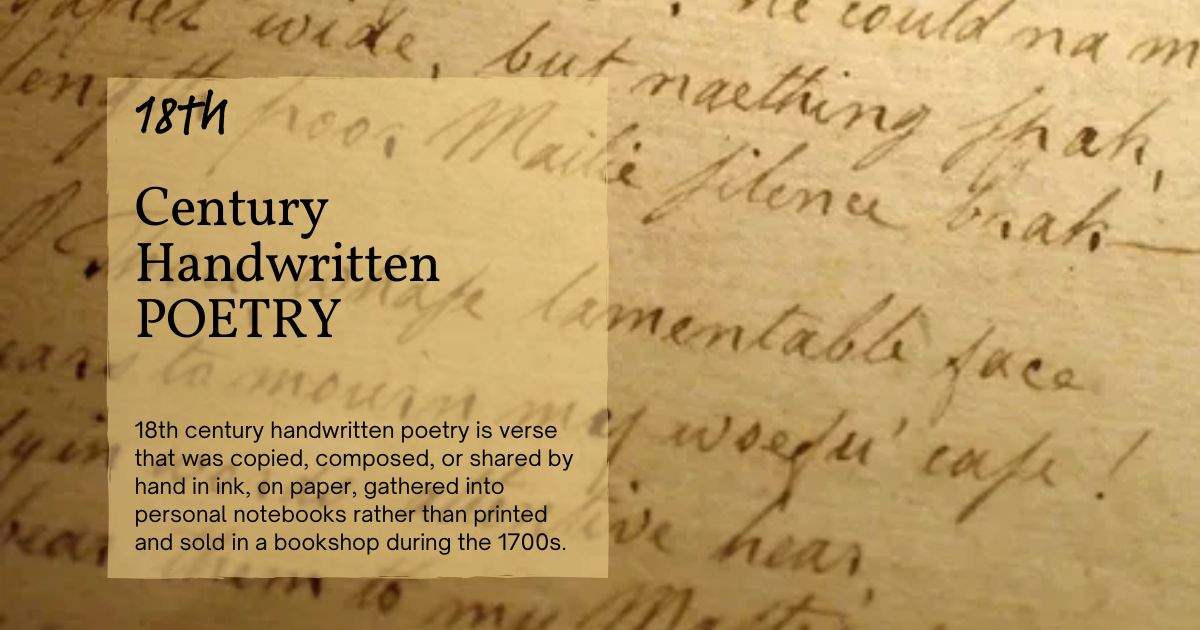
18th century handwritten poetry is verse that was copied, composed, or shared by hand in ink, on paper, gathered into personal notebooks rather than printed and sold in a bookshop during the 1700s. It ranges from the polished work of famous poets copied out for private pleasure to raw, original verse by ordinary people who never intended to be published at all. Today these handwritten pages survive in university archives, family collections, and digital libraries, giving readers a far more intimate view of 18th-century life than any printed anthology can offer.
I have spent hours scrolling through digitized manuscript pages from collections like the Brother ton Library at Leeds, and what strikes me every time is how personal the handwriting itself becomes part of the poem’s meaning: a crossed-out word, a smudge, a note in the margin. This guide walks through what this manuscript tradition actually is, why it existed alongside print, where the major collections live today, and how you can start reading these old pages yourself.
Key Takeaways
• 18th century handwritten poetry refers to verse copied or composed by hand during the 1700s, often kept in personal manuscript books rather than printed.

• Manuscript poetry was frequently used to circulate content that could not legally or safely be printed, including political satire and erotic verse.

• Major surviving collections include the Brotherton Collection at the University of Leeds (over 6,600 poems) and the Eighteenth-Century Poetry Archive (ECPA).

• Reading old handwritten poetry takes practice; the biggest hurdles are unfamiliar letterforms, abbreviations, and inconsistent spelling, not the language itself.

• Many 18th-century manuscript poets, especially women, never appeared in print at all, making these handwritten pages the only record of their work.
What Is 18th Century Handwritten Poetry?
18th century handwritten poetry covers any verse written, copied, or compiled by hand between roughly 1700 and 1799. Unlike a printed book, a manuscript poem exists as a single physical object, one specific sheet of paper or bound notebook, written in one person’s hand (or several hands, if it passed between friends). Some of these poems were entirely original compositions. Others were popular printed poems that a reader liked enough to copy out for their own collection, sometimes changing a word here or there in the process.
The practice was extremely common. At the University of Leeds, the Brotherton Collection alone holds more than 180 manuscripts containing nearly 7,000 individual poems and verses, ranging from large verse miscellanies to single handwritten leaves. These were not rare or unusual objects in the 1700s for much of the educated population, copying poetry by hand was simply how you built a personal library of the verse you loved.
It’s worth separating two related ideas that people often confuse: “manuscript poetry” is the object (a handwritten page or book), while “18th century handwritten poetry” more broadly includes everything written in that century, whether it was ever printed or not. A huge amount of 18th-century poetry survives only in manuscript form, because it was never submitted to a printer sometimes by choice, and sometimes because the content itself was too risky to publish.
Why Poets Wrote Poetry by Hand in the 1700s
There were practical, social, and legal reasons that handwritten poetry thrived alongside the printing press throughout the 18th century, and understanding them changes how you read these pages.
Censorship and the Risk of Going to Print
Printing in the 1700s was not free from consequences. Material that was satirical, politically dangerous, or sexually explicit could not be printed legitimately, so it circulated instead through handwritten copies passed from reader to reader. During the reign of James I, political satire moved cautiously through manuscript circles; by the Restoration period, oppositional poetry travelled openly among London’s coffee houses, including at gatherings sometimes nicknamed the “treason table.” Handwriting, in other words, was often the safer publishing method, a way to share dangerous ideas without a printer’s name attached to them.
The Coffee-House Culture of Passing Verse by Hand
Beyond censorship, handwritten poetry was simply a social activity. Eighteenth-century coffee houses functioned as informal literary clubs, where patrons read aloud, debated, and copied verse into their own notebooks. Manuscript poetry miscellaneous books mixing multiple poems, songs, and sometimes recipes or accounts were assembled by ordinary readers who selected, adapted, and arranged material to reflect their own taste.
As one Folger Shakespeare Library study of these miscellanies notes, the arrangement itself was a form of self-conscious, creative “making,” not a random pile of copied pages. Variety, in fact, was considered a genuine literary virtue at the time, not a flaw.
Manuscript Miscellanies and Commonplace Books Explained
If you spend any time researching this manuscript tradition, you’ll run into the terms “manuscript miscellany” and “commonplace book” constantly. Both describe personal notebooks filled with copied or original material, but they served slightly different purposes for their owners.
What a Commonplace Book Actually Contains
A commonplace book was a working notebook where a reader recorded passages, quotations, and poems they wanted to remember or return to closer to a scrapbook of favourite lines than a finished literary work. A verse miscellany, by contrast, leaned more heavily toward complete poems, songs, and riddles, often copied with more care because the book itself was meant to be read and enjoyed, not just referenced. In practice, the two categories blur constantly.
The Brotherton Collection’s manuscripts, for instance, rarely sit in isolation; many notebooks mix poetry alongside household recipes, personal accounts, letters, and even music, sitting side by side with plays and other everyday writing. As a result, 18th-century readers clearly didn’t separate their poetry from the rest of daily life the way a modern anthology does.
Famous 18th Century Handwritten Poetry Collections and Archives
A handful of major institutions have done the painstaking work of preserving, cataloguing, and in many cases digitizing this manuscript record, making it far more accessible than it was even twenty years ago.
The Brotherton Collection at the University of Leeds
The Brotherton Collection is one of the largest gatherings of 17th- and 18th-century English manuscript verse in the world. It includes 190 manuscripts of seventeenth- and eighteenth-century verse, and can be explored alongside the Brotherton Collection Manuscript Verse Index a reference tool listing first lines, last lines, attribution, author, date, length, verse form, and content for over 6,600 poems in the collection. Readers can view complete images of the original manuscripts online, which is often the closest most people will ever get to holding an 18th-century poet’s actual handwriting.
The Eighteenth-Century Poetry Archive (ECPA)
The Eighteenth-Century Poetry Archive is a peer-reviewed, open-access digital project devoted specifically to English-language poetry of the “long eighteenth century.” It builds on electronic texts created by the Text Creation Partnership from Gale’s Eighteenth Century Collections Online, giving researchers and casual readers alike searchable access to poems that would otherwise require a research-library visit. The ECPA includes writers ranging from famous names to lesser-known poets whose work only survives because someone thought to write it down.
How to Read 18th Century Handwritten Poetry Today
For most modern readers, the biggest barrier to enjoying this old manuscript verse isn’t the language, it’s the handwriting itself. Cursive styles from the 1700s look unfamiliar at first glance, but they follow consistent patterns once you know what to look for.
Five Beginner Paleography Tips
1. Start with a transcribed example side by side with the original image. Many digitized archives, including the Brotherton Collection Index, provide typed transcriptions next to manuscript scans, which is the fastest way to train your eye.
2. Learn the “long s.” In 18th-century handwriting, a lowercase “s” at the start or middle of a word often looks like an “f” without the crossbar, a common stumbling block for beginners.
3. Watch for standardized abbreviations. Writers frequently shortened common words with small superscript letters or a tilde-like mark over a missing letter, similar to shorthand.
4. Expect inconsistent spelling. Standardized spelling wasn’t fully established yet, so the same word might appear two different ways on the same page; this is normal, not an error.
5. Read slowly, out loud if possible. Because 18th-century poetry was often meant to be read aloud or recited in company, sounding out an unclear word can help you recognize it faster than staring at the letterforms alone.
Readers often tell us that the first page of a real 18th-century manuscript feels intimidating, but the second or third page reads far more smoothly. The patterns click quickly once your eye adjusts.
Notable Poets Behind 18th Century Manuscript Verse
Some of the era’s most recognizable names have surviving handwritten poetry, alongside countless anonymous or lesser-known writers. Thomas Paine, better remembered for political prose, also wrote poetry that survives partly through manuscript sources, collected in projects like the ECPA’s edition of his work. William Blake’s poems, including pieces like “The Tyger” and “A Poison Tree,” exist in manuscript notebooks in his own hand, complete with revisions that show his creative process in real time, something a clean printed edition can never fully capture.
Beyond famous names, the vast majority of 18th-century manuscript poets were amateur writers: clergymen, clerks, students, and family members who copied favorite verses or composed their own, never expecting an audience beyond their own household.
Women’s Voices in 18th Century Handwritten Poetry
Manuscript culture mattered enormously for women writers in the 1700s, many of whom had far more limited access to printing than their male counterparts. Publishing under one’s own name carried social risk for women in a way it rarely did for men, so handwritten circulation among friends, family, and reading circles became one of the few reliable outlets for female poets to share original work.
Scholars researching the eighteenth-century manuscript verse miscellany have specifically focused on how “obscure individuals” , often women from the lower gentry and middle class used these personal notebooks to respond to, curate, and shape the poetic culture of their day, even without a publisher’s backing.
Because so much of this material was never printed, manuscript archives are frequently the only surviving record of these women’s creative lives, which makes preservation projects like the Brotherton Collection genuinely irreplaceable rather than simply nice-to-have.
Where to Find Digitized 18th Century Manuscripts Online
You don’t need a research-library card to start exploring this manuscript record. Several major archives have digitized their holdings and made them freely searchable:
• Eighteenth-Century Poetry Archive (ECPA) open-access, searchable, peer-reviewed
• Literary Manuscripts Leeds Collection complete digital images of the Brotherton Collection’s 190 manuscripts
• Folger Shakespeare Library’s manuscript blog and catalog essays and digitized miscellanies with scholarly context
• University special collections libraries (such as Smith College’s Special Collections) often host handwriting guides alongside digitized 18th-century manuscript pages, useful for beginners learning to read period cursive
Most of these platforms let you browse by poet, collection, or first line, which makes it easy to start with a famous name and then wander into the anonymous manuscripts sitting right alongside them.
FAQs
Q: What exactly counts as 18th century handwritten poetry?
A: It’s any verse written, copied, or compiled by hand between roughly 1700 and 1799, kept in personal manuscript books, miscellanies, or single sheets rather than printed and sold. This includes both original compositions and hand-copied versions of already-published poems, since readers commonly copied favorite printed verse into their own notebooks.
Q: Why didn’t more of this poetry get printed at the time?
A: Several reasons: some content was politically or sexually risky to print, some poets (especially women) faced social barriers to publishing under their own name, and much of it was simply personal never intended for a wider audience beyond friends and family who shared the manuscript by hand.
Q: Where can I see real examples of 18th century handwritten poetry?
A: The Literary Manuscripts Leeds Collection offers complete digital images of the Brotherton Collection’s 190 manuscripts, and the Eighteenth-Century Poetry Archive (ECPA) provides open-access searchable texts. Both are free and don’t require academic credentials to browse.
Q: How hard is it to actually read 18th-century handwriting?
A: It takes some adjustment but isn’t as difficult as it looks. The main challenges are unfamiliar letterforms like the “long s,” common abbreviations, and inconsistent spelling not the vocabulary or grammar itself. Most readers get comfortable within a few pages of practice, especially using archives that pair manuscript images with typed transcriptions.
Q: Did famous poets like William Blake really write in manuscript form?
A: Yes. Blake’s notebooks contain drafts and revisions of poems like “The Tyger” and “A Poison Tree” in his own handwriting, showing edits and changes that never appear in printed editions. These manuscripts give a rare look at a poet’s actual creative process.
Q: Is 18th century handwritten poetry only relevant to historians?
A: Not at all. While historians and literature students use these archives for research, the poems themselves are simply enjoyable to read, often more personal and less polished than what made it into print, which many modern readers actually find more relatable, not less.
Final Thoughts
18th century handwritten poetry is easy to overlook because it sits in the shadow of the printed anthologies most of us grew up reading. But these manuscript pages tell a fuller, messier, more human story than any polished printed edition crossed-out lines, private jokes tucked into the margins, poems written by people, history is otherwise forgotten entirely.
Whether you’re drawn to famous names like Blake and Paine or to the countless anonymous voices preserved only because someone once picked up a pen, the manuscript record of the 1700s rewards the patient reader. Start with one digitized archive, follow a single poem from first line to last, and you’ll likely find yourself pulled further in than you expected.
Recent Article : Urdu Poetry & Shayari: Best Verses, Poets & Ghazals

Jennifer Aston is a passionate poetry curator and writer with a deep love for the written word. She believes poetry has the power to heal, inspire, and connect people across all walks of life. Through PoemSteric, she brings together timeless and modern verses for every emotion and every moment.