
Introduction
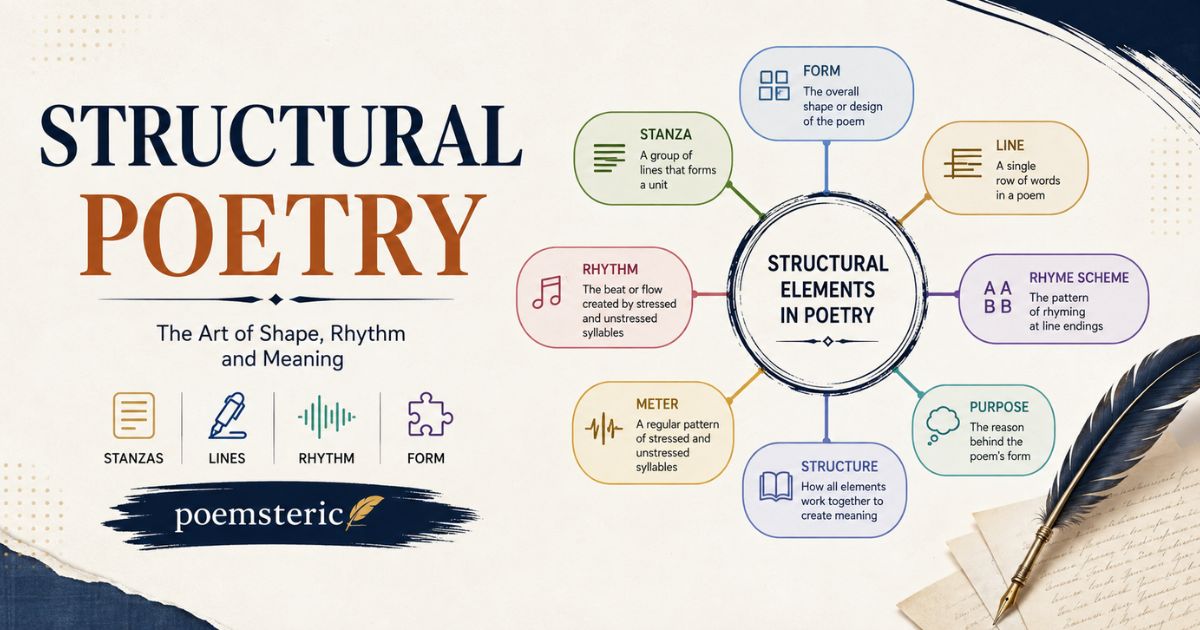
Structural poetry refers to the way a poem is organized on the page and in time. It includes line breaks, stanzas, rhyme schemes, meter, and volta turns. Unlike poetic form, which follows fixed external rules, structure is the unique internal architecture a poet builds to carry meaning, emotion, and rhythm.
However, many readers and writers confuse structure with form. They believe a poem must rhyme or follow a sonnet pattern to have structure. This is not true. Even free verse, which abandons traditional rules, relies heavily on poetry structure to guide the reader’s eye and ear. In my own reading of contemporary collections, the poems that stay with me longest are rarely the most ornate. Instead, they are the ones where every stanza breaks, every pause, and every turn feels inevitable.
This guide will teach you what structural poetry really means, how to identify its elements, and how to analyze any poem’s framework with confidence. You will learn the difference between form and structure, explore traditional and modern types, and walk away with a repeatable five-step method for close reading.
Key Takeaways
Before you read the full guide, here are the essential points to remember:
Structural poetry is about organization, not just rules. Every poem has a structure, even if it has no form.

The seven core elements are: line breaks, stanzas, rhyme, meter, repetition, white space, and the volta.

Form is external and inherited (sonnet, haiku). Structure is internal and chosen by the poet.

You can analyze any poem's structure in five clear steps, from first reading to final interpretation.

Contemporary poets in 2024 and 2025 are blending digital layout, visual space, and traditional turns in exciting new ways.
What Is Structural Poetry? (Definition & Core Concepts)
When we ask, “What is structural poetry?” We are really asking how a poem holds itself together. Structure is the skeleton beneath the skin. It determines where a line ends, where a stanza breaks, and where the meaning shifts. Without structure, a poem becomes prose with random line breaks. With it, a poem becomes a living, breathing object.
The term covers every decision a poet makes about the physical and sonic layout of a text. This includes micro-level choices like caesura (a pause within a line) and macro-level choices like the overall arc of the poem. For example, Gwendolyn Brooks’s 1960 poem “We Real Cool” uses short, clipped lines to mirror the brief, dangerous lives of its subjects. The poem structure is not decorative. It is the meaning.
The Difference Between Form and Structure in Poetry
Many students use “form” and “structure” interchangeably. However, they are not the same thing. Form refers to a pre-existing template: a sonnet has fourteen lines, a villanelle has nineteen lines with repeating refrains. These are rules poets inherit from tradition. Structure, by contrast, refers to the unique organization of an individual poem. A poem can follow no form at all and still possess a powerful, deliberate structure.
For instance, Walt Whitman’s 1855 poem “Song of Myself” rejects formal constraints. It has no rhyme scheme and no meter. Yet its structure is unmistakable. Whitman builds long, catalog-like lists that spiral outward and then contract. This structural poetry approach creates a sense of expansiveness that a formal template could never achieve. Therefore, form is a subset of structure, but structure is much broader.
Why Structure Matters in Poetic Meaning
Structure is not a container for meaning. It generates meaning. When a poet places a line break after the word “stop,” the reader stops. When a stanza shifts from past tense to present tense, the reader feels the shift in time. These are not accidents. They are structural choices that shape emotional response.
Consider the effect of white space. In the 2017 collection Don’t Call Us Dead by Danez Smith, empty space on the page represents silence, absence, and grief. The reader must cross that space physically, which mirrors the emotional crossing the speaker endures. This is why poetry structure is essential. It turns language into experience.
The Seven Structural Elements of Poetry
Every poem, whether traditional or experimental, uses a combination of seven core elements. Understanding these gives you a vocabulary for analysis and a toolkit for writing.
- Line breaks – Where a line ends and why.
- Stanzas – Groupings of lines that create units of thought.
- Rhyme scheme – The pattern of sounds at line endings.
- Meter – The rhythmic pattern of stressed and unstressed syllables.
- Repetition – Repeated words, phrases, or structures that create emphasis.
- White space – The silence between words, stanzas, and lines.
- The volta – The turn or shift in argument, emotion, or perspective.
These elements work together. A change in stanza length often signals a volta. A break in meter can highlight a key phrase. When you analyze a poem, you must look at how these pieces interact, not in isolation.
Line Breaks and Enjambment
A line break is the most basic unit of poetry structure. It tells the reader when to pause and when to continue. End-stopped lines end with punctuation, creating a sense of closure. Enjambed lines run over without punctuation, pulling the reader forward.
For example, in John Donne’s 1633 poem “The Flea,” the enjambment creates urgency. The argument spills from one line to the next, just as the speaker’s logic spills into persuasion. In contrast, Alexander Pope’s 1714 heroic couplets use end-stopped lines to create a sense of balance and wit. The choice between these two techniques changes the entire feel of a poem.
Stanza Organization and White Space
Stanzas are the paragraphs of poetry. They group ideas, create rhythm, and control pacing. A two-line stanza (couplet) feels quick and conclusive. A four-line stanza (quatrain) feels stable and balanced. An eight-line stanza feels dense and complex.
White space is the area around and between stanzas. It is not empty. It is active. In the 2020 collection Homie by Danez Smith, white space creates breath between traumatic memories. The reader must physically turn the page or cross the gap, which slows time. This is structural poetry at its most powerful.
Rhyme Scheme and Meter
Rhyme scheme is the pattern of end sounds, often notated with letters (ABAB, AABB, etc.). Meter is the beat of the poem, measured in feet. Iambic pentameter, for instance, has five iambs per line: da-DUM, da-DUM, da-DUM, da-DUM, da-DUM.
These elements create expectation. When Shakespeare uses iambic pentameter in his 1609 sonnets, he establishes a heartbeat. When he breaks that meter, the break carries weight. For example, in Sonnet 145, a sudden short line (“I hate, from hate away she threw”) physically enacts the disruption it describes. This is how poem structure becomes meaning.
The Volta (Turn) and Poetic Shifts
The volta is the turn in a poem. It is the moment where the argument shifts, the emotion deepens, or the perspective changes. In a Petrarchan sonnet, the volta typically occurs between the octave (first eight lines) and the sestet (final six lines). In a Shakespearean sonnet, it often arrives at the final couplet.
However, the volta is not limited to sonnets. In free verse, it can appear as a sudden shift in stanza length, a change in diction, or a break in imagery. For example, in Natasha Trethewey’s 2006 poem “Theories of Time and Space,” the turn happens when the poem shifts from memory to present observation. Learning to spot this turn is one of the most valuable skills in how to analyze poetry structure.
How to Analyze the Structure of a Poem
Many readers feel overwhelmed when they first approach a poem. They do not know where to begin. This five-step method removes that confusion. It works for sonnets, free verse, spoken word, and experimental texts.
1: Read the Poem Aloud to Hear Its Rhythm
Your first reading should always be aloud. Poetry began as an oral art. When you read aloud, you hear the meter, the caesuras, and the natural pauses. You notice where the poet forces you to breathe. You catch repetitions your eyes might skip.
For example, when I read Langston Hughes’s 1951 poem “Harlem” aloud, the repeated question “Does it dry up / like a raisin in the sun?” gains a prophetic rhythm. The line breaks slow the questions down. This sonic awareness is the foundation of all structural analysis.
2: Map the Stanza Breaks and Line Lengths
After your first reading, draw a simple map. Count the lines per stanza. Note where stanzas are equal and where they change. Ask: Why did the poet break here? What changes between stanza one and stanza two?
In Robert Hayden’s 1962 poem “Those Winter Sundays,” the first stanza describes the father’s labor. The second stanza shifts to the speaker’s indifference. The third stanza delivers the adult’s regret. Each stanza is a time zone. Mapping this reveals the poem’s emotional architecture.
3: Identify Patterns, Repetition, and Variations
Look for repeated sounds, words, or syntactic structures. Then look for where the pattern breaks. Repetition creates comfort. Variation creates surprise. The interaction between the two generates tension.
In Clint Smith’s 2016 poem “Theories of Time and Space,” the phrase “the past is never past” repeats with slight alterations. Each variation deepens the meaning. This is a hallmark of sophisticated structural poetry.
4: Locate the Turn or Shift in Meaning
Ask yourself: Where does the poem pivot? It may be a change in tone, a shift from description to reflection, or a move from question to answer. Mark this spot. It is often the emotional center of the poem.
In Elizabeth Bishop’s 1976 poem “One Art,” the volta arrives late. The speaker moves from listing minor losses to admitting the loss of a loved one. The structure builds to this moment through increasing stanza length and escalating repetition. The turn is devastating because the structure prepared us for it.
5: Connect Structure to Theme and Tone
Your final step is synthesis. Ask: How does the structure support what the poem is about? If the poem uses short, fragmented lines, does that reflect fragmentation in the speaker’s life? If the poem uses a strict form, does that form create irony or comfort?
In “We Real Cool,” the short lines mirror the brevity of the pool players’ lives. The structure is not an afterthought. It is the argument. This is the goal of all poetry structure analysis: to see the form and the meaning as one thing.
Common Types of Poem Structure (Traditional and Modern)
Poets have invented thousands of structures over the centuries. Some follow strict rules. Others invent new rules for every poem. Understanding the major categories helps you recognize patterns and appreciate innovation.
Traditional Fixed Forms: Sonnet, Villanelle, and Ghazal
Traditional forms are pre-existing structures that poets adopt and adapt.
- The Sonnet: Fourteen lines, typically in iambic pentameter. The Petrarchan sonnet divides into an octave and a sestet. The Shakespearean sonnet uses three quatrains and a couplet. Both rely on a volta.
- The Villanelle: Nineteen lines with five tercets and a final quatrain. It uses two refrains that repeat in a set pattern. Dylan Thomas’s 1951 “Do not go gentle into that good night” is the most famous example. The form’s repetition enacts the speaker’s refusal to accept death.
- The Ghazal: A Persian form of five to fifteen couplets. Each couplet is self-contained, and the second line of each ends with a refrain. The final couplet often includes the poet’s name. Agha Shahid Ali popularized the ghazal in English in the 1990s and early 2000s.
These forms are not prisons. They are traditions that poets enter into dialogue with. The best formal poems use the rules to create tension and release.
Free Verse and Open Form Structures
Free verse abandons regular meter and rhyme. However, it does not abandon structure. Instead, it invents new structures for every poem. Walt Whitman, T.S. Eliot, and Adrienne Rich all wrote free verse with powerful internal organization.
Free verse often relies on:
- Syntactic parallelism
- Imagistic progression
- Breath units (the length of a single breath)
- Visual shape on the page
For example, in Adrienne Rich’s 1973 poem “Diving into the Wreck,” the long, sinuous lines mimic the motion of swimming downward. The poem structure enacts the dive. This is why free verse demands close attention. Without traditional markers, every structural choice becomes more visible.
Visual and Concrete Poetry Structures
Visual poetry uses the physical shape of the text as part of the meaning. Concrete poetry, a movement that peaked in the 1950s and 1960s, places words in visual patterns that mirror the subject. For instance, a poem about an airplane might be shaped like wings.
In the digital age, this tradition has expanded. Poets now use code, animation, and interactive layout to create structural poetry that changes as the reader scrolls. These works challenge our definition of what a poem is. However, they still rely on the core principle: structure generates meaning.
Structural Poetry in Contemporary Writing (2024–2025)
Contemporary poets are redefining what structural poetry can do. In 2024, Diane Seuss won the Pulitzer Prize for Poetry for Frank: Sonnets, a collection that uses the sonnet form to explore addiction, grief, and working-class life. Seuss stretches the sonnet to its limits, proving that traditional forms can hold modern pain.
Meanwhile, poets like Don Mee Choi and Bhanu Kapil are using fragmented, non-linear structures to represent diasporic experience and trauma. Their work shows that structure is not neutral. A linear, chronological structure carries different assumptions than a fractured, recursive one.
In 2025, we are also seeing a rise in AI-assisted poetry that challenges human authorship of structure. However, the most respected contemporary poets continue to treat structure as a deliberate, ethical choice. They ask: Who does this form serve? What power does it reinforce or resist? This political awareness is the new frontier of poetry structure.
How to Use Structure to Strengthen Your Own Poems
If you are a writer, structure is your most powerful tool. Here are practical ways to use it:
Match structure to subject. If your poem is about chaos, consider fragmented stanzas. If it is about ritual, consider a repeating form.
Use the volta intentionally. Do not let your poem drift. Build toward a moment of change. This gives the reader a destination.
Experiment with white space. Where you place silence is as important as where you place words. Try breaking a stanza earlier than feels comfortable.
Read your drafts aloud. If a line break feels awkward when spoken, it probably is. Revise until the rhythm feels inevitable.
Study one form deeply. Learn the sonnet, the ghazal, or the pantoum until its logic becomes intuitive. Then break the rules with purpose.
Remember, structure is not decoration. It is the engine of your poem. Every choice should earn its place.
FAQs
Q: What is structural poetry?
A: Structural poetry refers to the internal organization of a poem, including its line breaks, stanzas, meter, rhyme, white space, and volta turns. Unlike poetic form, which follows fixed external rules like the sonnet or villanelle, structure is the unique architecture a poet builds for each individual poem. Every poem has a structure, even free verse. Structure shapes how the reader moves through the text, where they pause, and how they experience emotion. It is not decoration; it is the engine of meaning.
Q: What are the main elements of poetry structure?
A: The seven main elements are line breaks, stanzas, rhyme scheme, meter, repetition, white space, and the volta or turn. Line breaks control pacing. Stanzas group ideas. Rhyme and meter create sonic patterns. Repetition builds emphasis. White space creates silence and breath. The volta is the shift in argument or emotion. These elements work together to create the poem’s overall architecture and reader experience.
Q: How do you analyze the structure of a poem?
A: Follow a five-step method. First, read the poem aloud to hear its rhythm and natural pauses. Second, map the stanza breaks and line lengths to see the poem’s visual shape. Third, identify patterns, repetitions, and any breaks in those patterns. Fourth, locate the volta or turn where the meaning shifts. Fifth, connect every structural choice back to the poem’s theme and tone. This method works for traditional forms and free verse alike.
Q: What is the difference between form and structure in poetry?
A: Form is a pre-existing template with fixed rules, such as the sonnet’s fourteen lines or the villanelle’s refrains. Structure is the unique internal organization of an individual poem. A poem can follow no formal rules and still possess a powerful, deliberate structure. In fact, form is a subset of structure. All formal poems have structure, but not all structured poems follow a named form.
Q: What is a volta in poetry?
A: A volta is the turn or shift in a poem. It is the moment where the argument changes, the emotion deepens, or the perspective shifts. In a Petrarchan sonnet, it typically occurs between the octave and sestet. In free verse, it can appear as a sudden change in stanza length, diction, or imagery. Identifying the volta is essential because it often reveals the poem’s central insight or emotional climax.
Q: Can free verse have structure?
A: Yes. Free verse abandons regular meter and rhyme, but it does not abandon organization. Free verse poets use breath units, syntactic parallelism, imagistic progression, and visual white space to create structure. Because there are no traditional markers, every structural choice in free verse becomes more visible and more meaningful. The structure is invented fresh for each poem.
Final Thoughts
Structural poetry is not a niche topic for academics. It is the foundation of every poem ever written. Whether you are reading Shakespeare or a poem published yesterday, the structure is where the meaning lives. It is in the pause after a line. It is in the silence between stanzas. It is in turn that breaks your heart.
The best way to understand structure is to read closely and write deliberately. Use the five-step method in this guide. Study the forms that have lasted centuries. Then invent your own. The structure is not a cage. It is the architecture of feeling. Build something worth entering.
Recent Article : Caterpillar Poetry: 9 Famous Poems and What They Really Mean

Jennifer Aston is a passionate poetry curator and writer with a deep love for the written word. She believes poetry has the power to heal, inspire, and connect people across all walks of life. Through PoemSteric, she brings together timeless and modern verses for every emotion and every moment.