
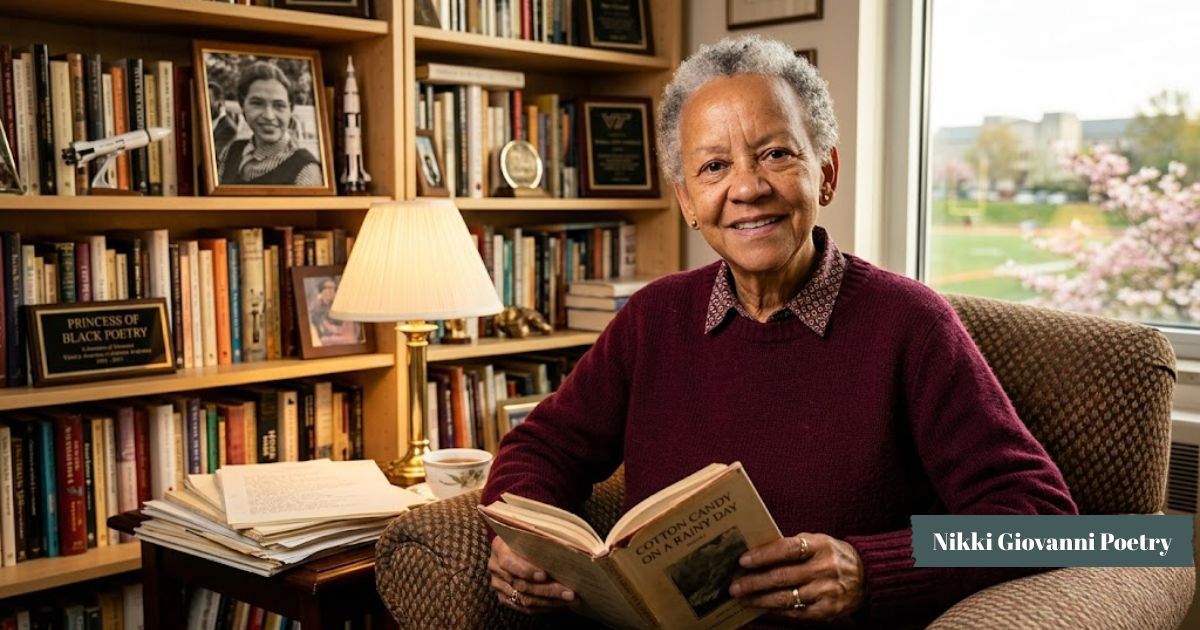
Nikki Giovanni poems capture the raw honesty of Black American life, spanning childhood memories, civil rights struggles, and quiet moments of love. Her most celebrated works including “Nikki-Rosa,” “Ego Tripping,” and “Knoxville, Tennessee” remain staples of American poetry classrooms because they speak plainly, without pretense, about identity and belonging. This guide walks through 15 poems that define her legacy, how to start reading her work, and where you can read the full poems for free.
Key Takeaways
Before diving into the full breakdown, here is the short version for readers who want the essentials first. Nikki Giovanni’s career spanned more than five decades, and her poetry evolved considerably during that time. However, certain threads stayed constant: plain language, personal honesty, and a refusal to soften hard truths.
• Nikki Giovanni (1943–2024) was a central voice of the Black Arts Movement.

• Her poetry blends plain, conversational language with deep emotional and political weight.

• “Nikki-Rosa” and “Ego Tripping” are widely considered her signature poems.

• Beginners should start with her shorter, autobiographical poems before tackling denser political works.

• Most of her poems can be read legally and for free on Poetry Foundation and Poets.org.
Who Was Nikki Giovanni? A Foundation for Understanding Her Work
To understand Nikki Giovanni’s poetry, it helps to know the woman behind it. Born Yolande Cornelia Giovanni Jr. on June 7, 1943, in Knoxville, Tennessee, she grew up mostly in Cincinnati, Ohio, though she spent formative teenage years back in Knoxville with her grandparents. That childhood split between two cities shows up again and again in her poems, most famously in “Knoxville, Tennessee” and “Nikki-Rosa.” She graduated from Fisk University with a degree in history, a detail that explains why so many of her poems read like carefully researched arguments rather than loose, abstract musings.
Early Life and the Roots of Her Voice
Giovanni self-published her first poetry collection, Black Feeling, Black Talk, in 1968, at a time when few publishers were interested in Black women’s voices. As a result, she built her early readership directly, selling books at readings and through word of mouth in Black communities. This scrappy, self-made start explains why her poetry never feels distant or academic; it was written to be spoken aloud to real audiences, not filed away in a university library.
Her Role in the Black Arts Movement
Giovanni became one of the defining poets of the Black Arts Movement, a cultural and literary movement of the 1960s and 1970s that linked art directly to Black political consciousness. Unlike some of her contemporaries, however, she wrote just as often about grandmothers and summer barbecues as she did about revolution. That balance between the political and the personal is arguably her greatest contribution to American poetry, and it is why her poetry still resonates with readers who are not necessarily looking for a history lesson.
Nikki Giovanni’s Poetry Through the Decades
Nikki Giovanni’s poetry did not stay still. Reading her chronologically shows a poet who kept sharpening her voice book after book, responding to a changing country while staying true to her core themes of family, race, and resilience.
1968–1970: Black Feeling, Black Talk and Black Judgement
Her earliest work is her angriest and most urgent. Written in the direct aftermath of the assassinations of Martin Luther King Jr., Medgar Evers, and Malcolm X, these poems confront white supremacy without apology. “The Great Pax Whitie” and “A Historical Footnote to Consider Only When All Else Fails” belong to this period, and both read like spoken-word performances rather than quiet page poetry.
2000s–2020s: Bicycles, Chasing Utopia, and Make Me Rain
By contrast, her later collections soften in tone without losing their edge. Bicycles: Love Poems (2009) became a New York Times bestseller and leans into tenderness and romance. Make Me Rain: Poems & Prose (2020), one of her final major collections, mixes celebratory poems about her loved ones with continued critiques of racism and white nationalism, proving she never fully retired her political voice; she simply learned to hold both softness and fire at once.
How to Start Reading Nikki Giovanni’s Poetry: A Step-by-Step Guide
New readers often feel intimidated by a five-decade body of work. In my own reading of Giovanni over the years, I have found that the order you read her poems matters almost as much as which poems you choose. Here is a simple, low-pressure way to begin.
1 : Begin With Her Most Accessible Poems
Start with “Nikki-Rosa” and “Knoxville, Tennessee.” Both are short, autobiographical, and written in plain conversational language, which makes them a gentle entry point. As a result, first-time readers usually connect with these poems immediately, without needing outside context or footnotes.
2 : Read Slowly, Then Read It Aloud
Once you’re comfortable, move to “Ego Tripping” and read it twice: once silently, then once aloud. Giovanni wrote for the ear as much as the eye, so hearing the rhythm out loud often reveals jokes, puns, and emotional beats that are easy to miss on a silent first read.
Best Nikki Giovanni Poems About Identity and Childhood
Several of Nikki Giovanni’s most beloved poems return to the theme of growing up Black in America not as a tragedy, but as a full, complicated, often joyful experience. “Nikki-Rosa” (1968) is the clearest example: it insists that childhood poverty does not automatically equal childhood unhappiness, and it pushes back directly against biographers who might later flatten her life into a single narrative of hardship. “Knoxville, Tennessee” celebrates summer visits to her grandparents through food, warmth, and family, written in short, simple lines that mimic a child’s own way of remembering.
“Ego Tripping (there may be a reason why)” takes a different approach entirely, imagining the speaker as a god-like, mythic figure who built the Sphinx and dined with pharaohs, before a final, funny line brings the poem back down to earth. Together, these three poems show how flexible Giovanni’s approach to identity really was, sometimes tender, sometimes proud and playful, but always specific rather than generic.
Best Nikki Giovanni Poems About Civil Rights and Justice
Nikki Giovanni wrote directly and repeatedly about the civil rights movement, often centering figures and moments that other poets treated only in the abstract. “Rosa Parks” honors the activist not just as a symbol but as part of a larger, organized movement, broadening the poem beyond a single moment on a Montgomery bus. “A Poem on the Assassination of Robert F. Kennedy” compares Kennedy to a felled tree, mourning the loss of what he might have provided for others.
“BLK History Month,” meanwhile, uses the imagery of planting seeds to argue for why a dedicated month of Black history education is necessary at all. What unites these poems is Giovanni’s refusal to let grief become vague; she always names names, cities, and specific historical facts, which is exactly what makes her civil rights poetry still feel urgent rather than dated.
Best Nikki Giovanni Poems About Love and Human Connection
Not all of Nikki Giovanni’s poetry is political. A significant portion of her catalog, especially in later collections like Bicycles: Love Poems, focuses on quieter, more intimate subjects. “Poem For A Lady Whose Voice I Like” is a favourite example a dialogue poem that reveals, in its final lines, that the “lady” in question is singer Nina Simone, turning the piece into a tribute from one Black artist to another. “Resignation” reads almost like a vow, listing small, everyday certainties (the sun rising, the seasons turning) as proof of steady, dependable love.
“Quilts” takes a gentler, more melancholy turn, comparing the speaker to a worn tablecloth that hopes a piece of itself might be repurposed into something warm and useful after it’s gone. These poems prove that Giovanni’s gift for plain language worked just as well for tenderness as it did for protest.
What Is Nikki Giovanni’s Most Famous Poem?
Nikki Giovanni’s most famous poem is widely considered to be “Nikki-Rosa,” followed closely by “Ego Tripping” and “Knoxville, Tennessee.” All three are frequently anthologized in American literature textbooks and taught in high school and college classrooms. “Nikki-Rosa” in particular is often cited as her signature piece because it directly challenges how outsiders assume Black childhood must be defined by poverty and struggle, rather than by love and memory, which is why it remains her most quoted and most taught poem today.
Where to Read Nikki Giovanni’s Poetry for Free (Legally)
Fortunately, readers do not need to buy every collection to start exploring Nikki Giovanni’s poetry. The Poetry Foundation (poetryfoundation.org) hosts a large, free archive of her individual poems along with a detailed biography. Poets.org, run by the Academy of American Poets, offers several of her poems alongside audio recordings and teaching guides, which is especially useful for readers who want to hear her read her own work.
Local libraries also typically carry The Collected Poetry of Nikki Giovanni: 1968–1998, which is the single best starting point if you’d rather read in book form. Avoid unofficial reprint sites that don’t credit her publisher, since these often contain transcription errors and strip out her original line breaks.
Nikki Giovanni’s Poetry Compared to Other Black Arts Movement Poets
Nikki Giovanni is often mentioned alongside Langston Hughes and Maya Angelou, but the three poets differ in important ways worth understanding before you read further.
| Poet | Signature Style | Best Starting Poem |
| Nikki Giovanni | Conversational, personal, direct | “Nikki-Rosa” |
| Langston Hughes | Jazz-influenced rhythm, musicality | “The Negro Speaks of Rivers” |
| Maya Angelou | Formal, oratorical, uplifting | “Still I Rise” |
Hughes leaned on musicality and jazz rhythm, while Angelou favored a more formal, almost oratorical tone built for public performance. Giovanni, however, stayed closest to everyday speech, which is exactly why new readers often find her the easiest of the three to connect with on a first read.
Common Mistakes New Readers Make With Nikki Giovanni’s Poetry
A few habits tend to trip up first-time readers of Nikki Giovanni’s work. First, many readers skip straight to her angriest, most political poems from 1968–1970 without any context, which can feel jarring rather than powerful. Second, readers sometimes assume every poem is autobiographical fact, when Giovanni frequently exaggerated or invented details for effect, as in “Ego Tripping.” Third, some readers treat her poetry as purely historical, tied only to the 1960s, and miss how much she kept writing and evolving right up until Make Me Rain in 2020. Finally, skipping her later, gentler collections like Bicycles means missing an entire, softer side of her voice that balances out the fire of her earlier work.
FAQs
Q1: What is Nikki Giovanni’s most famous poem?
A: Nikki Giovanni’s most famous poem is widely considered to be “Nikki-Rosa,” followed by “Ego Tripping” and “Knoxville, Tennessee.” These poems are the most frequently anthologized examples of Nikki Giovanni’s poetry in American classrooms, largely because they combine plain language with a strong, memorable emotional argument about Black childhood and identity.
Q2: How many poems did Nikki Giovanni write?
A: Nikki Giovanni published nearly 20 books of poetry over her career, along with essays and children’s books, meaning her individual poem count runs into the hundreds. Her work is collected most comprehensively in The Collected Poetry of Nikki Giovanni: 1968–1998, which brings together three decades of her published poems in a single volume.
Q3: What themes appear most often in Nikki Giovanni’s poetry?
A: Nikki Giovanni’s poetry most often explores Black identity, family and childhood, civil rights and racial justice, and love. She frequently moves between these themes within a single collection, blending personal memory with broader political commentary, which is part of what makes her poetry feel both intimate and historically significant.
Q4: Is Nikki Giovanni’s poetry appropriate for beginners?
A: Yes. Many of Nikki Giovanni’s poems, such as “Nikki-Rosa” and “Knoxville, Tennessee,” use simple, conversational language that makes them approachable for first-time poetry readers. Beginners are generally encouraged to start with these shorter, autobiographical pieces before moving to her denser, more overtly political poems from the late 1960s.
Q5: Where can I read Nikki Giovanni’s poems for free?
A: You can read many of Nikki Giovanni’s poems for free on the Poetry Foundation website and on Poets.org, both of which host official, correctly credited versions of her work. Poets.org also offers audio recordings of Giovanni reading select poems aloud, which many readers find helpful for understanding her intended rhythm.
Q6: Did Nikki Giovanni win any major awards?
A: Yes. Nikki Giovanni received the Langston Hughes Medal, the NAACP Image Award (seven times), the American Book Award, and the inaugural Rosa L. Parks Woman of Courage Award, among others. Her spoken-word album The Nikki Giovanni Poetry Collection was also nominated for a Grammy Award for Best Spoken Word Album.
Final Thoughts
Nikki Giovanni’s poetry rewards patient, chronological reading more than almost any other 20th-century American poet’s work. Start with her plainest, most personal poems, then work outward toward her more political and experimental pieces. Readers often tell us that once they understand the arc of her career from angry young poet to beloved elder voice every individual poem lands with more weight. Whether you come to her work through “Nikki-Rosa,” “Ego Tripping,” or Bicycles: Love Poems, you are stepping into one of the most honest and enduring bodies of poetry in African American poetry and American literature.
Recent Article : How to Read (and Write) War Poems Poetry That Moves People

Jennifer Aston is a passionate poetry curator and writer with a deep love for the written word. She believes poetry has the power to heal, inspire, and connect people across all walks of life. Through PoemSteric, she brings together timeless and modern verses for every emotion and every moment.