
Introduction
Every great poem has a heartbeat, and that heartbeat is meter. Meter in poetry is the organized pattern of stressed and unstressed syllables that gives a line its rhythm, its music, and often its emotional pull. Whether you’ve read Shakespeare in school or scrolled past a modern free-verse poem online, you’ve felt meter at work even if you never learned the name for it.
This guide breaks meter down in plain, everyday language. You’ll learn exactly what meter is, how it differs from rhythm, the major types of meter used in English poetry, and a simple step-by-step method to identify meter in any poem you read. We’ll also walk through real examples from classic poets so the concept sticks, not just as theory but as something you can actually spot on the page.
By the end, you’ll not only understand meter in poetry conceptually, you’ll be able to scan a line yourself, recognize which meter a poet chose, and even start experimenting with meter in your own writing. No linguistics degree required.
Key Takeaways
● Meter in poetry is the structured pattern of stressed and unstressed syllables in a line of verse.

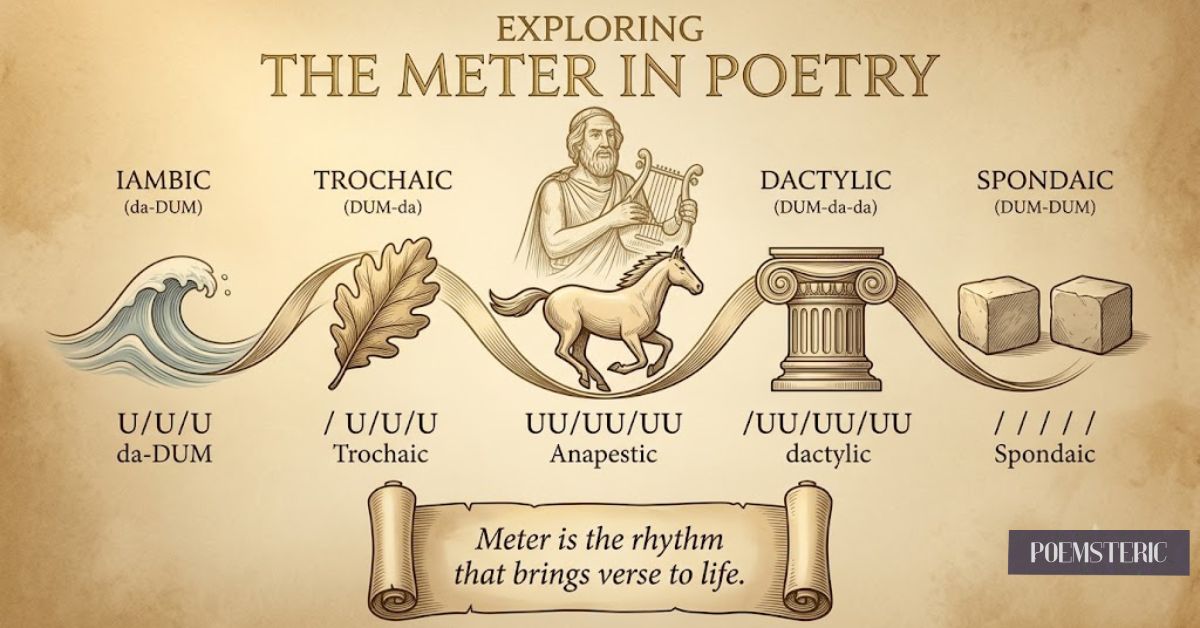
● The five most common meters in English poetry are iambic, trochaic, anapestic, dactylic, and spondaic.

● Meter is different from rhythm meter is the blueprint, rhythm is how it actually sounds when read aloud.

● You can identify meters using a four-step process called scansion.

● Free verse poetry deliberately avoids meter, but understanding meter still helps you write stronger free verse.

● Shakespeare's sonnets and many classic poems rely heavily on iambic pentameter, a five-foot iambic line.
What Is Meter in Poetry?
At its core, meter in poetry refers to the recurring pattern of stressed (accented) and unstressed (unaccented) syllables within a line of verse. Think of it as sheet music for words instead of notes, you have syllables, and instead of a time signature, you have a metrical pattern that repeats line after line.
Poets have used meters for thousands of years because repeated rhythmic patterns are pleasing to the ear and easier to remember, which is partly why ancient epics were composed in strict meter long before they were ever written down. A metrical line is typically described by two things: the type of foot (the smallest repeating unit of stress) and the number of feet per line.
Meter vs. Rhythm: What’s the Real Difference?
People often use “meter” and “rhythm” interchangeably, but they aren’t quite the same thing. Meter is the underlying, idealized pattern a poet sets up the blueprint. Rhythm is the actual, lived experience of that pattern when a real voice reads the line aloud, complete with natural pauses, emphasis, and the small variations every reader brings.
A useful comparison: meter is like a metronome ticking at a steady beat, while rhythm is like a musician playing slightly ahead of or behind that beat for feeling. A skilled poet often sets up a strict meter and then bends it slightly in a specific line to create emphasis, surprise, or emotional weight, which is exactly where rhythm and meter part ways.
How to Pronounce “Meter” in a Poetry Context
“Meter” is pronounced MEE-ter, with the stress on the first syllable, the same way you’d say the measuring unit or a parking meter. In British English, it’s spelled “metre” but pronounced identically. If you’re reading academic sources, don’t be thrown off by the spelling difference; both refer to exactly the same poetic concept.
Why Meter in Poetry Matters
Meter in poetry isn’t just an academic exercise it shapes how a poem feels emotionally. A galloping anapestic meter can create urgency or playfulness, while a slow, heavy spondaic meter can convey weight or solemnity. Poets choose meters deliberately, the same way a film composer chooses a tempo to match a scene.
Meter also aids memory and musicality. Before poems were widely written down, meter helped oral poets and their audiences remember long works, because a predictable rhythmic pattern is far easier to recall than unstructured prose. That’s part of why nursery rhymes and children’s poems still rely so heavily on strong, simple meters today.
Finally, meter creates a framework a poet can push against. Once a reader’s ear expects a certain pattern, even a small deviation from an extra stressed syllable, a broken foot draws attention and creates emphasis exactly where the poet wants it. This tension between expectation and surprise is one of the most powerful tools in a poet’s toolkit, and it simply isn’t available to a poet who never establishes a meter in the first place.
Poetic Feet: The Building Blocks of Meter
Before you can understand types of meters, you need to understand feet. A “foot” is the smallest repeating unit of stressed and unstressed syllables in a metrical line. Combine multiple feet in a row, and you get a full metrical line. For example, five iambic feet in a row is called iambic pentameter (“penta” meaning five).
Feet are usually marked using a simple notation: a curved mark (˘) for an unstressed syllable and a straight mark (ˊ) for a stressed one. Once you can hear the difference between a stressed and unstressed syllable in a word, identifying feet becomes much easier with practice.
Common Types of Poetic Feet
The most common feet in English poetry include the iamb (unstressed-stressed, as in “a-LONE”), the trochee (stressed-unstressed, as in “GAR-den”), the anapest (unstressed-unstressed-stressed, as in “in-ter-RUPT”), the dactyl (stressed-unstressed-unstressed, as in “HAP-pi-ly”), and the spondee (stressed-stressed, as in “HEART-BREAK”).
Each foot creates a distinct feeling when repeated. Iambs feel natural and conversational because they closely mirror everyday English speech patterns. Trochees feel more forceful and driving. Anapests and dactyls create a galloping, musical quality, which is why they show up so often in comic verse and children’s poems.
Types of Meter in Poetry
Once you understand feet, the meter itself is simply naming how many feet appear per line and what kind they are. Here’s a quick side-by-side comparison of the five most common types of meter in poetry, along with their typical feel and where you’ll most often encounter them.
| Meter Type | Foot Pattern | Typical Feel | Common Use |
| Iambic | unstressed-stressed | Natural, conversational | Sonnets, blank verse |
| Trochaic | stressed-unstressed | Forceful, driving | Chants, some ballads |
| Anapestic | unstressed-unstressed-stressed | Galloping, playful | Comic verse, light poems |
| Dactylic | stressed-unstressed-unstressed | Falling, musical | Epic poetry, waltz-like verse |
| Spondaic | stressed-stressed | Heavy, emphatic | Emphasis within other meters |
Iambic Meter
Iambic meter is by far the most common in English poetry because it mirrors natural speech rhythms. The most famous form is iambic pentameter five iambic feet per line used extensively by Shakespeare and Milton. A classic example is the line “Shall I compare thee to a summer’s day,” which falls into a clean unstressed-stressed pattern across ten syllables.
Trochaic Meter
The trochaic meter reverses the iamb, opening each foot with a stressed syllable. It creates a bold, insistent sound, which is why it appears in chants, marching rhythms, and poems like Longfellow’s “The Song of Hiawatha,” where the driving beat mirrors storytelling meant to be recited aloud.
Anapestic Meter
Anapestic meter builds up to a stressed beat across three syllables, creating a light, galloping rhythm. It’s a favourite for comic and rollicking verse, most famously in Clement Clarke Moore’s “‘Twas the night before Christmas,” where the bouncy rhythm mirrors the poem’s playful tone.
Dactylic Meter
Dactylic meter is the reverse of anapestic, starting strong and tapering off. It’s associated with classical epic poetry, particularly Homeric Greek verse, and gives lines a falling, waltz-like quality. In English, it’s rarer and harder to sustain naturally across a whole poem.
Spondaic Meter
True spondaic meter two stressed syllables in a row, repeated throughout a line is rare in English because it’s difficult to sustain naturally. More often, poets insert a single spondaic foot into an otherwise iambic or trochaic line to create emphasis, slowing the reader down at a key emotional moment.
Qualitative vs. Quantitative Meter
The English meter is what’s called “qualitative,” meaning it’s based on the quality of stress in which syllables are emphasized versus unemphasized. This is different from the “quantitative” meter, used in classical Latin and Greek poetry, which is based on syllable length (how long a syllable takes to pronounce) rather than stress.
This distinction matters if you ever study classical poetry in translation, because a translator working from Latin or Greek quantitative meter into English has to make a creative choice about how to represent that rhythm using English’s stress-based system instead, since a literal syllable-length translation wouldn’t feel metrical to an English ear at all.
For most modern readers and writers working in English, quantitative meter is mostly a historical curiosity, while qualitative, stress-based meter is what you’ll actually use and encounter in the vast majority of English-language poetry.
How to Identify Meter in a Poem (Step-by-Step Scansion)
The process of identifying meters in a line of poetry is called scansion. It sounds technical, but it’s really just a repeatable four-step process anyone can learn with a little practice. Here’s exactly how to do it.
Step 1: Read the Line Aloud
Start by reading the line out loud in your natural speaking voice, without trying to force any particular rhythm. Your ear is a better guide than your eye when it comes to identifying stress patterns, so resist the urge to analyze before you’ve simply listened to how the line naturally sounds.
Step 2: Mark Stressed and Unstressed Syllables
Go word by word and mark which syllables naturally carry more emphasis. Multi-syllable words often have a dictionary-standard stress pattern (like ban-AN-a), while single-syllable words depend on context; small words like “the” or “and” are usually unstressed, while nouns and verbs usually carry the stress.
Step 3: Group Syllables Into Feet
Once every syllable is marked, group them into repeating units, or feet. Look for a consistent two- or three-syllable pattern that repeats across the line, such as unstressed-stressed pairs (iambs) or stressed-unstressed pairs (trochees).
Step 4: Count the Feet to Name the Meter
Finally, count how many feet appear in the line and combine that count with the foot type to name the meter. Five iambic feet is iambic pentameter; four trochaic feet is trochaic tetrameter. With practice, this entire process takes seconds rather than minutes.
Real Examples of Meter in Famous Poems
Theory only sticks once you see meter in action. Below are two classic examples that show how differently meters can shape tone, even within the same broad iambic family.
Meter in Shakespeare’s Sonnets
Shakespeare’s sonnets are written almost entirely in iambic pentameter, ten syllables per line arranged in five unstressed-stressed pairs. This meter closely mirrors natural English speech, which is exactly why his lines still feel conversational and emotionally direct centuries later, even in formal love poetry.
Meter in Dickinson’s “Hope Is the Thing With Feathers”
Emily Dickinson frequently used a variation of common meter, alternating lines of iambic tetrameter and iambic trimeter. This hymn-like rhythm gives her poems a folk-song quality, reinforcing themes of endurance and quiet resilience through a steady, almost musical pulse.
Meter vs. Free Verse: Is Meter Still Relevant Today?
A common question from newer poets is whether meter still matters in an era dominated by free verse. The honest answer is yes, even if you never plan to write a single metrical poem yourself. Free verse poets deliberately choose not to use a fixed meter, but that choice only means something if you understand what you’re choosing to depart from.
Many celebrated free verse poets, including Walt Whitman, studied and absorbed metrical traditions before breaking from them intentionally. Understanding meter in poetry gives you a stronger ear for rhythm generally, which makes your free verse more deliberate and controlled rather than simply unstructured prose broken into lines.
In short, meter isn’t a relic, it’s a foundational skill that strengthens every kind of poetry you write, structured or not.
How to Write Your Own Metered Poem
Writing your first metered poem is easier than it looks if you follow a simple process rather than trying to force perfection immediately.
First, picking a simple meter to start with iambic tetrameter (four iambic feet per line) is a forgiving choice because it mirrors natural speech while still being short enough to control.
Second, write your sentence naturally first, without worrying about meter at all, then scan it using the four-step process above to see which parts already fit and which don’t.
Third, revise word by word, swapping synonyms or reordering phrases until the stress pattern lines up consistently across each line, remembering that small, natural-sounding tweaks usually work better than forcing an awkward word purely to fit the pattern.
Finally, read your revised lines aloud repeatedly. If a line trips your tongue or feels unnatural to say, that’s usually a sign the meter isn’t quite locked in yet, and it’s worth one more revision pass before moving on.
Common Mistakes Beginners Make With Meter
The most frequent mistake is forcing unnatural word order purely to fit a metrical pattern, which produces stiff, old-fashioned-sounding lines that feel disconnected from how people actually speak today.
Another common mistake is confusing meter with rhyme; a poem can rhyme without any consistent meter at all, and plenty of strongly metrical poems don’t rhyme whatsoever, so treating the two as the same thing leads to real confusion when analyzing or writing poetry.
Finally, many beginners give up on scansion too early because the first few attempts feel slow and uncertain. Like any skill, identifying meter gets dramatically faster with repetition, and most people find it becomes almost automatic after scanning just a handful of poems.
FAQs
Q: What is meter in poetry in simple terms?
A: Meter in poetry is the repeating pattern of stressed and unstressed syllables within a line of verse. It works like a rhythmic blueprint, giving the poem a musical, predictable beat. Poets combine different types of feet, such as iambs or trochees, to build lines with a consistent metrical pattern, which is part of what makes structured poetry feel different from ordinary prose.
Q: What are the main types of meter in poetry?
A: The five most common types of meter in poetry are iambic, trochaic, anapestic, dactylic, and spondaic. Each is defined by a different pattern of stressed and unstressed syllables within its foot. Iambic meter is the most widely used in English poetry because it closely mirrors natural speech, while the others create more distinct rhythmic effects.
Q: How do you identify meters in a poem?
A: You identify the meter through a process called scansion: read the line aloud, mark each syllable as stressed or unstressed, group the syllables into repeating feet, then count the feet to name the meter. For example, five iambic feet in a row is called iambic pentameter. With practice, this process becomes quick and almost automatic.
Q: Is meter the same as rhythm?
A: No, meter and rhythm are related but different. Meter is the idealized, underlying pattern a poet sets up on the page, while rhythm is how that pattern actually sounds when read aloud, including natural variations in emphasis and pacing. A poet often establishes a strict meter and then bends it slightly to create rhythmic emphasis in a specific line.
Q: Why do poets use meters?
A: Poets use meters to add musicality, aid memorability, and control emotional pacing. A galloping meter can create urgency, while a slow, heavy meter conveys weight. Meter in poetry also sets up reader expectations, so any deviation from the established pattern draws attention exactly where the poet wants emphasis, making it a powerful creative tool.
Q: Do all poems need a meter?
A: No, not all poems use meters. Free verse poetry deliberately avoids a fixed metrical pattern, favoring natural speech rhythms instead. However, many free verse poets studied traditional meter first, since understanding it strengthens their overall sense of rhythm, even in poems that intentionally break away from any consistent metrical structure.
Final Thoughts
Meter in poetry is one of those concepts that seems intimidating from the outside but becomes intuitive surprisingly fast once you break it into its component parts: feet, stress patterns, and repetition. Whether you’re analyzing Shakespeare, Dickinson, or a contemporary free verse poem that deliberately avoids meter, understanding this foundation gives you a sharper ear and a stronger set of tools as both a reader and a writer.
Start small, pick a poem you already love, scan a few of its lines using the four-step process above, and notice how the meter shapes its emotional effect. The more poems you practice on, the more naturally the meter will reveal itself, until you’re spotting iambs and trochees without even trying.
Recent Article : Slam Poetry Explained: History, Rules & 15 Examples

Jennifer Aston is a passionate poetry curator and writer with a deep love for the written word. She believes poetry has the power to heal, inspire, and connect people across all walks of life. Through PoemSteric, she brings together timeless and modern verses for every emotion and every moment.