
Introduction
Most people met their first acrostic poem in a third-grade classroom, spelling out their own name down the side of a worksheet. What often gets missed is how useful this simple form stays well into adulthood. An acrostic poem is one of the few poetic structures that asks nothing of you except a word and a little honesty about what that word means to you. There’s no rhyme scheme to wrestle with, no syllable count to track, and no formal training required to write one that actually lands.
This guide covers everything you need to understand and write acrostic poems with confidence: a clear definition, a short honest history of where the form came from, the different types of acrostics (including the trickier double acrostic), a step-by-step writing process, the real rules around rhyme and meter, and how the form shifts between kids and adults. Past that, you’ll find more than 60 original acrostic poem examples, organized by category, so you can either borrow inspiration or see the pattern clearly enough to write your own in minutes.
Whether you’re a teacher building a lesson plan, a parent helping with homework, or someone trying to write something meaningful for a birthday card or a eulogy, this page is built to get you from “what is this form, exactly” to “here’s mine” in one sitting.
Key Takeaways
Before diving into the full breakdown, here’s the short version of everything this guide covers:
● An acrostic poem spells a word or phrase using the first letter of each line, read top to bottom.

● Rhyme and meter are optional; most acrostic poems are written in free verse.

● The two main types are the single acrostic (first letters only) and the double acrostic (first and last letters).

● Acrostic poems work for any age group and any occasion, from classroom assignments to wedding vows.

● The length of the poem is fixed by the length of the word or phrase being spelled out.

● There are more than 60 original examples further down this page, grouped by family, occasions, love and relationships, and creative themes.

● Writing one takes five simple steps, covered in detail below, and requires no prior poetry experience.
What Is an Acrostic Poem?
An acrostic poem is a poem in which the first letter of each line, read vertically from top to bottom, spells out a word, name, or phrase. That hidden word is almost always the subject or theme of the poem itself, which is what separates an acrostic from a poem that simply happens to start each line with a random letter.
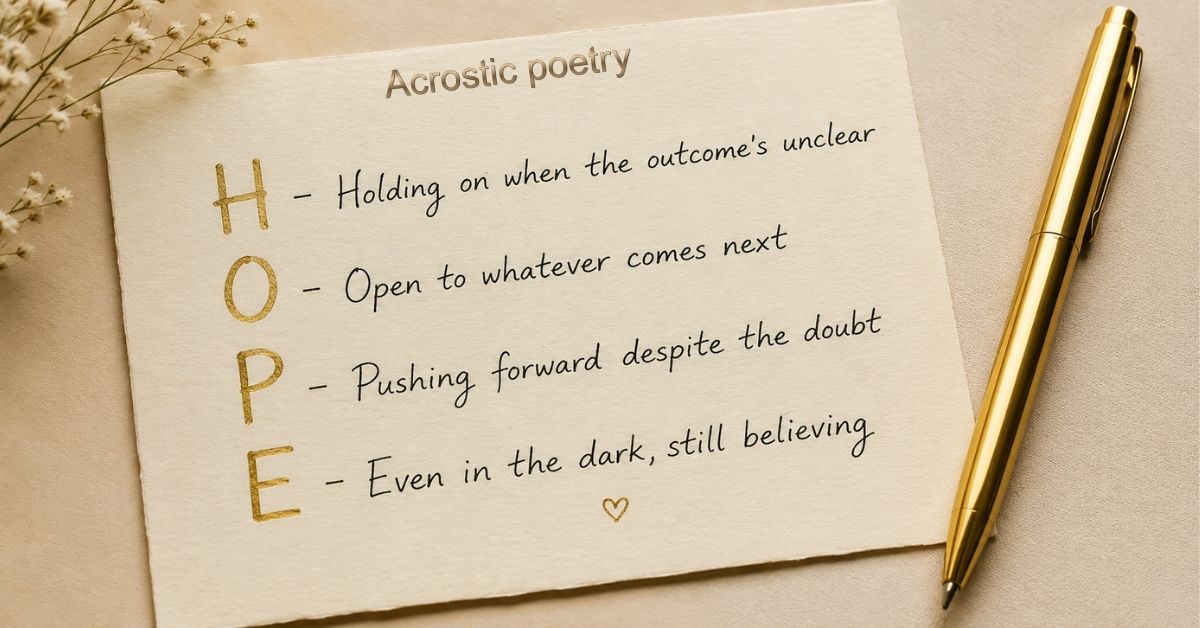
Take the word “HOPE.” A four-line acrostic poem about hope would have one line starting with H, one with O, one with P, and one with E, and each line would say something true or meaningful about hope as a concept. The vertical word acts like a spine holding the poem together, while the horizontal lines carry the actual meaning.
This is different from most poetic forms, which are defined by sound (rhyme, rhythm, meter). An acrostic is defined by a visual and structural trick: the shape of the words on the page, not how they sound out loud. That’s part of why the form is so approachable. You can write a technically correct acrostic poem in under two minutes, though writing a genuinely good one, where every line feels intentional rather than forced, takes a bit more care.
Acrostic poems can be as short as three lines (a name like “SAM”) or considerably longer (a phrase like “HAPPY BIRTHDAY TO YOU”). There’s no required length beyond whatever word or phrase you choose to spell out.
A Short History of Acrostic Poems
The acrostic form is old enough that its exact origin isn’t entirely settled, but its footprint runs through several ancient literary traditions. Early acrostic structures have been identified in Hebrew psalms, where certain verses were arranged so each line or stanza began with a successive letter of the Hebrew alphabet, functioning partly as a memory aid for oral recitation.
In English literature specifically, historians generally credit Walter Haddon, writing in the 1500s, as one of the earliest examples of the form in the language, though his acrostic appeared inside a Latin poem rather than standing on its own. From there, the form moved gradually from a scholarly curiosity into something poets used for personal or playful purposes.
Two names come up constantly in any serious discussion of acrostic poems: Edgar Allan Poe and Lewis Carroll. Poe used the acrostic to encode names directly into romantic verse, treating the hidden word almost like a private message meant for one specific reader. Carroll went further with “A Boat, Beneath a Sunny Sky,” the closing poem of “Through the Looking-Glass,” which spells out the full name of Alice Pleasance Liddell, the real child who inspired the Alice stories. Both examples matter because they show the acrostic being used for something more than decoration: as a way to hide a dedication in plain sight, readable only to someone who knows to look for it.
Despite this respectable literary lineage, acrostic poems have mostly stayed outside the canon of “serious” poetry, which is likely part of why the form feels so unintimidating today.
Types of Acrostic Poems You Should Know
Not every acrostic poem works the same way. Understanding the different types helps you choose the right level of challenge for what you’re writing.
Single Acrostics
A single acrostic is the standard version of the form and the one almost everyone means when they say “acrostic poem.” Only the first letter of each line matters, spelling out the chosen word from top to bottom. This is the version taught in elementary schools, used for classroom name poems, and the type behind the vast majority of examples you’ll find anywhere online, including in this guide.
Single acrostics are forgiving by design. Because only the first letter of each line is fixed, you have complete freedom over line length, word choice, and how literal or abstract each line gets. This is exactly why the form scales so well from a six-year-old’s homework assignment to an adult writing something for a retirement card.
Double Acrostics and Telestichs
A double acrostic raises the difficulty considerably. Instead of only the first letter of each line spelling out a word, both the first and last letters do, meaning you can read one word going down the left edge of the poem and another (or the same) word going down the right edge. Some writers use this to spell out two related words, such as a person’s first and last name, one down each side.
A telestich is a close cousin of the double acrostic: a poem where only the last letter of each line spells the hidden word, with no requirement on the first letter. Both forms demand much tighter control over line construction, since every line has to open and close in specific, predetermined ways while still reading naturally. They’re worth knowing about, but most people writing acrostic poems for the first time should start with the single version covered above.
How to Write Acrostic Poems: A Step-by-Step Guide
Writing an acrostic poem takes five steps, and none of them require any background in poetry.
Step 1: Choose your word or phrase. This becomes the spine of your poem and should reflect what the poem is actually about, whether that’s a name, an occasion, or a feeling.
Step 2: Write the word vertically down the left side of a blank page, one letter per line, leaving space after each letter.
Step 3: Brainstorm before you draft. For each letter, jot down two or three words or short phrases that start with it and relate to your subject. Don’t filter yourself yet.
Step 4: Build each line from your brainstormed words. A line doesn’t need to be a full grammatical sentence; a strong phrase or fragment often works better and reads more naturally within a stack of other lines.
Step 5: Read the poem aloud, both as individual lines and as a whole, then read only the first letters vertically to double-check the hidden word is intact. Revise any line that feels forced or that was clearly written just to hit a letter rather than to say something real.
A quiet trick worth knowing: it’s almost always easier to write the hardest letters first (Q, X, Z, U) and fill in the easier letters (S, T, A, E) around them, rather than working strictly top to bottom and getting stuck two-thirds of the way through.
Rules of Rhyme and Meter in Acrostic Poems
One of the most common misconceptions about acrostic poems is that they need to rhyme or follow a set rhythm, the way a sonnet or a limerick does. They don’t. The only structural requirement of an acrostic poem is the vertical spelling of the chosen word using the first letter of each line. Everything else, including rhyme, meter, line length, and even whether the poem uses complete sentences, is entirely up to the writer.
Most acrostic poems are written in free verse, meaning there’s no fixed syllable count or rhythmic pattern from line to line. This is partly practical: forcing both a specific starting letter and a consistent rhyme scheme onto every line makes the form dramatically harder to write well, and it often produces stiff, awkward phrasing as writers bend meaning to fit sound.
That said, nothing stops a confident writer from adding rhyme or meter on top of the acrostic structure for extra musicality; it’s simply an additional constraint layered onto the form, not a requirement of it. If you’re writing your first acrostic poem, or writing one for a child, skip rhyme and meter entirely and focus on getting each line to say something true and specific. That alone is enough to make the poem work.
Acrostic Poems for Kids vs. Acrostic Poems for Adults
The underlying structure of an acrostic poem never changes between a six-year-old and a sixty-year-old; what shifts is vocabulary, theme, and emotional weight. A child’s acrostic poem about “SUMMER” will likely mention ice cream, swimming pools, and no homework. An adult writing the same word might explore nostalgia, the passage of time, or a specific childhood memory tied to a particular summer.
For kids, acrostic poems work best as a low-pressure introduction to poetry and creative writing. Teachers often use them because the format gives a clear, achievable structure without demanding technical poetry knowledge, which helps young writers focus on vocabulary and self-expression rather than getting stuck on rules. Simple, concrete words (their own name, a pet, a favorite season) tend to work best with younger writers.
For adults, acrostic poems are frequently used for more emotionally weighted purposes: wedding vows, anniversary cards, retirement tributes, sympathy messages, or personalized gifts. The words chosen tend to be more abstract (LOVE, TRUST, LEGACY, FOREVER) and the lines often carry more emotional complexity or nuance than a child’s version would.
Neither version is more “correct” than the other. The form is genuinely built to flex across age and purpose, which is a large part of why it has survived, largely unchanged, for centuries.
60+ Acrostic Poems Examples by Category
Below are more than 60 original acrostic poem examples, organized into four categories: family, occasions, love and relationships, and creative or literary themes. Each one follows the standard single-acrostic structure covered above: read the first letter of each line from top to bottom to see the hidden word.
Acrostic Poems About Family
MOM
M Made my world warm and bright
O Offering love that never runs dry
M My first friend, my forever guide
DAD
D Dependable through every storm
A Always my quiet hero
D Doing everything without asking for thanks
SON
S Small hands that once held mine
O Overflowing with questions and wonder
N Now growing braver every day
HOME
H Holds every memory we’ve made
O Open doors, no matter the hour
M Made of laughter, not just walls
E Everyone’s welcome here
AUNT
A Always ready with advice
U Understanding without judging
N Never too busy for a visit
T Treats me like her own
UNCLE
U Unforgettable stories at every dinner
N Never runs out of jokes
C Comes through when it matters
L Loud laugh that fills the room
E Everyone’s favorite troublemaker
NIECE
N Notices everything, forgets nothing
I Imagination bigger than the sky
E Every visit ends too soon
C Curious about the whole world
E Endlessly loved
FAMILY
F Faces that feel like home
A Always in my corner
M Memories stacked up over years
I Imperfect but unbreakable
L Loud dinners, louder love
Y Yours no matter what
SISTER
S Shares my secrets and my clothes
I Instantly knows when something’s wrong
S Still my first best friend
T Teases me, then defends me
E Every memory has her in it
R Ride or die, always
BROTHER
B Built-in best friend from day one
R Roughhousing turned into respect
O Only person who gets the old jokes
T Trusted with every secret
H Here whenever I call
E Even when we argue, he shows up
R Ready to fight my battles too
MOTHER
M Made sacrifices I’m still learning about
O Only one who never gave up on me
T Taught me more than any book
H Held me together more than once
E Every lesson wrapped in patience
R Root of everything good in me
FATHER
F First one to believe in me
A Always working, rarely resting
T Taught me how to stand back up
H Hands that fixed everything
E Every “I’m proud of you” mattered
R Reason I keep trying
GRANDMA
G Gentle hands that braided my hair
R Recipes passed down like treasure
A Always had time to listen
N Never ran out of stories
D Doors always open, kettle always on
M Made every visit feel like home
A A love that never gets old
GRANDPA
G Gave me my first fishing rod
R Ran out of patience for no one but himself
A Always had a joke ready
N Never missed a birthday
D Days spent teaching without lessons
P Proud in a quiet, steady way
A A legacy in every story he told
COUSIN
C Closer than just family by blood
O Our childhood summers were the best
U Understands me without explanation
S Silly memories we still laugh about
I In every family photo together
N Never really apart, no matter the distance
Acrostic Poems for Special Occasions
PARTY
P Presents piling by the door
A All our favorite people in one room
R Ribbons and balloons everywhere
T Time flies when we’re together
Y Yet another memory to keep
CAKE
C Candles waiting to be blown out
A A slice for everyone, no exceptions
K Kept simple, made with love
E Every bite tastes like celebration
TOAST
T To the moments we almost missed
O Overflowing glasses, overflowing hearts
A A toast to how far we’ve come
S Something worth celebrating
T Together is the best part
WEDDING
W Walking down the aisle, hearts racing
E Every vow spoken with certainty
D Devoted through whatever comes next
D Dancing until our feet ache
I Into a future built together
N Nervous laughter turning into joy
G Growing old side by side
BIRTHDAY
B Blowing out candles, making a wish
I Instead of gifts, just being together
R Reflecting on another year gone by
T Time to celebrate simply existing
H Happy tears mixed with laughter
D Doing something you love today
A Another chapter starting
Y You deserve every bit of joy
GRADUATE
G Gowns and caps thrown in the air
R Relief after years of hard work
A A new chapter finally beginning
D Diplomas earned, not given
U Unforgettable years behind you
A Ambitions waiting to be chased
T Tears of pride from the crowd
E Everything starts here
HOLIDAY
H Homes decorated in warm colors
O Old traditions, new memories
L Lights strung across every window
I Invitations sent to everyone we love
D Dinner tables stretched to fit more chairs
A A pause from the everyday rush
Y Yearly reminder to slow down
SUMMER
S Sunshine that lasts past bedtime
U Unhurried days by the water
M Melting popsicles and bare feet
M Memories made in flip-flops
E Endless evenings that feel like freedom
R Return to it every single year
WINTER
W White mornings, quiet streets
I Inside warmth against outside cold
N Nights that come earlier each day
T Thick blankets and hot drinks
E Everything slower, softer, stiller
R Ready for spring, but not rushing it
SPRING
S Soft rain waking up the earth
P Petals unfolding overnight
R Renewal after a long winter
I Increasing daylight, hope rising with it
N New beginnings in every bud
G Green returning to the world
AUTUMN
A Amber leaves drifting to the ground
U Unmistakable chill in the morning air
T Trees undressing slowly, gracefully
U Unhurried walks through crunching leaves
M Memories of pumpkin spice and bonfires
N Nature’s last color before winter
EASTER
E Eggs hidden in every corner
A A morning of new beginnings
S Sunshine breaking through spring clouds
T Traditions passed from one generation to the next
E Everyone gathered around one table
R Renewal, hope, and family together
CHRISTMAS
C Cold nights warmed by candlelight
H Homes filled with the smell of pine
R Ribbons wrapped around every gift
I Invitations to give more than receive
S Snow falling softly outside the window
T Together under one roof again
M Memories made under the mistletoe
A A season of giving, not just gifts
S Silent nights, joyful mornings
REUNION
R Remembering faces we hadn’t seen in years
E Every hug lasting a little longer
U Unchanged bonds despite the distance
N Nostalgia mixed with new stories
I In one room again, finally
O Old jokes still landing
N Never truly apart, just far away
MEMORY
M Moments we didn’t know we’d treasure
E Every small detail somehow stayed
M Made stronger with each retelling
O Ordinary days that became extraordinary
R Reliving it all over again
Y Years later, still just as clear
Acrostic Poems About Love and Relationships
LOVE
L Learning you a little more each day
O Offering patience even on hard days
V Vowing to choose you again and again
E Everything feels lighter with you here
HEART
H Holding on through every season
E Every beat somehow knows your name
A Always finding my way back to you
R Real, steady, and unshaken
T Trusting you with all of it
KISS
K Keeping every promise with a touch
I In the quiet moments, not just the big ones
S Saying what words sometimes can’t
S Sealing a feeling that needs no explanation
HUG
H Holding what words can’t quite say
U Unspoken comfort in a single moment
G Grounding me, even on the hardest days
TRUST
T Told the truth even when it was hard
R Reliable when everything else felt uncertain
U Understanding without needing an explanation
S Steady, even through disagreements
T Together, no matter what comes
ADORE
A Admiring every little thing about you
D Devoted without needing a reason
O Only wanting your happiness above mine
R Remembering the smallest details you mention
E Endlessly grateful you’re mine
CHERISH
C Choosing you again, every single day
H Holding onto the little moments
E Every memory becomes a favorite
R Realizing how rare this really is
I In no rush to be anywhere else
S Simply grateful you exist
H Home is wherever you are
DEVOTED
D Determined to show up, always
E Every promise kept, not just spoken
V Valuing you above my own comfort
O Only wanting what’s best for you
T Time never feels wasted with you
E Even the hard days are worth it
D Devotion that doesn’t waver
FOREVER
F Feels too short a word for this
O Only getting surer with time
R Rooted in something steady and real
E Every year, choosing you again
V Vowing to stay through the changes
E Every version of you, I’ll love
R Right here, for as long as I can
PROMISE
P Placing my trust in your hands
R Ready to stay through the hard parts
O Offering more than just words
M Meaning every single one of them
I In sickness, in doubt, in joy
S Steadfast even when it’s difficult
E Every day, I’ll choose to keep it
ROMANCE
R Rediscovering each other, again and again
O Ordinary moments made extraordinary
M Missing you before you’ve even left
A A love that still surprises me
N Never running out of reasons to smile
C Choosing small gestures over grand ones
E Every day feels a little like the first
EMBRACE
E Every hug feels like coming home
M Moments that need no words
B Both of us, finally still
R Resting easy in your arms
A A comfort nothing else compares to
C Closer with every passing year
E Everything else fades away
SOULMATE
S Someone who somehow already knew me
O Overlapping in the strangest, best ways
U Understanding without over-explaining
L Loving the parts I hide from others
M Matching my pace without being asked
A A rare kind of easy
T Trusting you without a second thought
E Everything makes more sense with you
TOGETHER
T Through the good and the hard
O Only stronger standing side by side
G Growing in the same direction
E Every challenge easier to face as two
T Time spent well, however it’s spent
H Holding on when it would be easier to let go
E Even the quiet days feel full
R Right where I’m meant to be
FRIENDSHIP
F Familiar in the best way
R Reliable without needing to be asked
I Inside jokes only we understand
E Every hard time made lighter
N Never keeping score
D Distance doesn’t change a thing
S Showing up, even uninvited
H Honest, even when it’s uncomfortable
I In it for the long run
P Picking up right where we left off
Creative and Literary Acrostic Poems
HOPE
H Holding on when the outcome’s unclear
O Open to whatever comes next
P Pushing forward despite the doubt
E Even in the dark, still believing
DREAM
D Drifting somewhere the rules don’t apply
R Reaching for something just out of view
E Everything feels possible here
A A version of tomorrow, imagined tonight
M Made of everything I haven’t said yet
PEACE
P Pausing long enough to just breathe
E Everything quiet, nothing rushed
A Acceptance of what I cannot change
C Calm settling in where worry used to live
E Enough, finally, just as it is
COURAGE
C Choosing to try despite the fear
O Overcoming what once felt impossible
U Uncertain, but moving forward anyway
R Rising again after every fall
A Afraid, yet still showing up
G Growing stronger with every attempt
E Every small brave act counts
FREEDOM
F Finally unbound from what held me back
R Room to breathe, room to grow
E Every choice finally my own
E Escaping what no longer fits
D Discovering who I am without limits
O Open roads and open possibilities
M Moving forward on my own terms
WONDER
W Wide-eyed at the smallest things
O Overwhelmed by how vast the world is
N Never quite losing that curiosity
D Discovering something new every day
E Everything feels a little magical
R Remembering to look up more often
JOURNEY
J Just taking it one step at a time
O Only looking back to learn, not linger
U Uncertain paths that somehow made sense
R Realizing the destination was never the point
N Navigating detours without losing direction
E Every mile changed me a little
Y Yet to reach the end, and that’s alright
OCEAN
O Overwhelming in its endless blue
C Constant, no matter the weather
E Echoes of something ancient and vast
A A rhythm that never quite stops
N Nothing feels small standing beside it
MOUNTAIN
M Massive against a fading sky
O Overlooking everything below
U Unmoved by the passing seasons
N Never in a hurry to change
T Tall enough to make me feel small
A A quiet kind of strength
I Its peak always worth the climb
N Nature’s reminder to keep going
RAINBOW
R Rising after the storm has passed
A A promise painted across the sky
I Impossible to hold, easy to admire
N Never lasting quite long enough
B Bridging the gray with color
O Ordinary skies made extraordinary
W Worth stopping everything to watch
PHOENIX
P Pulled apart by everything I survived
H Held together by something stronger than fear
O Only rising because I had no other choice
E Everything I lost became fuel
N New from every ending
I Impossible to keep down for long
X Exactly who I was always meant to become
WHISPER
W Words too quiet for anyone else to hear
H Held close, meant only for you
I Intimate in a way shouting never is
S Softer than silence, louder than it seems
P Precious because it wasn’t meant to carry far
E Everything said without needing volume
R Remembered longer than any shout
HORIZON
H Hinting at something just out of reach
O Ordinary lines made into something worth chasing
R Reminding me the world keeps going
I Inviting me toward what’s next
Z Zero limits on what could be out there
O Open-ended, always shifting
N Never quite arriving, always worth the walk
STARLIGHT
S Small against the size of the sky
T Traveling years just to reach us
A A quiet kind of company at night
R Reminding me how small my worries really are
L Lingering long after the sun sets
I Impossible to look away from
G Guiding without ever making a sound
H Holding stories older than I can imagine
T Timeless in a way nothing else is
LEGACY
L Left behind in the smallest gestures
E Everything I built, someone else will carry
G Given freely, without expecting anything back
A A mark that outlasts the moment
C Continuing long after I’m gone
Y Yet to be finished, still being written
Best Occasions to Use Acrostic Poems
Because acrostic poems are flexible in tone and length, they fit naturally into far more occasions than people initially assume. Birthdays are the most common use case, since a name or a word like “BIRTHDAY” itself gives an obvious, personal structure to work from. Weddings are a close second; many couples use an acrostic of each other’s names, or a word like “TOGETHER,” as part of vows or a reading during the ceremony.
Graduations, retirements, and other milestone events lend themselves well to acrostic poems built around words like “JOURNEY,” “LEGACY,” or “COURAGE,” since these themes naturally reflect a transition or an accomplishment. Sympathy and memorial contexts are another meaningful use case: an acrostic built from a loved one’s name, read at a funeral or written inside a card, often carries more weight than a generic sentiment because it’s visibly personal and specific to that one person.
Beyond major life events, acrostic poems also work well for smaller, everyday moments: a thank-you note to a teacher, a card for a new parent, or a quick note of encouragement to a friend going through something difficult. Because the form takes minutes to write and requires no special skill, it’s one of the few kinds of poem that fits comfortably into a last-minute card just as well as a planned ceremony reading.
Common Mistakes to Avoid When Writing Acrostic Poems
The most frequent mistake in acrostic poems is forcing a line just to hit the required letter, producing something like “Xylophones remind me of you” purely because the word needed an X. If a line only exists to satisfy a letter and adds nothing to the meaning of the poem, readers notice immediately, and it undercuts the whole piece. It’s better to rework the surrounding lines, or occasionally choose a slightly different word, than to include one clearly forced line.
A second common issue is inconsistency in tone. Because each line is written somewhat independently around a single starting letter, it’s easy to end up with a poem that swings between playful and serious without any real reason, which reads as unfocused rather than intentionally varied. Deciding on an emotional tone before writing helps every line stay aligned.
Third, many first-time writers assume rhyme is mandatory and twist their phrasing awkwardly trying to force it in. As covered earlier, rhyme is optional, and forcing it usually produces weaker lines than simply writing in free verse would.
Finally, it’s easy to forget that punctuation and capitalization still matter. A poem with every line trailing off without punctuation, or capitalized inconsistently, looks unfinished even if the content itself is strong. A quick read-through focused purely on formatting, separate from a read-through focused on meaning, catches most of these issues before the poem is considered done.
Acrostic Poem Challenges and Activities to Try at Home
If you want to practice the form beyond a single poem, a few structured challenges make acrostic writing more engaging, especially for classrooms or family activities at home.
The Name Swap Challenge: Write an acrostic poem using a family member’s name without telling them, then read it aloud and have them guess who it’s about based only on the content of the lines, not the letters.
The Reverse Challenge: Instead of choosing a word and writing lines to match, write eight or nine unrelated sentences first, then see what word or phrase can be spelled from their first letters, treating the result as a found poem.
The One-Word Marathon: Pick a single long word (like “GRATITUDE” or “CELEBRATION”) and challenge everyone in the room to write their own version, then compare how differently each person interpreted the same letters.
The Double Acrostic Attempt: For more advanced writers, try building a poem where both the first and last letters of each line spell out a short word, as covered in the double acrostic section above. This is genuinely difficult and works well as a longer-term writing exercise rather than a quick activity.
These challenges work equally well in a classroom, a family gathering, or as a solo writing warm-up, and they tend to produce far more interesting results than simply being asked to “write an acrostic poem” with no additional constraint.
FAQs
Q: What is an acrostic poem in simple terms?
A: An acrostic poem is a poem where the first letter of each line spells out a word, name, or phrase when you read those letters from top to bottom. The hidden word usually names the poem’s subject, so an acrostic about “SPRING” would have six lines, each starting with S-P-R-I-N-G in order. Acrostic poems don’t need to rhyme or follow a strict rhythm, which makes them one of the most approachable poetic forms for beginners, students, and anyone writing a quick, meaningful message for someone else.
Q: Do acrostic poems need to rhyme?
A: No, rhyme is completely optional in acrostic poems. The only fixed rule is that the first letters of each line spell out the chosen word or name. Some writers add rhyme or a steady rhythm for musicality, but most acrostic poems are written in free verse, where the focus stays on meaning rather than sound patterns. This flexibility is exactly why acrostic poems work equally well as playful classroom exercises and as heartfelt gifts for birthdays, weddings, or memorials.
Q: What is the difference between an acrostic poem and a double acrostic?
A: A standard acrostic poem spells out a word using only the first letter of each line. A double acrostic goes further, spelling out a word using both the first and last letters of each line, so the same word (or two different words) can be read vertically down both edges of the poem. Double acrostics are considerably harder to write because every line has to open and close with a specific letter while still making grammatical sense.
Q: Are acrostic poems only for kids?
A: Not at all. Acrostic poems are popular in elementary classrooms because the format is easy to teach, but adults use the same structure for wedding vows, sympathy cards, retirement tributes, and personalized gifts. The difference is usually in vocabulary and theme rather than the technique itself: a child’s acrostic about “SUMMER” might mention ice cream and swimming, while an adult’s acrostic about “MARRIAGE” might explore trust, patience, and partnership.
Q: How long should an acrostic poem be?
A: The length of an acrostic poem is decided entirely by the word or phrase you choose to spell out, since one line corresponds to each letter. A name like “SAM” produces a three-line poem, while a phrase like “HAPPY BIRTHDAY” produces thirteen lines (spaces are usually skipped or marked with a line break). There’s no minimum or maximum beyond that, so writers can keep each line short and punchy or expand it into a full sentence.
Final Thoughts
Acrostic poems earn their staying power honestly. They ask very little in terms of technical skill, yet the finished result almost always feels personal, because the hidden word forces every line to circle back to one specific subject. That combination, low barrier to entry and high emotional payoff, is rare in poetry.
If you’re writing your first one, don’t overthink it. Choose a word that actually means something in your specific situation, whether that’s a name, an occasion, or a feeling, brainstorm loosely before you draft, and resist the urge to force a line just to fit a letter. The 60-plus examples above exist to make that process faster: borrow a line, adapt a structure, or simply use them as proof that a good acrostic poem doesn’t need to be complicated to land.
Whatever you’re writing one for, a birthday card, a classroom assignment, a wedding reading, or just for the quiet satisfaction of finishing a poem, the acrostic form remains one of the most forgiving ways into writing that still manages to feel intentional and specific to the person reading it.
Recent Article : Miscarriage Poems: Words for the Grief No One Sees

Jennifer Aston is a passionate poetry curator and writer with a deep love for the written word. She believes poetry has the power to heal, inspire, and connect people across all walks of life. Through PoemSteric, she brings together timeless and modern verses for every emotion and every moment.