
Introduction
We woke up. We reach for the glowing rectangle before our eyes even focus. We scroll through a feed of faces we barely know, hearts we tap without feeling, and headlines that steal our breath before breakfast. This is not science fiction. This is Tuesday. And somewhere in the middle of this noise, a quiet art form is emerging digital life poems that refuse to look away from the glow.
Poetry has always been the language of the obsessed. The Romantics were obsessed with nature. The Beat poets were obsessed with the open road. Today, a new generation of writers is obsessed with the screen, the device that lives in our pocket, on our nightstand, and increasingly, inside our heads. These are not poems written by people who have never touched a smartphone. These are poems written by people who cannot stop touching one.
In this article, you will find fifteen original poems that capture the raw, unfiltered experience of living in a screen-obsessed world. Each poem was crafted to reflect a specific moment, emotion, or fracture in our digital live from the first notification of the morning to the quiet horror of realizing you have spent three hours watching strangers live their lives. These are not polished academic exercises. They are bruised, honest, and deeply human.
Whether you are here because you feel the weight of your own screen addiction, because you are searching for poetry that speaks your language, or because you want to understand what this era sounds like when it is translated into verse, you are in the right place. These poems do not judge. They witness. And sometimes, witnessing is the first step toward change.
Key Takeaways
Before you dive into the poems, here is what you need to know:
Digital life poems are a rapidly growing genre that captures the emotional reality of living online anxiety, isolation, comparison, and unexpected connection.

The fifteen poems in this article are organized into three emotional phases: the morning ritual of checking, the hollow hours of endless scrolling, and the quiet rebellion of choosing to log off.

Each poem is accompanied by a brief reflection to help you understand the deeper meaning and how it connects to real-world screen behaviour.

You will also learn how to write your own poem about technology addiction, with step-by-step guidance.

The article includes book recommendations for readers who want to explore this genre further.
Verse on Virtual Reality: What Digital Life Poems Reveal About Us
Poetry about screens is not new, but its urgency is. In the past decade, our relationship with technology has shifted from “useful tool” to “inseparable companion.” The average person now spends over seven hours a day looking at a screen. For many, that number is closer to ten. We do not just use technology anymore. We exist inside it.
What digital life poems reveal is something statistics cannot capture: the feeling of that existence. A study from 2023 found that 72% of adults report feeling anxious when separated from their phones. But a poem can tell you what that anxiety sounds like at 3 a.m. when you cannot sleep and your thumb keeps refreshing a feed that has not changed in twenty minutes.
These poems reveal our loneliness disguised as connection. They reveal our restlessness disguised as curiosity. They reveal that we are not addicted to information we are addicted to the possibility of something better appearing on the next swipe. The poet does not need a research grant to understand this. The poet only needs an honest mirror and the courage to describe what they see.
The Anatomy of a Screen-Obsessed Poem
Not every poem about technology is created equal. The best ones do more than complain about smartphones. They excavate the emotional archaeology beneath the surface. Here is how to read one with intention.
How to Read a Poem About Technology Addiction
- Notice the device, but look past it. The phone or laptop is rarely the real subject. The real subject is usually fear, longing, or the ache of being unseen.
- Listen for the body. Great poems about screen obsession describe physical sensations the crick in the neck, the dry eyes, the thumb that moves before the brain decides.
- Identify the emotional pivot. Most strong poems have a moment where something shifts. Maybe the speaker realizes they have not spoken aloud in hours. Maybe they see their own reflection on the black screen and do not recognize themselves.
- Ask what is missing. Often, the most powerful lines are about what the screen has replaced: sunlight, silence, touch, boredom.
The Emotional Arc of Digital Life Poetry
Most poems in this genre follow a predictable but powerful arc: seduction → saturation → sorrow → suspicion → stillness. The poem begins with the allure of the screen, moves into the overwhelm of too much input, dips into genuine grief about what has been lost, questions whether any of it was real, and ends if the poet is brave with a moment of unplugged clarity.
This arc mirrors what psychologists call the “doom scrolling cycle”: the compulsive consumption of negative digital content that leaves us emotionally depleted but unable to stop. Poetry does not solve this cycle, but it names it. And naming something is the first step toward breaking its spell.
15 Raw Poems from the Scroll-Weary Soul
These fifteen original poems are organized into three movements, each capturing a distinct phase of our relationship with screens. Read them in order, or jump to the one that speaks to where you are right now.
The Morning Ritual of the Addicted
1: “The First Light”
Before my eyes open, my hand knows the way.
The screen blinks alive with a thousand small urgencies.
I have not yet brushed my teeth,
but I have already witnessed a stranger’s grief,
a politician’s lie,
and a recipe I will never cook.
The sun is rising outside my window.
I do not look up to confirm it.
Reflection: This poem captures the disorientation of waking into a digital world before waking into the physical one. The speaker’s priorities are already scrambled before their feet touch the floor.
2: “Notification Anxiety”
Three red bubbles. Fourteen emails. One missed call from a number I do not recognize.
My chest tightens like a fist.
None of these people are in the room.
None of them know I am still in bed.
But their absence demands my presence.
I answer before I ask who is calling.
Reflection: The poem explores how the quantity of digital demands creates a false sense of importance. The speaker feels urgency not because anything is urgent, but because the interface is designed to simulate urgency.
3: “The Mirror App”
I open the camera not to capture the world,
but to inspect my own face for flaws I did not know I had.
The filter smooths what age has earned.
The filter brightens what sleep has dimmed.
I post the version that does not exist.
I wait for strangers to validate a person who is not me.
Reflection: Social media comparison culture has created a generation of people who perform their own lives for approval. This poem holds up the absurdity of that transaction.
4: “Phantom Vibration”
My pocket buzzes. I reached.
Nothing. I reach again.
The third time, I did not even check.
I have trained my body to respond to a ghost.
My phone sits on the table, silent as a stone.
My thigh still hums with the memory of connection.
Reflection: Phantom vibration syndrome affects up to 89% of college students. This poem translates that statistic into a bodily experience the ghost of digital touch haunting the physical self.
5: “The Algorithm Knows”
It knows I am lonely before I do.
It serves me a video of a dog reuniting with a soldier.
I cry. I share. I watched three more.
The algorithm notes this.
Tomorrow, it will serve me more tears.
It does not care if I am healed.
It only cares if I am held
captive, I mean.
Captive is what I mean.
Reflection: The poem personifies the algorithm as a caregiver with sinister motives. It feeds emotional content not to soothe, but to retain attention. The speaker’s slip from “held” to “captive” is the poem’s emotional core.
The Hollow Hours of Infinite Scrolling
6: “Doomscroll at Midnight”
I tell myself one more article.
The headline promises to explain everything.
By paragraph three, I have forgotten why I clicked.
By paragraph seven, I am angry at a stranger’s opinion.
By the end, I am exhausted and empty,
holding a phone that feels heavier than it should.
The world is burning. I am watching.
That is not the same as helping.
Reflection: Doomscrolling is the compulsive consumption of negative news via digital devices. This poem captures the paralysis that follows the sense that witnessing tragedy has replaced the ability to act on it.
7: “The Comment Section”
I did not come here to argue,
but the third comment made my hands shake.
I typed a response. Deleted it. Typed it again.
A stranger called me a name I have never been called.
My heart raced like I was in danger.
I was sitting on my couch, safe and warm,
letting a paragraph ruin my evening.
I did not come here to argue.
I did not come here at all.
I was led.
Reflection: The poem explores how online spaces hijack our emotional responses. The speaker’s physical safety contrasts sharply with their psychological distress a hallmark of digital life.
8: “FOMO at Thirty-Five”
Everyone is at a party I was not invited to.
Everyone is on a beach I cannot afford.
Everyone is thinner, happier, more in love.
I know this because I have studied the evidence.
I have zoomed. I have compared. I have suffered.
My own life is happening in the other room.
I can hear my children laughing.
I do not go to them.
I am too busy mourning a life that is not real.
Reflection: FOMO fear of missing out has been amplified by social media to pathological levels. This poem grounds that abstraction in a specific, heart-breaking scene: a parent ignoring real children for digital envy.
9: “The Infinite Feed”
There is no bottom. I have checked.
I scrolled for three hours and found only more.
More outrage. More beauty. More nothing.
The feed is a river that never reaches the sea.
I am not drinking. I am drowning.
And still, my thumb moves.
And still, the river flows.
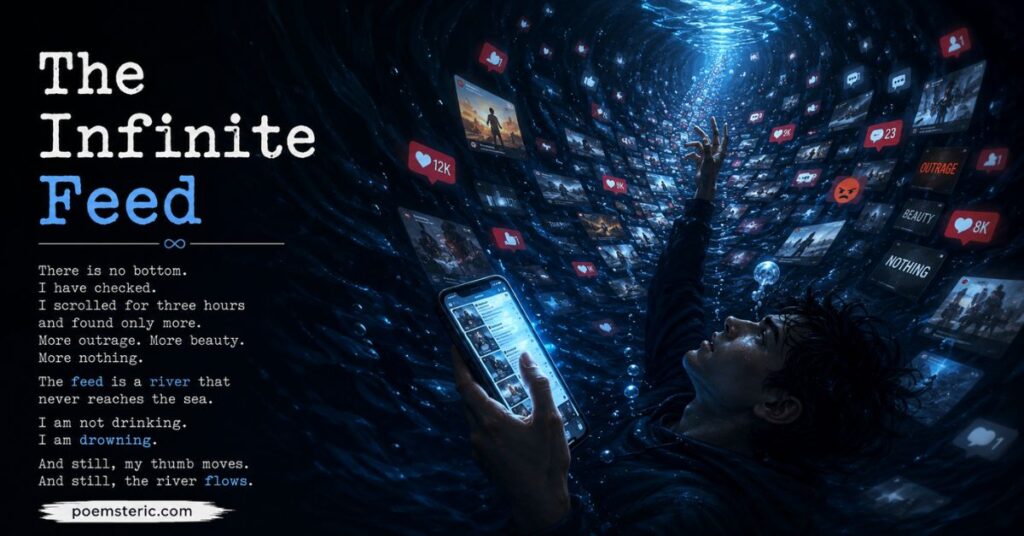
Reflection: The “infinite scroll” design is intentionally addictive. This poem uses the metaphor of drowning to describe a behaviour that feels voluntary but is structurally coerced.
10: “Blue Light Insomnia”
The doctor said stop looking at screens before bed.
I laughed. Then I cried. Then I looked at my phone to feel better.
Now it is 2 a.m. and my brain is a television
that no one remembered to turn off.
The news cycles through my skull.
The arguments replay.
The faces of people I will never meet
keep me company in the dark.
I am so tired.
I am so awake.
Reflection: Blue light from screens suppresses melatonin production, disrupting sleep cycles. This poem captures the cruel irony of using the device that causes insomnia to cope with the anxiety that insomnia creates.
The Quiet Rebellion of Logging Off
11: “The First Hour Without”
I left it in the other room.
In the first ten minutes, I reached for it seventeen times.
The next ten, I stared at the wall and felt panic.
By the forty-minute mark, I heard birds.
I had forgotten birds made sound in the afternoon.
By the hour, I was bored.
Boredom felt like a gift I had not earned.
Reflection: Digital detox is not just about removing a device. It is about relearning how to be present in a body, in a room, in a moment that is not optimized for engagement.
12: “The Analog Afternoon”
I wrote a letter. With a pen. On paper.
The pen ran out of ink. I had to find another.
This took twelve minutes.
Twelve minutes of problem-solving that did not involve a search engine.
I walked to the mailbox. The sun was warm.
The letter will arrive in three days.
I will not know when it is read.
This uncertainty feels like trust.
Reflection: The poem celebrates slowness as a form of resistance. In a world of instant delivery, the deliberate pace of analog communication becomes radical.
13: “What I Noticed When I Looked Up”
The barista’s hands were trembling.
The woman at the next table was crying into her coffee.
A child pointed at a cloud shaped like a whale.
I would have missed all of this
if I had been looking down.
The world is not less interesting than my feed.
I had just forgotten how to look.
Reflection: This poem is about attention restoration the psychological process of recovering the ability to notice after prolonged digital overstimulation.
14: “The Conversation I Almost Had”
We sat across from each other,
both of us holding phones like shields.
I put mine down. She did not notice.
I said her name. She looked up, confused,
as if I had spoken a foreign language.
We talked for twenty minutes.
It was awkward. It was real.
It was the most human I had felt in weeks.
Reflection: The poem acknowledges that face-to-face conversation has become a skill that atrophies without practice. The awkwardness is not a failure it is a sign of growth.
15: “The Log-Off”
I am not leaving forever.
I am just leaving for now.
The notifications will wait.
The news will continue without my witness.
The arguments will rage on,
and I will not add my voice to the noise.
I am going outside.
The screen will still be here when I return.
But I hope, when I return,
I will be someone who needs it less.
Reflection: The final poem is not a rejection of technology but a reclaiming of agency. The speaker does not demonize the screen. They simply choose to be more than what the screen allows.
Why We Need Poetry About Social Media Now More Than Ever
We are living through a transformation of human consciousness that has no precedent. Never before have billions of people shared a single psychological space a feed, a timeline, a comments section while remaining physically isolated from one another. The effects are only beginning to be understood.
What poetry offers that no study, no documentary, and no self-help book can match is emotional precision. A researcher can tell you that social media use correlates with increased rates of depression and anxiety. A poet can tell you what it feels like to watch your own life through the lens of a front-facing camera, always performing, never resting.
The poems in this article are not academic. They live. They come from the same bedrooms, commutes, and late-night scrolls that you know intimately. They do not offer solutions because solutions are not poetry’s job. Poetry’s job is to make the invisible visible. And right now, much of our digital suffering is invisible even to ourselves.
From Notification Anxiety to Digital Detox
Reading the fifteen poems in order creates a narrative arc. Here is how to use them as a map for your own relationship with screens:
- Acknowledge the ritual. Read Poems 1–5 and identify your own morning habits. Do you reach for your phone before you reach for your partner? Do you check email before you check the weather outside? Awareness is the foundation.
- Name the hollow. Read Poems 6–10 and notice which one stings. The one that hurts is the one that is true. Write down the specific behaviour it describes in your own life.
- Imagine the alternative. Read Poems 11–15 not as instructions, but as invitations. What would one hour without your phone feel like? What would you hear? Who would you see?
- Write your own. Use the guide in the next section to translate your experience into verse. You do not need to be a poet. You only need to be honest.
- Share selectively. If you write something true, consider sharing it with one person you trust not on social media, but in a text, a letter, or a conversation. Intimacy is the antidote to the performative connection that screens offer.
The Hidden Cost of Always Being Online: What Poets Are Warning Us About
The cost of our screen obsession is not just measured in hours. It is measured in what those hours replace. Every minute spent scrolling is a minute not spent looking into someone’s eyes, walking without a destination, or sitting with the discomfort of your own thoughts.
Poets are warning us about attention degradation the slow erosion of our ability to focus deeply. They are warning us about empathy fatigue the numbing effect of consuming too much distant suffering. They are warning us about self-estrangement the growing gap between who we are and who we perform online.
These are not abstract concerns. They show up in our bodies: the tension headaches, the sleep disorders, the phantom vibrations, the inability to read a book for more than ten minutes without reaching for a phone. The body keeps the score, even when the mind refuses to add it up.
The poets in this tradition writers like Joshua C. Frank, whose work on screen obsession has appeared in classical poetry journals, and the emerging voices of 2026 are not Luddites. They are witnesses. They use verse to slow down the speed of digital life just long enough for us to recognize ourselves in it.
How to Write Your Own Digital Life Poem: A Beginner’s Guide
You do not need an MFA to write a poem that matters. You need a moment, a feeling, and the willingness to be uncomfortable on the page.
Finding Your Authentic Voice in a World of Filters
- Choose your moment. Pick a specific instance of screen interaction. Not “I use my phone too much.” Something concrete: the moment you realized you had been scrolling for two hours, the time you texted someone in the same room, the night you fell asleep with your phone on your chest.
- Describe the physical details. What did your body feel like? What did the room look like? What sounds were present? Poetry lives in specificity.
- Name the emotion without naming it directly. Instead of “I felt lonely,” try “The comments section was full of voices, and none of them said my name.”
- Let it be ugly. Your poem does not need to rhyme. It does not need to be pretty. It needs to be true. The most powerful digital life poems are the ones that embarrass their authors slightly.
Structuring Your Poem for Maximum Emotional Impact
Option A: The List Poem. Write a list of everything you did on your phone today. Do not judge. Just a list. Then read it aloud. The cumulative effect will reveal its own meaning.
Option B: The Conversation Poem. Write a dialogue between you and your phone. Let the phone speak. What would it say? What does it want from you?
The Best Poetry Collections About Digital Life You Should Read Next
Option C: The Before and After. Describe a moment from your pre-smartphone life and the same moment now. Contrast is the engine of meaning.
Option D: The Single Sentence. Write one long, breathless sentence that captures the feeling of scrolling. Do not stop. Do not edit. Let it run.
If these fifteen poems resonated with you, the genre is richer than you might think. Here are collections that explore digital existence with depth and originality:
- u know how much i hate being alone in social situations by Stephon Lawrence — A collection that uses chatspeak, emojis, and the fragmented language of digital communication to explore anxiety and identity in the age of social media.
- Hivestruck by Vincent Toro — A formally inventive collection that traces our relationship with screens through multiple poetic forms, including persona poems spoken by machines and content moderators.
- Windows 85 by various contributors — A collection that explores the “melting point of incommensurable copresence”—the strange intimacy of being connected to others through distance, blur, and withdrawal.
- The Rendering by Anthony Cody — While focused on environmental and historical themes, this collection uses digital collage techniques and command prompt aesthetics to question how technology mediates our understanding of the world.
These collections prove that digital life poems are not a passing trend. They are a necessary literary response to a transformation of human experience that is still unfolding.
FAQs
Q: What are digital life poems and why are they important?
A: Digital life poems are a contemporary genre of poetry that explores how screens, social media, and internet culture shape our emotions, relationships, and sense of self. They are important because they offer emotional precision that statistics and studies cannot capture. While research can tell us that excessive screen time correlates with anxiety and depression, digital life poems translate those numbers into lived experience the phantom vibration in your pocket, the dread of an unread notification, the hollow feeling after three hours of scrolling. They make the invisible visible and remind us that we are not alone in our screen struggles.
Q: How can reading poetry about technology addiction help me reduce my screen time?
A: Reading poetry about technology addiction helps by creating a moment of emotional recognition. When a poem describes your own behavior with uncomfortable accuracy, it breaks the autopilot mode that keeps you scrolling. Poetry slows down time. It asks you to pay attention to one thing deeply instead of skimming everything superficially. Many readers report that after encountering a powerful poem about screen obsession, they become more aware of their own habits. Awareness is the first step toward change. Poetry does not replace digital detox strategies, but it can be the catalyst that makes them stick.
Q: Who are the best poets writing about screen obsession and digital life today?
A: Some of the most compelling voices in this space include Joshua C. Frank, whose classical-style poems indict modern screen culture with formal precision [web_search:1#0]; Stephon Lawrence, who uses chatspeak and emoji to capture digital anxiety; Vincent Toro, whose Hivestruck experiments with form to mirror our fragmented online attention; and emerging poets publishing in journals like Electric Literature and Poetry Foundation. The genre is expanding rapidly as more writers recognize that digital life poems are not a niche but a necessary response to one of the defining experiences of our era.
Q: What is the best way to start writing my own poem about social media or screen addiction?
A: Start with one specific moment, not a general complaint. Instead of “I hate social media,” write about the exact second you realized you had been scrolling for two hours, or the time you texted someone who was sitting three feet away. Describe the physical details: the blue light on your face, the crick in your neck, the silence of the room. Let the emotion emerge from the specifics. Use the step-by-step guide in this article to structure your poem. Remember: your digital life poems do not need to be perfect. They need to be true. Truth resonates more than polish ever will.
Q: Are there any poetry collections specifically about digital detox and unplugging from technology?
A: Yes, though most collections about digital life focus on the tension between connection and isolation rather than pure detox. Hivestruck by Vincent Toro and u know how much i hate being alone in social situations by Stephon Lawrence both explore what it means to exist in digital spaces, including the desire to escape them [web_search:1#7]. For readers seeking a more direct exploration of unplugging, look for anthologies focused on “slow living” poetry or nature verse that implicitly contrasts with digital speed. The poems in this article’s final section (Poems 11–15) also serve as a mini-collection about the experience and value of logging off.
Final Thoughts
We will not solve screen addiction with a single article or a handful of poems. The forces that keep us scrolling are engineered by some of the smartest people in the world, funded by billions of dollars, and reinforced by the architecture of our daily lives. But poetry offers something that no algorithm can engineer: the shock of recognition.
When you read a poem that describes your own 3 a.m. doom scroll, your own phantom vibration, your own moment of looking up and seeing the world you had forgotten, something shifts. You are no longer alone in your obsession. Someone else has been there. Someone else has named it. And in that naming, there is the faint possibility of change.
The fifteen poems in this article are not prescriptions. They are mirrors. Hold them up. See what looks back. And then if you are ready put the mirror down, and look at the room you are in. The light is different than you remember. The air is still. And for this one moment, you are exactly where you are supposed to be.
Recent Article : 40 Beautiful Poems of Sympathy to Heal and Honour Every Loss

Jennifer Aston is a passionate poetry curator and writer with a deep love for the written word. She believes poetry has the power to heal, inspire, and connect people across all walks of life. Through PoemSteric, she brings together timeless and modern verses for every emotion and every moment.