

Introduction
Every year, millions of people search for the right words to honour someone who served and didn’t come home. Memorial Day poems carry that weight in a way that small talk never can. Whether you’re writing a card for a veteran’s family, preparing a reading for a town ceremony, or simply want a few lines to share online, the right poem does the work that’s hard to do in your own words.
This guide brings together 21 original poems organized by exactly how you’ll use them: short ones for cards and texts, longer ones for ceremonies and speeches, and themed picks for veterans, parents, kids, and community events. Unlike most lists online that just dump poems with no context, this guide also shows you how to pick the right one, how to recite it without sounding stiff, and how to write your own if none of these quite fit. You’ll also find clear guidance on which classic poems are public domain and safe to print, post, or read aloud without any copyright concerns.
By the end, you’ll have not just a list, but a clear sense of which one belongs in your hands this Memorial Day.
Key Takeaways
• Memorial Day poems fall into two broad uses: quiet, personal tributes (cards, texts, gravesite visits) and public tributes (ceremonies, school events, community readings) and the right poem depends entirely on which one you need.
• Short poems work best for cards and social posts; longer narrative poems suit formal ceremonies where you have a few minutes to read.
• Many of the most famous Memorial Day poems, including 19th and early 20th century war poetry, are in the public domain and can be freely shared, printed, or recited without permission.
• Writing your own short tribute poem is easier than it sounds if you start from one specific memory rather than trying to summarize someone’s whole life or service.
• Reciting a poem well at a ceremony is more about pacing and pauses than performance slowing down matters more than projecting your voice.
What Makes Memorial Day Poems Different From Remembrance Day Poems
This is a mix-up almost every other article on this topic skips over, even though it shows up directly in Google’s “People Also Ask” results. Memorial Day is observed in the United States on the last Monday of May and specifically honors U.S. military members who died while serving. Remembrance Day, observed on November 11 in the UK, Canada, and other Commonwealth countries, marks the end of World War I and honors all war dead more broadly, often centered on the poppy as its defining symbol.
The poems overlap because both occasions grew out of the same global grief following the First and Second World Wars. A poem like “In Flanders Fields,” written by Canadian physician John McCrae in 1915, gets read on both occasions, which is exactly why search results blend the two terms together. But the framing differs: Memorial Day poems in the U.S. context tend to focus on individual service members, families, and the American flag, while Remembrance Day poems lean more heavily on the poppy, the unknown soldier, and a broader sense of collective wartime loss.
If you’re choosing a poem for a U.S. Memorial Day event, it’s worth picking ones with that more personal, family-and-service framing rather than borrowing straight from the Remembrance Day tradition, even though the two pools of poetry overlap. Knowing this distinction also helps when searching online, since the two occasions often return mixed results that don’t match your actual event.
Short Memorial Day Poems for Cards and Quick Tributes
Not every tribute needs to be long. If you’re signing a card for a veteran, sending a text to a friend who lost a parent in service, or captioning a photo for social media, a short poem often lands harder than a long one because it doesn’t dilute the moment.
The trick with short verses is precision. A four-line poem has no room for filler, so every word has to earn its place. Below is an original short verse written specifically for this kind of use:
They did not ask for medals,
they did not ask for fame.
They only asked we remember
and carry on their name.
This style works because it’s quotable, easy to remember, and doesn’t require explaining who it’s “about” it applies to any service member, which makes it flexible for cards, group texts, or a quick social caption.
Memorial Day Poems Under 4 Lines
For the shortest tributes, two-line couplets work surprisingly well on a card where space is limited:
Gone from our sight, never from our hearts
Memorial Day reminds us where gratitude starts
Short couplets like this are easy to hand-write inside a sympathy card or include under a photo, and they read as sincere rather than rehearsed.
Memorial Day Poems for Text Messages and Social Posts
For digital use, the tone can be slightly more conversational while still respectful:
Today we pause. Today we remember.
Not just the fallen, but the families who carry them forward.
This works well as a caption or a text to someone whose family member served, because it acknowledges the living, not just the dead, something most traditional war poems skip.
Long Memorial Day Poems for Ceremonies and Readings
Public ceremonies call for a different kind of poem one with enough length and structure to hold an audience for a minute or two without feeling rushed. These poems typically build through three movements: acknowledging the cost of service, honouring those lost, and turning toward collective remembrance.
A longer original piece suited to this setting:
We stand where flags have always stood,
on ground that once was simply ground,
until the weight of sacrifice
gave every blade of grass a sound.
They left their homes still warm with morning,
left their names on kitchen doors,
and walked into a kind of silence
only history explores.
We did not know them all by name,
yet something in us understood —
that freedom carries debts unspoken,
paid in full by flesh and blood.
So let this day be more than calendar,
more than flags at half-mast flown.
Let it be the quiet promise
that their names were never alone.
This kind of structure gives natural pause points after each stanza, which makes it easier to recite without rushing.
Memorial Day Poems for Public Speeches
When a poem is part of a larger speech, an excerpt works better than the full piece. Open or close your remarks with one stanza, then move into your own words; this avoids reading several minutes of verse to an audience expecting a speech.
Memorial Day Poems for Church and Community Services
Faith-based services often want language connecting sacrifice to something larger service, eternity, or peace. A line referencing rest or “going home” fits naturally into a church program alongside scripture readings or hymns.
Memorial Day Poems for a Fallen Soldier or Veteran
Poems written specifically for a fallen soldier carry a different register than general patriotic poems; they should feel personal even when the soldier is unnamed. The goal is to honor the individual behind the uniform, not just the uniform itself.
Not a name on a marble wall,
not a rank, not a number, not a date
a son who laughed too loud at dinner,
a friend who always showed up late.
The uniform was what he wore.
It was never who he was.
We remember the boy before the soldier,
and love him simply because.
This kind of poem works well at gravesite visits, veteran funerals, or VFW gatherings, where the audience already knows the person and doesn’t need the poem to explain who they were just to honor them well.
If you’re choosing a poem for a specific veteran rather than a general tribute, look for language that leaves room for the listener’s own memories instead of over-describing a generic soldier. The more “complete” a poem tries to be about who someone was, the less it fits any individual person perfectly.
Memorial Day Poems for a Parent, Spouse, or Family Member Lost in Service
This is one of the most searched but least served categories online. Most tribute poem lists focus on soldiers in the abstract and almost never address the people left behind the children who grew up without a parent, or the spouse who became a widow or widower far too young.
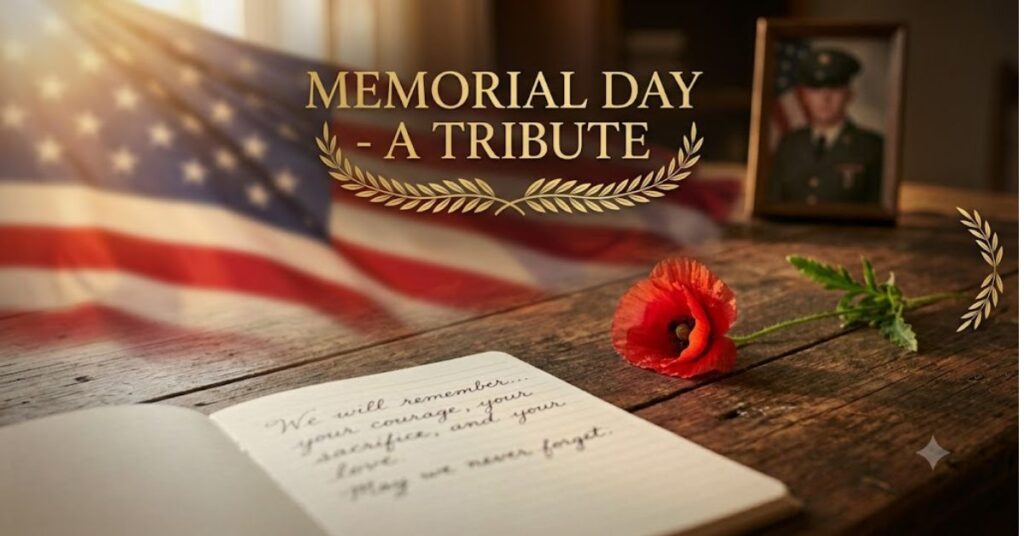
You taught me how to ride a bike
before you taught me how to wait.
Now I wait every Memorial Day
for a knock that comes too late.
But I carry what you carried
the flag, the name, the weight, the pride.
And on this one day every year,
I let myself stand by your side.
A poem like this acknowledges a complicated truth: grief for a parent or spouse lost in service doesn’t end, it just changes shape over the years. If you’re choosing or writing a poem for a family member, prioritize honesty over heroism — the people closest to the loss usually want acknowledgment of their grief, not just praise for the service member’s bravery.
Patriotic Memorial Day Poems for Schools and Community Events
School assemblies and town events need poems that are appropriate for mixed-age audiences, easy to recite aloud, and focused on gratitude rather than graphic descriptions of war. These poems work best when they emphasize freedom, flags, and collective remembrance rather than personal grief.
Red for courage, white for peace,
blue for the promise that won’t cease
on Memorial Day we raise our eyes
to colors earned through sacrifice.
This kind of verse is short enough for a student to memorize, simple enough for younger children to understand, and patriotic without veering into anything graphic or frightening for a school setting. For community parades and town events, these poems pair well with flag ceremonies, moments of silence, or the playing of “Taps.”
Teachers and event organizers often find it useful to pair a poem like this with a brief explanation of what each line represents: the colors of the flag, the idea of sacrifice, or why the community gathers on this particular day. That short context turns a recitation into a small lesson, which tends to stick with younger audiences far better than the poem alone.
Memorial Day Poems for Kids
Poems for children need to explain sacrifice and loss without frightening language, while still being honest that Memorial Day is about something serious. The best approach uses concrete, simple images, flags, flowers, photographs rather than abstract concepts like “ultimate sacrifice” that younger kids won’t fully grasp.
A flag, a flower, a photograph too —
These are the ways we say thank you.
To the ones who served so we could play,
We remember them on Memorial Day.
This kind of poem gives parents and teachers a starting point for a conversation rather than a complete explanation on its own. Pairing it with a simple discussion about what the flag and flowers represent helps kids connect the words to something real.
It also helps to let kids participate rather than just listen. Having a child place a small flag or flower while the poem is read, instead of just reciting it to them, gives the words something to attach to. Most children remember the action, the flag, the walk to the memorial, the quiet moment far longer than they remember the exact words of any poem.
How to Choose the Right Memorial Day Poem for Your Occasion
With 21 poems and styles to choose from, picking the right one comes down to two questions: who is this for, and where will it be read?
Identify Who You’re Honouring
Decide whether the poem needs to speak to a specific person (a particular soldier, parent, or veteran) or to service members in general. Specific tributes call for poems with room for personal memory; general tributes call for broader, more universal language.
Match the Tone to the Setting
A poem for a quiet gravesite visit should feel intimate and unhurried. A poem for a town ceremony with a microphone and an audience needs clearer structure and stronger pacing. A poem for a card needs to be short enough to read in ten seconds without losing its impact.
Once you’ve answered both questions, you’ll usually find that two or three poems from this list naturally fit at that point, read them aloud once before deciding, since poems that look right on the page don’t always sound right when spoken.
How to Write Your Own Memorial Day Poem
If none of the poems above feel quite right, writing your own is more achievable than most people expect. You don’t need to be a poet, you need one true memory and the willingness to keep it simple.
Start With One Memory
Don’t try to summarize someone’s entire life or service record. Pick one specific moment, a phrase they used, a habit, a smell, a sound and build the poem around that single detail. Specificity is what makes a tribute poem feel real instead of generic.
Use Simple, Honest Language
Avoid reaching for big, formal words like “valor” unless they genuinely reflect how you talk about the person. The most memorable tribute poems read like something the person themselves might have said, not a monument inscription. Four to eight lines is usually enough something someone can read in one breath without losing the emotion partway through.
A simple structure for beginners: two lines describing the person as they were, two describing what’s been lost, and two describing how you’ll remember them. This three-part shape gives you a starting structure without forcing rhyme or meter you’re not comfortable with.
Public Domain Memorial Day Poems You Can Legally Share
This is a question almost nobody answers clearly: which Memorial Day poems can you actually print, post, or read aloud without worrying about copyright?
In the United States, any poem published before 1929 is in the public domain, free to share, print, or perform without permission. This includes most classic war poetry tied to Memorial Day and Remembrance Day, since copyright on those older works has expired. “In Flanders Fields” by John McCrae, published in 1915, falls into this category, as do most Civil War-era and WWI-era memorial poems found in historical archives and academic collections.
Poems published more recently including most contributions on modern poetry-sharing websites and anything written by a living author are protected by copyright even if a website displays them publicly. Displaying a poem online does not mean it’s free to copy onto your own card, website, or social post. If you want to share a contemporary poem, link to the original source rather than reproducing the text, or write your own original tribute instead.
When in doubt, search the poem’s title along with the poet’s name and death date if the poet died more than 70 years ago, it’s very likely public domain.
How to Recite a Memorial Day Poem at a Ceremony
Reading a poem aloud at a ceremony is a different skill than writing or choosing one, and it’s the part most guides skip entirely.
The single biggest mistake people make is reading too fast out of nervousness. Slow down more than feels natural. What feels like an uncomfortable pause to you usually sounds like respectful weight to the audience. Pause at the end of each stanza, not just at periods, to let a line settle before moving to the next one.
Practice reading the poem aloud at least three times before the event, ideally once in the actual space if possible, since acoustics change how your pacing needs to work. Keep your eyes up periodically rather than staring at the page the entire time. Even brief eye contact with the audience during a poem makes the reading feel like a tribute rather than a recitation.
Finally, resist the urge to add commentary before or after. Let the poem stand on its own for a few seconds of silence once you finish, rather than immediately moving to the next part of the program. That silence is often the most powerful part of the reading.
Memorial Day Poems vs. Memorial Day Quotes: Which Should You Use
Poems and quotes serve different purposes, and mixing them up is a common reason a tribute doesn’t land the way you intended. A quote is usually a single line, often attributed to a known figure, used to make a quick point or open a speech. A poem builds an emotional arc over several lines and works better when you want the audience to feel something gradually rather than receive a single statement.
For cards and short social posts, either works, but a poem tends to feel more personal because it’s longer and less “borrowed” sounding than a famous quote everyone has already seen a hundred times. For speeches, quotes work well as an opening hook, while poems work better as a closing moment, since they leave the audience with feeling rather than information.
If you’re choosing between the two for a specific use, ask whether you want the audience to think (quote) or feel (poem) at that exact moment in your program, and let that guide the choice.
FAQs
Q: What is the most famous Memorial Day poem?
A: “In Flanders Fields” by John McCrae is the most widely recognized poem tied to Memorial Day and Remembrance Day. Written in 1915, it uses the image of poppies growing among soldiers’ graves to capture wartime loss. Because it was published before 1929, it’s in the public domain, so you can freely print, recite, or share it for any tribute.
Q: How do I write my own Memorial Day poem?
A: Start with one specific memory rather than trying to summarize a whole life or career. Keep the language simple and honest instead of formal. A four-to-eight-line structure works well: describe the person, name what’s been lost, then say how you’ll remember them. Memorial Day poems written this way feel more personal than borrowed ones.
Q: Are Memorial Day poems and Remembrance Day poems the same thing?
A: They overlap but aren’t identical. Memorial Day poems, observed in the U.S. in late May, tend to focus on individual American service members and families. Remembrance Day poems, tied to November 11 in the UK and Commonwealth countries, lean more on the poppy and collective wartime loss. Many classic poems get used for both occasions.
Q: Can I legally share Memorial Day poems online or in print?
A: It depends on when the poem was published. Anything published before 1929 in the U.S. is public domain and free to share. Poems by living authors or published more recently are still copyrighted, even if posted publicly online. When unsure, check the poet’s name and publication date, or simply write your own original tribute instead.
Q: What’s the best way to recite a Memorial Day poem at a ceremony?
A: Slow down more than feels natural, and pause at the end of each stanza rather than rushing through. Practice the poem aloud at least three times beforehand, and look up occasionally instead of reading the entire time. Let a few seconds of silence follow the final line before moving on with the program.
Final Thoughts
Memorial Day poems matter because they give shape to a grief and gratitude that’s hard to put into ordinary words. Whether you need four lines for a card, a full stanza for a ceremony, or the confidence to write your own tribute from scratch, the right poem is less about finding the “best” one and more about finding the one that matches who you’re honoring and where you’ll say it.
If you take one thing from this guide, let it be this: a short, honest poem written from real memory will almost always outlast a longer, more polished one borrowed from somewhere else. This Memorial Day, choose words that mean something to you, and to the person you’re remembering.
There’s no single correct poem for every family, every ceremony, or every kind of loss, and that’s exactly why this guide leans on choice rather than a single “best” answer. Read a few of these aloud before deciding. The one that catches in your throat a little, even slightly, is usually the right one.
Recent Article : Hafiz Poems | Greatest Sufi Poetry & Ghazals

Jennifer Aston is a passionate poetry curator and writer with a deep love for the written word. She believes poetry has the power to heal, inspire, and connect people across all walks of life. Through PoemSteric, she brings together timeless and modern verses for every emotion and every moment.