
Introduction
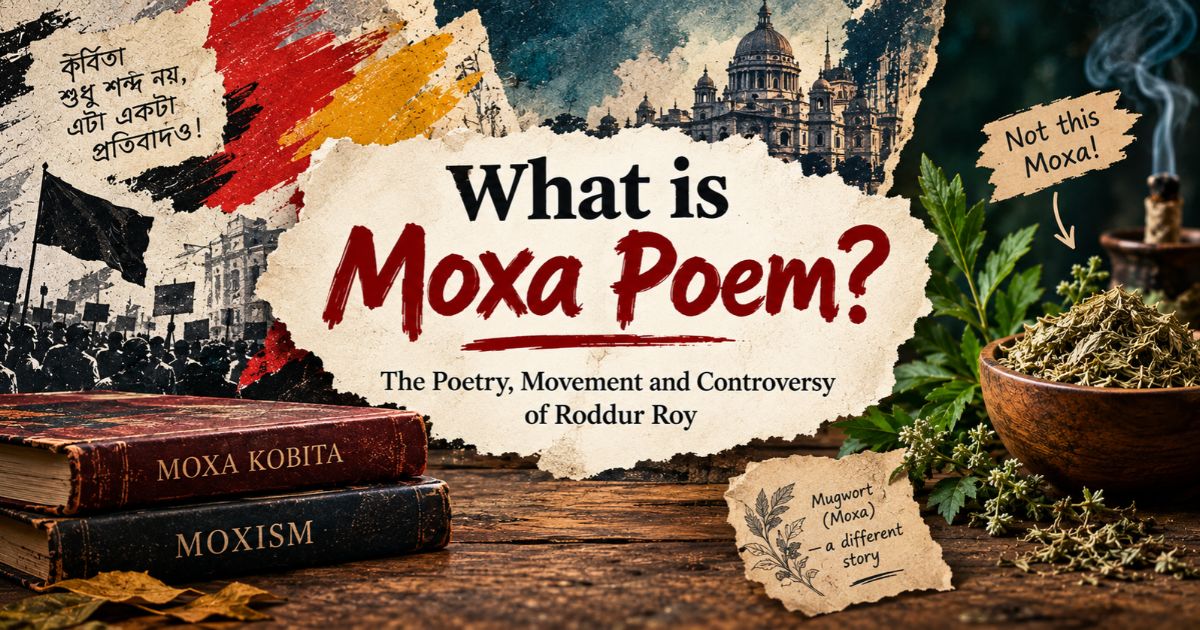
What is Moxa poem, in short? It’s the name most commonly linked to the poetry, performance style, and self-declared movement of Anirban Roy, a Bengali social media figure and poet better known as Roddur Roy. His poetry, gathered in works such as Moxa Kobita, is anti-establishment, surreal, and written in blunt, subaltern Bengali language, and it forms part of what he calls “Moxism.”
Readers often notice that this term has almost no plain-English explanation available online, since most of the source material lives in Bengali-language videos rather than written articles. This piece lays out who Roddur Roy is, what Moxism actually refers to, and how the style has been received all based on publicly documented, verifiable sources, without reproducing any of the original poem text.
Key Takeaways
- What is Moxa poem: The term refers to the poetry and broader artistic movement created by Bengali poet Roddur Roy (born Anirban Roy)
- Creator: Anirban Roy, from West Bengal, India, active online since 2012
- Movement name: “Moxism,” which Roy has described in interviews as a philosophy or a self-founded belief system tied to his poetry
- Style: Anti-establishment, surreal, and written in blunt, colloquial (“sub-altern”) Bengali
- Reception: Divisive – Roy has faced legal complaints and arrests over some of his public statements and creative content
- Different meaning entirely: “Moxa” is also the English name for a dried herb (mugwort) used in East Asian medicine a completely unrelated topic
What is Moxa Poem? Meet Roddur Roy
To properly answer what is a Moxa poem, you need to start with the person behind it, since the term barely exists apart from his own body of work.
Who Is Roddur Roy?
Roddur Roy is the public name of Anirban Roy, a poet, novelist, and YouTube personality from West Bengal, India. According to his Wikipedia entry, he began posting videos online in 2012, initially performing Rabindranath Tagore’s songs before shifting toward original, anti-establishment content that criticises contemporary Indian politics and society. He has described himself, in his own public statements, as a self-proclaimed psychoanalyst and post-modernist spiritual guide.
Roy has published several books, including Moxa Renaissance and Moxa Kobita (“Moxa Poems” in Bengali), alongside other titles such as And Stella Turns a Mom and Porom Kaorha Kabyo Grontho. In my own reading of the available sources, what stands out is how tightly his literary identity and his online persona are fused together — Roddur Roy isn’t simply a poet who also uses YouTube; the platform is where most of his poetry is actually performed and released.
What Moxism Means
Moxism is the name Roy has given to his broader creative and philosophical outlook, and “Moxa poem” or “Moxa Kobita” refers to the poetry produced under that label. Coverage of Roy, including reporting from Indian outlets, has described Moxa as something closer to a self-founded belief system or persona than a formal literary school, built around his image as an unconventional, rule-breaking cultural figure.
Commentators have loosely compared his position in contemporary Bengali culture to earlier literary rebels, such as the Hungryalist poets of 1960s Calcutta or the American Beat poets, since all three groups used shock, explicit language, and direct confrontation with authority as literary tools. Unlike those historical movements, however, Moxism is still an active, ongoing, one-person project rather than a settled or widely studied literary school, so any description of it reflects a moving target rather than a finished body of criticism.
Themes and Style in Moxa Poetry
Roy’s poetry, as described in published sources, consistently returns to a small set of recognisable features rather than following traditional Bengali verse forms.
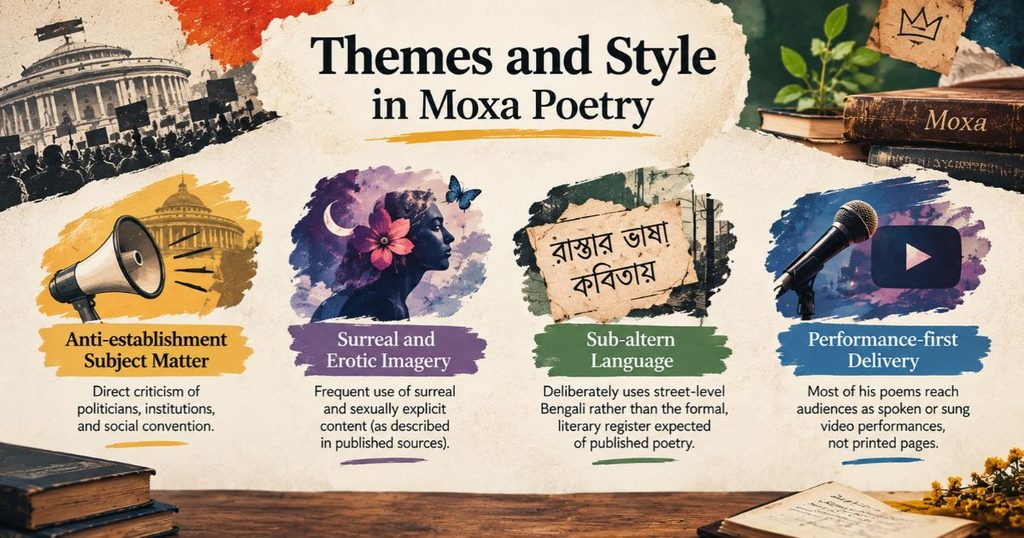
Because several of his works use explicit or vulgar language as a deliberate stylistic choice, this article describes that pattern without quoting any specific lines, in keeping with both copyright limits and the fact that Roy is a living author whose work remains fully his own. Readers who want the original text should look for his published books or official channels directly rather than relying on excerpts circulated secondhand.
Public Reaction and Controversy
Roddur Roy’s public career has been shaped as much by controversy as by his poetry itself, and any honest answer to what is Moxa poem needs to include that context.
In 2020, Roy released a parody of a well-known Rabindranath Tagore song, which drew criticism for its explicit language and led to a formal complaint and a temporary arrest, according to reporting at the time. He has faced further legal complaints in the years since, connected to public remarks made during live streamed broadcasts about political figures and institutions.
Reactions to Roy split sharply along generational and political lines. Some commentators and rights organisations have defended his arrests as an overreach against artistic and political expression, while others have argued his language crosses a line beyond acceptable public discourse. This split reception is itself part of why “Moxa poem” resists a single, tidy definition: it functions simultaneously as poetry, provocation, and personal brand.
The Other Moxa: A Note on the Herb (Disambiguation)
If you searched “what is Moxa poem” and ended up on a page about traditional medicine instead, you’re not alone. “moxa” has a second, completely unrelated meaning worth clearing up.
In that other context, moxa refers to dried mugwort, a herb burned on or near the skin in a traditional East Asian medical practice called moxibustion. The word entered English in the 1670s from the Japanese mogusa, meaning “burning herb,” and it has nothing to do with Bengali poetry, Roddur Roy, or Moxism. If your search results mix references to acupuncture points and mugwort with results about Bengali poetry, you’ve likely landed on this unrelated medical topic by accident, and the poetry-related answer above is the one to use instead.
FAQs
Q: What is Moxa poem?
A: “Moxa poem” refers to the poetry created by Bengali poet Roddur Roy, published under titles such as Moxa Kobita, as part of a broader self-described movement he calls Moxism. The poetry is anti-establishment, surreal, and written in blunt, colloquial Bengali. It has no connection to the herb moxa, which is an entirely separate term used in traditional East Asian medicine.
Q: Who is Roddur Roy?
A: Roddur Roy is the public name of Anirban Roy, a poet, novelist, and YouTube personality from West Bengal, India, active online since 2012. He describes himself as a self-proclaimed psychoanalyst and post-modernist spiritual guide, and his content mixes original poetry with sharp political and social criticism, often delivered directly through video.
Q: What is Moxism?
A: Moxism is the name Roddur Roy has given to his own artistic and philosophical outlook, and it forms the umbrella under which his “Moxa” poems are written. It functions more as a personal, ongoing creative persona than a formal, established literary school, and it remains closely tied to Roy’s individual public identity rather than a wider group of writers.
Q: Why is Roddur Roy considered controversial?
A: Roy has faced legal complaints and arrests connected to public statements and creative content, including a 2020 parody of a Rabindranath Tagore song that used explicit language and drew formal complaints. His work and public remarks have divided opinion, with some defending his right to provocative expression and others objecting to his language and tone.
Q: Is Moxa poem the same as moxa the herb?
A: No. What is Moxa poem and what is moxa the herb are two completely unrelated topics that simply share a spelling. The herb sense refers to dried mugwort used in the East Asian medical practice of moxibustion, a term with roots in 17th-century Japanese, while the poetry sense refers specifically to Roddur Roy’s Bengali literary work.
Final Thoughts
So, what is Moxa poem, in the end? It’s the poetry and self-declared creative movement of Roddur Roy, a Bengali writer and online personality known for anti-establishment, surreal work delivered in deliberately blunt language. Understanding it means understanding the person behind it, since Moxism remains a personal, still-developing body of work rather than a settled literary category with its own critical tradition.
If you take one thing from this article, let it be the disambiguation: check whether your search is actually about Bengali poetry or about a dried medicinal herb, since the two share nothing but a name. With that sorted, you now have an accurate, source-based answer to what is Moxa poem without needing to track down or repeat any of the original, copyrighted lines yourself.
Recent Article : How Many Cantos Are in a Poem? Full Guide

Jennifer Aston is a passionate poetry curator and writer with a deep love for the written word. She believes poetry has the power to heal, inspire, and connect people across all walks of life. Through PoemSteric, she brings together timeless and modern verses for every emotion and every moment.