
Introduction
The position of prologue in a poem is at the very beginning, before the main body of the work. It is a separate, introductory section that comes ahead of the central narrative or argument, and its job is to prepare readers with background, setting, characters, or theme for what the poem is about to do.
Key Takeaways
- A prologue sits at the start of a poem, play, or other literary work before the main narrative begins.
- Its function is to introduce or prepare: background, setting, characters, conflict, or theme.
- Not every poem has one. Many poems open directly with their main subject, with no separate introduction.
- A prologue differs from a preface (an author’s note about the work itself) and from an epilogue (which closes the work).
- In drama, a prologue is often spoken directly to the audience before the first act.
- Simplest way to remember the order: Prologue → Main poem → Epilogue.
Where the Prologue Sits in a Poem’s Structure
A prologue’s position is structural, not just a matter of coming first. It opens the work and stands apart from the main body, sometimes a few lines set off under their own heading, sometimes a longer introductory passage and readers meet it before the central story, argument, or dramatic situation gets underway.
The word itself points to this placement. Prologue comes from the Greek pro- (“before”) and logos (“word” or “speech”) literally, what is said before the main text. That origin is also why a prologue isn’t simply “whatever happens to come first”: plenty of poems open directly with their main speaker, image, or argument, with no separate introductory section at all. What marks a section out as a prologue is the combination of an early position and an introductory function it exists to set up what follows, not just to precede it.
Prologue → Background, setting, characters, theme
Main poem/narrative → The central story, argument, or action
Epilogue → Closing reflection or aftermath
Geoffrey Chaucer’s The Canterbury Tales is one of the clearest examples of this pattern in English poetry. Its General Prologue — 858 lines of Middle English — comes before any of the individual tales and introduces the roughly thirty pilgrims gathered at the Tabard Inn in Southwark before their journey to Canterbury. The tales that follow depend on this frame: without the General Prologue, a reader has no way of knowing who the storytellers are or why they’ve fallen in together. Long-running academic resources devoted to Chaucer’s work, including Harvard’s well-known Geoffrey Chaucer Page, treat this opening section as exactly that the frame the rest of the poem is built on.
Purpose of a Prologue in Poetry
A prologue can do several jobs, but they all come back to the same idea: preparing the reader for what’s ahead.
Introducing background and context. A prologue often supplies information a reader needs before the main poem develops an earlier event, a character’s history, the setting, or the conflict driving the action. This isn’t decoration; it’s the lens the rest of the poem is read through. A detail the prologue mentions in passing may only pay off once the main poem develops it further, which is part of why skipping a prologue can leave a reader working with an incomplete picture.
Setting tone and preparing the narrative. Beyond information, a prologue can establish mood serious, comic, tragic, mysterious, or reflective before the main section begins. Oregon State University’s Guide to Literary Terms, produced by the university’s School of Writing, Literature and Film, frames a prologue as the section that opens a work and introduces its key characters, setting, and background before the story itself gets going. That framing role is what separates a genuine prologue from a poem that simply opens with its first real scene: the prologue is about preparing the reader, not part of the action being prepared for.
Examples of Prologues in Poetry and Literature
Chaucer’s General Prologue to The Canterbury Tales. As above, this is one of the best-known examples of a prologue in narrative poetry. It opens in mid-April, describes each pilgrim by profession, appearance, and character, and sets up the storytelling contest that structures everything that follows. It is long, formal in its opening lines, and essentially the individual tales don’t make full sense without it.
Shakespeare’s Prologue to Romeo and Juliet. Spoken by the Chorus before the first scene, this fourteen-line prologue takes the form of a Shakespearean sonnet. It tells the audience upfront that the “pair of star-crossed lovers” will die, and names the feud between the Montagues and Capulets as the cause. It’s a useful counterexample to the idea that a prologue has to withhold information to do its job here, it openly gives away the ending, and the play’s tension comes from watching the events unfold anyway, rather than from not knowing how they’ll end.
Together, these two examples make the same point from opposite directions: a prologue’s position is what defines it, not its content. Whether it holds information back or gives it away, it always sits before the work it introduces.
Prologue vs. Main Poem vs. Epilogue
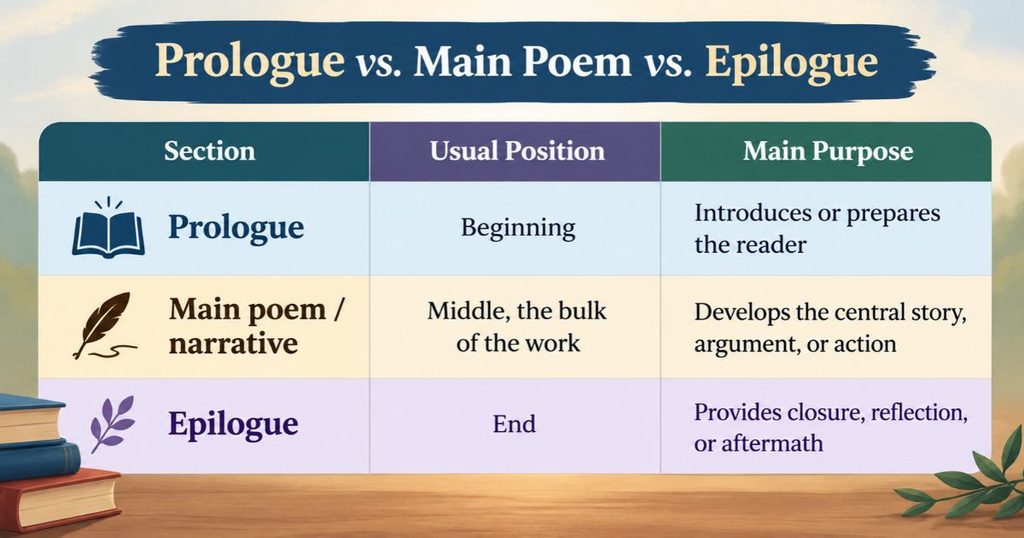
Not every poem uses the full pattern; plenty of poems consist only of a main body, with no separate prologue or epilogue at all. But when a poem does use one, this is the order it follows, and it’s a useful way to sanity-check whether a section you’ve found really is a prologue.
How to Tell Whether an Opening Section Is a Prologue
- Check where it sits. A prologue comes before the main narrative or central development not partway through, and not at the end.
- Check what it’s doing. Does it supply background, setting, characters, or theme, rather than start the “real” action itself?
- Look at what follows it. A genuine prologue is followed by a main section that it was preparing the reader for.
- Look for an explicit label. Some works simply head the section “Prologue,” which settles the question outright.
- Rule out a preface. A preface usually discusses the work itself, its writing, history, or purpose rather than functioning as part of the story.
- Rule out an epilogue. An epilogue does a similar job in reverse: at the end, looking back, rather than at the beginning, looking forward.
FAQs
Q. What is the position of the prologue in the poem?
A. It sits at the very beginning, before the main narrative or argument. Its role is to prepare readers with background, setting, characters, or theme for what the rest of the poem develops.
Q. Does every poem have a prologue?
A. No. A prologue is optional. Many poems open directly with their main speaker, image, or subject, without any separate introductory section.
Q. What’s the difference between a prologue and an epilogue?
A. Mainly position and direction. A prologue comes first and looks forward, preparing the reader for what’s coming. An epilogue comes last and looks back, offering closure or reflection on what’s already happened.
Q. Is a prologue considered part of the poem?
A. Generally yes, even though it’s structurally set apart from the main body. It can include verse, narration, or dialogue, and typically functions as the frame the rest of the poem sits inside, rather than as a separate work.
Final Thoughts
The position of a prologue in a poem is simple to state: it comes at the very beginning, before the main work, and exists to prepare the reader through background, setting, character, or theme. What makes a section a genuine prologue isn’t just being first it’s doing that preparatory work. Once you’re looking for both things together, early position and introductory purpose, spotting a prologue in any poem gets a lot easier.
Recent Article : What Type of Poem Is Leisure by W. H. Davies?

Jennifer Aston is a passionate poetry curator and writer with a deep love for the written word. She believes poetry has the power to heal, inspire, and connect people across all walks of life. Through PoemSteric, she brings together timeless and modern verses for every emotion and every moment.