
Introduction
A rhyme generator helps writers quickly find words that share similar sounds, making it easier to create poems, lyrics, slogans, and other rhythmic writing. Instead of searching through unrelated words, you enter a target word and explore possible perfect, near, slant, or multisyllabic rhymes.
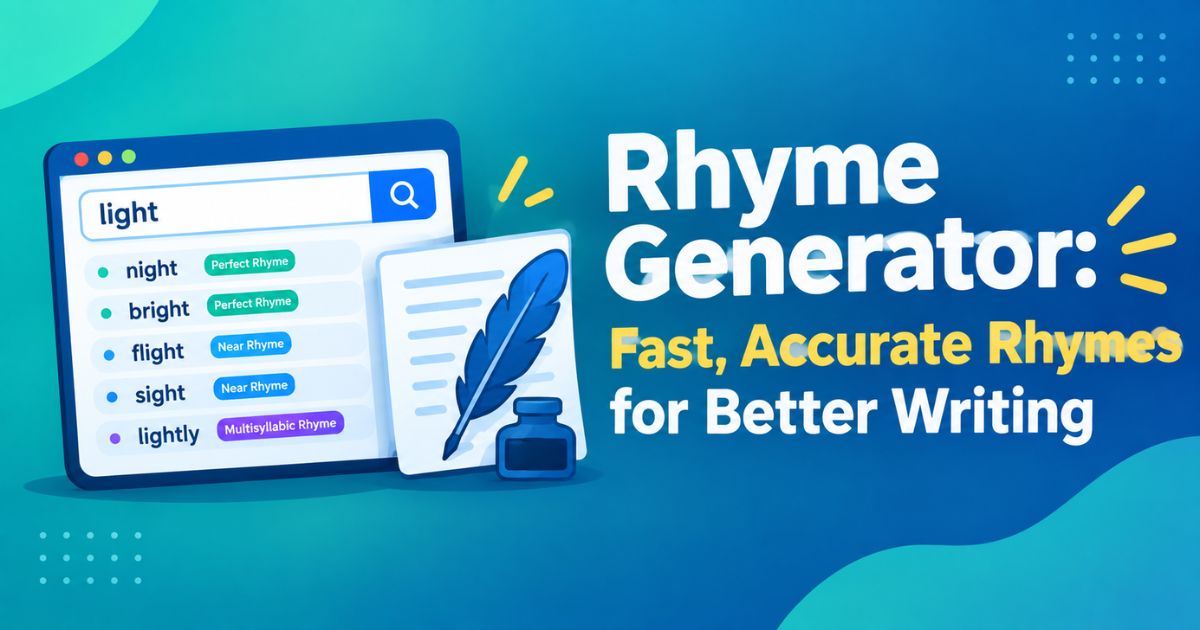
For example, if your target word is “light,” you might find “night,” “bright,” “flight,” and “sight.” However, good rhyming is not simply about matching endings. The best choice must also fit the meaning, rhythm, tone, and voice of the writing.
A useful rhyme tool therefore works best as a brainstorming assistant. It expands your choices while leaving the final creative decision to you.
Key Takeaways
- A rhyme tool finds words with matching or similar sounds.
- Perfect rhymes have closely matching stressed vowel and ending sounds.
- Near and slant rhymes offer greater flexibility.
- Internal rhymes occur within lines rather than only at line endings.
- Multisyllabic rhymes can create sophisticated rhythmic patterns.
- Context matters more than simply choosing the closest-sounding word.
- A rhyming dictionary and an automated generator serve slightly different purposes.
- Writers should read potential rhymes aloud before using them.
- Strong rhyme supports meaning, rhythm, and memorable language rather than distracting from them.
What Is a Rhyme Generator?
A rhyme generator is a digital writing tool that produces words matching the sound pattern of a selected word. Depending on its design, it may organize results by perfect rhyme, near rhyme, syllable count, pronunciation, or other phonetic characteristics.
Unlike a normal dictionary, a rhyme tool focuses primarily on sound relationships. This makes it useful when a writer already knows what they want to say but needs a word that fits the sound pattern of a line.
For example, suppose a poet writes:
The moon appeared above the ______.
If the intended ending is “sky,” possible rhymes might include “high,” “fly,” “cry,” and “why.” Each word creates a different meaning, even though the sound relationship is similar.
Therefore, the generator provides possibilities rather than automatically providing the correct answer.
Perfect, Near, and Slant Rhymes
A perfect rhyme generally matches the stressed vowel sound and everything following it. “Light” and “night” are straightforward examples.
A near rhyme, also called a slant rhyme in many contexts, has a less exact sound relationship. Words may share consonants or vowels without producing a complete match. Near rhymes are common in contemporary poetry because they can create musical connections without making every line sound predictable.
The distinction matters because different forms require different levels of sound matching.
Perfect rhyme: close phonetic match, such as light/night.
Near or slant rhyme: partial sound similarity that creates a looser connection.
Multisyllabic and Internal Rhymes
Multisyllabic rhymes involve two or more syllables. They can add complexity to rap, spoken-word poetry, and contemporary verse.
Internal rhyme happens inside a line rather than exclusively at the end. For example, a line might connect sounds in its middle and final phrases. This can strengthen rhythm while allowing the writer to avoid a repetitive end-rhyme pattern.
When searching for these rhymes, syllable count and pronunciation become especially important. Two words can look similar but sound different when spoken, so reading the options aloud is essential.
How to Use a Rhyme Generator Effectively
The most productive approach is to treat a rhyme search as part of the writing process rather than as a replacement for it.
Step 1: Write the idea first.
Decide what the line needs to communicate before searching for a rhyme. Meaning should guide the word choice.
Step 2: Identify the target sound.
Look at the word or phrase you want to match. Consider its stressed syllable and pronunciation.
Step 3: Generate several possibilities.
Do not immediately select the first matching word. Collect five to ten candidates when possible.
Step 4: Check meaning.
Remove words that technically rhyme but do not make sense in context.
Step 5: Check syllables and rhythm.
Read the complete line aloud. A rhyme that sounds excellent in isolation may make the whole line awkward.
Step 6: Test different rhyme types.
If perfect rhymes feel forced, experiment with near or slant rhymes.
Step 7: Revise the surrounding line.
Sometimes the strongest solution is not changing the final word. Instead, rewrite the entire line so the desired word fits naturally.
For example, a songwriter may need a rhyme for “fire.” If the obvious choices sound predictable, changing the sentence structure can create room for a more interesting word.
In my own reading of poetry, the strongest rhymes rarely exist only to prove that two words sound alike. They usually reinforce an image, emotion, joke, argument, or movement in the poem.
Rhyme Types and When to Use Them
Different rhyme techniques produce different effects. Traditional verse often benefits from obvious sound patterns, while contemporary poetry can use much looser relationships.
The choice should depend on genre, audience, subject, and intended rhythm. A playful children’s poem may benefit from obvious rhymes, while a serious spoken-word piece may gain more from subtle sound echoes.
Perfect Rhymes for Traditional Poetry
Perfect rhymes are especially useful when you want a clearly recognizable rhyme scheme. Ballads, nursery rhymes, humorous verse, and many traditional poetic forms use strong end rhymes.
Consider the simple pattern ABAB. The first and third lines rhyme, while the second and fourth lines share another rhyme. Such patterns can give a poem structure that readers recognize quickly.
Perfect rhymes can also help readers remember lines. However, predictable rhyming can become repetitive when every line ends with an obvious match.
Therefore, vary sentence structure and use rhyme where it strengthens the poem. Avoid changing an important idea simply to accommodate an easy rhyme.
Slant Rhymes for Modern Lyrics
Slant rhymes provide a looser alternative. They can connect words that sound related without producing a fully exact match.
Songwriters and contemporary poets often use this technique because it gives them more vocabulary choices. The writer can preserve a natural sentence while still creating sonic unity.
For example, a songwriter may prioritize an emotionally precise word over a perfect rhyme. A nearby sound can then provide enough musical connection without making the lyric feel forced.
This is particularly useful when writing about complex subjects. The language remains conversational while the sound pattern operates underneath it.
Rhyme Generator vs. Rhyme Dictionary
A rhyme generator and a traditional rhyming dictionary overlap, but they are not identical tools.
| Feature | Rhyme Generator | Rhyme Dictionary |
| Speed | Very fast | Usually requires browsing |
| Search method | Automated | Manual/reference-based |
| Large word lists | Often available | Depends on edition |
| Sound categories | May be included | Often carefully organized |
| Context | Usually limited | May include explanations |
| Best use | Quick brainstorming | Detailed word research |
A generator is convenient when you need possibilities immediately. A dictionary can be valuable when you want to study pronunciation, rhyme classifications, or unusual vocabulary.
Neither tool automatically determines whether a word is good for your poem. That decision depends on context.
For instance, finding ten rhymes for “heart” does not mean all ten belong naturally in a love poem. Meaning, tone, cliché level, and imagery still matter.
How Rhyme Generators Work
Most modern rhyme tools rely on information about pronunciation rather than spelling alone. This distinction is important because English contains many words that look similar but do not rhyme.
A phonetic approach examines the sounds within words and identifies relationships between their endings. Some systems can then separate exact matches from approximate matches.
Consider “blue” and “through.” Their spellings are different, but their relevant ending sounds can form a perfect rhyme. Conversely, words with similar spellings may fail to rhyme because their pronunciation differs.
More advanced systems may consider syllables, stress, phonetic patterns, and multiple rhyme categories. AI-based writing tools can additionally use language models to suggest rhymes according to context, although generated suggestions still need human review.
The result is most useful when technology handles the repetitive search while the writer handles judgment. That division keeps the writing process efficient without turning poetry into a mechanical exercise.
FAQs
Q: What is a rhyme generator used for?
A: It is used to find words that rhyme with a selected word. Writers commonly use it for poems, songs, rap verses, children’s poetry, slogans, and creative writing exercises. Depending on the tool, results may include perfect, near, slant, internal, or multisyllabic rhymes. The main benefit is speed: instead of manually remembering possible matches, you can review many sound-related words and choose the one that best fits your meaning and rhythm.
Q: Is a rhyme generator the same as a rhyming dictionary?
A: Not exactly. Both can help you discover rhyming words, but a generator generally provides automated results after you enter a target word. A rhyming dictionary is usually a reference resource organized around sounds, spellings, or rhyme families. A generator is convenient for rapid brainstorming, while a dictionary can provide deeper reference information. Many writers can use both depending on whether they need speed or detailed vocabulary research.
Q: What is the difference between perfect and slant rhyme?
A: A perfect rhyme creates a close match in the relevant stressed vowel and following sounds, as in “night” and “light.” A slant rhyme creates a less exact sonic relationship. It may share particular vowel or consonant sounds without matching completely. Perfect rhymes can produce strong traditional patterns, while slant rhymes often sound more flexible and conversational. The appropriate choice depends on the form, tone, and rhythm of the writing.
Q: Can a rhyme generator help with songwriting?
A: Yes. Songwriters can use one to brainstorm possible endings for verses, choruses, bridges, and other sections. However, a matching word is not automatically a good lyric. The word must fit the melody, syllable count, emotional meaning, and natural speaking rhythm. Near rhymes can sometimes work better than perfect matches because they preserve a conversational sound while still giving the song a subtle sonic connection.
Q: How can I find better rhymes instead of obvious ones?
A: First, generate a broad list rather than accepting the first result. Then remove clichés and words that do not fit your meaning. Try multisyllabic, internal, or slant rhymes when appropriate. You can also change the target word or rewrite the sentence around a more interesting candidate. Reading the complete line aloud is particularly useful because visual spelling can hide pronunciation problems and awkward rhythm.
Q: Should I always use perfect rhymes in poetry?
A: No. Poetry does not require every poem to use perfect rhyme. Some forms depend heavily on structured rhyme, while free verse may contain little or no deliberate end rhyme. Near rhyme, internal rhyme, repeated sounds, alliteration, and rhythm can create musical effects without exact matching. Choose the technique that supports the poem’s purpose. A forced perfect rhyme can weaken an otherwise strong line.
Final Thoughts
A rhyme generator can make the search for rhyming words faster, but it should remain a tool rather than the writer’s decision-maker. Strong poetry depends on more than matching sounds; it also requires meaning, rhythm, imagery, precision, and an appropriate poetic voice.
Start with your idea, generate several possibilities, test their pronunciation, and choose the word that strengthens the line. When a perfect rhyme feels forced, consider a slant rhyme, internal rhyme, or a complete rewrite.
Used thoughtfully, rhyme tools can expand vocabulary and help writers experiment with sound while preserving their own creative voice.
Recent Article : Poem Idea Generator: Fresh Prompts to Beat Writer’s Block

Jennifer Aston is a passionate poetry curator and writer with a deep love for the written word. She believes poetry has the power to heal, inspire, and connect people across all walks of life. Through PoemSteric, she brings together timeless and modern verses for every emotion and every moment.