
Introduction
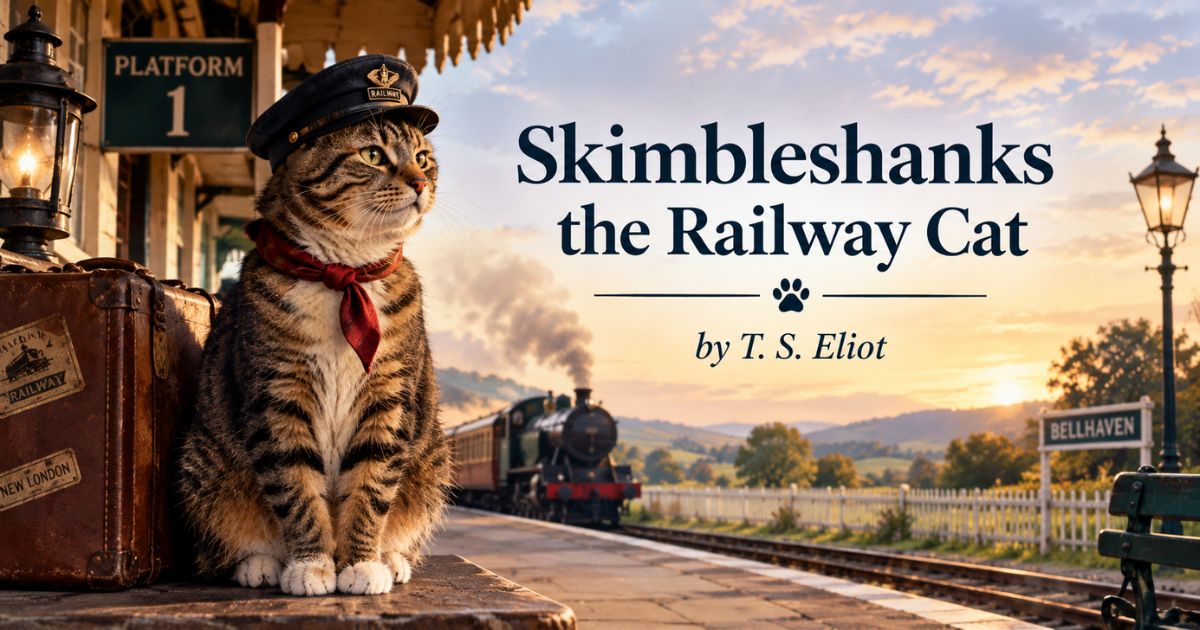
“Skimbleshanks: The Railway Cat” is a humorous poem by T. S. Eliot presents a cat as an extraordinarily responsible and influential member of a railway crew. The poem comes from Eliot’s Old Possum’s Book of Practical Cats (1939) and turns an ordinary night train journey into a playful story about duty, order, responsibility, and personality.
The poem’s central joke is that Skimbleshanks behaves less like an ordinary cat and more like a railway supervisor. The Night Mail cannot leave until he is found; he patrols the train, checks passengers, keeps order, interacts with railway staff, and appears to know everything happening around him.
For students, the poem is especially useful because it combines humour, personification, imagery, rhythm, rhyme, characterization, and an imaginative railway setting. The following Skimbleshanks the Railway Cat poem questions and answers are designed for revision, classroom preparation, and exam practice.
Key Takeaways
- Author: T. S. Eliot.
- Poem: “Skimbleshanks The Railway Cat.”
- Collection: Old Possum’s Book of Practical Cats, published in 1939.
- Main character: Skimbleshanks, a ginger/orange tabby cat who works the railway.
- Setting: The Night Mail, a train travelling between London and Glasgow, and the stations it visits.
- Central idea: Skimbleshanks is portrayed humorously as a highly responsible and indispensable railway worker.
- Important themes: Duty, responsibility, order, discipline, service, vigilance, and humour.
- Major literary device: Personification.
- The poem’s meter is borrowed from Rudyard Kipling’s poem “The Long Trail,” giving it an energetic, propulsive rhythm that mimics a moving train.
- The poem later became the basis for the song “Skimbleshanks: The Railway Cat” in Andrew Lloyd Webber’s 1981 musical Cats, using Eliot’s lyrics almost unchanged.
- Oxford University Press specifically notes the poem’s rhythmic effect and its amusing portrayal of Skimble as the most important figure aboard the train.
Background: Where Does This Poem Come From?
“Skimbleshanks: The Railway Cat” is one of the poems in T. S. Eliot’s 1939 collection Old Possum’s Book of Practical Cats — a set of light verse about the personalities of different cats, written for children but enjoyed widely by adult readers too. The collection includes 14 poems, opening with “The Naming of Cats” and closing with “The Ad-dressing of Cats,” with twelve character-driven poems in between featuring cats such as Growltiger, Macavity, the Rum Tum Tugger, and Gus the Theatre Cat. Skimbleshanks belongs to this same cast of memorable feline characters.
Skimbleshanks is generally described as a ginger (ginger-and-white) tabby cat who lives and works on the mail trains — a detail worth knowing, since the poem builds much of its humour from treating this ordinary-looking cat as an indispensable railway official.
Structurally, the poem borrows its meter from Rudyard Kipling’s poem “The Long Trail” a detail that connects Eliot’s playful cat poetry to an earlier, more traditional narrative-verse tradition, and helps explain why the poem has such a strong, driving rhythm.
From Page to Stage: The Poem’s Life in the Musical Cats
This poem has a significant afterlife beyond the page. In 1981, composer Andrew Lloyd Webber adapted Old Possum’s Book of Practical Cats into the musical Cats, and “Skimbleshanks: The Railway Cat” became one of its most energetic numbers, using Eliot’s original poem as its lyrics almost word-for-word. In the musical, Skimbleshanks is portrayed as the cat who effectively runs the overnight train from London to Glasgow, matching the poem’s own comic premise. This connection is worth knowing for a fuller picture of the poem’s cultural significance; it isn’t just a page-bound children’s poem, but a piece that’s been performed on stage worldwide for decades.
Who Is Skimbleshanks in the Poem?
Skimbleshanks is the railway cat who travels on the Night Mail, the train that runs overnight between London and Glasgow.
Eliot gives him responsibilities that would normally belong to railway employees. He supervises the train, checks the passengers, patrols the corridors, keeps an eye on the railway staff, and visits stations during the journey.
His importance is established immediately. At the beginning of the poem, the train is ready to leave, but Skimbleshanks is missing. The passengers and railway workers search for him because the train cannot properly begin its journey without him.
This exaggerated importance creates the poem’s central comic effect. Skimbleshanks is not merely an animal living on a train — Eliot transforms him into an almost legendary railway employee.
Question 1: Why is Skimbleshanks so important to the Night Mail?
Answer: Skimbleshanks is important because the poem presents him as responsible for maintaining order and comfort throughout the train. His absence creates immediate concern because the train cannot leave until he appears. During the journey, he continues to patrol the train, observe passengers, supervise activities, and interact with railway personnel. His exaggerated authority makes him appear like an essential member of the railway system.
Question 2: Where are Skimbleshanks found before the train leaves?
Answer: Skimbleshanks are eventually found in the luggage van. His relaxed appearance contrasts humorously with the anxiety that his absence has caused among the passengers and railway staff.
Question 3: What does Skimbleshanks’ disappearance reveal about his character?
Answer: His disappearance reveals how indispensable the poem makes him appear. Everyone immediately notices that he is missing, and the railway workers actively search for him. This establishes that Skimbleshanks has a special position on the train and that his responsibilities are taken seriously.
What Responsibilities Does Skimbleshanks Have?
Skimbleshanks performs a surprisingly large number of duties. He:
- Patrols the corridors
- Examines the passengers
- Keeps order
- Watches the railway staff
- Helps maintain a comfortable environment
- Visits railway stations
- Interacts with stationmasters
- Communicates with the police
- Keeps watch during the night
- Helps prevent disturbances
- Deals with mice
- Appears to supervise the overall journey
The humour comes from the contrast between his actual identity as a cat and his imagined professional responsibilities.
Question 4: How does Skimbleshanks maintain order on the train?
Answer: Skimbleshanks maintains order by constantly moving around the train and observing what is happening. He examines passengers, watches the railway environment, and discourages noisy or disruptive behaviour. His presence creates an atmosphere of discipline because the passengers know that he is always watching.
Question 5: Why do Skimbleshanks patrol the corridors?
Answer: His patrol symbolizes his sense of responsibility. He is presented as someone who refuses to leave anything unchecked. By moving through the corridors and observing passengers, he appears to supervise the entire train and ensure that everything remains orderly.
Question 6: How does the poem show that Skimbleshanks is always alert?
Answer: The poem repeatedly describes Skimbleshanks moving, watching, checking, and visiting different parts of the railway system while the passengers are asleep. He remains active throughout the night rather than simply resting like an ordinary domestic cat.
How is the Railway Setting Presented?
The railway is more than a background in the poem; it provides the poem with its movement, rhythm, humour, and atmosphere.
The reader encounters:
- The Night Mail
- Railway stations
- Guards
- Porters
- Stationmasters
- Police
- Passengers
- Compartments
- Corridors
- Luggage
- Railway signals
The poem moves from the train’s departure through its nighttime journey and eventual arrival. The setting also allows Eliot to make Skimbleshanks appear increasingly important. He is connected not just with the passengers but with almost every part of railway life.
Oxford University Press’s teaching guide identifies the train environment, passengers, railway staff, stations, and Skimble’s supervision as central features of the poem.
Question 7: Why is the railway setting important?
Answer: The railway setting gives Skimbleshanks a large system to supervise. It also creates opportunities for movement, sound, rhythm, and comic situations. The changing stations and activities make the poem feel like an actual nighttime journey rather than a static description of a cat.
What is the Role of the Night Mail?
The Night Mail is the train around which the poem is organized historically, a train travelling between London and Glasgow.
Its departure creates the opening problem: Skimbleshanks cannot be found. Once he appears, the journey begins, and the rest of the poem follows his activities during the nighttime journey.
The Night Mail therefore serves two purposes: it is the physical setting of the poem, and it provides the structure through which Eliot reveals Skimbleshanks’ character. Without the train, Skimbleshanks would simply be an unusual cat. On the Night Mail, he becomes a supervisor, guard, inspector, and caretaker.
Question 8: Why can’t the Night Mail leave without Skimbleshanks?
Answer: The poem humorously presents Skimbleshanks as an essential part of the railway operation. His absence causes confusion among the passengers and staff, suggesting that his approval or presence is necessary before the journey can begin.
What Kind of Character is Skimbleshanks?
Skimbleshanks is portrayed as alert, disciplined, responsible, confident, energetic, and slightly authoritarian. He takes his duties seriously, does not approve of unnecessary noise or disorder, and his constant patrol gives him an air of authority.
At the same time, Eliot keeps the characterization humorous. Skimbleshanks does not behave exactly like a human railway employee; he is still a cat, and details such as catching fleas and drinking tea with a possible drop of Scotch remind the reader that the entire situation is deliberately absurd.
Question 9: What are Skimbleshanks’ main character traits?
Answer: Skimbleshanks is:
- Responsible because he takes care of his railway duties.
- Alert because he remains watchful throughout the journey.
- Disciplined because he dislikes disorder.
- Confident because he behaves as though he has authority.
- Energetic because he constantly moves around the train.
- Helpful because he contributes to passenger comfort.
- Humorous because his human-like responsibilities are given to a cat.
Question 10: Why is Skimbleshanks a humorous character?
Answer: The humour comes from the contrast between what Skimbleshanks actually is and what he appears to be. He is a cat, yet he behaves like a railway supervisor. Eliot exaggerates his responsibilities so that the reader can enjoy the absurd idea of a cat controlling the Night Mail.
What Are the Main Themes of the Poem?
The poem contains several themes, but duty and responsibility are especially important.
Duty and Responsibility
Skimbleshanks takes his role seriously. He watches over the train while passengers sleep.
Order and Discipline
His presence helps maintain peace. The passengers are expected to behave properly because Skimble is watching.
Service
Skimbleshanks contribute to the comfort and safety of passengers without receiving the kind of formal recognition normally given to railway workers.
Humour
The entire premise is humorous because a cat is given extraordinary human responsibilities.
Personality and Individuality
The poem presents Skimbleshanks as a distinctive personality rather than an ordinary animal consistent with the wider collection’s interest in giving each cat its own name, quirks, and character.
Question 11: What is the central theme of “Skimbleshanks: The Railway Cat”?
Answer: The central theme is the importance of responsibility and duty, presented through humour. Skimbleshanks is portrayed as a dedicated figure whose constant vigilance helps keep the train orderly and comfortable. Eliot exaggerates his importance for comic effect, but the poem also celebrates the value of taking responsibility seriously.
How Does Eliot Use Personification?
Personification is one of the most important devices in the poem. It gives human qualities, actions, or responsibilities to something non-human. Skimbleshanks is literally a cat, but Eliot gives him human occupations and social responsibilities. He:
- Supervises people
- Checks the train
- Interacts with railway officials
- Communicates through gestures
- Maintains discipline
- Performs duties
- Appears to understand railway procedures
This makes the cat seem almost like a human employee.
Question 12: Why is personification important in the poem?
Answer: Personification allows Eliot to create the poem’s central comic idea. By giving Skimbleshanks human responsibilities, Eliot makes the cat appear unusually intelligent, disciplined, and authoritative. The technique also allows the poet to explore ideas about duty and professional responsibility in a playful way.
How Does Eliot Use Imagery?
Eliot uses visual, auditory, and movement-based imagery to make the railway journey vivid.
Visual imagery comes from descriptions of railway compartments, passengers, stations, Skimbleshanks himself, his tail, his eyes, and railway workers.
Auditory imagery comes from whispers, railway activity, signals, conversation, and the implied sound and rhythm of the train.
Movement imagery is especially important — Skimbleshanks continually moves through the train, while the train itself travels between stations. This creates a lively, cinematic quality.
Question 13: How does imagery contribute to the poem?
Answer: Imagery allows readers to visualize the train journey and Skimbleshanks’ activities. Instead of merely telling us that he is responsible, Eliot shows him moving through corridors, visiting stations, checking passengers, and interacting with railway personnel. The result is a vivid and energetic picture of the Night Mail.
How Does Rhythm Create the Feeling of a Train Journey?
The poem’s rhythm is particularly important. Eliot uses energetic lines, repeated sounds, rhyme, and rapid movement to create the impression of a train travelling along railway tracks and, as noted above, borrows its underlying meter from Kipling’s “The Long Trail,” a choice that gives the poem a driving, propulsive feel well suited to its subject.
Oxford University Press specifically points out that the poem’s rhythm can be examined as a way of creating the impression of a moving train. The poem therefore does not merely describe a train; its sound helps the reader experience the movement of one.
Question 14: How does the rhythm contribute to the poem?
Answer: The rhythm gives the poem speed and energy. Its repeated sounds and rapid movement resemble the motion of a train travelling along tracks. This makes the poem more musical and helps connect its form with its subject, a quality strong enough that the poem later worked almost unchanged as song lyrics in the musical Cats.
Why is the Tone Humorous?
The tone is primarily lighthearted, playful, energetic, and amusing. Eliot creates humour through exaggeration; a normal cat might sleep, wander, chase mice, or seek food, but Skimbleshanks behaves like the chief official of a railway system.
The poem never treats this contradiction as a serious problem. Instead, Eliot invites readers to enjoy the imaginative fantasy.
Question 15: What is the tone of the poem?
Answer: The tone is mainly humorous and playful, although it also contains admiration for Skimbleshanks’ discipline and responsibility. The exaggerated description of the cat’s importance creates much of the humour.
How Does Eliot Present the Passengers?
The passengers are mostly presented as people who rely on Skimbleshanks without fully understanding everything he does. They sleep while Skimbleshanks remain active.
This contrast is important. The passengers enjoy clean and comfortable sleeping spaces, quiet surroundings, a controlled environment, a sense of security, and the smooth progress of their journey; meanwhile, Skimbleshanks continues his nighttime duties.
Question 16: Why are the passengers unaware of much of Skimbleshanks’ work?
Answer: The passengers are asleep for much of the journey. While they rest comfortably, Skimbleshanks continue to patrol the train and visit stations. This creates the humorous idea that an extraordinary amount of work is being performed behind the scenes while passengers remain unaware of it.
Long-Answer Questions and Answers
Question 17: Explain how Skimbleshanks is presented as more than an ordinary cat.
Answer: Eliot presents Skimbleshanks as far more than an ordinary cat by giving him an extensive set of human responsibilities. He is connected with the operation of the Night Mail, monitors passengers, patrols corridors, supervises railway activities, and communicates with station officials and police. His behaviour suggests authority, discipline, and professional responsibility.
The exaggeration is deliberately humorous. A real cat would not normally be expected to supervise railway passengers or communicate with station officials. Eliot uses this impossible situation to create a playful character.
At the same time, Skimbleshanks’ exaggerated role gives him dignity. He is portrayed as energetic and dependable, and his presence makes the train seem orderly and secure.
Therefore, Skimbleshanks functions simultaneously as a comic animal character and a symbolic figure of responsibility.
Question 18: Discuss the theme of duty in “Skimbleshanks: The Railway Cat.”
Answer: Duty is central to Skimbleshanks’ characterization. He treats his railway role seriously and remains active while the passengers sleep. His patrols, supervision, and interaction with railway workers all suggest that he feels responsible for the smooth operation of the train.
Eliot presents duty humorously by assigning these responsibilities to a cat. However, the underlying idea remains recognizable: a system works well when individuals take their responsibilities seriously.
Skimbleshanks’ importance is established when the train cannot leave without him. His absence creates immediate confusion, while his return restores order.
The poem therefore celebrates responsibility while simultaneously making the idea amusing through exaggeration.
Question 19: How does Eliot combine humour and admiration in the poem?
Answer: Eliot creates humour by presenting a cat as an important railway official, but he also clearly admires Skimbleshanks’ discipline and efficiency. The exaggerated responsibilities are funny because they are impossible for an ordinary cat, yet Skimble is portrayed with genuine respect.
The reader is invited to laugh at the absurdity while also appreciating the character’s energy, vigilance, and sense of duty. This combination prevents the poem from becoming merely a joke. Skimbleshanks is funny, but he is also memorable and admirable.
Question 20: Explain the importance of the railway setting in developing Skimbleshanks’ character.
Answer: The railway setting gives Skimbleshanks a complex environment in which his unusual abilities can be displayed. The train contains passengers, railway workers, stations, luggage, compartments, corridors, and railway authorities.
Each part of this environment gives Skimbleshanks another opportunity to demonstrate his authority and vigilance. The setting also creates movement because the Night Mail travels between London and Glasgow, Skimbleshanks can repeatedly patrol, inspect, and interact with different people at different stops.
Thus, the railway is not simply a background. It is the system that allows Eliot to turn Skimbleshanks into a larger-than-life railway character.
Extract-Based Questions and Answers
The following are original exam-style questions based on short passages or paraphrased moments from the poem. They are deliberately kept brief rather than reproducing the poem at length.
Extract 1: The Train’s Departure Time
Question 21: What situation is established at the beginning of the poem? Answer: The Night Mail is preparing to depart, but Skimbleshanks cannot be found. The missing cat immediately becomes a problem because the railway workers and passengers believe the train cannot leave without him.
Question 22: Why is the opening situation humorous? Answer: It is humorous because a cat is treated as though he were an indispensable railway official. The seriousness with which everyone searches for him exaggerates his importance.
Extract 2: “Down the corridor he paces”
Question 23: Who is moving through the corridor? Answer: Skimbleshanks are moving through the corridor.
Question 24: What does this action reveal about him? Answer: It shows that he is alert and supervisory. He is not simply resting; he is actively monitoring the train.
Question 25: What poetic technique is strongly connected with Skimbleshanks’ behaviour? Answer: Personification is central because Skimbleshanks performs human duties and behaves like a railway official.
Extract 3: “Green-eyed stare”
Question 26: What does this image contribute to Skimbleshanks’ characterization? Answer: The image makes Skimbleshanks appear alert, confident, and slightly authoritative. His eyes become part of his commanding personality.
Question 27: How does the description contribute to the humorous portrayal? Answer: A simple action by a cat is presented almost like an official command. This exaggeration makes his character amusing.
Extract 4: The Sleeping Passengers
Question 28: What are passengers doing while Skimbleshanks continues working during the night? Answer: The passengers are largely asleep and unaware of the amount of activity Skimbleshanks undertakes.
Question 29: What contrast does this create? Answer: It contrasts the passengers’ peaceful rest with Skimbleshanks’ constant vigilance. The contrast emphasizes his dedication and adds humour to the poem.
Multiple-Choice Questions
Question 30: Who wrote “Skimbleshanks: The Railway Cat”?
A. W. B. Yeats B. T. S. Eliot C. Robert Frost D. Rudyard Kipling Answer: B. T. S. Eliot
Question 31: Where does the poem mainly take place?
A. On a ship B. In a school C. On a railway train D. In a theatre Answer: C. On a railway train
Question 32: What is the name of the train?
A. The Midnight Express B. The Northern Star C. The Night Mail D. The Railway Flyer Answer: C. The Night Mail
Question 33: Why does the opening of the poem become chaotic?
A. The passengers lose their luggage. B. Skimbleshanks is missing. C. The train has broken down. D. The stationmaster is absent. Answer: B. Skimbleshanks is missing.
Question 34: Which quality best describes Skimbleshanks?
A. Careless B. Lazy C. Responsible D. Fearful Answer: C. Responsible
Question 35: Which literary device is most important in the portrayal of Skimbleshanks?
A. Personification B. Onomatopoeia only C. Allegory D. Satire only Answer: A. Personification
Question 36: What is the dominant tone of the poem?
A. Tragic B. Humorous and playful C. Angry D. Mournful Answer: B. Humorous and playful
Question 37: What does Skimbleshanks do while many passengers are asleep?
A. Leaves the train permanently B. Patrols and supervises C. Drives the train D. Sleeps in a passenger berth Answer: B. Patrols and supervises
Question 38: Which idea is strongly associated with the poem?
A. The dangers of war B. Duty and responsibility C. Romantic heartbreak D. Religious conflict Answer: B. Duty and responsibility
Question 39: What effect does the rhythm of the poem help create?
A. The stillness of a forest B. The movement of a train C. The silence of a classroom D. The sadness of a funeral Answer: B. The movement of a train
Question 40: What makes Skimbleshanks humorous?
A. He refuses to work. B. He behaves like an important human railway official despite being a cat. C. He is afraid of passengers. D. He dislikes travelling. Answer: B. He behaves like an important human railway official despite being a cat.
Question 41: In what year was Old Possum’s Book of Practical Cats published?
A. 1922 B. 1939 C. 1955 D. 1981 Answer: B. 1939
Question 42: What later stage production is “Skimbleshanks: The Railway Cat” closely associated with?
A. Les Misérables B. The Phantom of the Opera C. Cats D. Hamilton Answer: C. Cats
Important Poetic Techniques to Remember
Personification — the cat receives human responsibilities, authority, and behaviour.
Imagery — Eliot creates vivid pictures of the train, passengers, railway workers, stations, and Skimbleshanks.
Rhyme — rhyme contributes to the poem’s musical and entertaining quality.
Rhythm — the energetic rhythm, borrowed in meter from Kipling’s “The Long Trail,” helps imitate the movement and sound of a train. Oxford University Press specifically highlights this feature in its teaching guidance.
Repetition — repeated names, sounds, and phrases reinforce the poem’s playful musical quality.
Humour — the central comic device is the exaggeration of a cat’s importance.
Personification-Based Characterization — instead of merely describing a cat, Eliot gives Skimbleshanks an elaborate human professional identity.
Exam-Focused Revision Points
Before an examination, students should remember these key facts:
- Author: T. S. Eliot
- Poem: “Skimbleshanks: The Railway Cat”
- Collection: Old Possum’s Book of Practical Cats (1939)
- Main character: Skimbleshanks, a ginger tabby cat
- Occupation: Railway cat
- Train: The Night Mail (London to Glasgow)
- Setting: A nighttime railway journey and its stations
- Central theme: Duty and responsibility
- Tone: Humorous, playful, energetic
- Major device: Personification
- Meter source: Borrowed from Kipling’s “The Long Trail”
- Later adaptation: Basis for a song in Andrew Lloyd Webber’s 1981 musical Cats
- Important character traits: Alert, responsible, disciplined, energetic, confident
- Important contrast: Sleeping passengers vs. working Skimbleshanks
- Important structural feature: The poem follows Skimbleshanks’ activities throughout the train journey
- Important sound feature: Rhythm and rhyme help create a lively sense of railway movement
Oxford University Press’s teaching guide also emphasizes Skimble’s supervisory role, the comfort of the passenger berths, his interactions with station staff, and the rhythmic movement created by the poem.
Quick Revision: 10 Questions You Must Know
- Who wrote “Skimbleshanks: The Railway Cat”? T. S. Eliot.
- Who is Skimbleshanks? He is the railway cat associated with the Night Mail.
- Why is he important? The poem humorously presents him as essential to the smooth running of the train.
- What happens when he is missing? Passengers and railway workers search for him because the train cannot properly depart without him.
- What does he do during the journey? He patrols, watches passengers, supervises activities, and visits railway stations.
- What is the main theme? Duty and responsibility, presented through humour.
- What is the dominant literary device? Personification.
- What is the tone? Humorous, playful, lively, and energetic.
- Why is rhythm important? It helps create the impression of a moving train.
- Why is Skimbleshanks funny? Because Eliot gives a cat the responsibilities and authority of a human railway official.
Final Thoughts
“Skimbleshanks: The Railway Cat” is much more than a humorous poem about an unusual cat. Through personification, T. S. Eliot creates a character who appears responsible for almost every aspect of a nighttime railway journey between London and Glasgow.
The poem’s humour comes from the absurdity of the situation, but its characterization is also surprisingly positive. Skimbleshanks represents discipline, responsibility, alertness, service, and professional pride. Its appeal has proven durable enough to outlive the page entirely, forming the basis for one of the most energetic numbers in Andrew Lloyd Webber’s musical Cats, decades after Eliot first published it in 1939.
For examination purposes, the most important connections to remember are:
- Skimbleshanks → responsibility
- Night Mail → railway setting (London to Glasgow)
- Personification → human qualities given to a cat
- Rhythm → movement of the train, borrowed in meter from Kipling
- Humour → exaggerated importance of the cat
- Theme → duty, order, and responsibility
- Legacy → basis for a song in the musical Cats (1981)
Understanding these relationships makes it easier to answer short questions, long-answer questions, extract-based questions, and multiple-choice questions confidently.
Recent Article : The Poem is Reminiscent of the Work of the: How to Find the Correct Answer

Jennifer Aston is a passionate poetry curator and writer with a deep love for the written word. She believes poetry has the power to heal, inspire, and connect people across all walks of life. Through PoemSteric, she brings together timeless and modern verses for every emotion and every moment.