
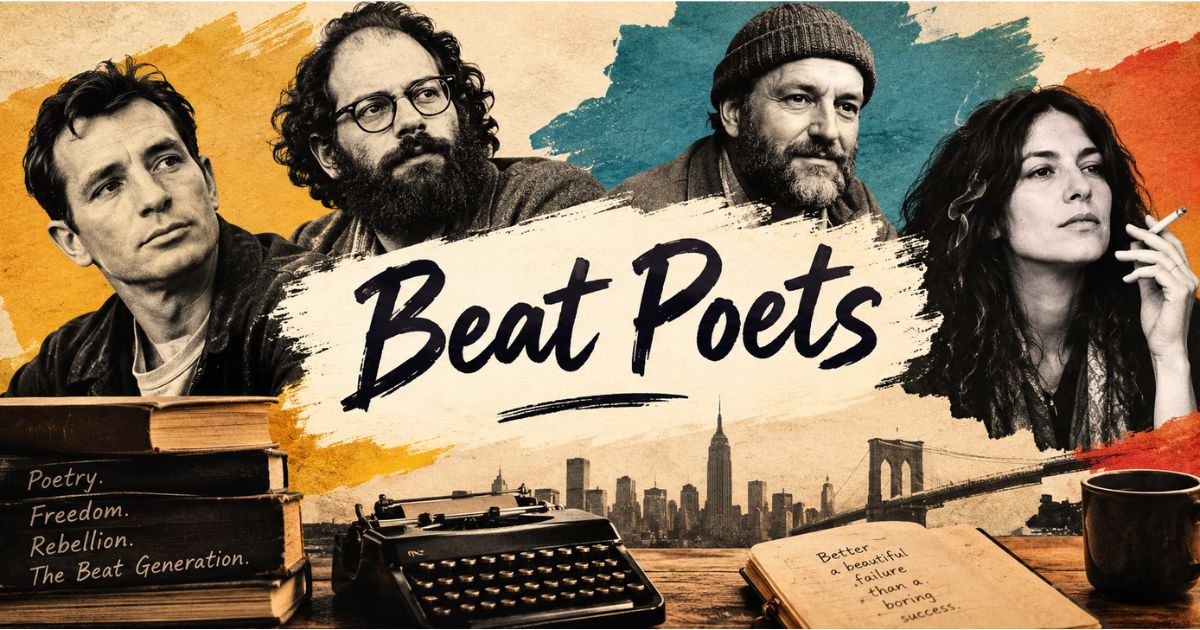
Who Were the Beat Poets?
The Beat poets were a group of American writers who emerged in the late 1940s and 1950s, known for rejecting mainstream literary conventions and social norms in favour of raw, personal, and often confrontational writing. The term “Beat Generation” is most closely associated with poet Allen Ginsberg, novelist Jack Kerouac, and writer William S. Burroughs, though the movement grew to include several other poets and writers connected through friendship, shared readings, and a common desire to write with total honesty about experience, identity, and American life.
The Beat poets matter because they permanently changed what American poetry was allowed to sound like freer in form, more personal in subject matter, and unafraid of subjects earlier generations avoided in print.
The Beat Generation and Its Historical Background
The phrase “Beat Generation” was coined by Jack Kerouac around 1948 to describe the mood of his own social circle, a feeling of being worn down by post war American life, paired with a hunger for meaning outside conventional success. The term reached a wider audience in 1952, when writer John Clellon Holmes published an essay in the New York Times Magazine titled “This Is the Beat Generation,” introducing the idea to mainstream readers for the first time.
The movement’s most pivotal moment came on October 7, 1955, at the Six Gallery in San Francisco, where Allen Ginsberg gave the first public reading of his poem “Howl.” The event, attended by fellow writers including Kerouac, is widely regarded as the beginning of the Beat movement as a public literary force, and it helped launch what later became known as the San Francisco Renaissance. Within a few years, the Beats moved from a small circle of friends into a nationally recognized and often controversial literary movement.
Major Beat Poets
While many writers were associated with the Beat movement, three figures are most closely identified with it: Allen Ginsberg, Jack Kerouac, and William S. Burroughs. Each contributed a distinct voice and form to the movement, though all shared a commitment to personal honesty, experimentation, and resistance to conventional literary expectations.
Allen Ginsberg
Allen Ginsberg is often considered the central poet of the Beat Generation. His poem “Howl,” first read publicly in 1955 and published in book form in 1956, became one of the most influential works of twentieth-century American poetry. Written in long, unbroken lines inspired partly by Walt Whitman, “Howl” addressed themes of mental illness, sexuality, and disillusionment with American society in language that was considered shocking at the time so much so that its publisher faced an obscenity trial in 1957. Ginsberg continued writing influential poetry for decades, including “Kaddish,” a deeply personal elegy for his mother.
Jack Kerouac
Jack Kerouac is best known as a novelist rather than a poet, but his influence on the Beat movement’s style and identity was enormous. His 1957 novel “On the Road,” based on cross-country travels with friends including Neal Cassady, captured the restless, spontaneous energy the Beats were known for and became the movement’s defining prose work. Kerouac’s spontaneous, unedited writing style also directly influenced how Beat poetry approached rhythm and structure.
William S. Burroughs
William S. Burroughs brought a darker, more experimental voice to the Beat movement. His 1959 novel “Naked Lunch” used fragmented, nonlinear structure and unflinching subject matter to explore addiction and social control, and it became one of the most legally and critically contested works associated with the movement. Though primarily a novelist, Burroughs’s influence on Beat writing extended into poetry through his radical approach to language and form, including his later development of the “cut-up” technique.
Major Themes in Beat Poetry
Beat poetry consistently returned to a handful of core themes: personal freedom, rejection of materialism, spiritual searching, and open discussion of topics including sexuality, drug use, and mental illness that mainstream literature of the time largely avoided. Much of this writing also expressed disillusionment with postwar American conformity, presenting individual experience as more meaningful than social expectation.
Another recurring theme was spontaneous, lived experience over careful, formal composition. Beat writers often treated travel, friendship, and direct sensory experience as subjects worth writing about honestly, rather than filtering them through traditional poetic convention.
Writing Style and Technique
Beat poetry is defined by its departure from traditional meter and rhyme in favor of free verse, long breathless lines, and rhythms influenced by jazz music and spoken speech patterns. Ginsberg’s “Howl,” for example, is built from extended, cascading lines rather than fixed stanzas, mirroring spontaneous thought rather than careful, measured composition.
This style was also shaped by an emphasis on spontaneity. Kerouac in particular promoted the idea of writing quickly and without extensive revision, treating the writer’s first, unfiltered expression as more valuable than a polished, edited version. While not every Beat poet followed this exact method, the broader preference for raw, direct language over formal structure became one of the movement’s most identifiable traits.
Influence on American Poetry and Counterculture
The Beat poets had a lasting impact on American poetry by helping legitimize free verse and confessional, personal subject matter within a literary mainstream that had previously favored more formal, restrained styles. Later movements in American poetry, including confessional poetry and various strands of postmodern verse, were shaped in part by the Beats’ willingness to write directly and personally about difficult subjects.
Beyond literature, the Beat movement became closely associated with 1950s and 1960s counterculture, influencing the later hippie movement and broader cultural attitudes toward authority, conformity, and self-expression. It’s worth distinguishing here between documented literary history and broader cultural interpretation: while the Beats’ direct literary influence is well documented, claims about exactly how much they shaped later social movements are, to some degree, a matter of critical interpretation rather than settled fact.
Important Works
Several works are considered essential to understanding the Beat movement. Allen Ginsberg’s “Howl and Other Poems” (1956) remains the movement’s most widely read poetry collection. Jack Kerouac’s “On the Road” (1957) is the novel most associated with Beat identity and style, while William S. Burroughs’s “Naked Lunch” (1959) represents the movement’s more experimental, darker literary edge. Together, these three works are often cited as the foundational texts of the Beat Generation.
Legacy
The Beat poets’ legacy lies in how permanently they expanded the boundaries of what American poetry could address and how it could sound. Their emphasis on personal honesty, free verse, and direct engagement with previously taboo subjects opened space for later generations of poets to write with similar openness. Decades after their most famous works were published, Ginsberg, Kerouac, and Burroughs remain widely read, studied, and referenced a testament to how significantly they reshaped modern American literature, even as their place within the traditional literary canon has remained a subject of ongoing academic debate.
FAQs
Q. What does “Beat” mean in the Beat Generation?
A.The term originally suggested being worn down or exhausted by mainstream postwar life, though it later took on additional meanings tied to rhythm and spiritual searching as the movement grew.
Q. Who are considered the three central Beat writers?
A. Allen Ginsberg, Jack Kerouac, and William S. Burroughs are most commonly identified as the movement’s central figures, though many other poets and writers were closely associated with it.
Q. What makes Beat poetry different from earlier American poetry?
A. Beat poetry favored free verse, long unstructured lines, and direct personal subject matter over the fixed meter and formal restraint common in earlier twentieth-century poetry.
Q. Why was “Howl” controversial?
A.Its frank treatment of sexuality, mental illness, and drug use led to an obscenity trial in 1957, though the poem was ultimately ruled to have literary merit and was allowed to remain in print.
Q. Are the Beat poets still influential today?
A. Yes, their emphasis on personal honesty and stylistic freedom continues to influence contemporary poets, and their major works remain widely taught and read.
Recent Article : New Baby Poems: Sweet Verses for a New Arrival

Jennifer Aston is a passionate poetry curator and writer with a deep love for the written word. She believes poetry has the power to heal, inspire, and connect people across all walks of life. Through PoemSteric, she brings together timeless and modern verses for every emotion and every moment.