
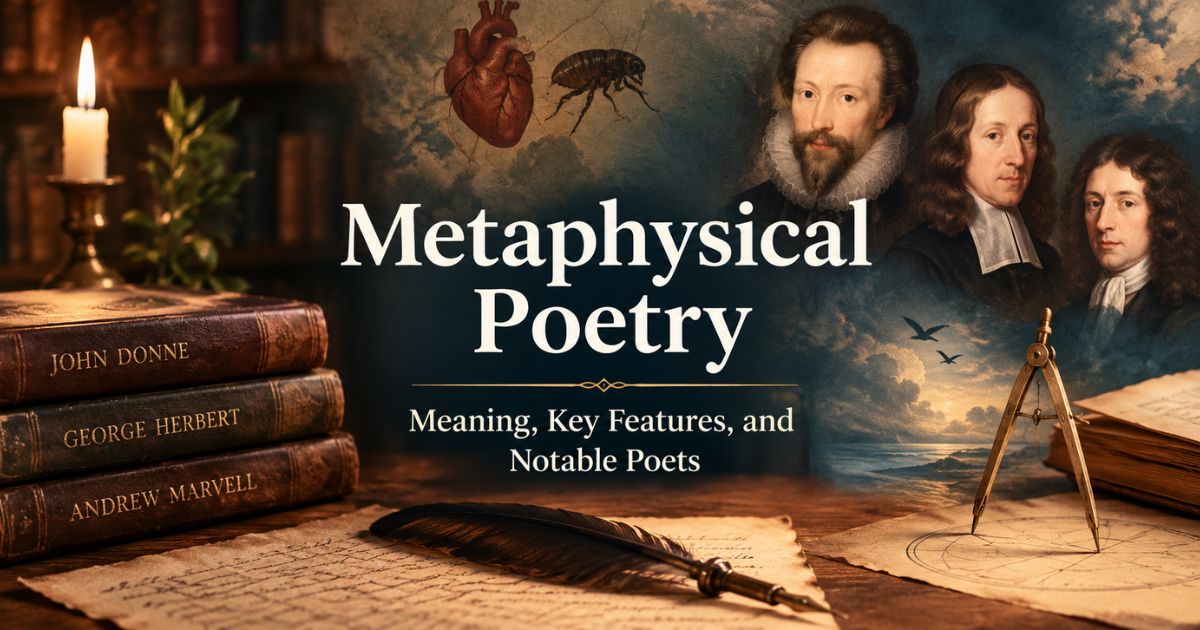
Introduction
A metaphysical poem is a style of verse, most closely tied to 17th-century England, that uses tightly reasoned argument, clever wordplay, and surprising comparisons to examine subjects like love, death, faith, and human nature. Instead of relying on flowing, decorative language, these poems read almost like a debate. The poet builds a case, twist by twist, using logic drawn from unexpected places. Importantly, the name doesn’t mean the poems are “about” metaphysics as a philosophical subject; it describes a particular way of thinking and writing.
This guide walks through exactly what separates a metaphysical poem from other poetic traditions, unpacks the techniques that define the style, and introduces the poets most responsible for shaping it so students and readers alike can recognize the style with confidence.
Key Takeaways
- “Metaphysical poetry” refers to a 17th-century literary style, not simply poetry that discusses metaphysical philosophy.
- Its trademark features are wit, paradox, and the metaphysical conceit an unusually elaborate metaphor.
- John Donne, George Herbert, and Andrew Marvell are the movement’s most studied poets.
- The poems often merge intellectual reasoning with strong emotion, particularly around love and religious devotion.
- The style faded for a time, then returned to prominence through 20th-century critics like T.S. Eliot.
Defining Metaphysical Poetry
Metaphysical poetry describes a body of English verse, written mainly in the 1600s, that approaches emotional and spiritual subjects through argument and intellect rather than pure lyricism. The term itself came later critic Samuel Johnson applied it in the following century to describe poets whose work shared a similar habit of yoking together very different ideas.
This is a key point of confusion worth clearing up: metaphysical poetry is not poetry written about metaphysics, the philosophical study of reality and existence. Rather, it’s a literary movement defined by how the poets thought and wrote through reasoned argument, inventive imagery, and intellectual tension even when their chosen subject was something as ordinary as a flea bite or a compass.
Recognizable Traits of the Metaphysical Style
Several features consistently appear across metaphysical poems, making the style fairly easy to spot once you know what to look for:
- A direct, argumentative voice, as though the speaker is mid-conversation
- Long, developed metaphors that carry through an entire poem
- A mix of heady intellect and genuine emotional stakes
- Deliberate contradictions used to reveal deeper truth
- Comparisons pulled from fields far outside typical poetic subjects, such as science or geometry
Together, these traits give metaphysical poems a distinctly different texture from the more musical, idealized verse that came before them, asking readers to think alongside the poet rather than simply feel a mood.
Understanding the Metaphysical Conceit
Perhaps the single most identifiable literary device in this tradition is the metaphysical conceit: an extended comparison between two things that, on the surface, have almost nothing in common. Unlike a passing metaphor, a conceit is worked out in careful detail, often across many lines, requiring the reader to follow its internal logic step by step.
John Donne’s poem “A Valediction: Forbidding Mourning” offers one of the clearest illustrations. He compares two parted lovers to the two legs of a drafting compass, one fixed in place, one moving in a wide circle, yet always connected and eventually reunited. The comparison feels strange at first, but as Donne develops it, the logic becomes persuasive and even moving. This ability to sustain an unlikely metaphor is what makes a conceit “metaphysical” rather than simply decorative.
Wit as Intellectual Precision
In this context, wit doesn’t refer to jokes or humor, it means the sharp mental agility needed to link distant or contradictory ideas into something coherent. Metaphysical poets frequently structure their work like a formal argument, using logic to justify or explain feelings such as longing, grief, or devotion.
Because of this, reading a metaphysical poem often feels like watching someone think in real time. A poem might start with a bold or startling claim and then spend its remaining lines defending that claim through comparisons, hypothetical situations, or philosophical reasoning. This is precisely why the style is so often labeled “intellectual poetry” it asks for active engagement, not passive listening.
The Role of Paradox
Paradox, a statement that appears self-contradictory yet expresses a genuine truth shows up throughout metaphysical verse, especially in poems concerned with faith or romantic love. Poets leaned on paradox to capture experiences too layered or conflicted for straightforward language, where two opposing ideas can both feel accurate at once.
Donne’s religious sonnets frequently use this technique, describing spiritual renewal as something that requires being broken down first. Paradox lets metaphysical poets express complicated inner states: devotion mixed with doubt, love mixed with fear with a precision that a plain statement can’t achieve, giving their work both emotional weight and philosophical depth.
Imagery Built on Unexpected Comparisons
Where earlier English poetry often drew its imagery from nature, classical myth, or idealized beauty, metaphysical poets reached instead toward astronomy, cartography, medicine, and everyday tools. This choice made their poetry feel unusually fresh and even a little jarring for readers used to more conventional verse.
Picturing a soul as a compass, love as a map spanning continents, or the human body as a finely tuned instrument all served the same purpose: making abstract emotional or spiritual states feel tangible and specific. These unusual comparisons push readers to reconsider familiar feelings of love, mortality, and faith from an entirely unfamiliar angle, which remains one of the style’s most striking qualities.
Faith, Philosophy, and the Human Condition
Metaphysical poetry frequently grapples with large existential questions: the fate of the soul, a person’s relationship with God, the certainty of death, and the meaning behind suffering. This is especially clear in the work of John Donne and George Herbert, both of whom were ordained clergymen and used poetry as a form of private spiritual wrestling.
That said, the movement wasn’t confined to devotional subjects. These poets also wrote extensively about desire, romantic love, and the passage of time, often folding the sacred and the physical into the same poem without much separation. This willingness to blend the spiritual with the sensual is one of the qualities that makes metaphysical poetry feel distinct from other religious verse of its era.
John Donne: The Movement’s Central Figure
John Donne is generally credited as the poet who established the metaphysical style, and his body of work spans both passionate love poetry and searching religious verse, all shaped by sharp wit and inventive conceits. His poems often open with a jarring or provocative line, then spend the rest of the poem constructing a careful argument around it.
This pattern of dramatic opening followed by close reasoning became something of a signature for the movement, echoed by poets who came after him. Donne’s talent for combining rigorous intellect with unguarded emotional honesty is a large part of why his poetry remains the standard starting point for studying this style.
George Herbert and Andrew Marvell
George Herbert, writing around the same period as Donne, devoted much of his poetry to religious themes, favoring plain, direct language paired with intricate formal techniques, including poems whose shape on the page mirrors their subject. His tone tends to feel more humble and reflective than Donne’s, though it shares the same careful use of paradox and reasoned structure.
Andrew Marvell, active slightly later, is best remembered for combining metaphysical wit with political and philosophical commentary. His poem “To His Coy Mistress” remains a widely studied example of metaphysical argument, using persuasive logic and unsettling, vivid imagery to press the case that time is short and should not be wasted. Taken together, Donne, Herbert, and Marvell demonstrate the range of the movement spanning romantic, devotional, and political concerns.
Notable Examples Worth Studying
A handful of poems are commonly used to illustrate the metaphysical style in classrooms and textbooks:
- “A Valediction: Forbidding Mourning” by John Donne – develops the compass conceit to express emotional steadiness despite physical distance.
- “The Flea” by John Donne – constructs an entire seductive argument around a single insect bite, blending logic and audacity.
- “Easter Wings” by George Herbert – uses visual shape alongside imagery to trace spiritual fall and eventual rise.
- “To His Coy Mistress” by Andrew Marvell – argues persuasively for urgency in love through striking, sometimes uncomfortable imagery.
Each of these examples highlights the core techniques associated with the style: sustained conceits, structured argument, paradox, and imagery borrowed from unlikely sources.
Why the Style Still Matters Today
Metaphysical poetry lost much of its critical standing for roughly two centuries before experiencing a significant revival in the early 1900s, largely thanks to poet-critic T.S. Eliot, who admired how these poets managed to fuse thought and feeling within a single unified poem. That reassessment placed the metaphysical poets among the key influences on modernist literature.
The style’s fingerprints are still visible in contemporary poetry that favors intellectual density, unconventional imagery, and layered emotional reasoning. Its central insight that seemingly unrelated ideas, like a soul and a compass or love and a map, can illuminate one another when carefully connected continues to offer poets a powerful way of capturing the complexity of human experience.
FAQs
Does metaphysical poetry mean poetry about metaphysics?
No, it’s a literary style defined by wit, paradox, and elaborate comparisons, not poetry that specifically addresses the philosophy of metaphysics. The name describes a way of writing, not the subject matter itself.
Who first used the term “metaphysical poetry”?
Critic Samuel Johnson popularized the label in the 18th century to describe the shared intellectual style of poets like Donne and Herbert, though the poets themselves never used this term for their own work.
What exactly is a metaphysical conceit?
It’s an extended, unexpected metaphor developed in careful detail across a poem such as comparing two separated lovers to the two legs of a drafting compass, as John Donne does in “A Valediction: Forbidding Mourning.”
Why is John Donne considered central to this movement?
Donne’s fusion of intellectual argument, paradox, and inventive conceits became the model that later poets, including Herbert and Marvell, built upon, which is why he’s often called the founder of the style.
Is metaphysical poetry only religious?
No. While religious and philosophical themes appear often, especially in Donne’s and Herbert’s work, metaphysical poets also wrote extensively about romantic love, desire, and the passage of time.
How is metaphysical poetry different from Romantic poetry?
Metaphysical poetry favors intellectual argument, wit, and unconventional imagery, while Romantic poetry (which came later) emphasizes emotion, nature, and imagination expressed in a more flowing, less argumentative style.
Final Thoughts
At its core, metaphysical poetry asks readers to slow down and think as carefully as they feel. Its poets treated love, faith, and mortality not as simple emotions to describe, but as puzzles worth reasoning through using paradox, conceit, and unlikely imagery to get closer to the truth of an experience. That combination of intellect and feeling is what has kept the work of Donne, Herbert, and Marvell relevant for centuries, and it’s why the style continues to reward close, patient reading today. Whether you’re encountering it for a class assignment or out of personal curiosity, recognizing these techniques is the first step toward appreciating just how inventive this 17th-century movement really was.
Recent Article : Get Well Soon Poems: Kind Words for a Speedy Recovery

Jennifer Aston is a passionate poetry curator and writer with a deep love for the written word. She believes poetry has the power to heal, inspire, and connect people across all walks of life. Through PoemSteric, she brings together timeless and modern verses for every emotion and every moment.