
Introduction
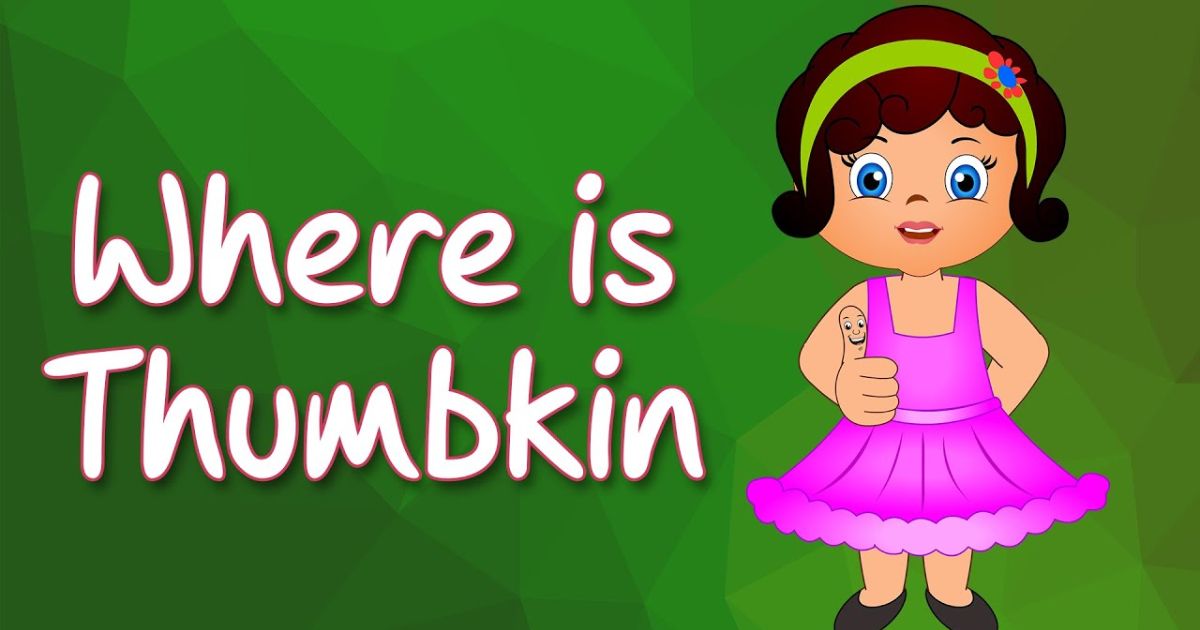
Where Is Thumbkin? is a traditional American fingerplay and children’s action song. It teaches young children the names of their fingers through a simple question-and-answer pattern, repeated movements, and the familiar melody of “Frère Jacques.”
The song begins by asking where the thumb is hiding. The child then brings the thumb forward, answers the question, makes it interact with the other thumb, and finally hides it again. The same pattern continues with the pointer, tall man, ring man, and pinky.
Unlike a traditional narrative poem, this rhyme is designed mainly for participation. Children do not simply listen to it. They sing, hide their hands, move individual fingers, and respond to repeated cues.
That makes the rhyme especially useful for toddlers and pre-schoolers. The combination of words, music, and movement supports finger recognition, coordination, memory, and early conversational skills.
The exact wording can vary between versions. For example, some versions say “How are you today, sir?” while others use “How are you this morning?” Some versions also call the middle finger “Tall Man” or “Middleman.”
Key Takeaways From the Rhyme
The rhyme is short, but it combines several learning activities into one playful routine. Its repetitive structure makes it easy for young children to remember. Here are the main things to know:
- Type: Traditional children’s song and fingerplay
- Origin: Generally associated with the United States
- Melody: Commonly sung to the tune of “Frère Jacques”
- Main purpose: Teaching children finger names through movement
- Characters: Thumbkin, Pointer, Tall Man, Ring Man, and Pinky
- Structure: Question, answer, greeting, response, and disappearance
- Audience: Mainly babies, toddlers, and preschool-age children
- Learning focus: Finger identification, movement, rhythm, memory, and participation
The song also uses call and response. One line asks a question, and the next provides an answer. This gives children a predictable pattern to follow.
For example:
Question → “Where is Thumbkin?”
Answer → “Here I am!”
The physical movement reinforces the spoken words. Therefore, a child hears the name “Thumbkin” while also seeing and moving the thumb. In my view, that combination is the rhyme’s biggest strength. It turns a basic lesson about fingers into a small game that children can repeat without needing complicated instructions.
Where is Thumbkin Poem Lyrics and Structure
The commonly used version moves through the fingers one at a time. Because this is a traditional children’s rhyme with many variations, wording differs slightly across sources. The following is a common traditional version.
Where Is Thumbkin?
Where is Thumbkin? Where is Thumbkin?
Here I am! Here I am!
How are you today, sir?
Very well, I thank you.
Run away! Run away!
The same structure is then repeated for Pointer, Tall Man, Ring Man, and Pinky. A final version may bring the whole family together.
The repetition is intentional. Children hear the same musical and verbal pattern while only one element changes. Instead of learning an entirely new verse each time, they learn a predictable sequence.
The rhyme can therefore be understood in five simple stages:
- Ask where the finger is.
- Bring the finger forward.
- Let the fingers “talk.”
- Respond politely.
- Hide the fingers again.
This predictable structure helps children anticipate what comes next. It also gives adults an easy way to teach the rhyme without complicated preparation.
The Five Finger Characters
Each finger receives a playful name:
- Thumbkin — the thumb
- Pointer — the index finger
- Tall Man — the middle finger
- Ring Man — the ring finger
- Pinky — the little finger
Some versions use slightly different names. However, the purpose remains the same: children learn to identify individual fingers while connecting each name with a physical movement.
Why the Repetition Matters
The repeated phrases are not filler. They make the song predictable enough for young children to join in. A child may first watch an adult perform the actions. After several repetitions, the child can begin anticipating when a finger should appear. That makes the rhyme useful for early language learning as well as physical development. The child listens for a familiar word, connects it with an object, and then performs a movement.
Fingerplay Actions: How to Perform Where Is Thumbkin
The actions are what turn this nursery rhyme into a fingerplay. The traditional routine starts with the hands hidden and gradually reveals each finger.
A simple performance can follow this sequence:
- Hold both hands behind your back.
- Ask, “Where is Thumbkin?”
- Bring one thumb forward.
- Bring the other thumb forward.
- Move the thumbs toward each other during the greeting.
- Wiggle or bow the thumbs during the response.
- Hide the first hand.
- Hide the second hand.
- Repeat the pattern with each finger.
These movements closely follow the song’s lyrics and are described in traditional fingerplay instructions.
Simple Actions for Each Verse
For Thumbkin, bring out the two thumbs. For Pointer, bring out the index fingers. Continue the same pattern with the middle, ring, and little fingers. You can make the fingers “talk” by gently moving them toward each other. Then, when the rhyme says “run away,” move the hands behind your back. The movements should remain gentle. Young children do not need perfect coordination at first.
Fun Ways to Teach the Rhyme
Parents and teachers can make the activity more engaging without changing the basic rhyme.
Try these simple approaches:
- Let children hide their hands before each verse.
- Ask them to name the finger before bringing it forward.
- Wiggle the fingers during the greeting.
- Let children perform the rhyme in pairs.
- Use the whole family verse as a group activity.
- Repeat the song slowly before increasing the normal rhythm.
These variations preserve the traditional structure while giving children more opportunities to participate.
Learning Benefits and History of the Nursery Rhyme
The historical origin of the song is not firmly established. Sources generally describe “Where Is Thumbkin?” as a traditional American fingerplay, and its exact authorship is unknown.
Its melody is commonly identified with “Frère Jacques,” the traditional French song also known in English through versions such as “Are You Sleeping?”
The combination of a familiar melody and simple finger movements helped make the rhyme useful in early-childhood settings. It has also appeared in children’s educational and entertainment contexts, which contributed to its familiarity among families.
The educational value comes mainly from active participation.
Children can practice:
- Finger identification
- Finger isolation
- Hand-eye coordination
- Listening skills
- Memory
- Rhythm
- Turn-taking
- Basic conversational patterns
Finger isolation is especially useful because the child learns that individual fingers can be identified and moved separately. Fingerplay activities can therefore support skills that later become useful for tasks involving drawing, writing, and manipulating small objects.
The song also models a very simple social exchange. Someone asks a question, someone answers, and the two participants exchange a polite greeting.
That makes Where is Thumbkin poem more than a song about body parts. It combines language, movement, music, and social interaction in one short activity.
FAQs
Q: What is the Where Is Thumbkin poem about?
A: The rhyme is about identifying the fingers through a playful fingerplay activity. It begins by asking where the thumb is, then brings the thumb forward before repeating the same pattern with the other fingers. The rhyme is mainly educational rather than narrative. Children learn finger names while practicing movement, rhythm, listening, and simple conversational exchanges.
Q: Is Where Is Thumbkin a nursery rhyme or a song?
A: It can accurately be described as both a nursery rhyme and a children’s action song. More specifically, it is a fingerplay, because children use their fingers and hands while singing it. The song is commonly performed to the melody of “Frère Jacques,” and its repetitive structure makes it especially suitable for babies, toddlers, and preschoolers.
Q: What tune is Where Is Thumbkin sung to?
A: Where Is Thumbkin is commonly sung to the melody of the traditional French song “Frère Jacques.” The same melody has been used for other English children’s songs and is familiar to many children and adults. Using an established tune makes the fingerplay easy to learn because children can concentrate on the finger names and movements rather than learning a completely new melody.
Q: What does Thumbkin teach children?
A: The rhyme teaches children to recognize and name individual fingers. However, its benefits extend beyond finger vocabulary. The movements encourage fine motor control and coordination, while the repeated musical pattern supports memory and listening. The question-and-answer format also introduces children to simple conversational turn-taking. As a result, the activity combines physical, language, musical, and social learning.
Q: Who wrote Where Is Thumbkin?
A: The specific author of Where Is Thumbkin is not known. It is generally treated as a traditional children’s song or fingerplay rather than a work with a confirmed individual author. Sources describe it as an American traditional song and note that its origins are unclear. Therefore, it is more accurate to credit it as traditional rather than assigning it to a specific modern songwriter.
Final Thoughts
The Where Is Thumbkin poem remains popular because it makes learning physical, musical, and fun. Instead of asking children to memorize finger names from a list, it turns each finger into a character that appears, speaks, and disappears. Its simple structure also explains its longevity. Children can learn the basic pattern quickly, while parents and teachers can repeat it with different fingers or add suitable variations.
Most importantly, the rhyme shows how a very short children’s song can support several early learning skills at once. Through repetition, movement, and call-and-response, children practice finger recognition, coordination, memory, rhythm, and basic communication. For a toddler or pre-schooler, that is the real value of this traditional fingerplay: learning happens through play.
Recent Article : When My Play Was With Thee Poem: Powerful Meaning

Jennifer Aston is a passionate poetry curator and writer with a deep love for the written word. She believes poetry has the power to heal, inspire, and connect people across all walks of life. Through PoemSteric, she brings together timeless and modern verses for every emotion and every moment.