
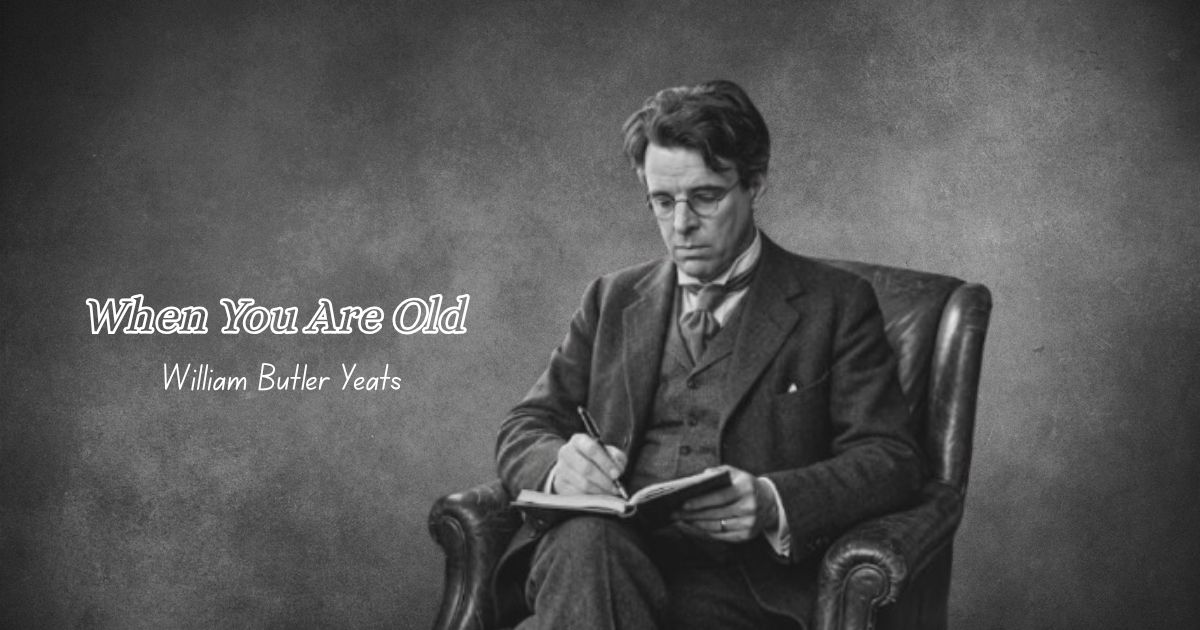
Introduction to Yeats’s Classic Lyric
William Butler Yeats wrote “When You Are Old” in 1891 and published it in 1893 in the collection The Rose. The poem speaks directly to a woman who will one day sit by the fire, look back on her youth, and realize that only one man loved the pilgrim soul in her. In plain terms, it is a quiet, dignified statement of unrequited love that has outlasted beauty. Readers still turn to it because the emotion feels honest and the language remains clear after more than a century.
This short lyric rewards close attention. Below you will find the full text, a careful line-by-line reading, the real historical background, the main themes, and practical ways to teach or simply enjoy the poem. Everything is written so that a first-time reader can follow every point without prior knowledge of Yeats.
Key Takeaways
- The poem is only twelve lines long, yet it carries a complete emotional arc.
- First, it asks the woman to remember her youth.
- Second, it contrasts the many men who loved her beauty with the one man who loved her inner self.
- Third, it ends with a gentle but firm claim: that true love has already been given and will not return.
- Yeats wrote the poem after Maud Gonne refused his marriage proposal.
- He does not beg or accuse, instead he offers a future moment of recognition.
- The tone is calm, almost resigned, which makes the feeling stronger.
- The poem never names the woman, yet every detail points to a specific real person.
- The work belongs to Yeats’s early romantic period and shows the influence of French Renaissance poetry, especially Pierre de Ronsard, while remaining unmistakably Irish in its quiet music.
- It is a personal statement shaped by a particular time, a particular woman, and a particular poetic tradition, not a generic love song.
Historical Background of the Poem
Yeats composed “When You Are Old” during the early 1890s, a period when he was deeply involved in the Irish Literary Revival. He was collecting folk stories, writing plays, and forming a distinct poetic voice that mixed romantic idealism with Irish subjects. The poem first appeared in the 1893 volume The Rose, a book that also contains “The Lake Isle of Innisfree” and other early classics.
At the time Yeats was in his late twenties. He had already met Maud Gonne in 1889 and fallen in love with her almost at once. She was a striking Irish nationalist, actress, and political activist. Yeats proposed marriage more than once; she refused each time. The poem can be read as one of several literary responses to that ongoing rejection.
Yeats and the Celtic Revival Context
The Celtic Revival sought to create a modern Irish literature rooted in myth, folklore, and national feeling. Yeats was a central figure. He believed poetry could help restore Ireland’s cultural confidence after centuries of English rule. “When You Are Old” does not mention Ireland directly, yet its mood of quiet longing and its focus on an idealized woman fit the romantic atmosphere of the movement. The poem’s simple diction and musical rhythm also show Yeats’s early preference for clear, song-like forms rather than the denser symbolism of his later work.
Inspiration from Pierre de Ronsard
Yeats openly modeled the poem on a sonnet by the French poet Pierre de Ronsard (1524–1585). Ronsard’s poem begins “Quand vous serez bien vieille” and advises a woman to remember that the poet once loved her when she was young. Yeats takes the same situation, shortens it, changes the rhyme scheme, and adds the memorable phrase “the pilgrim soul in you.” The borrowing is not plagiarism; it is a deliberate adaptation. Yeats transforms a Renaissance courtly gesture into a more personal and more restrained modern lyric. Knowing the French source helps readers see how Yeats both honours and revises tradition.
Full Text of When You Are Old
Here is the complete poem as Yeats published it:
When you are old and grey and full of sleep, And nodding by the fire, take down this book, And slowly read, and dream of the soft look Your eyes had once, and of their shadows deep;
How many loved your moments of glad grace, And loved your beauty with love false or true, But one man loved the pilgrim soul in you, And loved the sorrows of your changing face;
And bending down beside the glowing bars, Murmur, a little sadly, how Love fled And paced upon the mountains overhead And hid his face amid a crowd of stars.
The text is short enough to memorize in a single sitting, which is one reason it remains popular in anthologies and classrooms.
Line-by-Line Meaning of When You Are Old Poem
The first stanza sets the future scene. The woman is old, grey, and drowsy beside a fire. She is told to take down “this book” the very volume that contains the poem and to read it slowly. The act of reading becomes a form of remembering. The soft look and deep shadows of her younger eyes are presented as something she will revisit with a mixture of pleasure and loss.
The second stanza makes the central contrast. Many people loved her “moments of glad grace” and her beauty, whether their love was sincere or not. Only one man loved the “pilgrim soul” inside her and the changes that time brought to her face. The pilgrim soul suggests a restless, searching inner self rather than a fixed social identity. The speaker claims a deeper, more constant form of love.
The final stanza returns to the fireside. The woman bends toward the glowing bars of the grate and murmurs, a little sadly, that Love has fled. Love is personified as a figure who walked the mountains and then hid his face among the stars. The image lifts the personal emotion into a larger, almost mythical scale. The poem ends not with bitterness but with a quiet acceptance that the moment of true recognition has already passed.
Central Themes in Yeats’s Love Poem
Three themes dominate the lyric: unrequited love, the difference between surface beauty and inner worth, and the irreversible movement of time.
Unrequited Love and Quiet Devotion
Yeats does not rage against the woman’s refusal. He imagines a future in which she herself will acknowledge what she once overlooked. The emotion is controlled. This restraint gives the poem its power. Many readers find the tone more moving than open complaint because it respects the woman’s autonomy while still asserting the value of the speaker’s feelings.
Beauty, Aging, and the Passage of Time
The poem accepts that physical beauty fades. Grey hair, sleepiness, and a face marked by sorrow are presented without apology. What remains valuable is the “pilgrim soul.” Yeats suggests that the deepest love is the one that continues after the outward charm has gone. The fireside scene makes the passage of time concrete and domestic rather than abstract.
True Love Versus Superficial Admiration
The key distinction appears in the second stanza. Crowds of admirers respond to grace and beauty. Only one person responds to the soul and to the changing face. The poem therefore becomes a quiet defense of a particular kind of love one that is patient, observant, and lasting. This idea still resonates with readers who have experienced both shallow and deep attachments.
Symbolism and Imagery Explained
Yeats uses a small number of strong images that carry most of the poem’s weight.
The Fire and the Nodding by the Fire
The fire is both literal and figurative. Literally it is the hearth where an old woman sits. Figuratively it represents the warmth of memory and the lingering heat of past emotion. Nodding suggests both physical drowsiness and the gentle rhythm of recollection. The image is intimate and everyday, which keeps the poem from becoming overly grand.
Pilgrim Soul and Soft Look
The “pilgrim soul” is the poem’s most original contribution. A pilgrim is someone on a journey, often spiritual. Yeats applies the word to the woman’s inner nature, suggesting restlessness, searching, and depth. The soft look of her younger eyes contrasts with the later “changing face.” Together the two phrases map the distance between youth and age while insisting that the essential self remains worthy of love.
Literary Devices Used by Yeats
The poem is rich in controlled technique. Alliteration appears in “grey and full of sleep,” “soft look,” and “glad grace.” Assonance links “old” and “slowly,” “dream” and “deep.” Personification turns Love into a figure who flees to the mountains and stars. The second-person address creates immediacy; the reader feels spoken to even though the original audience was one specific woman. Yeats also uses a mild form of dramatic irony: the speaker knows something the future woman will only later understand.
Structure, Form, and Rhyme Scheme
The poem consists of three quatrains. The rhyme scheme is ABBA CDDC EFFE, a variation on the enclosed rhyme of the Petrarchan sonnet. The meter is predominantly iambic pentameter, though Yeats allows natural speech rhythms to soften the strict pattern. The result is musical without being a sing-song. The three-part structure mirrors the movement from future scene to past love to final reflection.
Who Was Maud Gonne and Why She Matters
Maud Gonne (1866–1953) was an Anglo-Irish woman who became a leading figure in Irish nationalism. Yeats met her in January 1889 when she visited his family home in London. He was immediately struck by her beauty and her passionate commitment to Ireland. Over the next decades he proposed marriage several times; she always declined, partly because she did not return his romantic feelings and partly because she prioritized political work.
She later married Major John MacBride. Yeats continued to write about her for the rest of his life, sometimes idealizing her, sometimes expressing bitterness. “When You Are Old” belongs to the early, more purely admiring phase of that long poetic conversation. Knowing her identity does not reduce the poem to autobiography, but it does explain the intensity of the emotion and the specific quality of the “pilgrim soul” Yeats saw in her.
How the Poem Reflects Yeats’s Personal Life
Yeats kept detailed journals and letters. From them we know that the years around 1891–1893 were marked by repeated emotional disappointment. He poured much of that feeling into poetry rather than into open confrontation. The poem therefore functions as both a private message and a public work of art. In my own reading of Yeats’s letters from this period, the restraint of the lyric stands out against the more turbulent private records. The finished poem transmutes personal pain into something ordered and shareable.
Comparison with Other Yeats Love Poems
Compared with later poems such as “No Second Troy” or “A Prayer for My Daughter,” “When You Are Old” is gentler and less complex. “No Second Troy” blames the woman for her destructive beauty and political passion. “When You Are Old” never blames; it simply records a difference in the quality of love. The early poem also lacks the occult and philosophical layers that appear in Yeats’s middle and late work. Readers who begin with this lyric often find it an accessible entrance to the larger body of Yeats’s love poetry.
Modern Relevance of When You Are Old Poem
The poem still speaks to anyone who has loved someone who did not fully return the feeling, or who has watched physical beauty change while feeling that the essential person remains. In an age of rapid digital attention and curated images, the insistence on loving the “pilgrim soul” feels especially pointed. Teachers report that students respond strongly to the idea that one quiet, lasting love can outweigh many louder admirations. The poem also models a mature way of accepting time’s passage without bitterness.
Step-by-Step Guide to Analyzing the Poem Yourself
Anyone can move from surface enjoyment to deeper understanding by following a clear sequence.
Read Aloud and Note First Impressions
Speak the poem slowly. Mark any words or phrases that stand out. Notice the shift from the domestic fireside to the mountains and stars. Write down the overall mood in one sentence.
Identify Key Images and Shifts
List the main images: fire, book, soft look, pilgrim soul, glowing bars, mountains, stars. Observe where the poem moves from future to past to a kind of timeless present. Ask what each image contributes to the emotional argument.
Connect to Biography and Theme
Once the images are clear, bring in the historical facts about Yeats and Maud Gonne. Then ask which of the three main themes unrequited love, aging, true versus false love feels strongest to you. Support your answer with specific lines. This three-step process works for most short lyrics and builds confident independent reading.
Common Misreadings and How to Avoid Them
Some readers treat the poem as pure autobiography and miss its artistry. Others assume the speaker is bitter and overlook the calm tone. A third mistake is to modernize the gender roles so thoroughly that the historical context disappears. The best correction is to keep returning to the actual words on the page and to the known facts of composition. The poem is both personal and carefully crafted; it is neither a diary entry nor a generic statement about all love.
Teaching When You Are Old in Classrooms
Teachers often use the poem in secondary-school or introductory college courses because it is short, emotionally clear, and rich in technique. Useful activities include having students rewrite the final stanza in contemporary language, comparing the Yeats version with a translation of Ronsard, or debating whether the speaker’s claim of exclusive true love is persuasive. The poem also works well as a starting point for discussions of consent, admiration, and the ethics of writing about a living person.
People Also Ask: What Does the Poem Really Mean?
The poem means that one form of love, quiet, attentive, and directed at the inner self outlasts the more common admiration of youth and beauty. It does not claim that the woman was wrong to refuse the speaker. It simply places before her a future moment of recognition. The meaning is therefore both personal and universal: many people will one day look back and measure the quality of the love they received.
Cultural Impact and Later Adaptations
The poem has been set to music by several composers, quoted in novels and films, and anthologized worldwide. Its opening lines are among the most recognized in English-language poetry. In Ireland it forms part of the national literary canon taught in schools. Outside Ireland it often appears in collections of love poetry or of poems about aging. The image of the old woman by the fire has become almost archetypal.
Translations and Global Reach
“When You Are Old” has been translated into dozens of languages. Translators face the challenge of preserving both the simple diction and the specific resonance of “pilgrim soul.” Some versions emphasize the romantic element; others highlight the philosophical acceptance of time. The poem’s brevity helps it travel well. Readers in different cultures often report that the central contrast between surface and depth feels immediately familiar.
Why the Poem Still Moves Readers Today
The emotion is honest and the language is free of ornament for its own sake. In twelve lines Yeats creates a complete dramatic situation, a clear moral distinction, and a memorable closing image. The poem respects the reader’s intelligence; it does not explain everything. That combination of clarity and restraint continues to reward repeated reading.
Practical Tips for Memorizing and Reciting
Break the poem into its three stanzas. Learn one stanza at a time, speaking it aloud. Pay attention to the natural pauses at the end of each line. When you recite, keep the tone quiet and steady rather than dramatic. The power lies in understatement. Many people find that once the poem is memorized it returns unbidden at moments of personal reflection.
FAQs
Q: What is the main message of an old poem?
A: The main message is that true love values the inner self the “pilgrim soul” more than temporary beauty or charm. Many may admire a person’s youth, but only one love sees and cherishes the deeper, changing person. The poem invites the reader to imagine a future moment of quiet recognition rather than demanding immediate response.
Q: Who was the woman in the old poem?
A: The woman is widely understood to be Maud Gonne, the Irish nationalist and actress whom Yeats loved for many years. He proposed marriage several times and was refused. The poem does not name her, yet the biographical context and Yeats’s other writings make the identification clear and historically grounded.
Q: What does “pilgrim soul” mean when you read an old poem?
A: “Pilgrim soul” refers to the restless, searching, spiritual part of a person that continues its journey through life. Yeats uses the phrase to distinguish surface beauty from the deeper self that he claims to have loved. The image suggests movement, depth, and an inner life that outlasts physical appearance.
Q: Is when you are an old poem based on another work?
A: Yes. Yeats adapted the central idea from a sonnet by the French Renaissance poet Pierre de Ronsard that begins “Quand vous serez bien vieille.” Yeats shortened the form, changed the rhyme scheme, and added the distinctive “pilgrim soul” image, creating an original English lyric rather than a direct translation.
Q: Why is the poem still popular more than a century later?
A: The poem remains popular because its emotion is honest, its language is clear, and its central contrast between shallow and deep love still feels true. The short length makes it easy to memorize and teach, while the quiet dignity of the speaker continues to move readers of every generation.
Q: How should a student analyze an old poem for an essay?
A: Begin with the full text and a paraphrase of each stanza. Identify the key images and the shift from future to past. Connect the poem to Yeats’s relationship with Maud Gonne and to the Ronsard source. Discuss the three main themes and at least two literary devices. End by stating why the poem’s restraint makes its claim of love more persuasive.
Final Thoughts
“When You Are Old” remains one of the clearest and most moving statements of unrequited love in English. It shows a young poet already capable of turning private feeling into public art without self-pity. The poem teaches that the deepest affection is often the quietest, that beauty changes, and that recognition sometimes arrives too late. Those lessons still matter. Readers who return to the fireside scene across decades usually find that the words have grown with them rather than diminished.
Recent Article : What is the Role of Immortality in the Poem? Key Meaning

Jennifer Aston is a passionate poetry curator and writer with a deep love for the written word. She believes poetry has the power to heal, inspire, and connect people across all walks of life. Through PoemSteric, she brings together timeless and modern verses for every emotion and every moment.