
Introduction
If you’ve searched “who is the poet of the poem” without naming a specific title, there isn’t one single answer to give; this phrasing doesn’t identify which poem you mean, so no name can be confidently supplied without more context. What this guide can do instead is explain exactly how to find that answer for whatever poem you’re actually working with, and clear up a mix-up that causes a lot of this confusion in the first place: the difference between the poet, the speaker, and the narrator of a poem.
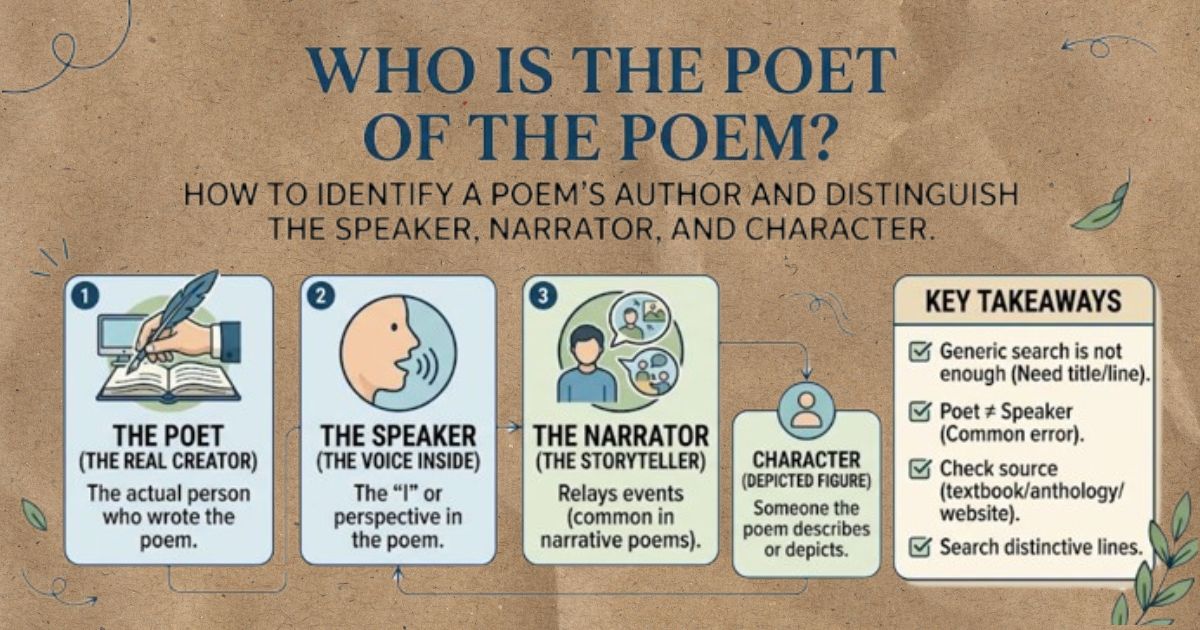
Key Takeaways
"Who is the poet of the poem" is not enough information on its own; no specific poem can be identified without a title, first line, or other detail.

The poet is the real person who wrote the poem; the speaker is the voice used inside the poem, and these are not always the same.

A narrator tells the poem's events, while a character is someone the poem describes or depicts; these two roles can overlap with the speaker but aren't identical to it.

The fastest ways to identify a poem's poet are checking the source material directly or searching a distinctive line from the poem itself.

Confusing the poet with the speaker is one of the most common mistakes in poetry analysis, and it's often the real question behind "who is the poet."
Is There One Specific Poem?
Based on the phrasing alone, no this query does not point to one identifiable poem. Unlike a search that includes a title, a famous first line, or a specific theme, “who is the poet of the poem” reads as an incomplete or generic search, most likely typed by someone who has a specific poem in front of them (in a textbook, worksheet, or exam paper) but didn’t include its details in the search. Rather than guessing at a poem and risking a wrong answer, the more useful response is explaining exactly how to find the correct one.
Why This Question Depends on Context
Every poem has its own, specific poet – Robert Frost, Emily Dickinson, Maya Angelou, and thousands of others each answer this question differently depending on which poem is being asked about. Without a title, author name, or a quoted line, there’s no reliable way to narrow this down to one person. Any article claiming to answer “who is the poet” for a query this broad, without asking which poem, is either guessing or giving a generic definition rather than a real answer.
Poet vs. Speaker vs. Narrator vs. Character
This confusion is often the real reason someone asks “who is the poet” in the first place; they may already know the poet’s name, but are actually trying to figure out who is “talking” inside the poem, which is a different question.
The Poet
The poet is the actual, real-world person who wrote the poem, the name that would appear on the cover of a book or the byline of a publication. This is a factual, historical detail: the poet exists outside the poem, in the real world, and can be looked up like any other author.
The Speaker
The speaker is the voice used within the poem the “I” or narrating perspective the poet has chosen to write in. Critically, the speaker is not always the poet themselves. Poets frequently write in the voice of an invented persona, a historical figure, or someone entirely unlike themselves. Referring to “the poet” when a poem’s content is really about “the speaker” is one of the most common errors in student poetry analysis, since it assumes every opinion or emotion in a poem reflects the poet’s real, personal views.
Narrator vs. Character
In poems that tell a story (narrative poems), a further distinction matters: the narrator is the voice relaying the events, while a character is someone the poem describes or who appears within that story. In many poems, the speaker and the narrator are the same voice but in poems with dialogue or multiple figures, a character can speak within the poem without being its narrator or speaker in the overall sense. Keeping these roles separate makes it much easier to answer exam questions accurately, since “who says this line” and “who wrote this poem” are frequently two different answers.
How to Identify a Poem’s Poet
Check the Title, Byline, and Source
The most reliable method is also the simplest: look at where the poem came from. A textbook, anthology, poetry website, or handout will almost always list the poet’s name directly above or below the poem’s title. If the poem was shared without this information, checking the original source the book, chapter, or webpage it was copied from usually resolves the question immediately.
Search Distinctive Lines from the Poem
If the source isn’t available, searching a unique, memorable line or phrase directly from the poem (in quotation marks) is usually enough to locate the poem and its poet, since search engines are generally very good at matching exact poem text. This works far better than searching for a generic phrase like “who is the poet of the poem,” which as this guide has shown doesn’t contain enough information to identify anything specific.
FAQs
How do I find out who wrote a specific poem?
Check the source it came from (textbook, anthology, or website) for a byline, or search a distinctive line from the poem in quotation marks to locate its original publication.
Is the poet always the same as the speaker?
No. The poet is the real person who wrote the poem, while the speaker is a voice the poet may have created, sometimes matching their own views, sometimes not.
What is the difference between a narrator and a speaker?
A narrator tells the events of a poem, while a speaker is the poem’s overall voice; in many poems these are the same, but in poems with multiple voices or dialogue they can differ.
Can a poem have an anonymous poet?
Yes. Some historical or folk poems have no known author and are labeled “anonymous,” which is different from simply not having found the answer yet.
Why does it matter whether it’s the poet or the speaker feeling something in the poem?
Because attributing a speaker’s emotions or opinions directly to the poet can lead to inaccurate analysis, poets often write convincingly from perspectives that aren’t their own.
Final Thoughts
There’s no shortcut around the fact that “who wrote this poem” requires knowing which poem is being asked about. But once that’s identified, the more valuable skill for poetry analysis is knowing the difference between the poet who wrote the words and the speaker (or narrator, or character) who appears to be saying them inside the poem, a distinction that solves far more confusion than a single name ever could.
Recent Article : What is the Theme of Keeping Quiet? Full Analysis

Jennifer Aston is a passionate poetry curator and writer with a deep love for the written word. She believes poetry has the power to heal, inspire, and connect people across all walks of life. Through PoemSteric, she brings together timeless and modern verses for every emotion and every moment.