
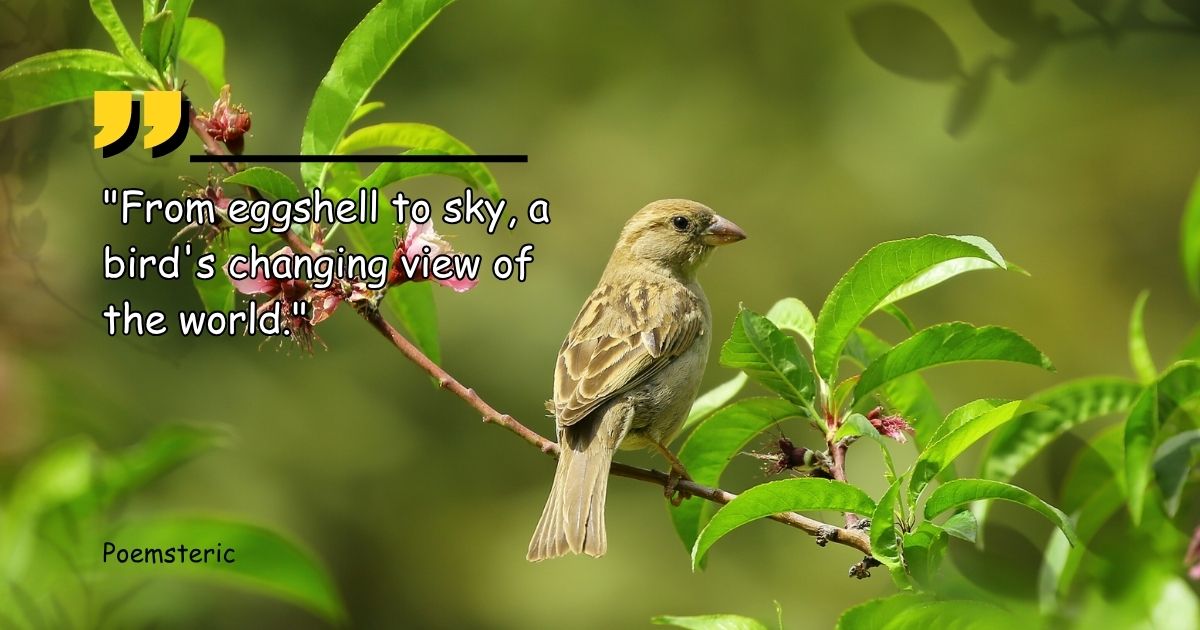
Introduction
This What a Bird Thought poem summary follows a young bird whose understanding of the world changes as it grows and explores. At first, the bird believes its small surroundings are the whole world, but each new experience expands its understanding. The poem ultimately shows that experience, curiosity, and exploration help us develop a broader view of life.
The poem is included in the Class 6 English Poorvi curriculum and consists of four stanzas. Its central idea unfolds through the bird’s changing perception of its surroundings from a small shell, to a nest, to leaves, and finally the vast sky.
Key Takeaways
This What a Bird Thought poem summary follows a bird's journey as it grows and discovers the world.

The bird first believes its eggshell is the entire world.

Later, it thinks its straw nest is the whole world.

After leaving the nest, it discovers leaves and trees.

Finally, it flies beyond the tree and sees the wide blue sky.

Each stage changes the bird's understanding.

The poem explores growth, experience, curiosity, exploration, and discovery.

Its deeper message is that our knowledge is limited by our experience, and exploring beyond familiar surroundings broadens our understanding.

The ending also introduces an important idea: even after gaining experience, we may still realize how much we do not know.
Poem Overview
What Is “What a Bird Thought” About?
“What a Bird Thought” presents the world through the eyes of a growing bird. The bird’s idea of the world changes every time it moves beyond its previous surroundings. At first, the bird lives inside a small, round, pale-blue shell. Because it has never experienced anything outside that space, it assumes the shell represents the whole world.
Later, the bird lives in a nest made of straw and protected by its mother. Its understanding expands slightly, but it still mistakes its immediate surroundings for the entire world. When the bird finally ventures outside, it discovers leaves. Eventually, it flies beyond the tree and sees the blue sky. At that point, it admits that it cannot explain how the world is really made.
This progression makes the poem more than a simple story about a bird. It becomes a lesson about how knowledge develops through experience.
What a Bird Thought Poem Summary
The Bird’s First World: The Shell
In the first stanza, the bird describes its earliest home as a small, round house made of a pale-blue shell. This refers to the eggshell in which the young bird begins its life. The bird feels comfortable there and thinks the world is small and round because its experience is extremely limited. It has not yet seen a nest, tree, sky, or anything beyond the shell.
This stage represents innocence and limited perception. The bird does not have enough experience to understand that its tiny home is only one small part of a much larger world.
The Bird Discovers the Nest
In the second stanza, the bird moves into a little nest. It feels safe and comfortable there, especially because it is protected by its mother. Now the bird thinks that the world is made of straw. This belief is different from its earlier idea, but the basic mistake remains: the bird still assumes that the small place it knows is the whole world.
The nest therefore represents another stage of development. The bird has experienced more than before, but its knowledge is still restricted to its immediate environment.
The Bird Flutters Out and Sees Leaves
The third stanza marks an important turning point. One day, the bird leaves its nest to discover what lies outside. It sees the leaves around it and realizes that its earlier understanding was incomplete. The bird describes itself as having been “blind,” meaning it had previously failed to see or understand the larger world. This moment represents exploration and discovery. The bird does not learn simply by being told something. It learns because it ventures beyond its familiar surroundings.
The Bird Flies Beyond the Tree
In the final stanza, the bird becomes mature enough to fly beyond the tree. This is the biggest expansion of its experience. It sees the blue sky, which is much larger than the shell, nest, or tree it previously considered its world. However, an interesting change occurs here. Instead of replacing one limited idea with another definite answer, the bird admits that it does not know how the world is really made.
This ending is important because the bird has learned something deeper: seeing more does not mean knowing everything. Even its neighbours cannot provide a complete answer.
Stanza-by-Stanza Explanation
Safety and Limited Experience
The first two stanzas describe the bird’s protected early life. First, the bird lives inside its shell. Then it moves into a nest where its mother protects it. In both situations, the bird feels satisfied because it knows nothing beyond its immediate surroundings. The important idea is limited experience. The bird’s understanding is not intentionally wrong; it is simply based on what it has experienced so far. This is similar to how young children understand life. Their early world is often limited to their home, family, school, and immediate surroundings.
Exploration and New Understanding
The third and fourth stanzas show the bird becoming more independent. When it leaves the nest, it sees leaves and realizes its earlier understanding was incomplete. When it flies beyond the tree, it sees the blue sky and discovers an even larger world. The ending prevents the poem from becoming a simple lesson where the bird finally discovers “the answer.” Instead, the bird recognizes that the world is too large to understand completely. This creates a powerful idea about continuous learning: every discovery can reveal something new that we did not know before.
The Bird’s Changing Understanding
The most important feature of the poem is the way the bird’s perception develops.
| Stage | What the bird sees | What the bird thinks |
| 1. Egg | Pale-blue shell | The world is small, round, and shell-like |
| 2. Nest | Straw and mother | The world is made of straw |
| 3. Outside the nest | Leaves | The bird realizes its earlier view was limited |
| 4. Beyond the tree | Blue sky | The world is much larger and remains partly unknown |
The progression can be understood as:
Limited experience → Exploration → Discovery → Greater awareness
The bird does not suddenly become an expert. Instead, every stage gives it a broader perspective.
That is the poem’s strongest educational idea. Our first understanding of something may be incomplete because we have only experienced a small part of it. When we explore, observe, and learn, our perspective changes.
At the same time, the final stanza teaches humility. Even after exploring beyond its original home, the bird cannot explain everything about the world.
Theme, Message, Poetic Devices & Vocabulary
Theme and Central Message
The main theme of “What a Bird Thought” is growth through experience and exploration. The bird’s physical growth is connected to its intellectual growth. As it moves from the shell to the nest and eventually beyond the tree, its understanding of the world becomes broader.
The poem also explores:
- Curiosity
- Discovery
- Innocence
- Experience
- Changing perspective
- Continuous learning
- Humility about knowledge
The message is simple but meaningful: we understand the world according to our experience, and exploring beyond familiar surroundings helps us develop a wider perspective. The poem also suggests that learning has no final limit. Even after gaining new experiences, there may always be more to discover.
Poetic Devices and Important Vocabulary
The poem uses simple imagery to help readers visualize the bird’s changing surroundings. Images such as the little house, pale-blue shell, straw, leaves, and blue sky create a clear picture of the bird’s journey.
Important vocabulary includes:
- Pale – light or faint in colour
- Shell – the hard outer covering of an egg
- Nestled – settled comfortably in a safe place
- Fluttered – moved or flew lightly
- Blind – unable to see or understand something
- Labours – work or tasks
- Neighbours – those living nearby
The repeated pattern of “I lived…” also helps show the different stages of the bird’s life and creates a clear progression from one experience to another.
Common Questions
Students searching for what a bird thought poem summary generally need more than a short retelling. They need to understand why the bird’s thoughts keep changing.
What Is the Central Idea of “What a Bird Thought”?
The central idea is that our understanding of the world develops as we gain experience and explore beyond familiar surroundings. The bird first thinks its shell is the world, then its nest, then the leaves around it. Finally, it sees the blue sky and realizes that the world is much larger than it previously imagined.
What Does the Bird Learn as It Grows?
The bird learns that its earlier ideas about the world were limited. Each new experience changes its understanding. Most importantly, the bird eventually recognizes that even after exploring, it cannot completely explain how the world is made. This shows that learning is continuous.
What Is the Message of the Poem?
The poem teaches that experience and exploration broaden our understanding. It encourages curiosity and reminds us not to assume that our limited experience represents the whole truth. The ending also encourages humility because there is always more to discover.
FAQs
Q: What is the summary of “What a Bird Thought”?
A: The poem describes a bird’s changing understanding of the world as it grows. First, it thinks the eggshell is the whole world. Then it believes its straw nest is the world. After leaving the nest, it discovers leaves and later flies beyond the tree to see the blue sky. Finally, it admits that it does not know how the world is really made.
Q: What is the theme of “What a Bird Thought”?
A: The main theme is growth through experience and exploration. The bird’s understanding changes as it moves beyond its familiar surroundings. The poem shows that our perspective can be limited when we have little experience, while exploration and learning help us develop a broader understanding.
Q: What does the bird think the world is made of?
A: The bird’s answer changes as it grows. First, it thinks the world is made of a pale-blue shell. Later, it thinks it is made of straw. After leaving the nest, it says the world is made of leaves. Finally, after flying beyond the tree, it admits that it cannot tell how the world is really made.
Q: What is the message of “What a Bird Thought”?
A: The poem’s message is that knowledge grows through experience, curiosity, and exploration. We may initially understand the world from a very limited perspective, but new experiences can change our ideas. The poem also reminds us to remain humble because even after learning many things, there is still more to discover.
Q: How does the bird’s understanding change in the poem?
A: The bird moves through four stages of understanding. It first sees its shell as the world, then its nest, then the leaves outside the nest, and finally the vast blue sky beyond the tree. Each stage represents a larger experience and a broader perspective. The final uncertainty shows that learning continues even after major discoveries.
Q: Why does the bird say it has been “blind”?
A: The bird uses “blind” to describe its earlier lack of understanding. It had assumed that the small world it knew was the entire world. After leaving the nest and seeing the leaves, it realizes that its previous belief was too limited. The word therefore represents a change from limited awareness to greater understanding.
Final Thoughts
“What a Bird Thought” is a simple poem with a deeper lesson about how knowledge develops. The bird’s journey from the shell to the nest, leaves, and open sky represents the gradual expansion of its experience. The most important idea is not simply that the bird discovers new places. It is that every new experience changes the way it understands the world.
That makes the poem especially useful for young readers: it encourages curiosity, exploration, and the willingness to recognize that our first understanding may not always be complete.
Recent Article : Pairs of Opposites in “The Voice of the Rain”: Easy Guide

Jennifer Aston is a passionate poetry curator and writer with a deep love for the written word. She believes poetry has the power to heal, inspire, and connect people across all walks of life. Through PoemSteric, she brings together timeless and modern verses for every emotion and every moment.