
Introduction
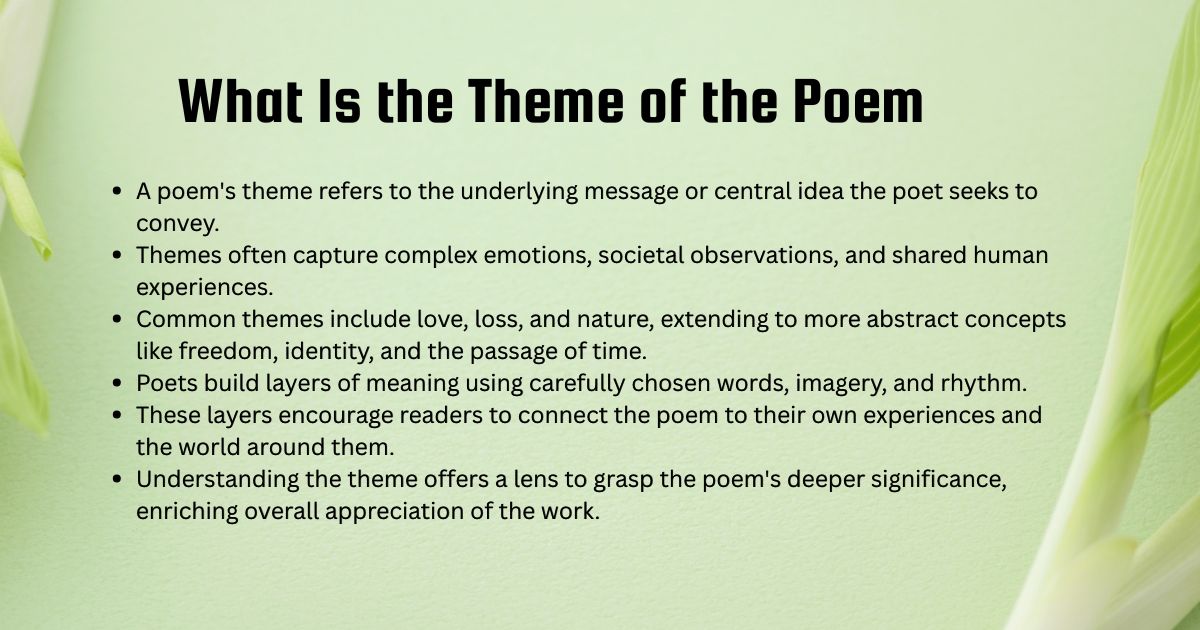
The theme of a poem is the central idea, insight, or message about life, people, or the world that the poet explores. It is usually broader than the poem’s subject. For example, a poem may be about nature, but its theme could be that nature provides comfort during difficult times.
Understanding what is the theme of the poem requires more than finding its subject. You need to look at the poet’s language, images, conflicts, emotions, patterns, and ending. Together, these details reveal what the poem is really saying.
For students, identifying the theme is one of the most important parts of poetry analysis. Once you understand the theme, it becomes easier to discuss the speaker, tone, imagery, symbolism, and literary devices.
Key Takeaways
A poem's theme is its deeper idea or insight.

A topic is usually a single subject, such as love, nature, or death.

A theme should express a complete idea rather than one word.

Repeated images, conflicts, symbols, and changes in tone can reveal a theme.

The title and ending often provide useful clues.

Strong theme statements should be supported with textual evidence.

A poem can explore more than one theme.

The same topic can produce completely different themes in different poems.
Theme in Poetry: What Does It Mean?
A theme is the deeper meaning that develops through a poem. It represents an idea about human experience rather than simply naming what the poem discusses.
For instance, love can be a topic. However, “love can survive physical separation” is a theme because it expresses an idea about that topic.
Poets rarely state their themes directly. Instead, they develop them through descriptions, comparisons, symbols, sounds, emotions, and events. Therefore, readers must connect these details to understand the poem’s larger meaning.
Theme vs. Topic
The distinction between topic and theme is essential.
A topic tells you what the poem is about. A theme tells you what the poet suggests about that subject.
| Topic | Possible Theme |
| Love | Love can provide strength during hardship. |
| Nature | Nature can restore a person’s sense of peace. |
| Death | Awareness of death can change how people value life. |
| Memory | Memories can preserve experiences that time cannot return. |
| Freedom | Freedom often requires courage and sacrifice. |
A topic can usually be expressed in one or two words. A theme normally needs a complete statement.
Theme vs. Main Idea
The main idea summarizes what a particular poem or section is mainly about. The theme goes deeper by expressing a broader insight.
For example, a poem might describe an elderly speaker remembering childhood. Its main idea could be that the speaker misses childhood. Its theme could be that growing older can make people deeply aware of what they have lost.
This distinction becomes especially useful when writing literary analysis. A summary tells readers what happens. A theme explains why those details matter.
How to Identify the Theme of a Poem
Finding a theme becomes easier when you read a poem actively instead of looking for one “correct” word.
Start by asking what the poem repeatedly emphasizes. Then examine the evidence supporting that idea.
1. Look for the Poem’s Main Subject
First, identify the subject.
Ask:
- Who or what is the poem about?
- What situation does the speaker describe?
- What problem or experience appears important?
- What ideas receive the most attention?
Do not stop at the subject, however.
If a poem repeatedly describes birds flying freely while a speaker watches from a confined place, the subject may be birds or freedom. The deeper theme might involve the human desire for freedom.
2. Notice Repeated Ideas and Images
Repetition is often an important clue.
Poets may repeat:
- Words
- Images
- Colors
- Sounds
- Symbols
- Comparisons
- Questions
- Emotional ideas
Suppose a poem repeatedly mentions fading light, falling leaves, and changing seasons. These details may point toward a theme involving time, change, aging, or mortality.
A single image does not automatically establish a theme. Instead, look for patterns across the poem.
3. Examine Conflict and the Speaker’s Experience
Conflict can reveal what a poem is trying to say.
Ask what the speaker wants and what prevents that desire from being fulfilled.
For example, a speaker may want to return to childhood but realize that time cannot be reversed. The conflict between memory and reality could support a theme about the irreversible nature of time.
Changes in the speaker are also valuable clues. If the speaker begins with confidence but ends with uncertainty, that transformation may reveal the poem’s deeper message.
4. Consider the Ending and Overall Message
The ending often provides one of the strongest clues to a poem’s theme.
Ask:
- What changes by the end?
- What realization does the speaker reach?
- Does the ending confirm or challenge an earlier idea?
- What emotion remains after the final line?
The ending should not be analyzed alone. Instead, connect it with the rest of the poem.
When the title, repeated images, conflict, and ending point toward the same idea, you have strong evidence for a theme.
What Is a Theme Statement?
A theme statement expresses the poem’s larger insight in a complete sentence.
A weak theme statement might be:
“The theme is sadness.”
Sadness is an emotion, not a fully developed theme.
A stronger statement would be:
“Loss can change the way people remember the past.”
That statement explains an idea about human experience.
A useful formula is:
Topic + Poet’s Insight = Theme Statement
For example:
Topic: Time
Insight: People cannot recover the past
Theme: Time makes people appreciate memories while reminding them that the past cannot be recovered.
A good theme statement should be broad enough to apply beyond one character or one event, but specific enough to reflect the poem’s evidence.
Common Themes in Poetry
Poetry explores almost every part of human experience. Some themes appear repeatedly because they remain meaningful across cultures and generations.
Love and Relationships
Poems about love may explore devotion, separation, heartbreak, sacrifice, jealousy, or emotional connection.
The theme might be that genuine love can remain powerful despite distance.
Nature
Nature poems often explore more than scenery. A landscape may become a way to discuss freedom, spirituality, loneliness, beauty, or human mortality.
For example, a poet describing a changing season may use nature to reflect the passage of human life.
Death and Mortality
Many poets use death to examine fear, acceptance, grief, or the value of life.
A poem does not need to be directly about someone dying to explore mortality. Images of fading flowers, darkness, winter, or disappearing light can contribute to this theme.
Identity
Poems about identity may explore culture, belonging, individuality, gender, memory, or personal transformation.
The central theme may suggest that understanding oneself requires confronting both personal experience and social expectations.
Time and Memory
Time is a particularly common poetic subject.
Poets often explore how memories preserve the past while also reminding people that they cannot return to it.
Freedom
Freedom may appear through images of birds, open landscapes, journeys, doors, oceans, or physical movement.
The theme may concern the value of independence or the sacrifices necessary to achieve it.
Loss and Grief
Poems about loss often explore how people respond after someone or something important disappears.
Rather than simply expressing sadness, these poems may suggest that memory allows relationships to continue in another form.
How to Find the Theme of a Poem Step by Step
If you need to identify a theme for an assignment or exam, use this simple process.
Ask the Right Questions
- What is the poem mainly about?
- What subject appears most important?
- What emotions dominate the poem?
- Which words or images repeat?
- What conflict does the speaker face?
- Does the speaker learn or realize something?
- What changes from beginning to end?
- What does the ending suggest?
- What idea connects these details?
After answering these questions, look for a common thread.
That common thread often leads directly to the poem’s theme.
Support the Theme With Textual Evidence
Never present a theme without evidence when writing formal literary analysis.
Choose details that clearly support your interpretation. These might include a repeated image, a metaphor, a change in tone, or an important line.
For example:
Theme: Memories can preserve happiness while also creating sadness about the past.
Then explain the evidence rather than simply quoting it.
A strong analysis follows this pattern:
Claim → Evidence → Explanation
The claim identifies the theme. The evidence points to something specific in the poem. The explanation shows how that evidence supports the theme.
Theme Examples From Famous Poems
Famous poems demonstrate how the same broad topic can produce different themes.
Robert Frost’s “The Road Not Taken” is often discussed in relation to choices, uncertainty, and how people understand their decisions. The poem’s complexity makes it useful for showing why readers should examine the whole text rather than reduce a poem to a simple slogan.
Emily Dickinson’s poetry frequently explores subjects such as death, immortality, nature, identity, and the inner mind. Her compressed language means that individual images can carry several possible meanings.
William Wordsworth often connects nature with memory, emotion, and personal development. In “Lines Written a Few Miles above Tintern Abbey,” nature becomes connected with memory and the growth of the speaker’s understanding.
Shakespeare’s Sonnet 18, meanwhile, explores beauty, time, mortality, and the ability of poetry to preserve something beyond physical life.
These examples demonstrate an important point: a theme is not always a single word. It is the larger idea created by the relationship among the poem’s details.
Common Mistakes When Identifying a Poem’s Theme
One common mistake is confusing the topic with the theme.
Writing “nature” or “love” may identify a subject, but it does not explain the poet’s insight about that subject.
Another mistake is treating the theme as a plot summary. A summary explains what happens. A theme explains what the poem suggests about that experience.
Readers also sometimes assume that every poem has only one theme. In reality, a poem can explore several connected ideas.
Finally, avoid choosing a theme without evidence. If the poem does not support your interpretation through its language, images, structure, or speaker, the interpretation becomes difficult to defend.
Theme, Tone, Mood, and Message: Key Differences
These literary concepts are related, but they are not interchangeable.
Theme is the deeper idea explored by the poem.
Topic is the subject being discussed.
Tone is the speaker’s attitude toward the subject.
Mood is the emotional atmosphere created for the reader.
Message is what the poem communicates or teaches.
For example, a poem about childhood memories might have:
- Topic: Childhood
- Theme: Growing older can make people value memories more deeply.
- Tone: Nostalgic
- Mood: Reflective and bittersweet
- Message: The past cannot be recovered, but its memories can remain meaningful.
Understanding these differences makes poetry analysis much more precise.
How to Write About a Poem’s Theme
When answering a poetry question, begin with a direct statement.
For example:
The central theme of the poem is the lasting power of memory and the emotional difficulty of accepting change.
Then explain how the poet develops that idea.
Use two or three strong pieces of evidence rather than mentioning every detail. Discuss imagery, repetition, symbolism, tone, or structure when those elements genuinely support your interpretation.
A useful paragraph structure is:
Theme statement → Evidence → Literary technique → Explanation → Link back to theme
This approach keeps your analysis focused and prevents your answer from becoming a simple summary.
FAQs
Q: What is the theme of the poem?
A: The theme of a poem is its deeper idea or insight about life, people, society, nature, or human experience. It goes beyond the poem’s basic subject. For example, “nature” is a topic, while “nature can provide comfort during difficult times” is a theme. Readers identify themes by examining repeated ideas, images, conflicts, symbols, tone, and the poem’s ending.
Q: How do I find the theme of a poem?
A: To find the theme, first identify the main subject. Then look for repeated words, images, emotions, conflicts, and symbols. Consider what the speaker learns and how the poem ends. Finally, connect these details into a complete statement about human experience. Support your interpretation with specific evidence from the poem.
Q: Can a poem have multiple themes?
A: Yes. Many poems explore multiple related themes. A poem about childhood, for example, might explore memory, loss, time, innocence, and growing older. However, not every possible interpretation should be treated as a major theme. Strong themes need meaningful support from the poem’s language, imagery, structure, speaker, or other literary elements.
Q: Is the theme the same as the main idea?
A: No. The main idea explains what a poem or passage is mainly about, while the theme expresses a broader insight about that subject. For example, a poem may describe a person remembering childhood. Its main idea could be that the speaker misses childhood, while its theme could be that growing older can make people appreciate memories more deeply.
Q: What is the difference between theme and message?
A: Theme and message are closely related, but they are not exactly identical. A theme is a broader idea explored throughout a poem, while a message is often the specific lesson or communication readers take from it. A poem may explore the theme of mortality while communicating the message that people should value life while they have it. The exact distinction can vary by context.
Q: Can the title help you identify a poem’s theme?
A: Yes. A poem’s title can provide an important clue about its subject, central idea, or emotional direction. However, the title should not be treated as proof by itself. Compare it with repeated images, important language, the speaker’s experience, and the ending. When several elements point toward the same interpretation, your thematic conclusion becomes stronger.
Final Thoughts
Understanding what is the theme of the poem becomes much easier when you stop searching for a single hidden word. Instead, look for patterns across the entire poem.
Consider the subject, repeated images, speaker, conflict, tone, symbols, and ending. Then turn those observations into a complete theme statement and support it with textual evidence.
The best poetry analysis does not simply tell readers what a poem is about. It explains what the poem suggests and how the poet creates that meaning. Once you learn that process, you can identify themes more confidently across poems from different periods, styles, and writers.
Recent Article : I Remember I Remember Poem Questions and Answers

Jennifer Aston is a passionate poetry curator and writer with a deep love for the written word. She believes poetry has the power to heal, inspire, and connect people across all walks of life. Through PoemSteric, she brings together timeless and modern verses for every emotion and every moment.