
Introduction
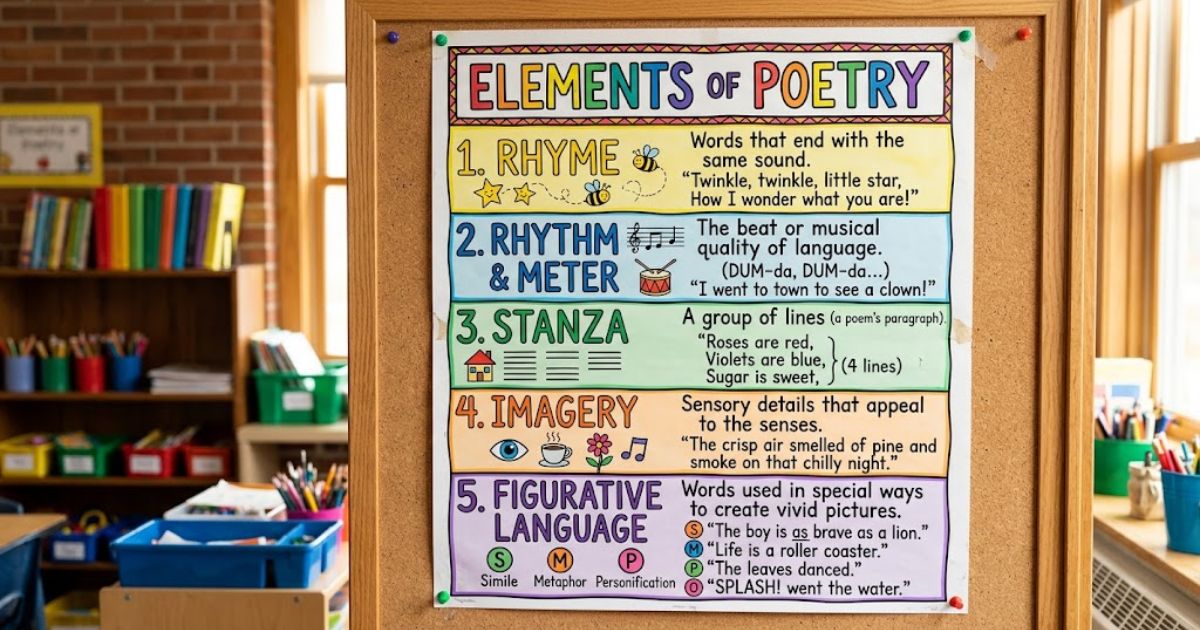
An element of the poetry anchor chart is a classroom poster that breaks poetry down into its core building blocks rhyme, rhythm, stanza, imagery, and figurative language so students always have a visual reference nearby. It turns abstract vocabulary into something a student can point to instead of guess at. Teachers hang these charts at eye level and return to them constantly throughout a poetry unit, and that repetition is exactly what makes them work.
This guide walks through what belongs on a strong poetry anchor chart, how to build one from scratch, and how to actually use it during real lessons rather than letting it sit as wall decoration.
Key Takeaways
An anchor chart is a visual teaching tool that displays key vocabulary and concepts for ongoing reference during a unit.

A strong poetry anchor chart covers, at minimum, rhyme, rhythm and meter, stanza, imagery, and figurative language.

Charts work best when built collaboratively with students, rather than pre-made and simply taped to the wall.

Interactive elements, such as flip flaps or student-added examples, tend to boost retention compared with static posters.

Free templates exist for teachers who want a starting point instead of building entirely from scratch.

The chart should stay visible and get referenced repeatedly throughout the unit, not introduced once and forgotten.
What Is an Element of a Poetry Anchor Chart? (Definition and Purpose)
An element of the poetry anchor chart is a large, visual classroom display that organizes the vocabulary and concepts students need in order to read, discuss, and write poetry. Unlike a textbook page, it stays posted on the wall for the length of a unit, giving students a constant reference during independent reading or writing time. In my own experience running elementary and middle school poetry units, the charts that get used the most aren’t the polished, store-bought versions. They’re the slightly messy ones the class built together on day one.
The purpose goes beyond decoration. Anchor charts “anchor” new learning to something visible and permanent, which matters for students still building academic vocabulary. A student who forgets the definition of a stanza mid-lesson can glance at the chart instead of raising a hand and interrupting the flow. As a result, that small bit of independence adds up across a unit, freeing the teacher to focus on deeper discussion rather than repeated vocabulary reminders.
It also helps to separate this chart from more general classroom posters. A generic “types of poems” poster might list forms like haiku, sonnet, and free verse without explaining how those poems actually work. A poetry element chart, however, breaks down the mechanical building blocks rhyme, rhythm, imagery that apply across nearly every poem a student will encounter, regardless of form. Many classrooms keep both chart types side by side, but the elements chart tends to get referenced far more often, since it applies universally rather than to one poem type at a time.
Why Anchor Charts Work for Teaching Poetry
Anchor charts work because they combine visual memory with repeated exposure, two of the strongest tools available for building retention in young learners. Poetry specifically benefits from this approach, because so much of its vocabulary meter, stanza, and enjambment feels abstract without a concrete visual anchor. Classroom instruction research consistently shows that displayed, co-created reference materials outperform materials students see only once in a worksheet or lecture, largely because passive repeated exposure reinforces memory even outside of direct instruction time.
There’s also a practical classroom-management benefit that often gets overlooked. Teachers managing twenty-five or more students can’t answer every vocabulary question in real time, especially during independent work. A well-placed poetry anchor chart absorbs a large share of those routine questions, letting a teacher redirect a raised hand with a simple “check the chart” instead of stopping to re-explain a term the class already covered. Over a full unit, this saved time adds up to meaningfully more instructional minutes spent on higher-level discussion instead of vocabulary review.
Core Elements of Poetry to Include on Your Chart
A strong poetry anchor chart doesn’t try to cover every literary term available. Instead, it focuses on the handful of concepts students will actually use while reading and writing during the unit.
Rhyme, Rhythm, and Meter
Rhyme refers to matching end sounds in lines of poetry, and it’s usually the first concept students recognize even before they can name it. Rhythm describes the pattern of stressed and unstressed syllables that gives a poem its musical quality, while meter is the more technical term for a consistent, countable rhythmic pattern, such as iambic pentameter used throughout much of Shakespeare’s sonnets. For younger students, keep the chart focused on rhyme and basic rhythm. Older students, however, benefit from a simple visual showing stressed and unstressed syllables marked above sample words, since seeing the pattern often clicks faster than a verbal explanation alone.
It also helps to give rhyme scheme its own small section, since students often confuse “rhyme” as a general idea with “rhyme scheme” as the labeled pattern (AABB, ABAB, and so on) used to describe an entire poem’s structure. For example, a simple poem with the pattern labeled directly in the margin clears up this confusion faster than a verbal explanation, especially for visual learners who need to see the letters lined up next to the actual rhyming words.
Stanza, Imagery, and Figurative Language
A stanza is a grouped set of lines within a poem, functioning much like a paragraph in prose, a comparison that usually helps the concept click quickly for students moving over from narrative writing. Imagery refers to descriptive language that appeals to the five senses, and it’s worth including a quick example directly on the chart, since abstract definitions rarely stick without a concrete illustration. Figurative language covers simile, metaphor, personification, and hyperbole. Rather than listing all four with dense definitions, many successful charts use a simple icon or color-coded section for each device, paired with one short example sentence.
Beyond these core terms, stronger charts often include a brief section on tone and mood, since students frequently confuse the two. Tone reflects the author’s attitude toward the subject, while mood describes the feeling the poem creates in the reader, a subtle but important distinction that benefits from a clear side-by-side example on the chart itself. For instance, including even a two- or three-word contrast, like “tone = writer’s attitude” next to “mood = reader’s feeling,” gives students a quick memory hook without requiring a full paragraph of explanation.
How Do Teachers Use a Poetry Anchor Chart in the Classroom?
Teachers often ask how to actually use the chart once it’s built, beyond hanging it on the wall, and this is where many otherwise well-made charts go underused. The chart should function as an active teaching tool, not passive decoration. Start each new poetry lesson by referencing a specific section relevant to that day’s focus, whether that’s a mini-lesson on metaphor or a rhyme-scheme activity.
During independent reading or writing time, encourage students to physically point to the chart when they’re unsure of a term, rather than immediately asking the teacher. This builds the habit of using the classroom environment as a resource, a skill that transfers well beyond the poetry unit itself. Some teachers add sticky notes or student work samples directly onto the chart throughout the unit, turning it into a living document that grows alongside the class’s understanding instead of staying static from day one.
Small-group and partner activities also pair well with anchor charts. Assign pairs a specific poem and ask them to identify as many chart elements as they can find, checking each one off against the poster from across the room. As a result, this turns a reference tool into a scavenger-hunt-style activity, which tends to hold attention far better than a purely lecture-based review session.
A quick comparison poem also helps students apply chart concepts in real time. Reading two short poems on the same subject one heavy on rhyme and simple rhythm, another written in free verse relying mostly on imagery gives students a concrete way to see how different poets lean on different elements to create very different effects. Asking students to identify which chart elements each poem relies on most heavily turns passive vocabulary review into genuine literary analysis, even for younger grades.
Assessment can tie directly back to the chart without creating extra work. Instead of a separate vocabulary quiz, ask students to annotate a new, unfamiliar poem by labeling as many chart elements as they can find directly on the page. This format tests real application rather than rote memorization, and it gives teachers a much clearer picture of which concepts still need reinforcement before the next unit.
How to Make Your Own Elements of Poetry Anchor Chart
Building your own chart takes more upfront time than printing a template, but the payoff in student engagement is usually worth it, especially for a concept students will return to repeatedly.
Step-by-Step Guide to Building a Chart
- Choose your core elements first. Decide on four to six terms maximum. Trying to cover everything at once overwhelms the chart and dilutes its usefulness as a quick reference.
- Sketch a rough layout before writing anything permanent. Plan where each section will go so the finished chart reads clearly from across the room.
- Build it with students, not just for them. Co-creating the chart during the first lesson dramatically increases how often students use it later, since they helped shape it themselves.
- Use color coding consistently. Assign one color per element category so students can quickly scan and locate information by color alone, even before reading the text.
- Add a simple visual or icon for each term. A small drawing next to “simile” or “imagery” helps non-verbal learners connect the word to a concrete image.
- Leave room to add examples throughout the unit. Reserve blank space or use sticky notes so the chart can grow as students encounter new examples in their reading.
- Laminate or protect the final version for reuse. A chart worth building once is usually worth protecting so it can be reused across multiple class periods or school years.
- Photograph the finished chart before displaying it. Keeping a digital copy means you can quickly recreate or reference the layout in future years, even if the physical poster eventually gets damaged or needs replacing.
Free Elements of Poetry Anchor Chart Ideas and Templates
Teachers short on prep time don’t need to start from a blank page every time. Sites like Teachers Pay Teachers offer thousands of free and low-cost templates, covering everything from basic rhyme-and-rhythm posters for early elementary grades to detailed figurative-language breakdowns suited for middle school. Pinterest also works well as a visual search tool for anchor chart layout inspiration, even when the actual content needs to be recreated by hand for copyright reasons.
For teachers who prefer digital versions, Canva offers free customizable templates that can be edited to match a classroom’s specific vocabulary list and then printed at poster size through most school print shops. Interactive notebook versions of smaller, foldable versions of the same content that fit inside a student’s personal notebook have also grown popular as a companion to the large wall chart, giving each student a portable reference copy to take home for homework or review. Combining a large wall chart with individual interactive notebook pages tends to reinforce the material more effectively than either format used alone, since students get both the shared classroom reference and a personal copy they can annotate freely.
FAQs
Q: What are the elements of a poetry anchor chart?
A: An element of a poetry anchor chart is a classroom poster that visually organizes the core building blocks of a poem’s rhyme, rhythm, stanza, imagery, and figurative language so students have a lasting reference during a poetry unit. Unlike a one-time handout, it stays posted on the wall and gets referenced repeatedly. Teachers often build it collaboratively with students during the first lesson so it reflects the class’s own vocabulary and examples.
Q: What should be included on a poetry anchor chart?
A: At minimum, a strong chart should cover rhyme, rhythm and meter, stanza structure, imagery, and figurative language like simile, metaphor, personification, and hyperbole. Many teachers also add a tone-versus-mood section, since students commonly confuse the two. Keeping the elements of the poetry anchor chart to four to six core terms, each with a simple example, prevents the poster from becoming too cluttered to use quickly.
Q: How do you make a poetry anchor chart with students?
A: Start by choosing four to six core terms, then sketch a rough layout before adding anything permanent. Build the chart together during a lesson rather than pre-making it, since co-creation increases how often students reference it later. Add color coding, a small icon per term, and blank space for examples students discover later in the unit.
Q: Why are anchor charts effective for teaching poetry?
A: Anchor charts combine visual memory with repeated exposure, which research on classroom instruction shows outperforms one-time worksheets or lectures for retention. Poetry vocabulary like meter, stanza, and enjambment is often abstract, so a visible, concrete reference helps it stick. An element of poetry anchor chart also reduces routine vocabulary questions during independent work, freeing up class time for deeper discussion.
Q: Where can I find free poetry anchor chart templates?
A: Teachers Pay Teachers offers thousands of free and low-cost templates ranging from basic rhyme posters for early elementary grades to detailed figurative-language charts for middle school. Canva also provides free, customizable digital templates that can be printed at poster size. Pinterest is useful for layout inspiration, though the actual content is usually best recreated by hand rather than copied directly.
Q: What’s the difference between a poetry anchor chart and an interactive notebook page?
A: A poetry anchor chart is a large, shared classroom poster meant to be visible to the whole class throughout a unit. An interactive notebook page is a smaller, foldable, individual version of similar content that each student keeps in their own notebook. Using both together tends to reinforce vocabulary more effectively than either format alone, since students get a shared classroom reference plus a personal copy they can annotate.
Final Thoughts
A well-built poetry anchor chart earns its wall space by getting used constantly, not by looking polished on day one and then fading into the background. The most effective charts are built with students, kept visible throughout the unit, and updated as the class encounters new examples in their reading. Whether you build one from scratch or adapt a free template, the goal stays the same: give students a quick, visual way to reconnect with poetry vocabulary every single time they need it.
Recent Article : Diction in Poetry: The Secret to Powerful Word Choice

Jennifer Aston is a passionate poetry curator and writer with a deep love for the written word. She believes poetry has the power to heal, inspire, and connect people across all walks of life. Through PoemSteric, she brings together timeless and modern verses for every emotion and every moment.